Showing posts with label family. Show all posts

Sunday, June 29, 2008

Dad's Roses

It sounds odd, calling them “Dad’s Roses,” considering my father had little to no interest in the yard and probably hated mowing the grass almost as much as I did when I was a kid. It was my maternal grandmother who grew roses – one, I remember especially, climbing over a trellis, a beautiful Peace Rose.

These roses, though, came from a bush N’s mother planted 23 years ago, taking a cut rose from the casket spray when my father was buried in July, 1985. Never mind that the rose sat forgotten on the back seat of the car for most of a broiling summer day after the funeral, but given her over-achieving green thumb, she stuck it in the ground anyway and put a jar over it. The next year, there were three blossoms on it on the first anniversary of Dad’s death. The bush has never done really well, and sometimes the deer, chomping their way through the back yard, managed to eat all the buds.

This year, however, there were three blossoms and two buds which barely survived a pretty nasty rainstorm last week.

I was thinking of taking them over to the cemetery but thought I’d like to enjoy them here. I’m not a great believer in graveside visits, anyway – they’re not really there: they’re wherever I am, in my heart, and certainly here, all over this house.

So for the past week, the roses have been kept in the only safe, cat-proof place I have – the refrigerator. They were a little past their prime even when they arrived, but that’s not what counts, for me. Having them is another memory, a connection with the past.

When they fall apart and the petals have dropped, I will dry them, then place them in a bowl, scattering some of them over the grave.

N’s mother died four years ago this month herself, so she wasn’t here to rescue a rose from my mother’s casket spray. I think we tried ourselves, but none of them made it. The one connection like that I have with my mom is the red peony by the back door, grown from a stalk she’d gotten from her folks when they moved into their first house in 1946, divisions from the plants my mother grew up with in the backyard of what was her mother’s first house. That means they were planted probably around 1919 or so. This year, barely hanging in there, the peony didn’t produce a single bud: maybe next year when the original plant might be celebrating its 90th birthday.

Sunday, May 18, 2008

My Dad's Birthday

This morning, I realized, in the midst of the drilge of a steady rain, today would be my father’s 90th Birthday.

How does one mark a milestone like that? It is still difficult to imagine him as anything other than the man crippled by rheumatoid arthritis for the last 22 years of his life, a disease that had set in when he was still in his mid-40s.

Many of the photos here in the house, though, are from times before he became ill, when I was still a child, helping me think back to better memories.

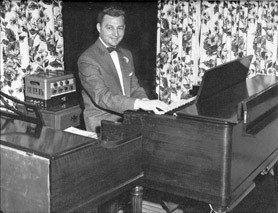
This photograph, one of my favorites, was taken two years before I was born, when he was 29, recently moved into the house in Paxtang, their first home, playing a Hammond Organ that was a brand new addition to his life. It amuses me to realize that one of the pieces of furniture I had to dispose of last spring is the chair seen in the foreground: after 60 years or more, it had long outlived its usefulness but still, it was difficult to let it go. I still have that lamp, btw...

In addition to being a respected merchant in uptown Harrisburg, manager of Greenberg’s Boston Store at 3rd & Verbeke, Dad was one of the better known “cocktail organists” in the area. He was not really into classical music, though I still play from a collection of popular works by Chopin he had bought in 1944 – it’s sitting on my piano now, and it’s on the music rack of the piano in my profile photo, taken when I was not yet a year old.

My dad played for various restaurants and clubs – I remember the Blue Mountain, especially – and, as I’ve mentioned in previous posts, even had his own radio show when I was a child and allowed to stay up on Wednesday nights to listen to it, just 15 minutes broadcasting live from the Blue Mountain Hotel (now, Felicita). It didn’t phase me, having a dad who had a radio show: didn’t everybody’s dad have one? Funny how I should end up spending 18 years of my life working at a radio station. On Wednesday nights, my dad took requests from the audience and played them on his radio program; for 18 years, I’ve taken requests from WITF’s radio audience on Wednesday nights.

He didn’t read music – after I started taking piano and theory lessons in 1st Grade, he would often ask me what note this one was, three ledger lines above the staff – and had learned to play the piano by putting his fingers into the slots where the keys would go down on an old player piano. When he was in elementary school, he walked into an assembly program (as I remember the story) and everybody was already singing “Happy Birthday” to one of the teachers. He slipped over onto the piano bench and began to accompany them. One of the teachers asked him how he knew what key they were singing in: he just knew. That was when they realized he had perfect pitch - the ability to identify a pitch just by hearing it.

And yet, without any musical training – the best piano teacher in town, Mrs. Mullen, didn’t want to give him lessons because he had a talent she thought classical training might spoil it – he could listen to a song and play it back, harmony and all. Quite literally, if he asked someone to “hum a few bars” of something for a request, he could continue in the key they were singing, then play the whole song complete with all the chords.

After twelve years of piano lessons, then four years of college followed by two graduate degrees, and having composed operas and symphonies and string quartets – I still can’t do that!

One time, when I was living in New York City during a time my father’s health was rapidly declining and he was no longer able to play, I was playing piano for ballet classes and practicing late one evening. Dick Thomas, who ran the New York School of Ballet and is the father of actor Richard Thomas, came in and jokingly said, “play Melancholy Baby,” but I realized I couldn’t remember anything past the first phrase of the song. I had grown up listening to my dad play hundreds and hundreds of songs but I never heard the words and never really knew the titles – but very often I would hear something years later and think “I remember Dad playing that!” So when I wrote to him, joking about Melancholy Baby, he got out an old list he’d kept of the songs he knew by heart and there, at #1,000, was Melancholy Baby.

We also had a baby grand piano (you can see it in the background of this photo) which my folks had purchased for their new house in 1947, trading in my maternal grandparent’s old upright (purchased in 1919 – I still have the stool and use it today for my own upright piano). By the time I arrived, the organ and the piano were set up side-by-side: Dad would sit at the organ with the keyboard of the piano to his right so he could play harmony and bass on the Hammond and the melody on the piano. (It was an idea he’d gotten from hearing an incredible musician named Al Rondo: he would be surrounded by four different pianos and organs – he was also blind, btw.) I started playing the piano standing with my butt propped up against the organ bench (since there was no piano bench, in this set-up) so my feet could reach the damper pedal. It was such an odd adjustment to go to my piano lessons up the street with Mildred Goho and sit down on an actual piano bench.

I never did learn to play the organ: I simply could not coordinate my hands and feet and keep my backside on the bench! And yet my dad could play two instruments at once. Great peripheral vision? Well, it probably helped he didn’t have to sit there, eyes glued to a score since he couldn’t read music anyway...

When I was a child, I learned to play the Nocturne in E-flat, Op.9/2 by Chopin from this collection he’d bought when he was in the Air Force. I don’t know if he ever tried playing any of it or why he’d bought it in the first place – “Chopin To Remember,” it was called– but he always loved having me play this one piece. I would trot it out for visitors or when we’d go visiting friends who had a piano. I never really practiced enough to actually become a pianist, though at one time I had enough technical ability to get through Stravinsky’s Three Scenes from Petrushka, no mean feat (but that was 30 years ago): when I was 6, I’d already made up my mind I wanted to become a composer because, then, nobody else would know if I was making mistakes.

After I’d written a piece for orchestra, it was my dad who talked to another merchant and musician in town who also played percussion in the Harrisburg Symphony, Al Morrison, who told him to bring me in to a rehearsal to meet the conductor, Edwin McArthur. He invited me to attend any rehearsals I wanted to and took the piece I’d composed called, unimaginatively enough, “Concert Piece,” and performed it with the orchestra at a Young Person’s Concert in 1964. My dad, being the good salesman that he was, took me around to lots of radio stations, since he knew many of the DJs. He called friends of his at the Patriot-News, the local newspaper (then and now) who took pictures and did an interview for the front page of the paper the week before the concert. The Forum was packed, with people filling in the aisles, the biggest crowd I’d ever seen at the Forum, all because of my dad’s efforts.

A few months ago, I went to see the Met Movie-cast of Puccini’s La Boheme and found myself sitting next to Al Morrison who could be in his late-80s or 90s now himself. I told him the story of how he introduced my dad and me to McArthur and he remembered that, asking me if I was still composing. For once, it didn’t bother me, sitting next to him during the broadcast as he hummed along with so many of Puccini’s wonderful tunes. It was just nice to reconnect for that moment with someone from my dad’s past, and my own as well.

The only surviving member of my dad’s family is his youngest brother, Donald, who’s now 82, I believe, and living in Florida.

My mother’s sister, Clara, just turned 90 this past March and I haven’t been able to get in touch with her since she’d recently moved and I don’t know which of these addresses, phone-numbers and e-mails is the current one. She said she’d call me when she got back from Thailand where she went in January to visit her son who lives in Chiangmai. She was pushing 90 and flying to Asia!

And there was e-mail recently from my older brother who just moved into a new home up in the Finger Lakes, including a photograph of his new grandson born in April whom he was holding in his baseball glove. Life goes on.

I think I'll go play some Chopin...


- Dr. Dick

Tuesday, July 10, 2007

My Dad

Today is a day of anniversaries. Less so that it's the birthday of Marcel Proust, the author of "In Search of Lost Time" (formerly known by the Shakespearean inspired but less apt translation, "Remembrance of Things Past"), born on this date in 1871, than it was the anniversary of my moving back to my home town in 1980, having left the University of Connecticut and New York City behind me.

July 10th, I often explained, was the date of "my accident." The plan had been that I would move back to my parents to help with my dad for a while and in the meantime look for a new teaching job before moving on. Instead, I ended up staying, never really finding that job I had planned on, never writing the music I had planned to, nor living the life that had been part of my plan since I was a child.

Today is also the anniversary of my father's death. That hadn't been part of the plan, either, at least not then. It's been 22 years now, not a "major"anniversary like 20 or 25, but this is the first time since my mother died that I observe it without her. I didn't really think about it before, but I was talking with my doctor who had also been my mother's doctor and had known my father as a friend and patient, too: he mentioned that he hadn't really taken the time to mourn his own father's death until his mother died a few years later and I'm finding, perhaps, the same sense of a double loss as I go through the house they built together, finding pictures and memories that might not have come to mind in the past 20 years or so. I'm told, in talking to other people, this is not unusual: it is how we are. Our energies become concentrated on the parent that is left. Whether it makes the void larger in the end, I don't know. My focus in the past four months has been my mother, adjusting to life without her; but more and more I realize how much a part of those memories are of "them" and not just "her." And I realize how much more I miss my father that I had been aware of before.

Many of the pictures and memories are of my father sitting at the organ or the piano. The first photo (above), taken before I was born, shows him playing a little spinet over at a friend's house. Whenever there was a piano or a Hammond organ in the room, he always gravitated toward it. Friends knew if they were having a party and they invited my mom and dad, they wouldn't have to worry about entertainment because my dad would play for hours. He enjoyed entertaining people and he loved to play.


In 1978, when I was playing piano for ballet classes in New York, I wrote to my father how someone asked me to play "Melancholy Baby" and I, for all my classical training, had not a clue, once you got beyond a few bars, how it went. My dad sat down with a list he kept of the songs he could play from memory, collected over the years from the '40s to the '60s, and #1,000 on his list was "Melancholy Baby.
"

He had perfect pitch which meant if he heard a note he knew which pitch it was -- an A-flat or a C, whatever. They figured this out when he was still in school: the class had already begun singing "Happy Birthday" when he slipped over to the piano to accompany everyone and knew exactly what key they were singing in. It always amazed me to listen to him when I was a kid: he'd hear a song on the radio and could sit down and play it back - not just the tune but all the chords as well. I couldn't figure out why I couldn't do that myself - I still can't, for that matter. He never took lessons, in fact never learned to read music. When I started taking lessons at the age of 6, he would show me a new song he'd gotten the sheet music for but couldn't figure out this one passage: what was that note? how did this phrase go?

In 1947 (see right) he got his start as a "cocktail organist" playing some nightclubs in town. By 1955, he had a 15-minute radio show live from the Blue Mountain Hotel every Wednesday night (as I recall). I would be allowed to stay up to listen to it. It didn't seem extraordinary to me (I was only 5 or 6 at the time). After all, didn't everybody's dad have their own radio show?

I grew up with the Hammond organ and the grand piano in our living room, placed in such a way he could sit on the organ bench, play the harmony on the organ keyboard with his left hand, the bass line on the pedals with his feet and the melody on the piano.

My folks built their suburban dreamhome around this combination, the focus of the large living room. The original plans called for a dining room and a living room separated by an archway, but they took out the archway and placed the organ and the piano at the one end, the fireplace at the other end. In this picture, taken in the early-'60s, he was playing the piano. That's a Leslie speaker tone-cabinet behind the piano.

In the mid-60s, my dad started having trouble with rheumatoid arthritis and eventually could no longer play the piano which required more strength and stamina than his fingers could manage. When it became clear I was going to pursue music as a career and trying to practice in the middle of the house's activity was not very practical, we sold the piano and I got an upright which we put back in my bedroom. The organ, however, was different, and my dad continued to play it for a few more years, despite how his hands were deformed by the arthritis.

When he would go into the hospital, he would play the little spinet piano in the solarium for the other patients after dinner, a nightly sing-along. He had song-sheets printed up and he took requests. Soon the room was full and they had to move it to a larger lounge. It was good therapy for the patients but it was also great for my dad. When he was in for a more extended stay, J.H. Troup's, one of the major music stores in town, brought in a Hammond for him to play.


But eventually he could no longer play - at least not well enough for his own liking. After they became born-again Christians, my parents didn't want to get rid of the organ. They were always praying for the miracle that he would be healed and he'd be playing just like had been before. To sell it now would be an act of bad faith. Even though he could barely walk after a knee replacement, he still would slide over onto the organ bench to play some hymns for their friends who came by for prayer meetings. They often said how they came by to cheer him up and instead left feeling cheered up and blessed themselves.


At some point in the mid-70s, there was an accident and he broke his neck, riddled as his bones were with the rheumatoid arthritis. They put this "halo cast" on him to keep his neck immobilized, a steel ring around his head held in place with four screws that went directly into the skull with a brace around his torso. I don't remember how long he was in this contraption but as soon as he was able, he was playing hymns at the organ.

By 1979, he was confined to a wheel-chair. In early September, sitting opposite my mother at the kitchen table as they were reading their Bibles together, my dad got a phone call from a friend of theirs who had been led by the Lord to throw a surprise birthday party for my mother who would turn 60 that year. Now of course, he couldn't very well just blurt this out while she's sitting right there, so the guy started naming the months. My dad was sitting there saying "No, no, no, no, no" and then finally "yes." But now they had to get the date and so they did the same thing again as he went down the list, "1st? 2nd? 3rd?" My dad kept saying, "no, no, no..." and eventually "yes" without letting on that it was a little over a week away. My mother was looking at him like "what ARE you talking about?" The friend would make all the plans and do all the calls, but anytime Mom would walk out of the house -- to get the mail, to walk the dog, to make a quick run for groceries -- my dad would get on the phone and call them with more people to invite.


It almost didn't happen: they had planned it around a prayer meeting regarding some particular
need which, as it turns out, was no longer an issue the day before the meeting -- "an answer to prayer," my mother said but my dad was fretting about how they were going to get her to go for the party, now, without spilling the beans! My mother was not one to go out much, especially considering dealing with Dad and his wheel-chair, but they convinced her to come because it would now be a "thanksgiving meeting for answered prayers." When she got there, it was a complete surprise! I love this photograph, taken just as she wheeled my dad through their door. The look of surprise on her face is one thing, but the look on his face, delighted that they had all managed to pull this off, is priceless.

A little more than a month after I moved back from New York, my father had another accident. The doctor said if his bones had been healthy, it would have snapped his spinal cord and he would have died instantly (though of course one could argue if his bones had been healthy, it wouldn't have happened), but because they were porous and fragile from the arthritis, it merely pinched it, causing him to become a quadraplegic in a matter of minutes.
It was another five years of constant care at home, during which he regained use of his arms and legs and was able, for a while, to walk again, taking 66 steps on his 65th birthday, with one to grow on before a bad jolt in the wheel-chair broke his tail bone. There were occasional stays in the hospital before he went to the Lebanon Veterans Hospital where he had a series of strokes a month later.

One of the horrible things with rheumatoid arthritis is that it won't kill you. He had dealt with this for about the last 21 years of his life. His first visit to the hospital for some kind of treatment for it -- in the days when "gold shots" were the standard form but he was allergic to them -- coincided with my first week in high school: I was 15, he was 46. That, too, certainly wasn't part of the plan.

My dad was a typical dad who tried to interest his son in the things he loved. He was disappointed that I didn't want to play baseball -- or even watch it. When I was 6, they took me ("dragged me") to a Phillies game back in the mid-'50s when Richie Ashburn was the big name star of the team and I was so bored out of my mind, I sat there the whole time reading a pile of comic books I'd taken along. I guess they were hoping the excitement of seeing it live - the experience - would win me over. My father loved to fish but I didn't even want to kill the worms, much less the fish. But I loved being outside in nature, wading in the stream, watching the birds, catching newts and crayfish. I didn't always like getting up even before the crack of dawn to get to the good spots before the fish would start biting, but then what teenager would?

But when I started to show an interest in music, my father was behind me 200%. He didn't know anything about classical music but he had a few friends who did. My folks found out what that tune was I was listening to all the time on one of my little kids recordings when I was 3 years old and when I was 4 or 5, they got me my first record, an LP of Leonard Bernstein and the New York Philharmonic of Rimsky-Korsakov's "Scheherezade" though it took them a while to find one without a belly dancer's midriff on the cover which they didn't think appropriate for a 5-year-old. I was probably 10 when my dad came home one evening with a book he'd found for me: Rimsky-Korsakov's autobiography, "My Musical Life" which I read from cover to cover.

After I had started taking piano lessons, he wanted me to also take "theory" lessons about the language of music, more than just reading the notes but finding out how it works. When he saw me copying out one of the little songs for my lesson -- an exercise in learning notation -- he got all excited because he thought I was actually composing it on the spot. When I really did start to compose my own music a few years later -- certainly by the time I was 10 -- he was there but never pushy or judgmental. I had written a short piece for orchestra when I was in 7th Grade and he told a friend of his who played in the Harrisburg Symphony. So my dad took me into a rehearsal at the old William Penn High School Auditorium to meet the conductor, Edwin McArthur, and hand him the slim score I had completed. When he told us the orchestra would perform the piece on a children's concert, my dad contacted friends he knew at the paper, on the radio, at the TV stations, and we did a round of interviews and photo sessions. It wouldn't have happened without his effort and I know I took it for granted -- this is what you do, this is how it happens. Doesn't every father do something like this for his child?

But he never stopped being my biggest fan. When I had works performed at Susquehanna University, my folks would make the hour's drive up from Harrisburg even though by that time it was difficult for him to walk, much less sit that long in a car. After I conducted a Harrisburg Symphony concert he couldn't attend because by that time he was bedridden at home, my Uncle Bob congratulated me by wishing his daddy could've been there to hear this -- my grandfather, who had died about 4 years earlier, played the trumpet when he was younger and was the member of several bands in the area -- and when I responded in the same tone of voice that I wished my daddy could've been there, too, Paul Beers, a local historian and columnist with the Harrisburg Patriot-News, overheard this and assumed that meant my dad, who was no longer working as an uptown businessman or playing the organ in the clubs any more, must have died So he referred to me in his article as "the son of the late Norm Strawser" which got a number of Dad's friends shook up, since they hadn't heard. Much to their surprise, he answered the phone when they called the house to find out what had happened (Paul wrote a very gracious correction รก la Mark Twain in his next column).

When it finally did happen, we were all there with him to say good-bye. Though he had on occasion been confused following the strokes -- mostly language things, like nouns not having their accustomed meanings which made it rather difficult to communicate some times -- mentally he was still very good and his faith was still very strong. He had always prayed for healing and it took a great deal of faith not to be discouraged when he wasn't. But at the very end, with minutes left, I realized his eyes were once again the brilliant blue they used to be, not the milky nondescript off-blue they'd been the past 15 years or so, as if that too was a side-effect of the arthiritis or the medication. The healing had begun. And then, his breathing slowing down, he went peacefully and without any apparent additional pain or fear.

It struck some people as odd, but we buried him in his red fleece jogging suit rather than the more traditional suit and tie, the kind he had worn most of his life as a businessman or an organist.
21 years later, when we were making arrangements for my mother at the same funeral home, Fackler-Wiedeman, they still remembered that red jogging suit. But his Christian friends who'd come to the house for prayer understood: red was "the blood of the lamb" and when he went to be with the Lord, he would be jogging in heaven.

Dr. Dick

Friday, May 18, 2007

One of those Epiphanies

This is a picture I’ve known for a while, perhaps years ago when I didn’t really think too much about it. This is my dad playing the Hammond Organ in the living room of the house I was born in, before I was born. I knew the organ was one that belonged to a friend of the family’s, Jack M, who after the War was building a house in Lemoyne and who’d ordered a Hammond organ from J.H. Troup, the best known music store in town, located on the south end of the square opposite the church.

Also part of the legend was how the organ was supposed to be delivered but Jack’s house wasn’t ready yet, so he asked my dad if he’d be willing to “give it a temporary home” because if Jack said no, the organ would go to the next person on the list and Jack would be moved to the bottom.
My dad, who’d learned to play the piano when he was a kid by watching a player piano and figuring out where to put his fingers when the keys went down, was delighted to help out. During the war, he had had a chance to play a Hammond in the base’s chapel and fell in love with it.

What I didn’t know until I was going through one of my mother’s ubiquitous calendars which she kept like a diary, was when the organ arrived and when it left for Jack’s now-completed house. I would have assumed months but it was only a short time – weeks, really – which puts a more definitive time on when this picture was taken.

Friday: April 18th – Organ [underlined several times] delivered in morning
Thursday: May 8th – Organ being taken to Jack’s

But in the week’s following this brief 3-week visit, there are about fifteen references to my dad going over to Jack’s, several times specifically “to play the organ.”

Then there was a week’s vacation in early August – on Monday, “Jack’s for supper – ball game... appt 8:00 to see Wayne Wiegle at Pueblo - organ” followed by a blank Tuesday and then, on Wednesday, “Jack’s at 12:30 - Wayne to audition Curly [my dad’s family nickname] at organ & sign papers for rental” [presumably for an organ at the Pueblo]. The next day, after my mother canned pickles during the afternoon and took my brother (then almost 6) down to my dad’s folks who were going to babysit him, my folks went to the Pueblo at 9:00 for my dad’s “debut at the organ.”

The first time he played as a “professional” musician. She added this note on the opposite page: August 7th, 1947, Norm had his debut playing the organ at the new night club “Pueblo” [then mentioning a friend who stopped in as a customer]. August 8, 1947 – went over much better. Received his first tip ($1.00) from a gentleman who requested ‘Trees.’”

And so my dad’s second career began: he would play at several clubs and restaurants in the area for the next 17 years or so, before the rheumatoid arthritis made it impossible for him to play. When he would go into the hospital for frequent treatments, he talked J.H. Troup’s into bringing in a Hammond so he could play every night for the other patients after dinner, leading them in sing-alongs and playing requests. It was as much therapy for him as it was for them and the room was always packed.

Today, my dad’s birthday, I looked at this picture of him playing Jack’s Hammond in our living room – a defining moment in his life – and realized, if it was taken between April 18th and May 8th, 1947, a month or less before he turned 29, that next week I will turn twice the age my father was in this picture.

Wednesday, April 11, 2007

The Past as a Present

Since this was intended as a "creativity" blog and I haven't been very creative recently, following my mother's death, there hasn't been anything to write about except I am very agitated about not being able to compose right now which I guess is a good sign. In the past, going a few months without feeling like writing made me question whether I was a composer or not.

Back in December, nearly finished with three of the pieces for violin and piano I'd been working on, I decided to take a break and write something else. Since it was Christmastime, a Christmas piece seemed logical, but that came to a halt on January 16th (and that after three days of inactivity) because of numerous distractions mostly related to the apartment and the constantly barking doberneighborman. I had decided it was time to move -- a hateful occupation of time that is sure to destroy the creative impulse as everything else falls before it.

The question was where? It would be a spring-time project.

In the past, most of my moves came toward the end of summer: in fact, the last move took place over the hottest week of the summer of 2001 and I refuse to get stuck with that again.

And not in winter: a former co-worker told me stories of moving into Central PA during the Blizzards of January 1996 -- she moved the weekend of the Flood, however, the one with the ice jam that took out the Walnut Street Bridge -- and I didn't want to risk scheduling movers only to tempt Mother Nature into coming up with something equally memorable in this otherwise unmemorable winter.

Since my mother's death in February, much of the time has been spent dealing with the grief and the changes one senses, even at my age, in losing one's mother. It has not been a weepy, mournful grief (trying to avoid those who've been weepy and mournful has helped) but a quiet, contemplative one that at times is sad and wistful, at others joyful and humorous, mostly depending on the memory of the moment or something I may have found as we clean through the stuff-congested house with its accumulation of not only my parents' lifetime but their parents as well.

A few weeks ago, a friend showed me a book he had just gotten back after loaning it out and I said I had to read it: it was called "When I'm Dead All This Will Be Yours!" by Teller, the shorter, quiet half of the master magicians Penn & Teller, a portrait of his dad (primarily) and the memories he discovered going through some of their stuff while, fortunately, both his parents were alive to tell him its significance. Through this "stuff" the son discovers aspects of his parents' lives he was unaware of before.

The cover shows a very wary Teller sitting in the midst of his dad's shop, a dusty broken victrola on his lap, his father emphatically expounding on the importance of some rusted contraption he's handing him. They're surrounded by tools, mops, jars full of nails, a porcelain pitcher, what looks like a stuffed raven but also paintings and what may be the cartoons Joe Teller had drawn in 1939 which become the focus of the book: these cartoons are The Discovery, something the son never even knew existed, and this leads to letters and reminiscences about the years his dad had gone tramping across the country (quite literally) before becoming an artist, meeting his future wife at an art school, then getting married just before World War II. After the war, Joe Teller settled into the world of commercial art, primarily as a "letter man" doing the wording for ads in the Philadelphia newspapers.

So far, I have not found a box of cartoons, but I did just find a box of india inks and paints, brushes and pen-nibs my dad used when he'd do the lettering for the ads he designed for "The Boston Store," one of the Greenberg stores in Harrisburg where he'd worked since graduating from high school (or perhaps even before) and had long been the manager. I found a card he had made for my mom's 60th birthday in which he wrote about how they met:

"It was the summer of '38 at Hershey Park when I saw 'Ginny' Hartman for the first time. I didn't know then that God had a plan for everyone's life from beginning to end, so on this special day I didn't know I was looking at the girl God had chosen for my life!

A few days later, in Pomeroy's Department Store, I saw the most beautiful, wholesome-looking girl I had ever seen. It was Ginny Hartman!! My heart 'pounded with excitement' on June 17, 1938 when I asked her for a date and she accepted. And on March 17, 1940, her name became Ginny Strawser."

As I remember the story, my dad, two years out of Hummelstown High School, was working at Greenberg's clothing store at 5th & Market in downtown Harrisburg. My mother, a '37 graduate of John Harris High School, was working at Pomeroy's at 4th & Market. The story goes that dad went back to Greenberg's, told a co-worker named Duke about the girl he'd just seen and wanted him to go back and find out her name: "she's wearing a white blouse and black skirt." When Duke got there, it turned out ALL the sales clerks wore white blouses and black skirts. It must've worked out okay, though: Duke's in the wedding photo as Best Man.

My dad was a natural-born musician, teaching himself to play the piano and eventually the Hammond organ. He couldn't read music but had perfect pitch and could play a thousand songs if you could hum a few bars. I found dozens of reel-to-reel tapes made in 1954 when my dad had a 15-minute radio show once a week, broadcast live from the Blue Mountain Hotel (now Felicita). I was 5 years old and thought everybody's dad had a radio show. Funny how I've just passed my 17th anniversary working at WITF-FM...

But I also knew somewhere there was a record. We have many recordings -- 45s, 78s and then the long-playing 33s. But this one was different: my dad made this recording and it was a song he wrote and sang while he was in San Diego during the War and sent to Mom back home. It was one of those things where servicemen could go to this studio and record greetings their loved ones back home could listen to -- think about it: they were on the verge of being shipped off to the Pacific Front -- but my dad wrote a song and performed it himself.

Last night, I found the record.

It was unmarked, just a blank label in a blank sleeve but I just knew it had to be that song. I haven't listened to it yet because I'm afraid one time may be the last time it would play or I'd break it. I want to wait till I can transfer it onto a CD just to make sure I can hear it again. It may not have been a box of cartoons, but it was a discovery all the same.

There was a story my mother told me shortly after Dad died in 1985. When he was in San Diego, he and a bunch of his Navy buddies were on a train that had an old piano on it. If there was a piano in a room, my dad wanted to play it, so he and his friends went over to the piano and he played while they all sang along to the popular songs of the day.

One of the passengers in that car was the wife of actor Raymond Massey who went up and complimented him, introducing herself and saying she had some "connections" (some guy named Crosby, I believe) if he'd be interested in playing in a band for Hollywood.

My dad, a Hollywood studio musician!

I wonder how different things would've been if he'd followed up on that. The war was over not long after that and the first thought in his mind was getting home to his family -- not just his wife but also his 4-year-old son, my older brother. He remembered the problems his parents had had, his father a trumpet player in numerous bands in the area and as family legend has it subbed in the Sousa band for part of a year. This became a bone of contention with my grandmother who didn't want to be stuck home with the kids while he travelled around playing music all over the place, so he gave it up.

My dad didn't "give it up," though. He stayed here in Harrisburg and became a well-known musician "on the side," maintaining his day job (one newspaper article about him when he was active in the Uptown Business Men's Association, described him as "shoe salesman to the poor") earning a kind of fame. True, it was not without its issues: if my folks went out on their anniversary, it was always a St. Patrick's Day party where Dad was playing the organ and Mom would sit there and listen to him. New Years Eve, she was always alone with the kids, ushering in the new year with a toast of homemade egg nog.

My parents built this house and we moved into it in March of 1960, around the time of their 20th wedding anniversary.

Now 47 years later, I will be moving into it myself. It's not a "new" place because I grew up here, though now it's "my" place even if it is still (and will always be to an extent) "their" place. It is not perfect -- there are aspects of "deferred maintenance" to contend with -- but it is a far cry from the cramped little apartments I have been renting all my life.

Once the piano is back in my old childhood bedroom, I can compose again. I won't have to worry about the sleeping (or fighting) schedules of upstairs neighbors, the noise of boom-boxes from the street, the loud music pounding through the walls from next door, the doberneighborman barking all day long as I'm trying to write. I can play the piano when I want and compose whenever I feel like it.

And I already have some pieces in mind to work on. But more of that, later.

Dr. Dick

Sunday, March 04, 2007

Loss & Remembrance

We are creatures of habit, building up a routine over the years of what is comfortable and anticipated. And though we might adapt as schedules and expectations evolve, for some reason of presumed invincibility we think things will never change, or perhaps hope they never will, even when change is inevitable. Because we expect people to always be there for us – with us – things go unsaid (but hopefully understood) and plans are put off because there’s always another day. Until we realize that, however it happened, there are no more days to procrastinate with. Now, instead, we look back to find consolation in memories.

In the week since my mother’s death, I have found boxes of pictures that I knew she had been sorting through and sometimes labeling, scanning pictures to e-mail to my brother and I or her sister on the computer we’d gotten her when she turned 80, including lots of photos from the 1920s to the 1940s as well as her parents’ wedding picture from 1911 and family photographs of her mother taken before they left England.

There were some with vague historical details that I only remember from what she had told me, then: a heavily bearded gentleman was her grandfather whom no one in the family seemed to know much about. All the known pictures of her grandmother show her in “widow’s black” which leads us to believe he died when she was not yet middle-aged. By association, she must be the young woman with her hand leaning demurely on her older husband’s shoulder in a carefully choreographed family portrait taken after his own father’s death, his mother (my great-great-grandmother) seated amidst her children looking very much like Queen Victoria who spent much of her own life wearing widow’s black. Looking at it, I’m not sure I can explain why I dated this picture to the 1870s, now, but it’s the start of a long line of family photographs – using this old technology – that ends with a photograph taken a year or so ago of my mother, then in her mid-80s, with her great-granddaughter. I will scan many of these onto a CD and hope that, when she grows up, my great-niece will have the technology available to view a CD-Rom, if looking at the sadness on the face of her great-great-great-great grandmother (whose name I do not even know) will connect her with a past she never knew existed.

But I also found other boxes that I had never seen before and which maybe Mother had forgotten she’d placed on a top shelf in a closet. Many of them were recognizable – this aunt, that uncle, though taken before I was born – and others may not really matter as long as I can tell they are part of her father’s large collection of friends and siblings.

In an album that had only a few pages of mounted photographs which my father had generously captioned – followed by several pages with fistfuls of unsorted, usually uncaptioned photos intended for later inclusion – I saw a series taken on a mild December day in 1940 with my Uncle Marlin who had died later in World War II. There was my mother, not quite 10 months a bride, standing with my uncle who looked proud and spiffy in his army uniform. Then I saw my dad in his army uniform and thought, “wait, he wasn’t in the army” before I realized he – and then my Uncle Bob too – were all having their pictures taken wearing Uncle Marlin’s jacket!

Some lack dates which might be helpful, others lack clues if you don’t know what to look for (one couple’s wedding photo she helpfully labeled “not a clue”).

It was good to find pictures of her that erase the pain of seeing her those final days. It was amazing to read through old calendars, some stored in boxes in her office (on a desk that her father had bought when he graduated from high school in 1905) that were kind of like journals where I could fill in the details, knowing an anecdote from the family history or discovering a day in June marked “1st Anniv of 1st Date” with my dad and pictures taken on her grandfather’s farm (see photo at left) in upper Dauphin County.

One anecdote I knew from early in my childhood: how Dad got his first Hammond organ. Well, not really his... He had played the piano since he was in grade school – he had perfect pitch but never took lessons from anyone, just figuring everything out by ear – and he learned how to play the organ much the same way during The War, sneaking into the base’s chapel though he was primarily playing the popular songs of the day to entertain his friends and anyone who’d listen. After the war, a friend of his, Jack, was building his own house and the Hammond organ he’d ordered was going to be delivered before the house was ready: would my folks mind if he’d have it delivered to their place in Paxtang so he wouldn’t lose the option on it (it would go to the next person on the list and he’d be bumped to the bottom, otherwise). Well, sure! Paging through a 1947-1948 ‘engagement’ book, my mother wrote down the day Jack’s Hammond was delivered (see photo at right). Later that summer, my dad made his debut at the Pueblo, a night-spot in Harrisburg, as a “cocktail organist” (the second night, she noted, went better than the first; a few days later, she also mentions his first tip, $1.00). Throughout the book were annotations of “Jack over for dinner” or “dinner at Jack’s” and frequent games of pinochle with Jack and other friends. On March 17th, 1948, she writes “Our 8th Wedding Anniversary.”

There was a box of her father’s early record-keeping, too: rent receipts he’d paid for apartments before they bought their first house the year my mother was born ($15/month rent – not bad) or lists of furniture they’d bought (including a piano for $420), lists of books he’d read, lists of facts he thought were important to remember, and a string of medallions he wore as a member of the Philadelphia branch of the Knights of Malta in 1918. Ironically, I realized, last Friday sitting there amidst these boxes of papers and pictures we were sorting through on the floor, looking up at the desk I often looked up at when I was a child, that that Friday was my grandfather’s birthday and so we went out for dinner to celebrate the past.

My mother had become a keeper of lists herself: the gene is apparently inherited from her father. There are ledger books with every book she read since 1985 when my father died and piles of books that she’d not yet logged but which had post-it notes on them indicating when she’d finished reading them. There’s a ledger itemizing every piece of clothing she bought between 1984 and 1994. There are bundles of notes listing every visitor and phone call she received and made since 1993 (and I suspect I will find previous years tucked away somewhere else). Her more recent calendars, while devoid of highlights like she noted in 1947, may have contained less interesting information – the high and low temperatures for every day or when the Lawn Guy mowed the grass (highlighted in green). She was, if anything, a meticulously organized packrat. I have inherited the packrat gene but unfortunately not her organizational skills: my laissez-faire approach to clutter is something I inherited from my dad.

There are bundles of letters still to be sorted and read, though fewer than I would’ve thought. But that is for another day. In this age of e-mail and instant messaging – and yes, I found print-outs my mother had made of several of the chat sessions we’d had when she first got her computer – what will be left for families to reminisce over in the future? I can hold a 130-year-old photograph in my hand and feel the connection with my family’s distant English roots, but what of all those jpg’s locked in some already out-dated computer software program or storage format? What about all those reel-to-reel audio tapes she’d made from the radio broadcasts when my dad had a weekly 15-minute show, live from the Blue Mountain Hotel in the mid-1950s? We had often talked about trying to resurrect them so she could hear them again before she died, but it kept getting put off, too involved a process, perhaps, and even at 87½ we still felt there was time.

One of my rituals these past 15 years or so was to call my mother, however often I may have talked to her the rest of the week, Sunday nights following the 11:00 news. Even though she was expecting it, she said it always made her jump when the phone rang and she would worry if I was a few minutes late. We would talk, maybe, for an hour or more, both of us night-owls (I was born, according to my baby calendar in which she annotated every event and illness that first year, at 2:58 a.m.). But tonight was the first Sunday night since the funeral that I know she’s not there for me to call on the phone.

Years ago, I had found a quote – mentioned in one of May Sarton’s journals – attributed to St. John Chrysostom:

He whom we have loved and lost
Is no longer where he once was.
He is now wherever we are.


And I also know that, after 21 years, my mother and my father are together again. And these two understandings help me considerably in dealing with her loss.

-- Dr. Dick

Photo credits: all from family collections - (1) Mother in a black dress taken by my dad in early-1940s; (2) Mom & Dad on the Hartman Farm in Williamstown PA, 1939, the year before they married; (3) My dad, Norm Strawser, playing Jack's Hammond organ in the living room of our house in Paxtang (two years before I was born); (4) Mom & Dad in 1944, a photograph I found in her wallet the day she died, February 23rd, 2007.