This weekend, the Harrisburg Symphony is performing a program with four works on it – I've blogged about three of them over at the Harrisburg Symphony Blog, here (“The Sorcerer's Apprentice,” Prokofiev's “Lt. Kizhe” complete with a link to the entire 1934 film the suite is taken from, and Bernstein's suite from the film, “On the Waterfront”).
The other work on the program, Richard Strauss' tone poem, “Death and Transfiguration,” is included in this post.
Back in the late-'80s, when I worked for the Harrisburg Symphony as Assistant Conductor and Orchestra Manager, conductor Larry Newland had initially proposed Christopher Rouse's The Infernal Machine, Strauss' Death and Transfiguration and Dukas' Sorcerer's Apprentice for the same concert. Of course, I, never a fan of your typical marketing slogans, blurted out "Great: Rouse, Strauss and Mickey Mouse!"
I was later told that was NOT the real reason the program was changed - the Rouse was done in January, 1988, the Dukas the following season, in November, 1989, and the Strauss was either dropped or moved to a season after I'd quit and was no longer keeping records of their repertoire. Spoilsports...
*** ***** ******** ***** ***
Meanwhile, I'm working on a climactic scene (or at least the dramatic turning-point scene) of “The Lost Chord,” having just introduced composer Elliott Carter as a character helping the hero and his team-mates on their quest to solve the ancient mysteries also being sought by both the villain, Tr'iTone (a.k.a. composer Iobba Dhabbodhú), and the Chief of Security for the International Composers Alliance (who seems a bit villainous at times), Yoda Leahy-Hu.
Recent characters added to the cast list include code-cracker Haydn Plainview, police detectives Heidi Ho and two of her former colleagues on the NYPD Vice Squad, DePuis LeJour (called “Toots” when she's working) and Wanda Menveaux (think the famous aria from Massanet's Louise and, for the other, Musetta's Waltz with its opening line, “Quando m'en vo” - Whenever I walk alone on the street, men turn and look at me - not The Girl from Ipanema but from Puccini's La Boheme), plus Emil Tesoro y Tonto and his partner Dolly-Sue Apache (think of Don Ottavio's arias in Mozart's Don Giovanni).
There's also a brief appearance by the thief who stole Buzz Blogster's coat (bugged with a GPS unit by the ICA agent Kay Gelida Manina): Damien Johnson is a known thief around Lincoln Center and Carnegie Hall, having recently stolen four basses from musicians in the area in one night. Since the story takes place on November 4th, the night the Yankees defeated the Phillies to win the 2009 World Series, I should point out that Johnny Damon had stolen four bases during the series' 4th game a few nights earlier.
And now I've started Chapter 25 as I continue re-reading my way through Thomas Mann's “Doctor Faustus,” the climactic chapter with composer Adrian Leverkühn's transcript of his dialogue with the Devil during which the plot's Faustian bargain is sealed. It's written in a pseudo-old-fashioned (one could even say “fustian”) style, Leverkühn imitating the delivery of an equally old-fashioned (and similarly fustian) former theology professor of his since it essentially parallels (if not parodies) the debate between the Devil and Martin Luther centuries before.
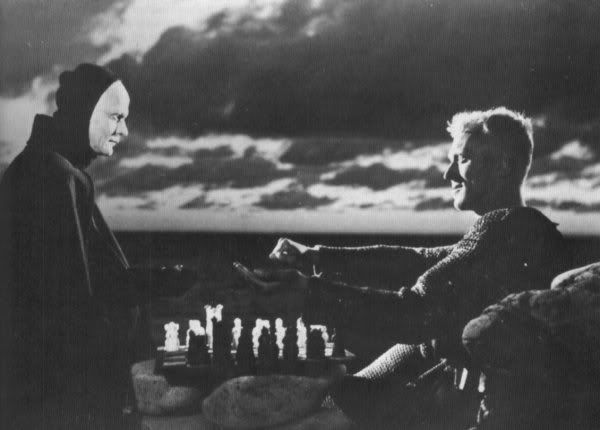
While, Schoenbergically speaking, this is going to be a tough row to hoe (or read), I admit I'm trying to think how I can use this in “The Lost Chord,” perhaps combining it with the chess game (which, admittedly, is with Death, not the Devil) from Bergman's “The Seventh Seal.” In this case, it would be during Tr'iTone's interrogation of Dr. Dick, which in addition will use my version of Abbott and Costello's “Who's on First” skit regarding the whereabouts of Yoda Leahy-Hu.
Thinking more of the film “Lt. Kizhe” than just Prokofiev's delightful music for it - a commenter at the Symphony Blog sent me this link to the original film – perhaps I should also include an almost true incident back when I worked for the orchestra either as assistant conductor or later as the personnel manager. A close friend, Vikki Moore, who'd been the personnel manager before I took over the job, and I used to joke about how we could easily confuse the conductor by inadvertently creating a musician with a well-placed typo, then wondering if we'd be able to bring it off in true Kizhean fashion.
There had been a concert, once, when the program and its personnel page had to go to print before we had decided upon hiring several key musicians after a series of auditions. So rather than leaving them blank, I decided I should make up some names figuring, you know, who would notice... Since this was a special fund-raising concert, though, and the theme was “The Orient Express,” I decided to go into Agatha Christie's wonderful mystery, “Murder on the Orient Express” and select seven different names for those players not yet hired. There were actually some people in the audience who noticed this and commented on it. I felt so much better, then, thinking the time it had taken to execute the idea (so to speak) was worth the extra effort.
- Dr. Dick
Showing posts with label journal. Show all posts
Showing posts with label journal. Show all posts
Thursday, March 25, 2010

Tuesday, February 23, 2010
Schubert, Leverkühn & Me

Part 1 includes video footage of Karl Böhm conducting the Vienna Philharmonic in 1973 of the entire symphony in eight installments (clocking in at 51 minutes) – not my ideal performance, if I have one, but what I could find complete, courtesy of YouTube.
Part 2 covers some of the historical background of the symphony, how it fits in with the history of the form and with Schubert's development as a writer of symphonies.
Part 3 explores more personal issues around the composition of the Great C Major and Schubert's quest for a new, expanded musical language and sense of structure.
This is actually a continuation of a post written last week about Schubert's D Minor String Quartet, “The Death and the Maiden,” which became more tied in with the “Great C Major” posts than I was originally anticipating. In a sense, all four of them constitute something of a cycle.
*** ***** ******** ***** ***
Recently, I picked up my copy of Thomas Mann's “Doctor Faustus” again, a novel about a fictional composer supposedly modeled on Arnold Schoenberg, not at all to Schoenberg's liking, especially as the composer in question, Adrian Leverkühn, invented a system of composing very similar to Schoenberg's Method with 12 Tones but whose genius is also considered to be the result of syphilis and, if that weren't enough, a pact with the Devil.
The book is one of the greatest works in literature about compositional creativity and one of the few books by a non-musician that is not so totally cringe-worthy whenever it discusses the details of music, not that that didn't stop Schoenberg from pursuing a lawsuit against the author.
 I'd first read it when I lived in New York City back in the late-70s, not a very good time for an insecure composer unsure of his future direction both aesthetically and professionally to be contemplating such a tale. It was difficult reading on any number of levels, not the least because much of my best reading time was on the subway: I had read much of Mann's “Magic Mountain” on the subway, too, and speaking of not good times to be reading something, found myself turning the page to start the climactic scene of Tolstoy's “Anna Karenina” while standing at the 101st Street Subway Station of the Broadway downtown train...
Once again, sometime in the early-90s, I thought I'd try reading it again but this time got bogged down in the turgid translation's style, the famous debate between the composer and the Devil (part of this is Mann's fault: he imagines it being written down by the composer as a parody of Martin Luther's didactic theological style). So I put it aside.
Then, in 1997, I bought the well-reviewed new translation by John E. Woods. It was becoming quite the thing to bring out new translations to replace the traditional (and often only) ones available to English readers of both Mann and the Russian writers like Tolstoy and Dostoievsky. In fact, over the past 12 years or so, I found myself collecting the new Pevear and Volokonsky translations of most of the Russian novels I'd already read, mostly in Constance Garnett's standard translations. Suddenly it dawned on me that the reason I could never tell the difference between Tolstoy's style and Dostoievsky's style was that Constance Garnett couldn't either: in fact, what I was reading was her style, not theirs.
Typical of my habits, I've purchased them as they came out but not necessarily read them, yet: “War and Peace,” yes (see my earlier post here about that experience), and Dostoievsky's “The Idiot” but not, so far, the others.
Also sitting on that “to-read (someday) pile” was Wood's translation of “Doctor Faustus.” I had gotten about 80 pages into it a few years ago and, for some reason, probably coinciding with a time I was trying to do some writing of my own, I put it aside.

One of my favorite passages is the long concert-lecture the young composer and his friend the narrator attend in their small, largely unmusical hometown, Kretzschmar's talk about Beethoven's Piano Sonata in C Minor, Op.111. Not too many summers ago, when I was doing a Gretna Music pre-concert talk for Jeremy Denk's performance of this work – paired wonderfully with Charles Ives' equally monumental “Emerson” Sonata – I didn't bother preparing my usual behind-the-scenes in-depth remarks: I simply read most of Thomas Mann's account of the work. It was one of the few times I can recall having everybody's attention...
Well, at any rate, the other night, I resumed reading after a few days' hiatus and found this passage near the beginning of Chapter XXI, following a letter from the composer, Adrian Leverkühn, about his enthusiasm for Chopin (I am reminded that next week is the 200th Anniversary of Chopin's birth) and about...
- - - - - - -
“...the conservatism of his mode of life, which often looked like rigidity and could appear somewhat oppressive to me. It was not for nothing that in his letter he had expressed sympathy for Chopin's not-wanting-to-know, his unadventuresomeness. He, too, wanted to know nothing, see nothing, indeed experience nothing, at least not in the manifest, external sense of the word; he was not interested in variety, new sense impressions, amusement, relaxation – and particularly when it came to relaxation, he like to make fun of people who are constantly relaxing, getting tanned and strong, though no one knows for what. 'Relaxation,' he said, 'is for people for whom it does no good.' He had little use for traveling in order to see something, absorb a new experience, 'educate' himself. He disdained pleasures of the eye and as sensitive as his hearing was, he had always had almost no desire to school his eye to forms in the visual arts. He approved of the differentiation made between eye-people and ear-people, claimed it to be incontrovertible, and counted himself definitely among the latter... True, Goethe also says that music is totally inborn, something within that needs no great nourishment from without, no experience drawn from life. But there is also an interior sight, a sense of vision that is different from and includes more than mere seeing.”
(... Thomas Mann: Doctor Faustus – translation by James E. Woods, published by Alfred A. Knopf, New York, 1997 – p.188.)
- - - - -
It surprised me to read this: it was like reading an encapsulated description of myself.
*** ***** ******** ***** ***
For me, at the moment, I am immersing myself in Schubert, not Chopin. Last week, as I wrote earlier, I was writing one of my up-close and personal posts (see also, here) posts, this one setting up Brooklyn Rider's impending performance of Schubert's String Quartet in D Minor, the “Death and the Maiden” Quartet. This week, it's been Schubert's final symphony, the “Great C Major” Symphony for this weekend's concerts with the Harrisburg Symphony. Rather than experiencing adventures and travels, I have been quite content to burrow into scores and biographies, cross-referencing dates and chronologies, placing compositions in context and in general ignoring the weather (among other realities) to consider imponderable issues like “where did Schubert's 'late-style' come from?”
How did a composer who could write such original and innovative songs like “Gretchen am Spinnrade” and “The Erl-King” when he was a teen-ager write such pleasant but derivative symphonies like his 5th and 6th Symphonies by the time he was 21, only to write four years later the B Minor Symphony we know as the “Unfinished”? And how could he not recognize the magnitude of what he'd accomplished and just put the work aside when the 3rd movement he'd started wasn't going in the right direction? How did all this lead to 'The Great C Major' only three years later? Never mind what else he might have written if hadn't died a two months short of his 32nd birthday after completing the String Quintet in C and the last three piano sonatas in a little over two months?
In between these two great symphonies – the only two of all he had started that have entered the repertoire as avowed masterpieces – he wrote the “Death and the Maiden” Quartet, part of a project, that spring of 1824, to evolve a more expansive style and write a 'grand symphony,' something on a larger scale than anyone (except Beethoven) had ever done before. Beethoven, a composer who Schubert thought, writing in his diary when he was 18, was so full of eccentricities as to be unnatural. What made him change his mind?
Here was a composer going through a “style change,” putting his youthful endeavors behind him and taking on the fearsome work of reinventing himself – and Schubert, one of the most insecure composers among the pantheon of great composers, dealing with the Unknown by plodding along, unaware he had created some of the greatest music ever composed (at least in my opinion) but never being deterred by the fact so few others even knew he existed. Wouldn't someone who'd be considered more... what, normal? - just have chucked it all or decided to write what people wanted in order to gain some acceptance, some recognition? Some form of income or at least acknowledgment to validate what he was doing?
In that sense – insecurity, yearning for validation and perhaps a thousand other fears – I identify with Schubert as well, though I am nearly twice his age, now, and have accomplished the tiniest fraction of what he composed in his short life, if one weighs it by mere quantity, never mind the quality.
No, I don't yearn to “write like Schubert” or even adopt his creative aesthetic, though his concept of reinventing himself, somehow, intrigues me, translated to my own style and times.
That is also what lies behind a lot of what I am reading, now, in Mann's “Faustus,” how this late-blooming composer is working to invent himself to make the transition from a young to a mature composer. At my age, of course, that's a little late, but then I had two decades where I did almost no composing and, worse, little thinking about composing. So I have a lot to get caught up with, which is why I normally describe myself as a “recovering composer.” It takes a lot of work and I'm still not sure I have it in me, much less the talent, to work my way through to the other side.
(I should also point out, unlike both Schubert and Leverkühn, I am not, to my knowledge, suffering from syphilis... Just thought I'd mention that.)
Yesterday, I read a bit of advice for would-be writers posted at the Guardian, the English newspaper's website, where Colm Tóibín suggests “if you have to read [something], cheer yourself up read[ing] biographies of writers who went insane.”
Right before that, he writes “Work in the morning, a short break for lunch, work in the afternoon and then watch the six o'clock news and then go back to work until bed-time. Before bed, listen to Schubert, preferably some songs.”
I just finished listening to one of Schubert's deliciously expansive piano sonatas, the one written before the last three. It's the Piano Sonata in G Major, D.874 – my recording, on the Sony label with Arkady Volodos. The little music-box of a trio in the 3rd Movement is enough to transport me beyond any world that includes Afghanistan, Sarah Palin or Health Care Reform in it. The last movement, if not the whole sonata, is one continuous smile. It is, however it was called into being, a small bit of magic that can be shared between a man who wrote it in 1826 and a man who is listening to it 184 years later.
But yes, tonight I think I will listen to some Schubert songs – probably not the end of “Die schöne Müllerin” (where the young lover commits suicide by drowning himself in the brook) or any of “Winterreise” (when I first heard “Der Leiermann,” the song cycle's desolate conclusion, I was so depressed I could barely function for days), but there are so many to choose from.
And then I will go back to reading about Adrian Leverkühn, Thomas Mann's would-be composer who invents his own original style, who will, eventually, die insane.
After all, what is a metaphor for?
- Dr. Dick
Wednesday, February 10, 2010
Dancing the Snowpocalypso: The Blizzards of February
 Considering Washington DC and Baltimore got 30” of snow, 16” of snow on my front porch (see right) doesn't seem like much. President Obama referred to it as "Snowmageddon" while others called it "Snowpocalypse."
Someone said we broke the record earlier this morning for "The Snowiest February," set back in 1893. I don't remember that one... but I think I will remember this one. The second storm in four days started last night and I just checked: so far, 13" and it's not supposed to stop until this evening.
Having a next-door neighbor who cleared my driveway with his snow-blower (which I've nicknamed “Moses,” for its parting of the White Sea) certainly helped ease the impact of the first storm. I had nothing to go to over the weekend so the idea of sitting snuggly in my living room, wrapped in cats and listening to the Met broadcast of Verdi's “Simon Boccanegra” was a pleasant use of my time (fortunately, I hadn't planned on schlogging my way out to the local movie palace to see their HD transmission of the opera).
 Looking out at the back yard (see left), watching the birds coming in to the feeder, was refreshing, reminding me how beautiful a snow scene can be - as long as I didn't have to go to work in it or deal with a concert. It's unfortunate that Market Square Concerts' CD Release Party with cellist Zuill Bailey scheduled for tonight has been postponed - driving there would've been one thing, parking in-town quite another. But as this storm is developing, I have no qualms in saying "Sorry, I'm not leaving my house"...
It's not that the northeastern part of the United States isn't used to the occasional big snow storms.
When I was going to grad school in Rochester, NY, famous (along with Buffalo) for heavy snowfalls mostly from “Lake Effect Snow” which people usually pronounce as if it's not “real snow” despite the fact it still has to be shoveled, we joked about the region's two seasons: Winter and the 4th of July. We got 14” of snow one day then had a day where the high was in the mid-40s so much of it would melt, followed the next day by another foot of snow. I remember being able to figure out how cold it was as I left my apartment for my eight block walk into the school: if I had to zip up my coat, it was 10° or less. If my mustache froze by the time I reached the Chinese Restaurant half way to school, it was probably 0°. One morning, my mustache froze as I stepped off my porch: it was -8° when I passed the time-and-temperature clock a block from the school. Yet somehow you get used to this, after a while.
Another great storm was one in February 1978 when I was teaching at the University of Connecticut. This was the blizzard that collapsed the roof of the relatively new Coliseum in downtown Hartford just a few hours after a UConn basketball game, there. I remember huddling in one room of the apartment with my roommate (so we could conserve heat if we'd lose power) listening to the howling wind all night. One of the movies we watched on TV was something called "Bug," one of the worst films I've ever seen, about incendiary cockroaches attacking California. This storm was the first time they actually closed the campus and suspended all classes: in 15 minutes, the grocery store near the Fine Arts buildings was sold out of beer. When I finally got in to my office, the snow had drifted so high the two-story Fine Arts Building looked like a single story. My office window on the first floor was completely blocked by snow for about a week. I remember sleeping there for 3 nights to avoid the roads: talk about cabin fever...
And it's not like we haven't gotten hit by successive storms in the past, here, either.
The (in)famous Winter of 1996 saw numerous storms waving across the mid-state – the first storm had almost 2' feet of snow and was followed a few days later by a storm that measured around a foot, as I recall. But then successive Wednesdays saw weekly blizzards until by January 20th or so we'd gotten about 80” in total snowfall. There was no place to put the snow when you tried to shovel your car out or clear your sidewalk. I would sit in my living room and watch hats struggle past because that was all you could see: the sidewalk, so narrow you had to walk sideways to get through, was like a trench cut five or six feet into the snow.
And that was before the January Thaw. It could've been just another blizzard but it was so mild, it was just rain. Lots of rain, enough to cause one of the worst floods in Harrisburg since Hurricane Agnes in 1972. Part of the old iron trestle bridge (the Walnut Street Bridge, known since before my childhood days as “Old Shaky”) crinkled into a heap of scrap metal in a matter of minutes from the pressure of the ice-jam, lodging itself under the stone span of the Market Street Bridge a block below.
In 1994 there had been a pair of storms in January – one, around Martin Luther King Day and the next a few days later. I remember these because N's father had died that Sunday and it had already started to snow when we were called to the hospital. The next storm hit the night before the funeral and the only reason I was able to make it was because a neighbor with a 4-wheel drive vehicle got a snow-day at work. The roads, however, were impassable and we were unable to get to the cemetery, It was also bitterly cold – the coldest temperatures ever recorded here coincided with these storms: several nights of subzero readings bottomed out at -22°.
There was a President's Day Storm in 1979 – blame Carter – which dumped 20” of snow in Harrisburg. I was living in New York City at the time where we had something similar, bringing the whole city to a complete standstill. As I recall, even the subways were closed. Another President's Day Storm in 2003 – blame Bush – dropped almost 27” on parts of the mid-state over a period of three days.
Curiously, I have no real recollection of this one.
There's one memory I can't match to a storm, maybe one of the mid'90s ones. The Sunday evening engineer got stuck overnight at the radio station and pulled a 24-hour air-shift until I was able to get in to relieve him (I have no idea why they couldn't get someone else in before then). A non-music person, he had to deal with almost a whole day's worth of classical music announcing, trying to pronounce names he had never seen before. I was finally able to get out of my house and into the station by 2pm, taking the board until 1 or 2am after he'd been rested up and took the overnight shift until the next day's crew was able to get back on schedule. That may well be why I don't remember much of that storm...
Hmmm. President's Day is coming up next Monday – and I see there's a “chance of flurries” in the extended forecast.
I do remember a March snowstorm in 1993, the only big storm of the season, but it dumped some 20+” in Harrisburg. Penn Street, a quaint narrow one-lane alley with fashionable row homes in my neighborhood, was drifted shut from side to side: you could barely tell there were cars parked there, completely hidden by the drifts except for a little bump here and there and the occasional antenna poking out.
In 1983, with that Lincoln's Birthday Blizzard, I didn't have a car to worry about so, basically, I didn't have a care about how much snow there was: it was amazing and it was kind of fun. I was a good bit younger, then, too.
Ten years later, it took me several days till I could get my car dug out – back trouble – and in the 1996 storms, the only parking place I could find was four blocks away from my house. Not fun when you leave work at 1am. That spring, then, a garage just around the corner from my apartment became available and I was able to get it: no more walking four blocks at 1am after a blizzard! Right. So the first snow storm we had brought a snow plow down Penn Street and they piled it... right in front of my garage door! So I had to sheer away a freaping cliff of SEVEN FEET of snow to get my car out of the garage!
Next month, it will be 50 years since I first moved into this house with my parents. We had some bad storms that first winter, too, in 1960-61. I don't recall the number of inches for either of them, but there were two in fairly close succession. And drifting, too – my west-side neighbors are slightly higher than us on our little hill, and the snow would blow down from his driveway and cover ours. I recall his driveway being almost clear. Ours was so deep, once it was plowed, it was like looking down a canyon. You couldn't see the cars going up or down. Walking down for the mail reminded me of that great scene in “The Ten Commandments” when the Israelites crossed the Red Sea: I hoped I would make it back to the house before it would collapse...
Yesterday, before the storm and while the sun was still shining brightly on my snowy front yard, I saw five robins flying back and forth between the trees and my roof. They may have been a little early for Spring – I don't recall the earliest date I've seen robins, here – but sometimes there are robins wintering over in the mountains just a few miles north of us, here. They were gone soon. I hope they found a safe place to hang out till this is over.
 There are icicles hanging from the edge of the roof: these are the ones outside my bedroom window (see left) looking east.
So now I'm listening to the moaning of the wind which kicked in around 9am – they're calling for wind gusts up to 40mph with the heaviest snow later this afternoon – and wondering if we'll get the 18-20” that's the upper range of today's prediction. On top of what's left of the last storm, that's more snow than I care to deal with, right now.
When I checked last night at 10:30, there was a mere 3” of new snow on that front porch post – I'd cleared off the old snow before it had begun snowing just after 4:00. This morning at 8:00, there was 7.5” on the post. But the second phase of this second storm – the new Low that is supposed to form off the coast and “explode” into a fierce Nor'Easter late this morning – hasn't begun yet.
 Here is a photo taken at 11:30 looking along my front sidewalk toward the driveway (to the west). I'd shoveled most of that walk yesterday but now there's 13" of new snow on it and it's drifting. Uh huh...
 Okay, it's not the end of the world and I'd rather deal with snow than with mudslides like Los Angeles or earthquakes like Haiti. As someone posted at Facebook – and don't get me started on their “new look” – “snow and adolescence are two things that will go away if you ignore them long enough.”
Did I just hear thunder? Yes - a friend in CT heard a report on the radio that the Mid-Atlantic was experiencing "thunder snow," something that used to be a rare occurrence but is becoming less so, these days. Still, if the banshees weren't enough, that's better than the Grim Shoveler...
39 days till Spring! See you then!
- Dr. Dick
Saturday, December 26, 2009
On the 2nd Day of Christmas
There were two doves sitting in the Japanese Maple waiting for me to put seed out in the bird-feeder this morning. It is pouring-down rain right now – better than most of what has been saturating much of the country the past few days – and in the low-40s: most of the snow is gone now, though yesterday it was at least a white Christmas if not a pretty one. The ice-storm everyone had dreaded didn't seem to materialize but with the temperatures hovering just above freezing, I was not one to venture out onto the roads, traffic or no traffic. It was a very quiet day spent with the cats who enjoyed playing with their new catnip toys; in the spirit of the holiday, three of them gave me furballs in return...
Not one to watch much TV – though too much in the evenings, lately – I decided to watch two movies: a version of Babes in Toyland with Laurel and Hardy (I decided to pass on the one scheduled for later in the day with Drew Barrymore and Keanu Reeves) and “The Bishop's Wife” with Cary Grant as an angel answering the prayers of a bemused bishop, David Niven. I found myself identifying with the old professor played by Monty Woolley. For more modern fare, I had listened to David Sedaris' “Santaland Diaries” the day before. But otherwise, not much.
And so, now that the pre-holiday orgy of consumerism is over, I can retire my “Bah! Humbug” scarf for another year. It is has been something I've worn every year since a friend gave it to me back in the early-'80s. Usually, I get it out for Black Friday but with the desperation involved in this year's pre-Thanksgiving Day Christmas sales, I was wearing it about a week earlier than usual.
It's not Christmas that bothers me: it's the way it is celebrated. There are two Christmases: the religious holiday and its spirit of “Peace on Earth” and the secular holiday which is all about the Accumulation of Stuff and, beyond the idea that three kings once brought presents to a baby in Bethlehem, has very little to do with the other.I find it ironic that, as a not very religious person, the materialism of the holiday as its observed offends me.
While some Christians would complain that saying “Happy Holidays” instead of “Merry Christmas” is the secularists' attempt to destroy Christmas, I rarely see anything religious in all the advertising for all the sales that dominates the life-style of many Americans for at least one month out of the year, beyond wishing people a “Merry Christmas” as they urge them to come spend their money in these difficult times in order to keep the economy afloat.
As a sign of these desperate times, a snowstorm the weekend before Christmas could be accused of nearly destroying the American Economy's delicate recovery because people couldn't get out to do their shopping. Late on Christmas Eve, I was still getting e-mail urging me to shop on-line even as midnight was approaching: didn't it matter it wouldn't be there for anyone to open on Christmas Morning?
Bah! Humbug...
After getting back from having dinner with some friends on Christmas Eve, I was just about to drop off to sleep around 2am when I heard this great roar and the house shook with a clanging that lasted a few seconds. The Ghost of Christmas Past, the first of my visitors this night? No, it was the water softener going into its monthly cycling, a little louder than usual in the stillness of the night.
For me, it is music that gets me in the holiday spirit, whether it's the old popular Christmas songs that all seem to be from the '40s and '50s but still dominate (if not saturate) the atmosphere today, or those classical settings of sacred texts pertaining to the actual Christmas holiday.
It had only begun with the Susquehanna Chorale's concert which I attended at Market Square Church on the 18th – especially with the Fantasia on Christmas Carols by Ralph Vaughan Williams, based on British carols not as familiar to us today (which is why they were favorites of RVW's) and the 'signature piece' which ends each of their Christmas concerts, Malcolm Sargent's arrangement of “Silent Night” (you can listen to another performance of it here, beginning about 1:07 into the clip). In between, it would hardly matter what they sang because I knew it would be sung well even if the idea of me participating in the audience sing-along carols reminded me of Saturday Night Live's “Have Yourself a Merry Little Christmas” sung by Kermit the Frog and Robert de Niro.
On Christmas Eve, while making an ill-timed run to the bank and the grocery store and then out to some friends for dinner, I listened to the Waverly Consort's medieval Christmas pageant which I'd seen twice and have listened to often.
Since I'd spent much of Christmas Day composing (more on that, later), I didn't want to settle down to listen to any more music until after I was finished for the day, so it was late evening by the time I got around to it, listening to only two pieces.
The first was one I hadn't really listened to before: Danish composer Poul Ruder's “Christmas Gospel,” a 1994 textless orchestral work, may not have been suitable for playing on the radio because it sounds more like the soundtrack for a science fiction film rather than a short silent film of the Christmas Story. It's only 10 minutes long and the program book marks the timing cues where each aspect of the story begins: some of them are only a few seconds long and they do little more than set a cinematographic mood whether it's the arrival of Mary and Joseph at the stable, the labor contractions (oddly, one of the longer sections of the score) which become more dissonant until resolving in a radiant major chord with the birth of Christ, or the part that is often overlooked in modern-day tellings, Herod's Massacre of the Innocents.
And while it doesn't sound very "Christmassy" and did in fact sound more like a science-fiction filmscore, I figured to some the story of the Virgin Birth surrounded by angels may indeed seem like science-fiction: which could explain why someone as rational and logical as Thomas Jefferson would edit the Mysteries out of his copy of the Bible including the magic of the nativity with its angels, focusing on the humanistic elements of the story – this from one of this country's founding fathers whose viewpoint is often overlooked when today's religious discussions argue about returning to the faith on which this country was founded.
 The major work for my evening's playlist was going to be Ralph Vaughan Williams' telling of the same story but with Biblical texts interspersed with poetic meditations (much like Bach would have done in his cantatas, actually). Entitled “Hodie” (from the text, “Hodie Christus natus est,” This Day Christ Is Born), it's a vital hour-long work he completed it in 1954 when he was 81 (you can read more about it, here; you can also listen to clips of a recent Naxos recording here.)
For me, this is as much a holiday tradition for me as Handel's “Messiah” is for others, not that one's likely to hear a live performance of it around here.
Before going to bed, another tradition: listening to Dylan Thomas reading his “A Child's Christmas in Wales.”
And then I slept.
Not one to watch much TV – though too much in the evenings, lately – I decided to watch two movies: a version of Babes in Toyland with Laurel and Hardy (I decided to pass on the one scheduled for later in the day with Drew Barrymore and Keanu Reeves) and “The Bishop's Wife” with Cary Grant as an angel answering the prayers of a bemused bishop, David Niven. I found myself identifying with the old professor played by Monty Woolley. For more modern fare, I had listened to David Sedaris' “Santaland Diaries” the day before. But otherwise, not much.
And so, now that the pre-holiday orgy of consumerism is over, I can retire my “Bah! Humbug” scarf for another year. It is has been something I've worn every year since a friend gave it to me back in the early-'80s. Usually, I get it out for Black Friday but with the desperation involved in this year's pre-Thanksgiving Day Christmas sales, I was wearing it about a week earlier than usual.
It's not Christmas that bothers me: it's the way it is celebrated. There are two Christmases: the religious holiday and its spirit of “Peace on Earth” and the secular holiday which is all about the Accumulation of Stuff and, beyond the idea that three kings once brought presents to a baby in Bethlehem, has very little to do with the other.I find it ironic that, as a not very religious person, the materialism of the holiday as its observed offends me.
While some Christians would complain that saying “Happy Holidays” instead of “Merry Christmas” is the secularists' attempt to destroy Christmas, I rarely see anything religious in all the advertising for all the sales that dominates the life-style of many Americans for at least one month out of the year, beyond wishing people a “Merry Christmas” as they urge them to come spend their money in these difficult times in order to keep the economy afloat.
As a sign of these desperate times, a snowstorm the weekend before Christmas could be accused of nearly destroying the American Economy's delicate recovery because people couldn't get out to do their shopping. Late on Christmas Eve, I was still getting e-mail urging me to shop on-line even as midnight was approaching: didn't it matter it wouldn't be there for anyone to open on Christmas Morning?
Bah! Humbug...
After getting back from having dinner with some friends on Christmas Eve, I was just about to drop off to sleep around 2am when I heard this great roar and the house shook with a clanging that lasted a few seconds. The Ghost of Christmas Past, the first of my visitors this night? No, it was the water softener going into its monthly cycling, a little louder than usual in the stillness of the night.
For me, it is music that gets me in the holiday spirit, whether it's the old popular Christmas songs that all seem to be from the '40s and '50s but still dominate (if not saturate) the atmosphere today, or those classical settings of sacred texts pertaining to the actual Christmas holiday.
It had only begun with the Susquehanna Chorale's concert which I attended at Market Square Church on the 18th – especially with the Fantasia on Christmas Carols by Ralph Vaughan Williams, based on British carols not as familiar to us today (which is why they were favorites of RVW's) and the 'signature piece' which ends each of their Christmas concerts, Malcolm Sargent's arrangement of “Silent Night” (you can listen to another performance of it here, beginning about 1:07 into the clip). In between, it would hardly matter what they sang because I knew it would be sung well even if the idea of me participating in the audience sing-along carols reminded me of Saturday Night Live's “Have Yourself a Merry Little Christmas” sung by Kermit the Frog and Robert de Niro.
On Christmas Eve, while making an ill-timed run to the bank and the grocery store and then out to some friends for dinner, I listened to the Waverly Consort's medieval Christmas pageant which I'd seen twice and have listened to often.
Since I'd spent much of Christmas Day composing (more on that, later), I didn't want to settle down to listen to any more music until after I was finished for the day, so it was late evening by the time I got around to it, listening to only two pieces.
The first was one I hadn't really listened to before: Danish composer Poul Ruder's “Christmas Gospel,” a 1994 textless orchestral work, may not have been suitable for playing on the radio because it sounds more like the soundtrack for a science fiction film rather than a short silent film of the Christmas Story. It's only 10 minutes long and the program book marks the timing cues where each aspect of the story begins: some of them are only a few seconds long and they do little more than set a cinematographic mood whether it's the arrival of Mary and Joseph at the stable, the labor contractions (oddly, one of the longer sections of the score) which become more dissonant until resolving in a radiant major chord with the birth of Christ, or the part that is often overlooked in modern-day tellings, Herod's Massacre of the Innocents.
And while it doesn't sound very "Christmassy" and did in fact sound more like a science-fiction filmscore, I figured to some the story of the Virgin Birth surrounded by angels may indeed seem like science-fiction: which could explain why someone as rational and logical as Thomas Jefferson would edit the Mysteries out of his copy of the Bible including the magic of the nativity with its angels, focusing on the humanistic elements of the story – this from one of this country's founding fathers whose viewpoint is often overlooked when today's religious discussions argue about returning to the faith on which this country was founded.
 The major work for my evening's playlist was going to be Ralph Vaughan Williams' telling of the same story but with Biblical texts interspersed with poetic meditations (much like Bach would have done in his cantatas, actually). Entitled “Hodie” (from the text, “Hodie Christus natus est,” This Day Christ Is Born), it's a vital hour-long work he completed it in 1954 when he was 81 (you can read more about it, here; you can also listen to clips of a recent Naxos recording here.)
For me, this is as much a holiday tradition for me as Handel's “Messiah” is for others, not that one's likely to hear a live performance of it around here.
Before going to bed, another tradition: listening to Dylan Thomas reading his “A Child's Christmas in Wales.”
And then I slept.
Thursday, October 29, 2009
The Car Also Rises
Following the auto accident, now over two weeks ago, I have been dealing with the usual issues though my insurance company, Liberty Mutual, has been really great in handling everything. I didn't need a rental car to get back and forth to work, having no job to go back and forth to – and my one-night-stand class at Harrisburg Area Community College on Aĭda last week was canceled for lack of interest – so I didn't bother getting a rental until I knew for certain what the settlement would be and what I would have to spend when buying a new (read “used”) car.
The guy from Enterprise came over and picked me up in this deep red 2009 Toyota Camry. On the way back to their office to do the paperwork, we were almost in two separate accidents while sitting at the same traffic light! It was around 5:15pm on a rainy Friday afternoon, at an intersection that shouldn't be blocked, so we left the requisite amount of space open in front of us. Two small cars pulled around us to get in front of us so they could be that much closer to the intersection when the light would change, the one's butt sticking out into the right lane. Their impatience now meant a car turning in from Rt. 22 was unable to make the left-hand turn into the side-street so traffic now was backed up across the west-bound lane on Rt. 22 and south-bound traffic turning left onto Rt. 22. I think the guy obstructed by these drivers' impatience decided to move on, and almost colliding with a car who was trying to sneak around him in this idiotic impasse. Only one car made it through that change-of-light. And as soon as the right lane could make its turn onto Rt. 22, someone coming out of the side-road tried sneaking across into the left-turn lane which my driver allowed him to do but the guy was very nearly broadsided by someone going too fast in the right lane hurrying to make the light who chose to step on his horn rather than his brake.
Two near-hits happening within seconds of each other! I was about to tell the guy to turn around and take me back home, forget the rental...
After being shocked to find a customer standing at the Enterprise place who looked exactly like the guy who totaled my car on the 12th - was it a coincidence or just too small a world? - finishing the paperwork and driving home, I was annoyed to realize how much I disliked this Toyota Camry. Sitting at the wheel, I couldn't see the front end or back end of the car, not knowing how much hood or trunk there might have been to judge distance: it was longer than I was used to (in fact, it barely fit in my garage: you couldn't walk around it once the door was shut) and it felt much wider. I had difficulty judging where I was on the road and given the downpour and the idiots with their high beams on, it was a long five mile ride home. Later, I discovered I could adjust the seat, raising it an inch or so which allowed me to see – aha! – the front end of the car. At 5'7", I didn't think I should feel like Lily Tomlin's Edith Ann character, sitting in her oversized rocking chair, here, perhaps, looking at the world through the rim of the steering wheel. But of course, now I kept hitting my head on the door-frame when I'd get out of the car, but hey...
On Monday, I began checking on-line for cars, seeing what might be available and how much it might cost. Whatever it would cost would certainly be outside my post-employment, pre-retirement budget, thanks to a guy who couldn't focus enough to see a red light (by the way, it's official: I got the police report - he did not have insurance). Given the damage to my car and what could've happened after being “T-Boned” at about 50mph, I was determined I would get another Subaru. Several people told me, including the adjuster from the insurance company who examined my wrecked car (and he should know, given his line of work), that Subarus are one of the better-built brands, right up there with the older Volvos.
The problem is, not many people seem to trade them in. I found nothing at a couple of places I'd looked at, so far.
*** ***** ******** ***** ***
Years ago, because a friend had good luck with a Subaru and recommended the salesman he'd worked with at Cumberland Valley Motors, I bought my first used car there in 1990. Now, I'd owned a Corvair in the '70s which did everything Ralph Nader said it would do (if only it could've run as long as Nader'd been running for President...) followed by a Toyota Corona (or was it a Corolla? Some cigar...) which I nicknamed “Hiroshima's Revenge” and got rid of when it was no longer drivable shortly after I moved back to Harrisburg in 1980. Most of the intervening time, I lived in town where I could either walk to work or rely on public transportation or friends for most everything else. But in 1990, I got a job that required a 4 mile drive through the worst parts of town, coming home at 1am.
When I told the salesman at CVM what I was looking for, he showed me this bronze box of a Honda Civic station wagon. It had just been traded in by an older couple who wanted something smaller now that they were retired. But it had a/c and a radio which was all I cared about and it was an affordable price. Since I had not been driving much at the time, I asked my friend who'd driven me out there to give it a test spin. He said it was okay. I said “okay, I'll take it.” Elapsed time was about 15 minutes.
The salesman looked at me in disbelief. “My wife spends more time thinking about which pair of shoes she's going to buy than you did to buy a car!”
I drove that car for the next 16 years, until it would finally no longer pass inspection. So I went back to CVM and the same salesman and said “I need a new car.” He showed me a list of things, nothing that caught my eye (mostly because of the prices).
Then he said, “you see that woman over there? She's thinking of trading in her 2001 Subaru for a new model.” It was her second or third day back, looking over this one or that one, not making up her mind. My salesman had sold her the car, CVM had done all the maintenance on it, I could trust them that it was a good car. “If she goes into that office,” he continued, “that means she's made up her mind.”
A minute later, she did.
So we hurried out to the parking lot and he pointed out her car. Now, obviously, we couldn't take it out for a test drive but if I was interested in it, we could check it out later, maybe the next day. I walked around it. It looked pretty sharp: a 2001, sleek and black with black leather interior. It also had a CD player, something I hadn't thought about with the old Honda. In fact the only thing I didn't like about it, I remember, was the faux leopard-skin cover she had around the steering wheel.
“Okay,” I said, “I'll take it.”
“Don't you want to test drive it?”
I put a down-payment on it to hold the car and we finished the paperwork long before she'd finished everything she needed to buy her new one. Two days later, after she'd picked up hers and the trade-in had gone through the shop, I picked it up and drove it off. Yeah, I really liked it (except in the summer, a black car with black leather interior was like driving a microwave).
*** ***** ******** ***** ***
Then, two weeks ago, a guy with the initials D.J. – how I'd hated that term when I was working at the radio station – decided it was time for me to buy a new car.
So this past Monday, around 2:15, I saw this 2004 Subaru Outback listed at CVM. I called to make an appointment – the salesman I had worked for had recently left the company, however – and got over to see it before 3:30.
By 4:00, it was mine.
As it turned out, it had just been traded in that morning and posted on-line around noon-time. The listing described it as beige with cloth interior but it was really a greenish-gold with beige leather interior. The paint on the side-view mirrors was a bit funky looking, like a road-salt skin-rash, the total mileage was about what I'd had on the 2001 Impreza, and it had a few things my old car didn't have, including a driver's seat you could raise or lower (good for my back but unnecessary to see the front of the car) and a defroster in the rear windshield. But considering how much I disliked the Camry, I decided I will take this one for a test drive, just to see how comfortable it would be. We got less than a ¼ mile down the road and I said “well, that's all I need to know, it's fine. I'll take it.”
We went back, finished filling out the paperwork and I made arrangements to come over and pick it up the next night. It's now sitting in my garage and with any luck, I'll be driving it for many years to come, knock on plastic laminated artificial wood-substitute.
And of course, depending on the Other Driver.
On my way home – at 7pm, it was again raining heavily – a tractor trailer decided to drift over into my lane because he probably couldn't see I was there. Fortunately nobody was behind me, so I could slow down considerably and give up the contested space without risking car or life. A little later, a car in front of me started swerving to the right, then the left - texting, no doubt. I was glad to get home again.
But this reminds me: I need to get out and buy a new pair of shoes, now...
The guy from Enterprise came over and picked me up in this deep red 2009 Toyota Camry. On the way back to their office to do the paperwork, we were almost in two separate accidents while sitting at the same traffic light! It was around 5:15pm on a rainy Friday afternoon, at an intersection that shouldn't be blocked, so we left the requisite amount of space open in front of us. Two small cars pulled around us to get in front of us so they could be that much closer to the intersection when the light would change, the one's butt sticking out into the right lane. Their impatience now meant a car turning in from Rt. 22 was unable to make the left-hand turn into the side-street so traffic now was backed up across the west-bound lane on Rt. 22 and south-bound traffic turning left onto Rt. 22. I think the guy obstructed by these drivers' impatience decided to move on, and almost colliding with a car who was trying to sneak around him in this idiotic impasse. Only one car made it through that change-of-light. And as soon as the right lane could make its turn onto Rt. 22, someone coming out of the side-road tried sneaking across into the left-turn lane which my driver allowed him to do but the guy was very nearly broadsided by someone going too fast in the right lane hurrying to make the light who chose to step on his horn rather than his brake.
Two near-hits happening within seconds of each other! I was about to tell the guy to turn around and take me back home, forget the rental...
After being shocked to find a customer standing at the Enterprise place who looked exactly like the guy who totaled my car on the 12th - was it a coincidence or just too small a world? - finishing the paperwork and driving home, I was annoyed to realize how much I disliked this Toyota Camry. Sitting at the wheel, I couldn't see the front end or back end of the car, not knowing how much hood or trunk there might have been to judge distance: it was longer than I was used to (in fact, it barely fit in my garage: you couldn't walk around it once the door was shut) and it felt much wider. I had difficulty judging where I was on the road and given the downpour and the idiots with their high beams on, it was a long five mile ride home. Later, I discovered I could adjust the seat, raising it an inch or so which allowed me to see – aha! – the front end of the car. At 5'7", I didn't think I should feel like Lily Tomlin's Edith Ann character, sitting in her oversized rocking chair, here, perhaps, looking at the world through the rim of the steering wheel. But of course, now I kept hitting my head on the door-frame when I'd get out of the car, but hey...
On Monday, I began checking on-line for cars, seeing what might be available and how much it might cost. Whatever it would cost would certainly be outside my post-employment, pre-retirement budget, thanks to a guy who couldn't focus enough to see a red light (by the way, it's official: I got the police report - he did not have insurance). Given the damage to my car and what could've happened after being “T-Boned” at about 50mph, I was determined I would get another Subaru. Several people told me, including the adjuster from the insurance company who examined my wrecked car (and he should know, given his line of work), that Subarus are one of the better-built brands, right up there with the older Volvos.
The problem is, not many people seem to trade them in. I found nothing at a couple of places I'd looked at, so far.
*** ***** ******** ***** ***
Years ago, because a friend had good luck with a Subaru and recommended the salesman he'd worked with at Cumberland Valley Motors, I bought my first used car there in 1990. Now, I'd owned a Corvair in the '70s which did everything Ralph Nader said it would do (if only it could've run as long as Nader'd been running for President...) followed by a Toyota Corona (or was it a Corolla? Some cigar...) which I nicknamed “Hiroshima's Revenge” and got rid of when it was no longer drivable shortly after I moved back to Harrisburg in 1980. Most of the intervening time, I lived in town where I could either walk to work or rely on public transportation or friends for most everything else. But in 1990, I got a job that required a 4 mile drive through the worst parts of town, coming home at 1am.
When I told the salesman at CVM what I was looking for, he showed me this bronze box of a Honda Civic station wagon. It had just been traded in by an older couple who wanted something smaller now that they were retired. But it had a/c and a radio which was all I cared about and it was an affordable price. Since I had not been driving much at the time, I asked my friend who'd driven me out there to give it a test spin. He said it was okay. I said “okay, I'll take it.” Elapsed time was about 15 minutes.
The salesman looked at me in disbelief. “My wife spends more time thinking about which pair of shoes she's going to buy than you did to buy a car!”
I drove that car for the next 16 years, until it would finally no longer pass inspection. So I went back to CVM and the same salesman and said “I need a new car.” He showed me a list of things, nothing that caught my eye (mostly because of the prices).
Then he said, “you see that woman over there? She's thinking of trading in her 2001 Subaru for a new model.” It was her second or third day back, looking over this one or that one, not making up her mind. My salesman had sold her the car, CVM had done all the maintenance on it, I could trust them that it was a good car. “If she goes into that office,” he continued, “that means she's made up her mind.”
A minute later, she did.
So we hurried out to the parking lot and he pointed out her car. Now, obviously, we couldn't take it out for a test drive but if I was interested in it, we could check it out later, maybe the next day. I walked around it. It looked pretty sharp: a 2001, sleek and black with black leather interior. It also had a CD player, something I hadn't thought about with the old Honda. In fact the only thing I didn't like about it, I remember, was the faux leopard-skin cover she had around the steering wheel.
“Okay,” I said, “I'll take it.”
“Don't you want to test drive it?”
I put a down-payment on it to hold the car and we finished the paperwork long before she'd finished everything she needed to buy her new one. Two days later, after she'd picked up hers and the trade-in had gone through the shop, I picked it up and drove it off. Yeah, I really liked it (except in the summer, a black car with black leather interior was like driving a microwave).
*** ***** ******** ***** ***
Then, two weeks ago, a guy with the initials D.J. – how I'd hated that term when I was working at the radio station – decided it was time for me to buy a new car.
So this past Monday, around 2:15, I saw this 2004 Subaru Outback listed at CVM. I called to make an appointment – the salesman I had worked for had recently left the company, however – and got over to see it before 3:30.
By 4:00, it was mine.
As it turned out, it had just been traded in that morning and posted on-line around noon-time. The listing described it as beige with cloth interior but it was really a greenish-gold with beige leather interior. The paint on the side-view mirrors was a bit funky looking, like a road-salt skin-rash, the total mileage was about what I'd had on the 2001 Impreza, and it had a few things my old car didn't have, including a driver's seat you could raise or lower (good for my back but unnecessary to see the front of the car) and a defroster in the rear windshield. But considering how much I disliked the Camry, I decided I will take this one for a test drive, just to see how comfortable it would be. We got less than a ¼ mile down the road and I said “well, that's all I need to know, it's fine. I'll take it.”
We went back, finished filling out the paperwork and I made arrangements to come over and pick it up the next night. It's now sitting in my garage and with any luck, I'll be driving it for many years to come, knock on plastic laminated artificial wood-substitute.
And of course, depending on the Other Driver.
On my way home – at 7pm, it was again raining heavily – a tractor trailer decided to drift over into my lane because he probably couldn't see I was there. Fortunately nobody was behind me, so I could slow down considerably and give up the contested space without risking car or life. A little later, a car in front of me started swerving to the right, then the left - texting, no doubt. I was glad to get home again.
But this reminds me: I need to get out and buy a new pair of shoes, now...
Wednesday, October 14, 2009
Remains of the Car
 “Life comes at you fast,” they say: things happen when you least expect them.
 There's also a commercial I've seen on TV – perhaps for an injury lawyer or maybe for a life insurance company - that shows a woman in a car's passenger seat, talking to someone off-camera, her back to the window, oblivious to the car suddenly speeding toward her to the imminent and unavoidable collision, the video clip cutting off dramatically at the point of impact.
That's pretty much what I saw on my way home Monday evening after dropping off a friend at his place. We'd been to the viewing for a former neighbor of ours when we'd lived in town, the victim of domestic violence. It was after 9:30 when I was heading south on Mushroom Hill Road, crossing Route 322 after waiting for the left-turn lane's light to change. It seemed to take forever: it was a long day – productive, since I was close to finishing the song, “Say 'Yes' Quickly,” with only three measures to go before the rough draft would be done – and I needed to stop at the store because I would be out of cat food by afternoon. Since the road crews might be working on paving Rt 83 that night and I wanted to avoid the hassle, I decided to take the back road and, once the light finally changed, pulled out across 322.
When I looked over at the passenger side window, I saw a red-and-white truck – higher-built and larger than a pick-up truck – barreling down on me. He clearly hadn't paid attention to the red light or to my pulling out into the intersection. There wasn't even time for an expletive, much less the decision to step on the gas when I felt and heard the impact, saw my windshield shatter and realized I was spinning.
I have no idea how much my car spun but I remember feeling nothing painful and how it all happened in slow motion. When I came to a stop with a thud, I was afraid I was going to be going down an embankment there and felt I needed to get out of the car as quickly as possible. Perhaps the gas tank would explode? I opened the car door, unclasped my seat-belt but then realized I didn't have the strength to move my legs. When I called out for help, I felt very weak and distant and thought “Maybe I'm having a heart attack?” or perhaps, in hindsight, “Is this what dying is like?” But after about 15-30 seconds, I was able to get out and stand up, getting my bearings despite the fact I had lost my glasses. I heard a woman shouting “don't let him get away, don't let him get away.” There was the red-and-white truck, pretty badly mangled, in the middle of the intersection.
If I was originally heading north - “toward 12:00” - then my car had stopped spinning, counter-clockwise (at least, that's what I thought at the time but as I've replayed this in my mind since then, I've realized I was spinning clockwise), I was pointed at 4:00. I was nowhere near the embankment. Then I realized what stopped me from spinning was the car behind me: I had slammed into her driver's-side door as she was headed north toward Mushroom Hill. She was the one who was yelling “Don't let him get away.” I figured his truck was so badly damaged, it didn't seem like he could.
Once I made sure she was all right and asked her if she could call the police, I went towards the truck which by this time had started to back up and turn down toward me. When I realized he was going to keep on going, I thought I'm not about to stand in front of him and just hope he stops. As he drifted past me, I saw a middle-aged man with a graying beard or goatee wearing what might have been a red flannel shirt and a work vest - though I'm not sure about that: the image conjured up a “hard-working man” - who was definitely not looking at me. His truck, its fender scraping against the wheel and parts of it dangling and clattering on the macadam, drifted slowly down the hill toward the Wal-Mart entrance. I ran after him trying to catch the license plate number but without my glasses, I couldn't see any of it clearly and figured he was moving faster than I could, anyway.
 It had been a clear night but it looked like it had been raining, suddenly. No, not rain – maybe gasoline all over the intersection, all over my car? It didn't smell like gas, didn't look like antifreeze. Someone later said it was the truck's transmission fluid. I figured he wasn't going to get very far, not with all the damage to his truck. By the time I got around to see the passenger side of my car, I almost fainted: I'd already seen what it looked like from the inside, the empty seat scrunched into something barely a foot wide. If there had been someone with me, he would have been dead, most likely.
 Several people came over to help. I remember at least two groups of young people – kids, I'd called them, though maybe college-aged or in their early-20s. Four of them had been over at the Turkey Hill Mini-Mart and ran over to see if we were okay, if we needed them to call the police. I told them thanks, but the woman in the other car had already done that. Then he said, “Is there anyone else you need to call?” and I thought, yes, I should call N before he falls asleep – he may not answer the phone if I call him later. Besides, I'll need a ride home.
At one point, just as the Swatara Township police started to arrive – three or four cars' worth – another group of kids who'd witnessed the accident came over and said they'd followed the truck when they realized he was getting away. “We got the license plate number” they said proudly and she handed it to me though without my glasses I could barely read it. She said they'd followed him into the parking lot at Verdelli's where he'd pulled off the road, about a mile away from the accident. I asked her instead to give it to the policeman standing a few yards away. I hope I remembered to thank them for their kindness as well as courage, but I think in the commotion and all the distractions, I didn't and didn't see them again, either.
Following the routine, I got out my license and found my insurance card which took a little time to find in the mess – meanwhile, one of the guys there found my glasses neatly folded in the back seat – and I noticed that while neither of the air-bags had deployed (because it was a broadside collision?), the CD player was still playing and hadn't even skipped a cut! I had been listening to Elliott Carter's “Dialogues” for Piano & Orchestra – I never listen to the radio any more – and it was still playing as the police had arrived.
It turned out I was bleeding a little, a small cut on my forehead and in front of my right ear, just below the ear-piece of my glasses. Considering what could have happened, it wasn't much. In fact, it had stopped bleeding by then, barely noticeable. I kept pressing against my chest which felt tight – muscle-strain, nothing more? Nothing seemed to be broken or fractured, no pain – I hadn't hit the steering wheel because of the seat-belt. Other than feeling a little dazed and shook-up (I remember joking with one of the kids “well, I feel a little verklempt, you know?” and they laughed), I was fine. After N got there, one of firemen, who'd just gotten there, too, asked me if I wanted them to call an ambulance, if I should go into the Emergency Room for anything, no back pain or neck pain – no, no, I didn't feel anything like that, in fact nothing really at all, though we joked that I will feel differently in the morning. It would be impossible, being 60, now, not to feel something after the thrashing I'd gotten during the impact and then spinning around like that.
It was strange, too, to feel glass inside my left shoe and, even more strange, under my upper denture! How did it get there?!
The woman whose car I'd landed against – her driver's door was bashed in but I couldn't see any scratch on the back bumper of my car - had to crawl over the console to get out the passenger side: other than being shook up, she said she was okay, too, lighting a cigarette to calm herself down as we talked to the police. The officer went over the details, told us what we'd need to do, calling our insurance agents, how the police would prepare the reports they'd mail to us and which we'd then send in to the insurance companies. He gave us his card and told us the name of the officer who'd be handling the investigation with the hit-and-run driver who would now be facing, among other violations, “leaving the scene of an accident.” Then the policeman said “Oh, they found there were warrants out for his arrest, so they just took him straight to jail.” No wonder he didn't want to hang around...
 The firemen cleaned up the place, sweeping up the debris from my car, spreading sand over the fluid on the road, then the tow-truck arrived and hauled what was left of my car up onto the flat-bed. It was then I realized, having been laid-off and unable to find work the past year, that now, with no income I was going to have to buy a car: the insurance wasn't likely to pay to replace it, especially since it was unlikely the guy who hit me even had insurance. Add to the muscle aches a sinking feeling in the pit of my stomach: this is not what I needed, now. Whether the guy had been drinking or was on his cell-phone, maybe texting – I have no idea – but this was not going to be what he needed, either: things were going to be very different for both of us, but at least, speaking for myself, I was alive. And that was enough for me.
 - - - - - - -
These photographs of my car were taken the next afternoon at the tow-truck's storage area. My car looked bad enough and I still marvel that I walked away from it with only a scratch or two – God and His angels looking after me, or what – but then I saw the burned-out skeleton of a car next to mine, one that had clearly rolled over, judging from the clumps of dirt and grass ground into its shattered roof-line, and was amazed that anyone could have survived that one at all. It all happens so quickly, doesn't it?
- Dr. Dick
Saturday, May 02, 2009
Gifts that Keep on Giving
Most of the past few weeks have been either busy or not busy and when “not busy” either “sick” or unable to focus on writing any more recent posts, here.
Some of the seeds I planted on April 21st actually sprouted. The other day, I counted 14 moon-glory seedlings bursting their first round of leaves up through the soil. Something else started to do the same but when I checked it later in the day, it was obvious it had already become lunch to a squirrel.
Last weekend, I was involved in rehearsals and performances for the Harrisburg Symphony’s concert version of Tosca – but just attending, not performing. I’ve been blogging about them over at the Harrisburg Symphony Blog, along with a couple of posts about Tuesday’s chamber music program, “Stuart & Friends.” I still need to post something about the Harrisburg Symphony Youth Orchestra concert that night, too.
Meanwhile, April 23rd was the 2nd Birthday for the Copperfields – Abel, Baker, Charlie, Blanche & Freddie. New catnip toys and some more pom-pom balls (the kind that are not perfectly round so they bounce and roll in all different directions) were added to those already lurking in the various Bermuda Triangles that inhabit this house. Pictures were kind of pointless since it’s impossible to get all of them to stand still long enough for the camera – or at least, this camera.
Another important anniversary passed on Friday, the 1st of May. It was two years ago I had to go to a hospital emergency room to find out if the intense pain on the lower right side of my abdomen was a hernia or appendicitis.
Since it happened at work, the result of pulling opening the very heavy sound proof door to the radio control room where I worked then, my doctor would not see me until I had filled out the necessary paperwork with Workman’s Comp, had a file with a claim number and everything ready to find an approved specialist who would then examine me instead (the nurses’ cynical laugh as she told me this did not bode well). But since this new doctor couldn’t see me for, like, two weeks, I was told to go to E.R. if appendicitis was a concern for me (and since I still had all my original parts, it was). When I signed in, the admitting nurse was surprised I had all this information all ready for her: she dutifully filled it into the appropriate forms (so it surprised me when, sometime later, I received a bill for this only to discover this information had somehow not made it to the billing department). I was wheeled back – past the room where my mother had been examined before her death 6 weeks earlier – then taken down for an MRI which revealed it was neither appendicitis nor a hernia. It was, in fact, TWO hernias, one on either side of the groin, plus a pulled abdominal muscle and – oh, yes – gall-stones.
Without going into too detailed a history of the two years since then, let’s leave it that the doctor examining me later that month felt the hernias were not that serious and could be “taken care of” after the pulled muscle (which could not be taken care of by surgery or medicine) had a chance to heal. A few weeks? A couple of months? Well, more like six months. Then they could work on the hernias. Meanwhile, I could return to work if I didn't lift anything over 10 pounds. It didn't seem likely to put in for a six month leave-of-absence. Knowing what I know now, I'm sorry I hadn't.
About four months later, then, the company had installed a new “automatic door opener” with a handicap logo on the button. Until it was installed, since I worked the evening air-shift, most nights I could just leave the door propped open a little bit, enough to break the vacuum seal that made it relatively sound-proof but of course three of those nights were when the Vacuum Guy and his family came to clean the building and one of those nights was Listener Requests night when I would have to open the door repeatedly for the jaunt down to the music library at the other end of the Atrium. Then after a couple of weeks, it broke and I was back to pulling the door open to get out of the room and re-injured myself. The claim was still active so at least I didn’t need new paperwork to see the specialist again.
Basically it took about a year for the muscle to finally heal well enough but by then the hernias were becoming increasingly more urgent. In the spring, I decided I would have to take time off – people were saying maybe two or three weeks – but I would wait until after an important fund-raising campaign and other events were out of the way. By that time, I was “laid off.”
So now, we had to clarify the role of Workman’s Comp in all this since I was no longer an employee where the work-related incident occurred. It also turned out the doctor had informed the insurance company the left hernia appeared to be slightly older than the right one and since it didn’t have its own file and claim number, it would not be handled by Workman’s Comp. All of this occurred during a transition period running parallel with my being “laid off” where one Human Resources director was being replaced by another.
So now this also meant I had to wait until the health insurance coverage was clarified. For some reason, there were a couple of confusions about setting this up and so I had to wait a few months which of course involved another visit to the doctor’s because it had now been longer than the allowable lapse between a visit and scheduling the surgery. By December, there were days I was barely able to walk or do steps. The surgery was scheduled for early February, the right one billed to the Workman’s Comp company, the left one to my personal health insurance, being maintained through a COBRA agreement (now, when I discuss a free-lance gig, I think in terms of how many weeks of medical insurance it will cover – even a semester’s worth of adult education classes for the fall looks like it will pay for two months).
Now, since the diagnosis in May ‘07, whenever I went to the grocery store I had to take along a friend when I needed to buy cat litter since the 20-pound containers were too heavy for me to lift. After a while, I could manage to lift the 14-pound containers, but to carry them from the car to the respective litter boxes at the other end of the house, living alone, I would usually either drag them on a beach towel or use what had been the li’l red wagon of my childhood. If my pack horse could not go with me when I needed to get groceries, I would make a special run when he was, stocking up on litter and, say, those 40-pound bags of water-softener salt I needed periodically. Needless to say, I have aged considerably in those two years, as friends will attest.
After an agonizing few weeks healing after the hernias’ repair, things began to feel markedly better. So one day, while cleaning the litter boxes – with nine cats,, I could not do them all in one day since it was too much bending, stooping, scooping and hauling out to the trash – I thought I should by now be able to pick up a 20-pound container. I lifted it six inches off the ground and knew immediately this was a mistake. As the day progressed, I realized I had injured myself to some extent - again...
Another trip to the doctor indicated the repaired hernias were fine but I had “aggravated” the old pulled abdominal muscle. It might take, say, another two or three months for it to heal – that would mean, perhaps, mid-May or mid-June. And how do I find out if I’m ready to resume something like normalcy? Lift a 20-pound container of cat litter again, just to see?
Since December, I have been unable to exercise on my treadmill and I’ve probably put on another 10-15 pounds, having been sedentary for about 6 weeks before the surgery and for the three months since: I can go about 5-10 minutes before it begins to hurt instead of the 40-45 minutes I could do the summer before. But I can get the same effect walking up a flight of steps. It gets very frustrating.
Through all this, my workman’s comp representative has been wonderful. The specialist I’ve been going to has been great and the surgery and subsequent recovery flew by not as fast as I’d like but as well as could be expected, having had two matching hernias operated on at the same time.
What was unexpected, however, was a bout with flu-like symptoms this past week. Unless you’ve been living under a media-free rock, you would know that a person with a runny nose had as much power as a terrorist with a bomb to divert a plane from Munich to Washington, forcing it to land in Boston. “Swine Flu” is on everybody’s lips: people in Mexico are dying of it, there are suspected cases of it popping up all over the world but, fanning our own fears, more critically in this country. The fact that Pennsylvania is surrounded by states with confirmed cases has sent most of the state into Panic Mode.
When I started getting a sore throat Tuesday night, after spending a few days in a crowded and very warm auditorium with a couple thousand people during our summer-like 90+ heat-wave, I wasn’t surprised. That one of my friends who had stopped by on Sunday, dropping off an old computer of his to replace my 6-year-old veteran, had just come back from a business trip to Mexico, however, got me to wondering about it a little more seriously. What if it weren’t just “a” flu, but “the” flu, the Flu–du-Mal?
Fortunately, I did not develop any of the nasty symptoms that supposedly differentiated normal flu from Swine Flu and my friend whose computer could put a different spin on the term “computer virus” was fine, F-I-N-E, fine. So I shouldn’t worry. My flu developed just like other bouts in the past, almost indistinguishable from those near-annual “change-of-season” colds that last a few days then burn themselves out of your system on their own.
Unfortunately, one of those symptoms was a nagging cough and one of the side effects of regular coughing fits is abdominal pain, especially when you are overweight, out-of-shape and dealing with an aggravated formerly-pulled muscle. I could deal with the aching rib-cage, but this abdominal pain is making it difficult, once again, to walk, bend over or lift much of anything. I figure I’ve now put the muscle back another 2-3 months, making it maybe July or August, now, before it might be back to normal, a state quickly fading from memory.
The fever officially broke around 4am on Friday morning. By Saturday morning, the headache is less, the body-ache bearable but I’m still coughing, despite the Robitussin (less phlegm but still racking waves across the abdomen).
Needless to say, after two years, this has really gotten old...
So as I contemplated the 2nd birthday of the Five Kittens – born two days after I rescued their stray cat of a mother from my old mid-town neighborhood – and in my flu-state meditated on the Hernias’ 2nd Anniversary, it is not the kittens I look at and think “the gift that keeps on giving.”
- Dr. Dick
Some of the seeds I planted on April 21st actually sprouted. The other day, I counted 14 moon-glory seedlings bursting their first round of leaves up through the soil. Something else started to do the same but when I checked it later in the day, it was obvious it had already become lunch to a squirrel.
Last weekend, I was involved in rehearsals and performances for the Harrisburg Symphony’s concert version of Tosca – but just attending, not performing. I’ve been blogging about them over at the Harrisburg Symphony Blog, along with a couple of posts about Tuesday’s chamber music program, “Stuart & Friends.” I still need to post something about the Harrisburg Symphony Youth Orchestra concert that night, too.
Meanwhile, April 23rd was the 2nd Birthday for the Copperfields – Abel, Baker, Charlie, Blanche & Freddie. New catnip toys and some more pom-pom balls (the kind that are not perfectly round so they bounce and roll in all different directions) were added to those already lurking in the various Bermuda Triangles that inhabit this house. Pictures were kind of pointless since it’s impossible to get all of them to stand still long enough for the camera – or at least, this camera.
Another important anniversary passed on Friday, the 1st of May. It was two years ago I had to go to a hospital emergency room to find out if the intense pain on the lower right side of my abdomen was a hernia or appendicitis.
Since it happened at work, the result of pulling opening the very heavy sound proof door to the radio control room where I worked then, my doctor would not see me until I had filled out the necessary paperwork with Workman’s Comp, had a file with a claim number and everything ready to find an approved specialist who would then examine me instead (the nurses’ cynical laugh as she told me this did not bode well). But since this new doctor couldn’t see me for, like, two weeks, I was told to go to E.R. if appendicitis was a concern for me (and since I still had all my original parts, it was). When I signed in, the admitting nurse was surprised I had all this information all ready for her: she dutifully filled it into the appropriate forms (so it surprised me when, sometime later, I received a bill for this only to discover this information had somehow not made it to the billing department). I was wheeled back – past the room where my mother had been examined before her death 6 weeks earlier – then taken down for an MRI which revealed it was neither appendicitis nor a hernia. It was, in fact, TWO hernias, one on either side of the groin, plus a pulled abdominal muscle and – oh, yes – gall-stones.
Without going into too detailed a history of the two years since then, let’s leave it that the doctor examining me later that month felt the hernias were not that serious and could be “taken care of” after the pulled muscle (which could not be taken care of by surgery or medicine) had a chance to heal. A few weeks? A couple of months? Well, more like six months. Then they could work on the hernias. Meanwhile, I could return to work if I didn't lift anything over 10 pounds. It didn't seem likely to put in for a six month leave-of-absence. Knowing what I know now, I'm sorry I hadn't.
About four months later, then, the company had installed a new “automatic door opener” with a handicap logo on the button. Until it was installed, since I worked the evening air-shift, most nights I could just leave the door propped open a little bit, enough to break the vacuum seal that made it relatively sound-proof but of course three of those nights were when the Vacuum Guy and his family came to clean the building and one of those nights was Listener Requests night when I would have to open the door repeatedly for the jaunt down to the music library at the other end of the Atrium. Then after a couple of weeks, it broke and I was back to pulling the door open to get out of the room and re-injured myself. The claim was still active so at least I didn’t need new paperwork to see the specialist again.
Basically it took about a year for the muscle to finally heal well enough but by then the hernias were becoming increasingly more urgent. In the spring, I decided I would have to take time off – people were saying maybe two or three weeks – but I would wait until after an important fund-raising campaign and other events were out of the way. By that time, I was “laid off.”
So now, we had to clarify the role of Workman’s Comp in all this since I was no longer an employee where the work-related incident occurred. It also turned out the doctor had informed the insurance company the left hernia appeared to be slightly older than the right one and since it didn’t have its own file and claim number, it would not be handled by Workman’s Comp. All of this occurred during a transition period running parallel with my being “laid off” where one Human Resources director was being replaced by another.
So now this also meant I had to wait until the health insurance coverage was clarified. For some reason, there were a couple of confusions about setting this up and so I had to wait a few months which of course involved another visit to the doctor’s because it had now been longer than the allowable lapse between a visit and scheduling the surgery. By December, there were days I was barely able to walk or do steps. The surgery was scheduled for early February, the right one billed to the Workman’s Comp company, the left one to my personal health insurance, being maintained through a COBRA agreement (now, when I discuss a free-lance gig, I think in terms of how many weeks of medical insurance it will cover – even a semester’s worth of adult education classes for the fall looks like it will pay for two months).
Now, since the diagnosis in May ‘07, whenever I went to the grocery store I had to take along a friend when I needed to buy cat litter since the 20-pound containers were too heavy for me to lift. After a while, I could manage to lift the 14-pound containers, but to carry them from the car to the respective litter boxes at the other end of the house, living alone, I would usually either drag them on a beach towel or use what had been the li’l red wagon of my childhood. If my pack horse could not go with me when I needed to get groceries, I would make a special run when he was, stocking up on litter and, say, those 40-pound bags of water-softener salt I needed periodically. Needless to say, I have aged considerably in those two years, as friends will attest.
After an agonizing few weeks healing after the hernias’ repair, things began to feel markedly better. So one day, while cleaning the litter boxes – with nine cats,, I could not do them all in one day since it was too much bending, stooping, scooping and hauling out to the trash – I thought I should by now be able to pick up a 20-pound container. I lifted it six inches off the ground and knew immediately this was a mistake. As the day progressed, I realized I had injured myself to some extent - again...
Another trip to the doctor indicated the repaired hernias were fine but I had “aggravated” the old pulled abdominal muscle. It might take, say, another two or three months for it to heal – that would mean, perhaps, mid-May or mid-June. And how do I find out if I’m ready to resume something like normalcy? Lift a 20-pound container of cat litter again, just to see?
Since December, I have been unable to exercise on my treadmill and I’ve probably put on another 10-15 pounds, having been sedentary for about 6 weeks before the surgery and for the three months since: I can go about 5-10 minutes before it begins to hurt instead of the 40-45 minutes I could do the summer before. But I can get the same effect walking up a flight of steps. It gets very frustrating.
Through all this, my workman’s comp representative has been wonderful. The specialist I’ve been going to has been great and the surgery and subsequent recovery flew by not as fast as I’d like but as well as could be expected, having had two matching hernias operated on at the same time.
What was unexpected, however, was a bout with flu-like symptoms this past week. Unless you’ve been living under a media-free rock, you would know that a person with a runny nose had as much power as a terrorist with a bomb to divert a plane from Munich to Washington, forcing it to land in Boston. “Swine Flu” is on everybody’s lips: people in Mexico are dying of it, there are suspected cases of it popping up all over the world but, fanning our own fears, more critically in this country. The fact that Pennsylvania is surrounded by states with confirmed cases has sent most of the state into Panic Mode.
When I started getting a sore throat Tuesday night, after spending a few days in a crowded and very warm auditorium with a couple thousand people during our summer-like 90+ heat-wave, I wasn’t surprised. That one of my friends who had stopped by on Sunday, dropping off an old computer of his to replace my 6-year-old veteran, had just come back from a business trip to Mexico, however, got me to wondering about it a little more seriously. What if it weren’t just “a” flu, but “the” flu, the Flu–du-Mal?
Fortunately, I did not develop any of the nasty symptoms that supposedly differentiated normal flu from Swine Flu and my friend whose computer could put a different spin on the term “computer virus” was fine, F-I-N-E, fine. So I shouldn’t worry. My flu developed just like other bouts in the past, almost indistinguishable from those near-annual “change-of-season” colds that last a few days then burn themselves out of your system on their own.
Unfortunately, one of those symptoms was a nagging cough and one of the side effects of regular coughing fits is abdominal pain, especially when you are overweight, out-of-shape and dealing with an aggravated formerly-pulled muscle. I could deal with the aching rib-cage, but this abdominal pain is making it difficult, once again, to walk, bend over or lift much of anything. I figure I’ve now put the muscle back another 2-3 months, making it maybe July or August, now, before it might be back to normal, a state quickly fading from memory.
The fever officially broke around 4am on Friday morning. By Saturday morning, the headache is less, the body-ache bearable but I’m still coughing, despite the Robitussin (less phlegm but still racking waves across the abdomen).
Needless to say, after two years, this has really gotten old...
So as I contemplated the 2nd birthday of the Five Kittens – born two days after I rescued their stray cat of a mother from my old mid-town neighborhood – and in my flu-state meditated on the Hernias’ 2nd Anniversary, it is not the kittens I look at and think “the gift that keeps on giving.”
- Dr. Dick
Friday, May 01, 2009
Life & Art
One of those ironies of Life/Art.
Tonight, I was watching a TV broadcast of the original movie version of Leonard Bernstein’s West Side Story, with its classic reworking of the story of Romeo & Juliet reset in 1950s New York, replacing Shakespeare’s feuding families with gangs of White & Puerto Rican teen-agers.
After it’s over at 11pm, I switched to Channel 21 News to hear this, by way of this Associated Press bulletin:
POTTSVILLE, Pa. (AP) -- An all-white jury on Friday acquitted two Pennsylvania teenagers of all serious charges against them stemming from the fatal beating of an illegal Mexican immigrant last summer.
Tonight, I was watching a TV broadcast of the original movie version of Leonard Bernstein’s West Side Story, with its classic reworking of the story of Romeo & Juliet reset in 1950s New York, replacing Shakespeare’s feuding families with gangs of White & Puerto Rican teen-agers.
After it’s over at 11pm, I switched to Channel 21 News to hear this, by way of this Associated Press bulletin:
POTTSVILLE, Pa. (AP) -- An all-white jury on Friday acquitted two Pennsylvania teenagers of all serious charges against them stemming from the fatal beating of an illegal Mexican immigrant last summer.
Wednesday, April 22, 2009
An Earth-Day Journal
Another Earth Day rolls around though it was yesterday, in a warm sunny lull between a rainy Monday and a stormy Tuesday afternoon, I managed to plant some seeds and pot up some pachysandra and euonymous that I’d been rooting over the winter. The few strands I’d trimmed off the euonymous last fall, a low bushy, vine-like version of the plant, is now  all I have left after the deer, ignoring the fact it was touted as being “deer-proof,” nibbled it to the ground where it has yet to resprout. The forsythia are fading, the leaves now adding a tinge of lemony green to the once solid golden mounds in my back yard. The neighbor’s magnolia tree whose scent made it almost pleasant to walk to the mailbox to pick up my junk-mail, has passed its prime, shedding its thick milky-white petals onto brown-turning heaps on the grass.
With the milder weather, it’s good to see plants I had been afraid had died over the winter were actually showing signs of life. The clematis out front is already full of leaves and dozens of buds (usually it has 10-15 flowers on it; last spring it had 104) but the three varieties of wild milkweed I’d planted to be a refuge for monarch butterflies had so far not materialized. The oak-leaf hydrangea I planted last fall has managed to survive, pinkish-red nubbins that will gradually unfurl into these huge leaves.
 In the back, the white bleeding heart was one of the first to emerge (I quickly put a peach-basket over it so it wouldn’t becomes someone’s lunch) and now the astilbe which looked like it had died last fall is sending up spindly red shoots. The peonies are back, mostly in places where they won’t do well any more. When they were planted 50 years ago, it was sunny but now the dogwood overshadows everything and they will get little sunlight once its leaves come out, including the one surviving deep red one, part of the original stock my mother had brought from her mother’s first house where it was planted in 1919 (it didn’t bloom last year, but I’m afraid to move it to a better spot for fear of killing it outright).
The “beauty berry” bush, with its iridescent purple berries that the birds love, so far shows no signs of rejuvenation. The two different kind of hosta and the “lamb’s ear” I’d planted near it, however, seem to be on the verge of life. It depends how tempting they look in Nature’s Cafeteria in this land where the deer and the jackalope play...
It’s been an on-going challenge once the deer nibbled down the epimeium after it started sprouting. Planting seeds in starter-pots seems pointless to me but at least if they germinate, they have a better chance of making it to seedlings than if I planted them directly into the ground. Last year’s lush carpet of pre-pubescent alyssum and impatiens were mowed down by rabbits in less time than time-lapse photography could’ve recorded their sprouting. Then I bought plugs of already grown plants to plant there instead: they lasted a day.
I joked about using lady-bugs to control aphids and praying mantises to control grasshoppers, but I’m not sure what I would use to control the squirrels, rabbits and deer. Perhaps a puma but then what would I use to control the puma population? Fire-arms do not strike me as a terribly green solution, regardless of the legality of firing them in my own back-yard.
The other night, sitting in the darkened living room with the drapes closed after watching the 11pm news (with some report of another escaped criminal a county away), I heard the scrape of a porch chair pushed back against the picture window and wondered if I really wanted to open the drape to see what was there. I’ll assume it was rabbits frolicking on the porch who bumped against it or maybe a deer coming up to see if the drive-through window was open ("Got any house-plants in there?").
This morning I looked out to see pile of – let’s assume – rabbit-barf on the porch with the remains of what can only have been an iris once growing twenty feet away. Fortunately, there were many shoots to choose from, so this was less devastating than it might have been had it been the lone white bleeding heart recently freed from its peach-basket protection. I’m wondering if I should clean up the barf or move it over closer to the iris bed to remind them, “see, this is what this plant makes you do.” But like little children they’ll probably have to check it out one more time, at least, to see if it does it again.
All of the trees in my yard were planted within the first year my parents had built this house. In fact, the biggest silver maples in the very back had been saplings on the field when we bought it and, unfortunately, my mother decided we should try to keep them – free trees, you know. Unfortunately, there are now three other clumps of silver maples across the yard and we have dealt with this nemesis of “whirrly-gig” propeller seeds in the spring and the copious quantities of leaves in the fall clogging up rain-gutters. I’m wondering how much it would cost to take them out – they’re all huge – especially now that dead branches are constantly falling into the yard: one three-foot branch was impaled in the grass, sticking almost straight up most of the winter (this photo, right, was taken in February, looking toward the parent clump that in 1959 had been a small sapling).
But then the yard would seem so much less without trees there. I had joked when I was a kid and had to mow the grass (about 3/4s of an acre was huge to a teen-ager even on a riding mower) that if I ever lived here in the future, I would plant nothing BUT trees until it killed all the grass. So it seems odd now to be thinking about removing trees...
Considering the Japanese Maple is turning 50 (we were told it might live 25-30 years) and the two dogwoods have also lived well past their standard shelf-life, I wonder what to plant in readiness? At my age, with all due apologies to Joyce Kilmer, I would probably never see full-grown trees there again.
Then there are the forsythia which originally came from a bush we’d been given by my father’s mother. Most nursery-bred forsythia seem to be sterile and don’t spread, making nice little accent shrubs along the house or round bushes in the middle of the yard. This one, probably a forest-born weed that had been growing too close to their back door, soon took over our back yard. That first summer, we planted it in what was then the bare eastern corner at the back of the house. Somehow it started growing in the northeast corner of the yard. Trimming it one fall, Mother kept a bunch of branches cut into three foot lengths, for some reason, stacked in the garage for several years before she thought they would make great stakes in the vegetable garden she was going to put in in the northwest corner of the yard, growing peppers and tomatoes and, alas, zucchini.

I think this lasted three or four summers before the amount of work it took to raise them far outweighed the frustration of either eating all the zucchini or trying to give them away. She would forget to harvest them for a few days only to find they had developed into potentially lethal weapons. Since the rabbits didn’t seem to eat these plants, I figured we could use the zucchini to club them to death. If you just turned them into compost, no doubt the seeds would sprout and soon we wouldn’t be able to see the house for zucchini vines. Anyway, even before the garden expired, the stakes from the forsythia – the ones that had been kept in the garage for several years – had sprouted and spread like the undead. And now there are two vast clumps on the western side of the yard that clearly have an agenda of their own. Beautiful for the month of April, they create a vast wooded network for squirrels and rabbits, protection for the birds from overhead hawks and ample space for a complexful of catbirds to nest in.
In the mid-80s, N and I came out to chop down the original forsythia which had by then, a storey tall, taken over the corner of the house. N’s dad brought out his saws and clippers and, of course, the “chipper” for turning tree branches into sawdust. This project took the three of us most of the day and I was exhausted before we were even half-way through, though N’s dad, then in his mid-70s, was still going strong as the sun began to set. As I look around the yard 25 years later, I figure that original pre-sawdust forsythia was maybe 1/12th of what there is out there now... and it’s still growing and spreading from the original stump which no chemical seemed capable of killing.
Meanwhile, one of this spring’s project is staring me in the face: reseeding the vast patch of brown where the geothermal system was installed last August. I have not yet calculated the increase in my electrical usage to heat the house this winter compared to the previous winter’s expenses with the old oil furnace, but I was glad to be able to declare “30% of the installation cost” on my federal taxes last week – or rather, the “up to $2,000" part of it which was really less than half of that 30%. But still, comparing that to the 0% amount allowed by Pennsylvania, I’m not complaining.
Amidst the calls of birds – does it mean something different when a call of a falling perfect fourth repeated four times is answered by an inversion of those same pitches but repeated five times? – I hear the cry of the lawn-mower as I sit on my bench under the Japanese Maple and work my way slowly past the half-way point of David Copperfield (only because of time dedicatable to reading, not for any lack of enjoyment). Floyd the Pink Flamingo (an original 1955 Florida souvenir, not any cheap modern plastic imitation) is now back in place after migrating to the living room for the winter.
Once again the Earth has gone full-circle, constantly renewing itself as it has done for centuries and eons, by whatever means man has devised for the telling of time. I drive through my community which I remember was mostly farm-land fifty years ago and is now chock full of houses – though I can still see the pond not far away where we used to swim when we were kids, now home to mallards and geese and the occasional passing white egret. I look at the topographical map my grandfather gave me that was printed in 1899 and though many of the basic roads are already there, the place seems unrecognizable otherwise.
This area had been settled in the 1750s, woods and fields before it became farmland. And now some 300 acres of nearby woods, fields and farmland are being turned into townhouses and McMansions, just one of the most recent development projects in the vicinity. The impact on the region’s traffic and infrastructure is one thing but I wonder about the deer, for instance, whom I’d never seen in my back yard before: why are they stopping by now? Probably because their fields have been foreclosed and they have to move on? Maybe I should not worry so much about them eating a few of my plants...
- Dr. Dick
 all I have left after the deer, ignoring the fact it was touted as being “deer-proof,” nibbled it to the ground where it has yet to resprout. The forsythia are fading, the leaves now adding a tinge of lemony green to the once solid golden mounds in my back yard. The neighbor’s magnolia tree whose scent made it almost pleasant to walk to the mailbox to pick up my junk-mail, has passed its prime, shedding its thick milky-white petals onto brown-turning heaps on the grass.
With the milder weather, it’s good to see plants I had been afraid had died over the winter were actually showing signs of life. The clematis out front is already full of leaves and dozens of buds (usually it has 10-15 flowers on it; last spring it had 104) but the three varieties of wild milkweed I’d planted to be a refuge for monarch butterflies had so far not materialized. The oak-leaf hydrangea I planted last fall has managed to survive, pinkish-red nubbins that will gradually unfurl into these huge leaves.
 In the back, the white bleeding heart was one of the first to emerge (I quickly put a peach-basket over it so it wouldn’t becomes someone’s lunch) and now the astilbe which looked like it had died last fall is sending up spindly red shoots. The peonies are back, mostly in places where they won’t do well any more. When they were planted 50 years ago, it was sunny but now the dogwood overshadows everything and they will get little sunlight once its leaves come out, including the one surviving deep red one, part of the original stock my mother had brought from her mother’s first house where it was planted in 1919 (it didn’t bloom last year, but I’m afraid to move it to a better spot for fear of killing it outright).
The “beauty berry” bush, with its iridescent purple berries that the birds love, so far shows no signs of rejuvenation. The two different kind of hosta and the “lamb’s ear” I’d planted near it, however, seem to be on the verge of life. It depends how tempting they look in Nature’s Cafeteria in this land where the deer and the jackalope play...
It’s been an on-going challenge once the deer nibbled down the epimeium after it started sprouting. Planting seeds in starter-pots seems pointless to me but at least if they germinate, they have a better chance of making it to seedlings than if I planted them directly into the ground. Last year’s lush carpet of pre-pubescent alyssum and impatiens were mowed down by rabbits in less time than time-lapse photography could’ve recorded their sprouting. Then I bought plugs of already grown plants to plant there instead: they lasted a day.
I joked about using lady-bugs to control aphids and praying mantises to control grasshoppers, but I’m not sure what I would use to control the squirrels, rabbits and deer. Perhaps a puma but then what would I use to control the puma population? Fire-arms do not strike me as a terribly green solution, regardless of the legality of firing them in my own back-yard.
The other night, sitting in the darkened living room with the drapes closed after watching the 11pm news (with some report of another escaped criminal a county away), I heard the scrape of a porch chair pushed back against the picture window and wondered if I really wanted to open the drape to see what was there. I’ll assume it was rabbits frolicking on the porch who bumped against it or maybe a deer coming up to see if the drive-through window was open ("Got any house-plants in there?").
This morning I looked out to see pile of – let’s assume – rabbit-barf on the porch with the remains of what can only have been an iris once growing twenty feet away. Fortunately, there were many shoots to choose from, so this was less devastating than it might have been had it been the lone white bleeding heart recently freed from its peach-basket protection. I’m wondering if I should clean up the barf or move it over closer to the iris bed to remind them, “see, this is what this plant makes you do.” But like little children they’ll probably have to check it out one more time, at least, to see if it does it again.
All of the trees in my yard were planted within the first year my parents had built this house. In fact, the biggest silver maples in the very back had been saplings on the field when we bought it and, unfortunately, my mother decided we should try to keep them – free trees, you know. Unfortunately, there are now three other clumps of silver maples across the yard and we have dealt with this nemesis of “whirrly-gig” propeller seeds in the spring and the copious quantities of leaves in the fall
 clogging up rain-gutters. I’m wondering how much it would cost to take them out – they’re all huge – especially now that dead branches are constantly falling into the yard: one three-foot branch was impaled in the grass, sticking almost straight up most of the winter (this photo, right, was taken in February, looking toward the parent clump that in 1959 had been a small sapling).
But then the yard would seem so much less without trees there. I had joked when I was a kid and had to mow the grass (about 3/4s of an acre was huge to a teen-ager even on a riding mower) that if I ever lived here in the future, I would plant nothing BUT trees until it killed all the grass. So it seems odd now to be thinking about removing trees...
Considering the Japanese Maple is turning 50 (we were told it might live 25-30 years) and the two dogwoods have also lived well past their standard shelf-life, I wonder what to plant in readiness? At my age, with all due apologies to Joyce Kilmer, I would probably never see full-grown trees there again.
Then there are the forsythia which originally came from a bush we’d been given by my father’s mother. Most nursery-bred forsythia seem to be sterile and don’t spread, making nice little accent shrubs along the house or round bushes in the middle of the yard. This one, probably a forest-born weed that had been growing too close to their back door, soon took over our back yard. That first summer, we planted it in what was then the bare eastern corner at the back of the house. Somehow it started growing in the northeast corner of the yard. Trimming it one fall, Mother kept a bunch of branches cut into three foot lengths, for some reason, stacked in the garage for several years before she thought they would make great stakes in the vegetable garden she was going to put in in the northwest corner of the yard, growing peppers and tomatoes and, alas, zucchini.

I think this lasted three or four summers before the amount of work it took to raise them far outweighed the frustration of either eating all the zucchini or trying to give them away. She would forget to harvest them for a few days only to find they had developed into potentially lethal weapons. Since the rabbits didn’t seem to eat these plants, I figured we could use the zucchini to club them to death. If you just turned them into compost, no doubt the seeds would sprout and soon we wouldn’t be able to see the house for zucchini vines. Anyway, even before the garden expired, the stakes from the forsythia – the ones that had been kept in the garage for several years – had sprouted and spread like the undead. And now there are two vast clumps on the western side of the yard that clearly have an agenda of their own. Beautiful for the month of April, they create a vast wooded network for squirrels and rabbits, protection for the birds from overhead hawks and ample space for a complexful of catbirds to nest in.
In the mid-80s, N and I came out to chop down the original forsythia which had by then, a storey tall, taken over the corner of the house. N’s dad brought out his saws and clippers and, of course, the “chipper” for turning tree branches into sawdust. This project took the three of us most of the day and I was exhausted before we were even half-way through, though N’s dad, then in his mid-70s, was still going strong as the sun began to set. As I look around the yard 25 years later, I figure that original pre-sawdust forsythia was maybe 1/12th of what there is out there now... and it’s still growing and spreading from the original stump which no chemical seemed capable of killing.
Meanwhile, one of this spring’s project is staring me in the face: reseeding the vast patch of brown where the geothermal system was installed last August. I have not yet calculated the increase in my electrical usage to heat the house this winter compared to the previous winter’s expenses with the old oil furnace, but I was glad to be able to declare “30% of the installation cost” on my federal taxes last week – or rather, the “up to $2,000" part of it which was really less than half of that 30%. But still, comparing that to the 0% amount allowed by Pennsylvania, I’m not complaining.
Amidst the calls of birds – does it mean something different when a call of a falling perfect fourth repeated four times is answered by an inversion of those same pitches but repeated five times? – I hear the cry of the lawn-mower as I sit on my bench under the Japanese Maple and work my way slowly past the half-way point of David Copperfield (only because of time dedicatable to reading, not for any lack of enjoyment). Floyd the Pink Flamingo (an original 1955 Florida souvenir, not any cheap modern plastic imitation) is now back in place after migrating to the living room for the winter.
Once again the Earth has gone full-circle, constantly renewing itself as it has done for centuries and eons, by whatever means man has devised for the telling of time. I drive through my community which I remember was mostly farm-land fifty years ago and is now chock full of houses – though I can still see the pond not far away where we used to swim when we were kids, now home to mallards and geese and the occasional passing white egret. I look at the topographical map my grandfather gave me that was printed in 1899 and though many of the basic roads are already there, the place seems unrecognizable otherwise.
This area had been settled in the 1750s, woods and fields before it became farmland. And now some 300 acres of nearby woods, fields and farmland are being turned into townhouses and McMansions, just one of the most recent development projects in the vicinity. The impact on the region’s traffic and infrastructure is one thing but I wonder about the deer, for instance, whom I’d never seen in my back yard before: why are they stopping by now? Probably because their fields have been foreclosed and they have to move on? Maybe I should not worry so much about them eating a few of my plants...
- Dr. Dick
Thursday, March 05, 2009
Frühlingsehnsucht
Spring is officially two-weeks-and-a-day away by the calendar, not that we haven’t had spring-like days on occasion since the Groundhog prognosticated or won’t have winter-like days on occasion in the month ahead as Old Man Winter, hanging on like on unwelcome visitor, occasionally procrastinates.
Yesterday, a moment to Think Spring, was one of those rites of the anticipated season – attending the Philadelphia Flower Show.
My friend N and I had planned for some time to take a bus trip courtesy of the Susquehanna Township Parks & Recreation Department. We’ve done this before since neither of us particularly enjoy the prospect of driving the Schuylkill Expressway, winding our way in and out of the city and then dealing with parking around the Convention Center.
What I hadn’t counted on was not being so fully recovered from last month’s surgery to repair a pesky pair of hernias: the biggest problem for me was having the incisions located across the belt-line where the body naturally “folds” when you sit in a normal chair. It makes sitting and bending a problem. Going to a couple of concerts in the past few weekends was painful more because of the chairs I had to sit in than anything else (Whitaker’s, in this sense, are far easier to deal with than those nightmares called seats at the Forum). Walking isn’t such a big deal except for the constant rubbing against fabric. Replacing a belt with suspenders helped eliminate one layer of stress. By the day of the trip, I felt things should go pretty well, but a week before was still a bit iffy.
My last apartment in Harrisburg had a landlord who weed-whacked the grass and anything I had planted in it because he couldn’t tell the difference between lilies-of-the-valley, clematis or sunflowers and any of the usual weeds that proliferated in this patch of dirt. After he sold the place, the new landlord reluctantly mowed the yard twice a year and so with everything else nearly up to my armpits there was no sense planting anything that couldn’t be seen even it had survived the mowing.
But at my house, now, most of what I tried planting turned into rabbit fodder or turned out to be something that, if it did survive the rabbits, really wasn’t going to grow in 99% shale.
So I tend to garden vicariously by visiting friends who have the patience and skill for gardening (regardless of the soil quality or the varmint population) and on occasion attending the Philadelphia Flower Show.
As for houseplants... living in a house with nine cats (five of them not yet two years old), even putting out silk flowers risks hearing “nom nom nom nom - crash!” in the middle of the night, only to find stray bits of artificial petals and leaves scattered about the house by daybreak. Gone are the days I would try to prolong the agony of an orchid a friend had once sent me from his own greenhouse...
*** ***** ******** ***** ***
I’ll blog about the show itself later, especially after I’ve uploaded the 60-some pictures I took and see if any are presentable. I had taken over a hundred the last time: there was something about this show that kept camera activity at a minimum, whether it was the bad lighting, the fact much of it seemed already to have been past its prime (on the fourth day of the show, yet it runs till Sunday), or just thinking it was not as interesting as it had been in years past (perhaps the victim of the economy with cheap representations of the main theme, Bella Italia).
On the trip down the Turnpike, we watched the grim roadside world dealing with the latest snowfall from Sunday’s and Monday’s storms. Not much snow but enough to keep everything white, brown and black. On one farm, there was a doghouse in the middle of a large fenced-in area, the dog sitting up black against the snow, a path worn down to the dirt from the doghouse to a large nearby tree. Shetland ponies with their long shaggy manes roamed in a field at another when I spotted on the lane toward the house, two or three small kids in a tiny hay-filled wagon being pulled by another pony, their own miniature hay-ride on a crisp winter morning.
And there were deer along side the highway, often standing inside the dividing fence between the farmland or woods and the highway’s embankment. The snow had been filled with the footprints of men in the maintenance crews cleaning up the trees and branches that had fallen over the fences from the recent winds, but every now and then, a couple of does or some no-longer-spotted fawns munched on the dry grass and twigs.
 Once we were on the Schuylkill Express and the view became more industrialized, I turned to the book I’d taken along. Rather than try to sink my concentration into a novel, in situations like this I enjoy reading – or re-reading for the umteenth time – one of May Sarton’s journals, this one “Journal of a Solitude,” kept while she was living in a small out-of-the-way New Hampshire village. As I’m reading her entries from February that year, describing how it had, this one morning, warmed up to 0° after several nights with lows of -10°, I thought of a former co-worker who’d complained on Facebook about the previous day’s 13° – if he wanted weather like this, he’d move to Siberia. So of course I checked a weather-site and found it was actually 12° in Siberia at the moment. Even though it was a comparably toasty 28° when we left for Philadelphia, I realized I’m not the only one looking forward to springtime.
Everywhere in Sarton’s journal there is the eagerness to get back to her gardening – which she views as “a door to the holy” – her concern for how things are surviving the winter, that it might be too soon to remove the spruce branches protecting the daffodil bulbs because there could still be more snow. Even in the dead of winter, if her house does not have spring flowers in it – potted daffodils and tulips, bowls of amaryllis, vases of cut flowers – the house seems dead without them. In January she writes, “Ordering seeds is my reward for finishing the income-tax figures.”
Then N points out a car passing us, an elderly woman driving a car with one of those PD plates (that have replaced the “handicapped” label) driving with her left hand on the wheel, her right hand busy texting someone on her cell phone. I wonder if “texting-while-driving” (especially at high speeds on what is commonly called The Sure-Kill Expressway) constitutes an official handicap?
At that point, I was reading Sarton’s description of a neighbor well past her “middle years” who boasted about getting the local paper to suppress her real age and print it as 39 after she’d been involved in a slight accident with her car. Sarton, about to turn 59 – my age as I’m reading this – complained that growing older is viewed in this country as a sin, that even people who are only in their 30s mourn their lost and wasted youth. By belittling old age, we give young people nothing to look forward to, that maturity is not an asset, that life is all downhill after 30.
Things have not changed much from the “Don’t Trust Anyone Over 30" days of the 1960s. To put the journal in context, I found this passage thought-provoking:
- - - - - - -
“At nine I forced myself to look at and listen to Nixon’s nonconversation with four TV pundits. His answer that one cannot be asked to project a vibrant dream when in the middle of a nightmare summed it all up – his total lack of vision in the humane sense. For it is surely just to the nightmare time that vibrant dreams are born and can be communicated effectively... Churchill in 1940, Roosevelt in the Depression Years. What a cramped little soul comes through from Nixon!”
- - - - - - -
Then she goes on to contrast this with David Brinkley’s interview with six high-school magazine editors.
- - - - - - -
“These kids were articulate, caring, thoughtful, and realistic. But what has Nixon said to give them hope? Still, their talk warmed the cold air and I went to bed feeling happy about the future and in the thought of what the eighteen-year-old vote may do to change the crass defeatist atmosphere.”
- - - - - - -
Later that month, she received the first printed copies of her latest volume of poems, A Grain of Mustard Seed, which she got ready to mail out to her closest friends.
 - - - - - - -
“... I felt let down to be alone with this newborn babe, to have no one to whom I could show it. I picked it up and tasted it here or there... an odd book, for an odd time, the devastating sixties of the assassinations and the grinding down of hope about the war, the ghettos, the unemployed, all that plagues and haunts us.”
- - - - - - -
Things had not changed drastically from 1971 to the past several years of the Bush White House or to the current gloominess of our economy.
*** ***** ******** ***** ***
After having seen the Flower Show and felt rejuvenated by seeing so many beautiful flowers if not exhausted by the walking, we grabbed a quick dinner at the Reading Market across the street at a little Chinese diner called The Golden Bowl (which, to Henry James fans, would indicated it is not all its cracked up to be) and then sat in plushly comfortable leather-covered chairs (at a semi-reclining position, much more bearable than an ordinary chair with its ordinary fold across one’s ordinary waist-line). I tried to read more but was distracted by the music in the sound-system’s background as much by the constant conversation and cell-phone calls of those around me. Just as I opened the book to where Sarton wrote about it being, once again, -10° with more snow on the way, I became conscious I was listening to Robert Schumann’s “Spring Symphony,” one of those serendipitous simultaneities of life and art. Thoughts of spring after the flower show made it almost seem like an audio-hallucination.
It turns out they were playing mostly movements – which I loathe, relegating great art to the mereness of wallpaper – and mostly stuff I tried to block out from my hearing (one of those insipid Rossini String Sonatas, for example). But then they played all of Mendelssohn’s Violin Concerto, a war-horse I had not heard since at least last June. I could not hear it clearly enough to tell who might have been performing except it was not the traditional 1st movement cadenza Mendelssohn published with his work, meaning it was either Joshua Bell who supplied his own, or Daniel Hope who used an earlier edition before Mendelssohn changed it on his violinist’s advice. Then, much to my surprise, there was the last movement of Paul Hindemith’s “Symphonic Metamorphoses on Themes of Carl Maria von Weber.”
With that, the bus arrived and we were on our way home. And a little bit closer to springtime.
- - - - - - -
Quotes from May Sarton's Journal of a Solitude - 1973, W.W. Norton & Company (New York) (the paperback reprint, 1992).
The photograph of May Sarton is by Stathis Orphanos
Yesterday, a moment to Think Spring, was one of those rites of the anticipated season – attending the Philadelphia Flower Show.
My friend N and I had planned for some time to take a bus trip courtesy of the Susquehanna Township Parks & Recreation Department. We’ve done this before since neither of us particularly enjoy the prospect of driving the Schuylkill Expressway, winding our way in and out of the city and then dealing with parking around the Convention Center.
What I hadn’t counted on was not being so fully recovered from last month’s surgery to repair a pesky pair of hernias: the biggest problem for me was having the incisions located across the belt-line where the body naturally “folds” when you sit in a normal chair. It makes sitting and bending a problem. Going to a couple of concerts in the past few weekends was painful more because of the chairs I had to sit in than anything else (Whitaker’s, in this sense, are far easier to deal with than those nightmares called seats at the Forum). Walking isn’t such a big deal except for the constant rubbing against fabric. Replacing a belt with suspenders helped eliminate one layer of stress. By the day of the trip, I felt things should go pretty well, but a week before was still a bit iffy.
My last apartment in Harrisburg had a landlord who weed-whacked the grass and anything I had planted in it because he couldn’t tell the difference between lilies-of-the-valley, clematis or sunflowers and any of the usual weeds that proliferated in this patch of dirt. After he sold the place, the new landlord reluctantly mowed the yard twice a year and so with everything else nearly up to my armpits there was no sense planting anything that couldn’t be seen even it had survived the mowing.
But at my house, now, most of what I tried planting turned into rabbit fodder or turned out to be something that, if it did survive the rabbits, really wasn’t going to grow in 99% shale.
So I tend to garden vicariously by visiting friends who have the patience and skill for gardening (regardless of the soil quality or the varmint population) and on occasion attending the Philadelphia Flower Show.
As for houseplants... living in a house with nine cats (five of them not yet two years old), even putting out silk flowers risks hearing “nom nom nom nom - crash!” in the middle of the night, only to find stray bits of artificial petals and leaves scattered about the house by daybreak. Gone are the days I would try to prolong the agony of an orchid a friend had once sent me from his own greenhouse...
*** ***** ******** ***** ***
I’ll blog about the show itself later, especially after I’ve uploaded the 60-some pictures I took and see if any are presentable. I had taken over a hundred the last time: there was something about this show that kept camera activity at a minimum, whether it was the bad lighting, the fact much of it seemed already to have been past its prime (on the fourth day of the show, yet it runs till Sunday), or just thinking it was not as interesting as it had been in years past (perhaps the victim of the economy with cheap representations of the main theme, Bella Italia).
On the trip down the Turnpike, we watched the grim roadside world dealing with the latest snowfall from Sunday’s and Monday’s storms. Not much snow but enough to keep everything white, brown and black. On one farm, there was a doghouse in the middle of a large fenced-in area, the dog sitting up black against the snow, a path worn down to the dirt from the doghouse to a large nearby tree. Shetland ponies with their long shaggy manes roamed in a field at another when I spotted on the lane toward the house, two or three small kids in a tiny hay-filled wagon being pulled by another pony, their own miniature hay-ride on a crisp winter morning.
And there were deer along side the highway, often standing inside the dividing fence between the farmland or woods and the highway’s embankment. The snow had been filled with the footprints of men in the maintenance crews cleaning up the trees and branches that had fallen over the fences from the recent winds, but every now and then, a couple of does or some no-longer-spotted fawns munched on the dry grass and twigs.
 Once we were on the Schuylkill Express and the view became more industrialized, I turned to the book I’d taken along. Rather than try to sink my concentration into a novel, in situations like this I enjoy reading – or re-reading for the umteenth time – one of May Sarton’s journals, this one “Journal of a Solitude,” kept while she was living in a small out-of-the-way New Hampshire village. As I’m reading her entries from February that year, describing how it had, this one morning, warmed up to 0° after several nights with lows of -10°, I thought of a former co-worker who’d complained on Facebook about the previous day’s 13° – if he wanted weather like this, he’d move to Siberia. So of course I checked a weather-site and found it was actually 12° in Siberia at the moment. Even though it was a comparably toasty 28° when we left for Philadelphia, I realized I’m not the only one looking forward to springtime.
Everywhere in Sarton’s journal there is the eagerness to get back to her gardening – which she views as “a door to the holy” – her concern for how things are surviving the winter, that it might be too soon to remove the spruce branches protecting the daffodil bulbs because there could still be more snow. Even in the dead of winter, if her house does not have spring flowers in it – potted daffodils and tulips, bowls of amaryllis, vases of cut flowers – the house seems dead without them. In January she writes, “Ordering seeds is my reward for finishing the income-tax figures.”
Then N points out a car passing us, an elderly woman driving a car with one of those PD plates (that have replaced the “handicapped” label) driving with her left hand on the wheel, her right hand busy texting someone on her cell phone. I wonder if “texting-while-driving” (especially at high speeds on what is commonly called The Sure-Kill Expressway) constitutes an official handicap?
At that point, I was reading Sarton’s description of a neighbor well past her “middle years” who boasted about getting the local paper to suppress her real age and print it as 39 after she’d been involved in a slight accident with her car. Sarton, about to turn 59 – my age as I’m reading this – complained that growing older is viewed in this country as a sin, that even people who are only in their 30s mourn their lost and wasted youth. By belittling old age, we give young people nothing to look forward to, that maturity is not an asset, that life is all downhill after 30.
Things have not changed much from the “Don’t Trust Anyone Over 30" days of the 1960s. To put the journal in context, I found this passage thought-provoking:
- - - - - - -
“At nine I forced myself to look at and listen to Nixon’s nonconversation with four TV pundits. His answer that one cannot be asked to project a vibrant dream when in the middle of a nightmare summed it all up – his total lack of vision in the humane sense. For it is surely just to the nightmare time that vibrant dreams are born and can be communicated effectively... Churchill in 1940, Roosevelt in the Depression Years. What a cramped little soul comes through from Nixon!”
- - - - - - -
Then she goes on to contrast this with David Brinkley’s interview with six high-school magazine editors.
- - - - - - -
“These kids were articulate, caring, thoughtful, and realistic. But what has Nixon said to give them hope? Still, their talk warmed the cold air and I went to bed feeling happy about the future and in the thought of what the eighteen-year-old vote may do to change the crass defeatist atmosphere.”
- - - - - - -
Later that month, she received the first printed copies of her latest volume of poems, A Grain of Mustard Seed, which she got ready to mail out to her closest friends.
 - - - - - - -
“... I felt let down to be alone with this newborn babe, to have no one to whom I could show it. I picked it up and tasted it here or there... an odd book, for an odd time, the devastating sixties of the assassinations and the grinding down of hope about the war, the ghettos, the unemployed, all that plagues and haunts us.”
- - - - - - -
Things had not changed drastically from 1971 to the past several years of the Bush White House or to the current gloominess of our economy.
*** ***** ******** ***** ***
After having seen the Flower Show and felt rejuvenated by seeing so many beautiful flowers if not exhausted by the walking, we grabbed a quick dinner at the Reading Market across the street at a little Chinese diner called The Golden Bowl (which, to Henry James fans, would indicated it is not all its cracked up to be) and then sat in plushly comfortable leather-covered chairs (at a semi-reclining position, much more bearable than an ordinary chair with its ordinary fold across one’s ordinary waist-line). I tried to read more but was distracted by the music in the sound-system’s background as much by the constant conversation and cell-phone calls of those around me. Just as I opened the book to where Sarton wrote about it being, once again, -10° with more snow on the way, I became conscious I was listening to Robert Schumann’s “Spring Symphony,” one of those serendipitous simultaneities of life and art. Thoughts of spring after the flower show made it almost seem like an audio-hallucination.
It turns out they were playing mostly movements – which I loathe, relegating great art to the mereness of wallpaper – and mostly stuff I tried to block out from my hearing (one of those insipid Rossini String Sonatas, for example). But then they played all of Mendelssohn’s Violin Concerto, a war-horse I had not heard since at least last June. I could not hear it clearly enough to tell who might have been performing except it was not the traditional 1st movement cadenza Mendelssohn published with his work, meaning it was either Joshua Bell who supplied his own, or Daniel Hope who used an earlier edition before Mendelssohn changed it on his violinist’s advice. Then, much to my surprise, there was the last movement of Paul Hindemith’s “Symphonic Metamorphoses on Themes of Carl Maria von Weber.”
With that, the bus arrived and we were on our way home. And a little bit closer to springtime.
- - - - - - -
Quotes from May Sarton's Journal of a Solitude - 1973, W.W. Norton & Company (New York) (the paperback reprint, 1992).
The photograph of May Sarton is by Stathis Orphanos
Subscribe to:
Posts (Atom)