Showing posts with label books. Show all posts

Tuesday, June 05, 2012

Reading Wilhelm Dichter's "God's Horse" & "The Atheists' School"

This is one of those books I would probably never have found if not for word-of-mouth.

In the mid-90s, a close friend of mine told me his dad had written a book – “God’s Horse,” a kind of memoir about growing up in Poland – but it was only available in Polish. It had even been a finalist for the NIKE Literary Award, Poland’s highest prize for writers. The English translation finally came out this year – a long wait! In the interim, two more volumes followed and this English edition contains the first two. The third is currently in preparation.

Of course I was going to read it – who wouldn’t want to read a book by their friend’s father?

Usually, I’m not one to write reviews, especially where friends are involved, since it’s difficult to be honest either for the reader or the friend. Would I like it? What would I say if I didn’t?

So, familiarities aside, yes – I liked it and I don’t have to worry about finding something to say just to be nice. Given my association with the author and knowing his family – I’d met them in the late-70s – my immediate reactions may be different than yours.

*** ***** ******** ***** ***

To begin with, consider these dates: Wilhelm Dichter was born in what was then southeastern Poland (once part of Austria) in 1935. The Soviet Union occupied the area in 1939, followed by the Germans in 1941 in advance of the Nazi invasion of the Soviet Union. Though “Dichter” is a German word – it means ‘poet’ – Wilhelm’s father’s name was Rabinowicz and his family was part of the Jewish community that transcended the political boundaries of the day.

I have never been comfortable with what is generally termed “holocaust literature,” turning this horrible period of history into some form of entertainment: I could not imagine sitting in my living room watching “Sophie’s Choice” on TV and it took everything I could muster to go see Roman Polanski’s film “The Pianist.” Living in New York City and feeling particularly 'down' one day, I was riding the subway and realized the elderly man sitting next to me had a series of numbers tattooed on his forearm – a daily reminder of life in the concentration camps – and here, I had been complaining about having a bad day…

Reading about this particular childhood – what should be an idyllic, innocent time most of us should recall with pleasure – was more powerful for its narrative style. Some reviews have described its clipped and uncomplicated sentences as “Hemingway-like,” though I think that’s inaccurate. Dichter’s style in “God’s Horse,” the story of this childhood, may be telescoped and simple but its viewpoint is that of a child, not an adult looking back on his childhood and certainly not that of an adult with an aversion for subordinate clauses. It is this child-like simplicity – and I am reminded, when listening to Mozart, of the difference between child-like and childish – that gives this part of his story its impact. If a child could not comprehend the horror he was experiencing, simple direct prose can seem vague, almost indifferent – this, then, was ‘normal’ – but the adults who are reading it can infer what he only implies.

When I got to this part of the story early in the book, I often found myself sitting there staring at the page, stunned. That this inhumanity could have been experienced by anyone filled me with hopeless anger, yet it was experienced by someone I knew, someone I had sat across from at the dinner table and joked with, someone who had not only survived this but went on to absorb it, somehow, into his daily life.

A child who should describe the joy of, say, going to visit his grandparents on a sunny day is instead remembering leaving the attic where they’d been hiding, his mother taking him along to visit her sister’s family who were hiding in a well outside the town and how a bomb had hit the house while they were gone, exposing the attic where his father, ill with tuberculosis and always afraid his coughing would give them away, had hung himself by his tie.

It was difficult to read – I cannot imagine how difficult it was to remember it and write it down much less to have lived it – but the story moves on from there, during the transition to Communism, his mother marrying a man who had also lost his family, and adopting his name – Dichter – now facing another form of discrimination, not only being Jewish but having a German last name in Russian-dominated Polish society that equates Germanness with atrocity. As a Jew, Wilhelm finds himself in a school with mostly Catholic children run by the atheist state. His awareness of the world, growing up with the political propaganda, not just the bullying that seems to be the universal norm for this age, shifts again in the formative years of his early teens.

The writing style changes subtly with his maturing viewpoint. He observes squabbles within his family and their friends, tinged by the best-forgotten past and the delicate balance of the party line. He deals with issues any young teenager would face – he liked to draw, would he become an artist? or an engineer like his step-father? The drudgery of school, the grayness of living in a Warsaw still being reclaimed from the war’s rubble, are all part of this growing up.

History, from what I learned in school, was a collection of wars and battles, kings and presidents, which rarely seemed to notice there were people who lived under them or died on their battlefields. We read biographies of famous people or novels about them. But very rarely do we get a glimpse of the daily life, the average people who usually count for nothing in the greater historic scheme, dealing with the realities these so-called great men have created.

There is a recurring line that whenever Wilhelm is offered tea, he always says “but make it strong.”

It may not be just the tea that has made the author strong, helped him survive and adapt. But it is a riveting story that – knowing him and his son – is more than just a story. When I finished reading it, I thought someone should make a movie of this – it doesn’t need the usual Transformers or comic-book Super Heroes that populate movies so popular these days. Instead of animated figures, they’re real people, here. And in a way, wouldn’t we – on the outside – learn more from real people than from computer-generated graphics?

A few days later, I had stopped by to visit a friend who offered me tea, and I found myself saying, “Yes, please, but make it strong.”

*** ***** ******** ***** ***
Wilhelm Dichter’s “God’s Horse and The Atheist School” has been translated into English by Madeline Levine, professor emeritus from the University of North Carolina at Chapel Hill. It is published by Northwestern University Press and is available at Amazon and Barnes & Noble. The third volume, Learning English, appeared in 2010 and the translation is in preparation.


Thursday, September 22, 2011

Tolstoy & The Kreutzer Sonata: Literature & Music

I’ve discovered that reading Tolstoy’s The Kreutzer Sonata on a gloomy morning is not the best way to start the day. 

Preparing the post about Janáček’s 1st String Quartet for the Market Square Concerts blog, I decided I should reread the novella. 

If you’re not familiar with it or haven’t read it yourself, you can check out this wikipedian summary, the eQuivalent of Cliffs Notes.

You can read the complete novella here.

(If you think musical terminology is vague or confusing, consider this: a novella, too short for a novel and too long for a short story, is considered to be about 17,500 words to 40,000 words, though National Novel Writing Month (coming up in six weeks) considers a novel to be at least 50,000 words. On the other hand, “in Russian, novella is ‘povest’ (повесть), while novel is ‘roman’ (роман); short story is ‘rasskaz’ (рассказ) and it is the extremely brief form that is called ‘novella’ (новелла).” Perhaps more to the point, a novel has more characters, subplots and development of ideas whereas a novella has more focus on one unified plot from a single point of view.)

Tolstoy’s novella “is an argument for the ideal of sexual abstinence and an in-depth first-person description of jealous rage. The main character, Pozdnyshev, relates the events leading up to his killing his wife; in his analysis, the root causes for the deed were the 'animal excesses' and 'swinish connection' governing the relation between the sexes."

In an essay entitled “The Lesson of The Kreutzer Sonata”, Tolstoy (photographed here in 1908) explains his view of the subject matter. Regarding carnal love and a spiritual, Christian life, he points out that not Christ, but the Church (which he despised and which in turn excommunicated him) instituted marriage. "The Christian's ideal is love of God and his neighbor, self-renunciation in order to serve God and his neighbor; carnal love – marriage – means serving oneself, and therefore is, in any case, a hindrance in the service of God and men".

Of course, his religious viewpoints evolved over several years and might stem from the summer he began reading Schopenhauer in the late-1870s, while in the midst of writing Anna Karenina, a conversion he then shared with the character Levin. In 1882, he published “A Confession” which documented many of his new-found ideas, rejecting many traditional religious and social viewpoints.

Tolstoy, completing The Kreutzer Sonata in 1889, found himself confronted by controversy when attempting to publish it. Mimeographed copies – and I was surprised to see that Edison had patented a mimeograph machine in 1876 – circulated in Russia until it was officially available in print (see photo, right).

However, the book also ran into problems in the United States in 1890 when the United States Post Office prohibited the mailing of newspapers containing serialized installments of The Kreutzer Sonata, a decision later confirmed by the U.S. Attorney General .  

The New York Times reported in August, 1890, that four street vendors were “captured” by a New York City 1st Precinct policeman with cartfuls of “mutilated paper-covered reprints” of Tolstoy’s banned novel, admitting they’d received them from a “Barclay Street publishing house” and hawking them with the sign “Suppressed” in order to attract potential buyers’ attention.

The judge at their hearing was told by the prosecuting attorney that this book “came within the category of indecent literature,” showing the judge a specially marked copy with specifically marked passages.

Justice White, in the Tombs Police Court, apparently found “nothing likely to affect public morals” and felt the peddlers’ offense (“if any had been committed”) was misleading the public by “parading the book as a suppressed publication.” The peddlers and the publishers were then summoned for a further appearance.

Apparently, the case went on to the Common Pleas Court No. 4 in Philadelphia where, on Sept. 24th, 1890, Judge M. Russell Thayer ruled that Tolstoy’s novel, The Kreutzer Sonata, was not obscene.

He was quoted in the New York Times that day as stating in his opinion “[t]he book is a novel, possessing very little dramatic interest or literary merit. There is nothing in this book which can by any possibility be said to commend licentiousness, or to make it in any respect attractive, or to tempt any one to its commission. On the contrary, all its teachings paint lewdness and immorality in the most revolting colors. Nor is there any obscenity or indecency in the language used or in the story told, however it may offend a refined taste. It undoubtedly teaches the doctrine… that celibacy is better than marriage and a higher and purer state of being. And that it is the idea of a perfect Christian life, to which all Christian men and women should aspire. This strikes us, of course, as being very absurd and ridiculous, and as being opposed alike to Christianity and to the best interests of society. It may even seem to us to be the product of a diseased mind, yet the doctrine is by no means new in the world. The same idea was prevalent among many of the early Christians, who looked upon marriage as one of the consequences of the fall, and regarded it as has been said by a writer upon this subject as a tolerated admission of an impure and sinful nature.”

(Reading this 121 years later, I am reminded of the on-going arguments for and against the equality of marriage issues being discussed in our nation’s courts and legislatures today, but I digress… If proponents for the acceptance of marriage – arguing certain historical, social and practical considerations of the time – had meekly acquiesced to the teaching of these early Church fathers, it is very likely there would no Christians alive today to continue the argument.)

The Judge continues, “[t]he hermits and anchorites of the early Christian times considered abstinence from marriage and from all sexual commerce as the triumph of sanctity and the proof and means of spiritual perfection. Modern Christianity, with cleaner and more sensible view of the subject, while it denounces licentiousness, looks upon marriage as a divine institution. Roman Catholics regard it with the veneration of a sacrament, and all Christian sects see in it an institution which lies at the foundation of all civilized society.” (He ignores certain sects, including the Shakers and the Ephrata Cloisters, where celibacy was a requirement of membership, not to mention the Catholic attitude towards its priests and its monasteries.)

The Judge continues, “Count Tolstoi’s ‘Kreutzer Sonata’ may contain very absurd and foolish views about marriage. It may shock our ideas of the sanctity and nobility of that important relation, but it cannot on that account be called an obscene libel. There is no obscenity in it. On the contrary, it denounces obscenity of every description on almost every page. Nor can the language in which he expresses his ideas be said to be in any proper sense obscene, lewd or indecent. It is not against the law to print or sell books which contain ideas and doctrines upon religious subjects which conflict with and are contrary to the orthodox teachings upon the subject. Every man has the right under such a government as ours to discuss such questions, either orally or in print, if he does so in a proper and becoming manner, and does not in doing so violate the decencies of life. He may call in question and argue against any received doctrine of the Christian faith, if he uses in doing so proper and becoming language but if one should introduce into such a discussion blasphemous language or ideas, or obscene, lewd, or indecent thoughts or words, or should make his description the occasion for reviling and scoffing at the most sacred things, or speaking of them in a profane, abusive, or indecent manner, he would unquestionably be liable to be indicted and punished therefor.

“But a careful and critical reading of the whole book has clearly convinced us that it is not liable to the charge of either obscenity or indecency. On the contrary, as we have already said, its whole purpose and scope is to denounce those vices in the severest manner. The fact that the author in discussing the question of marriage has come to some silly and very absurd conclusions, opposed alike to what is ordinarily conceived to be the Christian doctrine on the subject and the general opinion of civilized societies throughout the world, does not make its publication or sale a violation of the law. The work may be offensive to our opinions and convictions, just as others are which are daily sold in our book stores without objection or challenge from anybody, but it cannot be justly said to be of an obscene or lewd character; nor is it either in its sentiments or language in any degree calculated to minister to corrupt or licentious practices or to gratify lewd desires, or to encourage depravity in any form.”

I particularly like Judge Thayer’s concluding statement:

“The court was reminded upon the argument that the Czar of Russia and the Post Office officials of the United States have condemned this book as an unlawful publication; that the former has prohibited its sale within his dominions and the latter has forbidden its transmission through the mails. Without disparaging in any degree the respect due to these high officials within their respective spheres, I can only say that neither of them has ever been recognized in this country as a binding authority in questions of either law or literature.”

That did not stop Theodore Roosevelt, then a member of the United States Civil Service Commission, from calling Tolstoy a "sexual moral pervert."

*** ***** ******** ***** ***

When I started rereading the novella (my 1957 Vintage edition, translated by Isai Kamen, is 115 pages long), I soon realized I had not bothered to finish it the first time around, back in the mid-1970s.

(See photo, right, taken in 1908, of Tolstoy in his study.)

Rather than finding the author’s arguments about marriage “obscene,” I think I simply found the form of the piece – the first 52 pages are like reading a lecture (sermon, perhaps “screed” would be better terms) – tedious. At the time, I was just more interested in (pardon the expression) a ripping good story.

Back then, I was also reading Tolstoy’s Anna Karenina and I practically glossed over (with glazed eyes) the “boring” bits that form the secondary plot of the novel, the bits that are eliminated from any staged or filmed version of the story of a woman who gives up her happily married family life to live with the man she loves. Tolstoy’s theories on agrarian reform and the other philosophical musings as expressed by the character Levin might pale by comparison, like space-filling interludes between the meat of the matter, but they are an important part of the novel's overall scope. (Maybe it’s time to re-read this one, too, since I’d added the Pevear-Volokhonsky translation to my library a few years ago.)

This is no different than his novel, War and Peace which I’ve read at three different stages in my life and found different reactions to it each time. The first time, as a kid, I remember skipping over much of the theorizing on the nature of history to get to the “good parts” with their thrilling battle scenes.

The second time, now in my 20s and in the midst of the Viet-Nam War, I realized how much those “good parts” were effectively and strikingly “anti-war” despite being considered great writing about heroic war-time events.

The third time, more recently, I tended to focus on the philosophizing more than the personal romance of the story which is usually what seems to attract film-makers and what most people tend to remember about the book. Though I was familiar with the story, I still found myself discovering new insights into the characters and their relationships.

(You can read my previous post about the impact of reading War and Peace this last time, during another period of modern warfare.)

So, this time, I persevered through Tolstoy’s Kreutzer Sonata and while I still find the philosophical hectoring annoying, I also still find myself wishing somehow Tolstoy had followed the frequent writer’s advice, “don’t tell – show.”

Still, the story – depressing as it is – is a powerful one, particularly once it turns more to the “story” itself, the dramatic conflict between Pozdnyshev and his unnamed wife. And guess what: the building rage in the husband’s narrative is psychologically more compelling than if we were observing it second-hand through an omniscient narrator.

No doubt, had Tolstoy been forced to submit his work to a focus group, it would have ended up being about 60 pages long, if that, all the philosophizing about morality and society and the institution of marriage left on the cutting room floor. Even the violent scene about the murder would be considered tame compared to what one sees on TV these days (been there/done that, in a manner of speaking).

*** ***** ******** ***** ***

With the intensity of such a dramatic situation, it’s not surprising it was adapted to the stage. In 1906, it ran on Broadway (see photos, right and below left). An article in the British newspaper, the Guardian – “The Kreutzer Sonata: Three Degrees of Separation” by Emerson Quartet violinist, Eugene Drucker, a novelist himself – included a photograph from a stage adaptation from 2009.  There were several film adaptations as well, three of them between 1911-1915. And of course, there is Prinet’s famous painting, “The Kreutzer Sonata” from 1901 (see header illustration) depicting an event that actually is never described (only imagined) in Tolstoy’s original: a passionate kiss between the violinist and the wife, one hand still connecting to the piano, carried away by the music’s passion.

Keep in mind that the husband in Tolstoy’s narrative is telling the story and much of what he mentions may or may not have happened – like that kiss – implied only in the way jealous minds imagine possibilities, then accept them as likelihoods before believing they are realities.

As I mentioned in the Market Square Concerts blog post, Janáček in his string quartet came to this not as a literal representation of its dramatic potential but as a psychological portrait seen from the vantage point of the wife.  

Curiously, in his later years, Tolstoy’s new-found religious attitudes created severe difficulties between himself and his long-suffering wife, Sofia (or Sonya). Their early years may have been marked by “sexual passion and emotional insensitivity,” a comment which makes The Kreutzer Sonata sound a bit autobiographical. She bore him 13 children, five of whom died in childhood (see family photo, below right, taken two years before he finished The Kreutzer Sonata). He died in 1910 at the age of 82, running off during the winter following a bitter argument with his wife, only to die in a nearby train station.

Though Janáček first began working on a string quartet – and then a piano trio – inspired by Tolstoy’s Kreutzer Sonata in 1908, it wasn’t until 1923 that he actually composed the quartet we know by that name. Between those years, his own marriage deteriorated and they had already agreed to a mutual “in-house” separation before the composer met Kamila Stösslová in 1917.

*** ***** ******** ***** ***

Tolstoy was considered a “Christian anarchist” but also had very strong views about other matters, not just religion and society. In addition to ideas about property and agrarian reform, he also was very clear about his views on art. For instance, he thought Shakespeare lacked any merit: reading the Bard’s most famous plays, he wrote, “not only did I feel no delight, but I felt an irresistible repulsion and tedium...".

His attitude about music is also obvious in this excerpt from Chapter 23 of The Kreutzer Sonata, when Tolstoy’s character describes the affect listening to music has on him. He had invited certain musically inclined friends to a dinner party and a little musicale with his wife playing the piano for this violinist named Trukhashevsky, a man he is already jealous of.

= = = = = = = = = = = = = 
“They played Beethoven’s Kreutzer Sonata,” he continued. “Do you know the first presto? You do?” he cried. “Ugh! Ugh! It is a terrible thing, that sonata. And especially that part. And in general music is a dreadful thing! What is it? I don’t understand it. What is music? What does it do? And why does it do what it does? They say music exalts the soul. Nonsense, it is not true! It has an effect, an awful effect – I am speaking of myself – but not of an exalting kind. It has neither an exalting nor a debasing effect but it produces agitation. How can I put it? Music makes me forget myself, my real position; it transports me to some other position, not my own. Under the influence of music it seems to me that I feel what I do not really feel, that I understand what I do not understand, that I can do what I cannot do. I explain it by the fact that music acts like yawning, like laughter: I am not sleepy but I yawn when I see someone yawning; there is nothing for me to laugh at, but I laugh when I hear people laughing.

“Music carries me immediately and directly into the mental condition in which the man was who composed it. My soul merges with his and together with him I pass from one condition into another, but why this happens I don’t know. You see, he who wrote, let’s say, the Kreutzer Sonata – Beethoven – knew of course why he was in that condition; that condition caused him to do certain actions and therefore that condition had a meaning for him, but for me – none at all. That is why music only agitates and doesn’t lead to a conclusion. Well, when a military march is played the soldiers march to the music and the music has achieved its object. A dance is played, I dance and the music has achieved its object. Mass has been sung, I receive Communion, and that music too has reached a conclusion. Otherwise it is only agitating, and what ought to be done in that agitation is lacking. That is why music sometimes acts so dreadfully, so terribly. In China, music is a State affair. And that is as it should be. How can one allow anyone who pleases to hypnotize another, or many others, and do what he likes with them? And especially that this hypnotist should be the first immoral man who turns up?

“It is a terrible instrument in the hands of any chance user! Take that Kreutzer Sonata, for instance, how can that first presto be played in a drawing-room among ladies wearing low-necked dresses? To hear that played, to clap a little and then to eat ices and talk of the latest scandal? Such things should only be played on certain important significant occasions, and then only when certain actions answering to such music are wanted; play it then and do what the music has moved you to. Otherwise an awakening of energy and feeling unsuited both to the time and the place, to which no outlet is given, cannot but act harmfully. At any rate that piece had a terrible effect on me; it was as if quite new feelings, new possibilities, of which I had till then been unaware, had been revealed to me. ‘That’s how it is: not at all as I used to think and live, but that way,’ something seemed to say within me. What this new thing was that had been revealed to me I could not explain to myself, but the consciousness of this new condition was very joyous. All those same people, including my wife and him, appeared in a new light.

“After that allegro they played the beautiful but common and unoriginal andante with trite variations and the very weak finale. Then, at the request of the visitors, they played Ernst’s Elegy and a few small pieces. They were all good, but they did not produce on me a one-hundredth part of the impression the first piece had. The effect of the first piece formed the background for them all.”

( Tolstoy: The Kreutzer Sonata – translated by Aylmer Maude. Signet Classic edition, New American Library, New York 1960.)
= = = = = = = = = = = = =

I’ll close with an anecdote about Tolstoy’s musical taste.

In January, 1900, Sergei Rachmaninoff and the great bass, Fyodor Chaliapin, were invited to Tolstoy’s home, Yasnaya Polyana (see photograph of birches along the main entrance to the estate).

Rachmaninoff played one of his own compositions, then accompanied Chaliapin in his song “Fate,” which is partly based on the famous opening of Beethoven’s 5th Symphony.

After the performance, Tolstoy spoke to Rachmaninoff (who was still smarting from the disastrous premiere of his first symphony almost three years earlier), asking him, “Is such music needed by anyone? I must tell you how I dislike it all. Beethoven is nonsense.”

Later, as his guests were leaving, Tolstoy obliquely apologized to the young composer.

“Forgive me if I’ve hurt you by my comments.”

Rachmaninoff, so the story goes, responded, “How could I be hurt on my own account if I was not hurt on Beethoven’s?”

One wonders what he would have thought about the intense and often neurotic music Janáček wrote inspired by one of his most intense and neurotic stories?

- Dick Strawser

Wednesday, June 16, 2010

Bloomsday 2010

Who is that reading James Joyce's Ulysses?  
- - - - - - -

BELLO
(savagely.) The nosering, the pliers, the bastinado, the hanging hook, the knout I'll make you kiss while the flutes play like the Nubian slave of old. You're in for it this time. I'll make you remember me for the balance of your natural life. (His forehead veins swollen, his face congested.) I shall sit on your ottomansaddleback every morning after my thumping good breakfast of Matterson's fat ham rashers and a bottle of Guinness's porter. (He belches.) And suck my thumping good Stock Exchange cigar while I read the Licensed Victualler's Gazette. Very possibly I shall have you slaughtered and skewered in my stables and enjoy a slice of you with crisp crackling from the baking tin basted and baked like sucking pig with rice and lemon or currant sauce. It will hurt you.

(He twists her arm. Bloom squeaks, turning turtle.)

BLOOM
Don't be cruel, nurse! Don't!
- - - - - - -
James Joyce: Ulysses (p.532-533Modern Library Edition 1992)

Yes, it's June 16th again – Bloomsday! The day on which the action (if that's an appropriate term) in James Joyce's novel Ulysses originally took place in 1904.

And around this time of year, I try to read a little more of the novel. I'm not making much progress, over the years, sometimes barely remembering Bloomsday itself, but last week, I picked up my copy again and started where I had left off last year – p.424 – and last night made it to p.533, the passage quoted above.

I am now into one of the longer stretches of the book (it continues to p.609), the end of what Joyce marked as Part II and which, by those dividing the novel according to Homer's epic, is referred to as “Circe.”

For those who read a few lines and then think "shouldn't I be reading something that makes sense?" there's always Cliff's Notes... Here's their rendering of "Circe."

It is written as a “play-within-the-novel” complete with costume and character descriptions as well as stage action, but it is a surreal (or at least more surreal than normal) description of the late-night passage of Leopold Bloom and another main character, Stephen Dedalus, through a bawdy section of town known as “Nighttown,” including a visit to the local whore-house. In fact, the scene above takes place in the parlour: Bello originally appeared as Bella Cohen, “a massive whoremistress... dressed in a three-quarter ivory gown, fringed round the hem with tasselled selvedge, and cools herself, flirting a black horn fan like Minnie Hauch in Carmen”) but changed gender somehow after Bloom had a diaglogue with the fan and then the heel of her foot, subsequently changing gender himself. In the inner reaches of his mind and imagination, so far in this play, he has been brought up before the court as a pervert for writing nasty letters to women of social standing (replete with masochistic asides), sent off to be executed, then crowned ruler of Ireland and becoming increasingly god-like (“Bloom assumes a mantle of cloth of gold and puts on a ruby ring. He ascends and stands on the stone of destiny... The peers do homage, one by one, approaching and genuflecting”) before he is pilloried for being a womanizer and set on fire but, it turns out, this is all a 20-page fantasy going on in his mind while he's berating Zoe, one of the prostitutes, for smoking a cigarette.

You can read two previous Bloomsday posts - 2008 and 2009.

WBAI continues its 32-year tradition of live on-air celebrations of Bloomsday. In fact at 10pm EDT, you can hear the “Circe” chapter with female impersonator Charles Busch taking on the role(s) of Madame Bella Cohen.

The broadcast, which includes related poetry and songs as well as readings of Joyce's letters to his lover Nora who inspired the character of Bloom's wife, will end with Molly Bloom's soliloquy (performed by Galway native Caraid O'Brien) as she's lying in bed, thinking about her lovers, her husband, her children and her stalled artistic career. It's 45 pages of Joyce's classic “stream-of-consciousness” but contains only eight sentences.

WNYC will also broadcast its own celebration of Bloomsday live from the Symphony Space on Broadway where Stephen Colbert will be one of the readers (in a New York Times article, Mr. Colbert admitted in an e-mail message that “Performing ‘Ulysses’ on Bloomsday at Symphony Space is the only way I’ll ever finish the damn book”)

It also begins at 7pm and will include several excerpts from the book as well as parallel passages from Homer's Odyssey.

Though Molly's orgasmic monologue (“performed by Fionnula Flanagan in a prodigious performing feat that lasts two and a half hours.”) will occur (unedited) well after midnight, the station mentions that “James Joyce’s classic novel, Ulysses, contains language and concepts that may not be suitable for younger listeners.” (No doubt...)

But it does remind me of the famous United States District Court case when obscenity charges were filed against the periodical in 1922 after they had begun serializing excerpts from the book four years earlier. The court's lawyers described the book as being "the work of a disordered mind," but that was another matter... Anyway, the initial trial delayed the publication of the complete book in the United States until 1933 when Random House challenged the decision in court. Judge John Woolsey wrote in his decision that while using familiar "old Saxon words," the work was not intended to be obscene according to the laws of the United States since it did not intend to titillate and "nowhere does it tend to be an aphrodisiac" (I am trying to imagine a whole generation of American boys growing up with wild sexual fantasies resulting from their reading James Joyce's Ulysses...). Within minutes of hearing Judge Woolsey's ruling, Random House began preparing the first publication of the work which became available in January, 1934, twenty years after Joyce began writing the novel and almost 12 years after it was first published in France by an ex-patriot publisher.

You can find out more about Bloomsday on Broadway at symphonyspace.org and you can listen to it on-line, starting at 7pm EDT, at wnyc.org.

Incidentally, if you're not one to try reading it yourself, there's a complete audiobook edition from Naxos read by Jim Norton and Marcella Riordan (there was an earlier abridged edition released in 1994, so be sure you get the unabridged recording released in 2004). It's 22 CDs and takes over 27 hours to listen to so I'm not sure you'd want to try it all in one sitting. The "Circe" Chapter I mentioned above begins at Disc 13, cut 6 and continues through Disc 16, cut 8.

So a Happy Bloomsday to all and to all, good reading (or listening)!

In the photograph, btw, that's Marilyn Monroe, reading Molly Bloom's soliloquy from James Joyce's Ulysses.

- Dr. Dick

Thursday, March 25, 2010

Odds & Ends: Kizhe, the Devil & 'The Lost Chord'

This weekend, the Harrisburg Symphony is performing a program with four works on it – I've blogged about three of them over at the Harrisburg Symphony Blog, here (“The Sorcerer's Apprentice,” Prokofiev's “Lt. Kizhe” complete with a link to the entire 1934 film the suite is taken from, and Bernstein's suite from the film, “On the Waterfront”).

The other work on the program, Richard Strauss' tone poem, “Death and Transfiguration,” is included in this post.

Back in the late-'80s, when I worked for the Harrisburg Symphony as Assistant Conductor and Orchestra Manager, conductor Larry Newland had initially proposed Christopher Rouse's The Infernal Machine, Strauss' Death and Transfiguration and Dukas' Sorcerer's Apprentice for the same concert. Of course, I, never a fan of your typical marketing slogans, blurted out "Great: Rouse, Strauss and Mickey Mouse!"

I was later told that was NOT the real reason the program was changed - the Rouse was done in January, 1988, the Dukas the following season, in November, 1989, and the Strauss was either dropped or moved to a season after I'd quit and was no longer keeping records of their repertoire. Spoilsports...

*** ***** ******** ***** ***

Meanwhile, I'm working on a climactic scene (or at least the dramatic turning-point scene) of “The Lost Chord,” having just introduced composer Elliott Carter as a character helping the hero and his team-mates on their quest to solve the ancient mysteries also being sought by both the villain, Tr'iTone (a.k.a. composer Iobba Dhabbodhú), and the Chief of Security for the International Composers Alliance (who seems a bit villainous at times), Yoda Leahy-Hu.

Recent characters added to the cast list include code-cracker Haydn Plainview, police detectives Heidi Ho and two of her former colleagues on the NYPD Vice Squad, DePuis LeJour (called “Toots” when she's working) and Wanda Menveaux (think the famous aria from Massanet's Louise and, for the other, Musetta's Waltz with its opening line, “Quando m'en vo” - Whenever I walk alone on the street, men turn and look at me - not The Girl from Ipanema but from Puccini's La Boheme), plus Emil Tesoro y Tonto and his partner Dolly-Sue Apache (think of Don Ottavio's arias in Mozart's Don Giovanni).

There's also a brief appearance by the thief who stole Buzz Blogster's coat (bugged with a GPS unit by the ICA agent Kay Gelida Manina): Damien Johnson is a known thief around Lincoln Center and Carnegie Hall, having recently stolen four basses from musicians in the area in one night. Since the story takes place on November 4th, the night the Yankees defeated the Phillies to win the 2009 World Series, I should point out that Johnny Damon had stolen four bases during the series' 4th game a few nights earlier.

And now I've started Chapter 25 as I continue re-reading my way through Thomas Mann's “Doctor Faustus,” the climactic chapter with composer Adrian Leverkühn's transcript of his dialogue with the Devil during which the plot's Faustian bargain is sealed. It's written in a pseudo-old-fashioned (one could even say “fustian”) style, Leverkühn imitating the delivery of an equally old-fashioned (and similarly fustian) former theology professor of his since it essentially parallels (if not parodies) the debate between the Devil and Martin Luther centuries before.

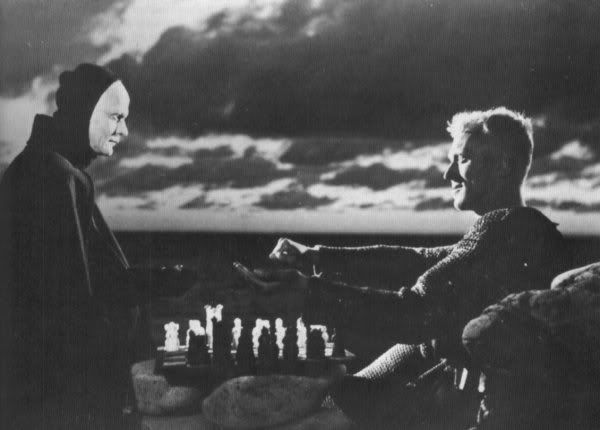
While, Schoenbergically speaking, this is going to be a tough row to hoe (or read), I admit I'm trying to think how I can use this in “The Lost Chord,” perhaps combining it with the chess game (which, admittedly, is with Death, not the Devil) from Bergman's “The Seventh Seal.” In this case, it would be during Tr'iTone's interrogation of Dr. Dick, which in addition will use my version of Abbott and Costello's “Who's on First” skit regarding the whereabouts of Yoda Leahy-Hu.

Thinking more of the film “Lt. Kizhe” than just Prokofiev's delightful music for it - a commenter at the Symphony Blog sent me this link to the original film – perhaps I should also include an almost true incident back when I worked for the orchestra either as assistant conductor or later as the personnel manager. A close friend, Vikki Moore, who'd been the personnel manager before I took over the job, and I used to joke about how we could easily confuse the conductor by inadvertently creating a musician with a well-placed typo, then wondering if we'd be able to bring it off in true Kizhean fashion.

There had been a concert, once, when the program and its personnel page had to go to print before we had decided upon hiring several key musicians after a series of auditions. So rather than leaving them blank, I decided I should make up some names figuring, you know, who would notice... Since this was a special fund-raising concert, though, and the theme was “The Orient Express,” I decided to go into Agatha Christie's wonderful mystery, “Murder on the Orient Express” and select seven different names for those players not yet hired. There were actually some people in the audience who noticed this and commented on it. I felt so much better, then, thinking the time it had taken to execute the idea (so to speak) was worth the extra effort.

- Dr. Dick

Tuesday, February 23, 2010

Schubert, Leverkühn & Me

Today was a blogging day: though I'd recently completed the last of the songs – “To Music” – for the cycle of seven songs about inspiration called “The Other Side of Air” and should be copying it instead, I ended up writing three posts today about Schubert's “Great C Major” Symphony over at the Harrisburg Symphony Blog:

Part 1 includes video footage of Karl Böhm conducting the Vienna Philharmonic in 1973 of the entire symphony in eight installments (clocking in at 51 minutes) – not my ideal performance, if I have one, but what I could find complete, courtesy of YouTube.

Part 2 covers some of the historical background of the symphony, how it fits in with the history of the form and with Schubert's development as a writer of symphonies.

Part 3 explores more personal issues around the composition of the Great C Major and Schubert's quest for a new, expanded musical language and sense of structure.

This is actually a continuation of a post written last week about Schubert's D Minor String Quartet, “The Death and the Maiden,” which became more tied in with the “Great C Major” posts than I was originally anticipating. In a sense, all four of them constitute something of a cycle.

*** ***** ******** ***** ***

Recently, I picked up my copy of Thomas Mann's “Doctor Faustus” again, a novel about a fictional composer supposedly modeled on Arnold Schoenberg, not at all to Schoenberg's liking, especially as the composer in question, Adrian Leverkühn, invented a system of composing very similar to Schoenberg's Method with 12 Tones but whose genius is also considered to be the result of syphilis and, if that weren't enough, a pact with the Devil.

The book is one of the greatest works in literature about compositional creativity and one of the few books by a non-musician that is not so totally cringe-worthy whenever it discusses the details of music, not that that didn't stop Schoenberg from pursuing a lawsuit against the author.

I'd first read it when I lived in New York City back in the late-70s, not a very good time for an insecure composer unsure of his future direction both aesthetically and professionally to be contemplating such a tale. It was difficult reading on any number of levels, not the least because much of my best reading time was on the subway: I had read much of Mann's “Magic Mountain” on the subway, too, and speaking of not good times to be reading something, found myself turning the page to start the climactic scene of Tolstoy's “Anna Karenina” while standing at the 101st Street Subway Station of the Broadway downtown train...

Once again, sometime in the early-90s, I thought I'd try reading it again but this time got bogged down in the turgid translation's style, the famous debate between the composer and the Devil (part of this is Mann's fault: he imagines it being written down by the composer as a parody of Martin Luther's didactic theological style). So I put it aside.

Then, in 1997, I bought the well-reviewed new translation by John E. Woods. It was becoming quite the thing to bring out new translations to replace the traditional (and often only) ones available to English readers of both Mann and the Russian writers like Tolstoy and Dostoievsky. In fact, over the past 12 years or so, I found myself collecting the new Pevear and Volokonsky translations of most of the Russian novels I'd already read, mostly in Constance Garnett's standard translations. Suddenly it dawned on me that the reason I could never tell the difference between Tolstoy's style and Dostoievsky's style was that Constance Garnett couldn't either: in fact, what I was reading was her style, not theirs.

Typical of my habits, I've purchased them as they came out but not necessarily read them, yet: “War and Peace,” yes (see my earlier post here about that experience), and Dostoievsky's “The Idiot” but not, so far, the others.

Also sitting on that “to-read (someday) pile” was Wood's translation of “Doctor Faustus.” I had gotten about 80 pages into it a few years ago and, for some reason, probably coinciding with a time I was trying to do some writing of my own, I put it aside.

So the other week, I saw it sitting there, again, its buttery gold cover making it look like an old parchment manuscript, inviting me into its parallel universe once again. I picked up where I left off and covered episodes I recalled as clearly as if I'd read them only months ago, not years – or, actually, decades ago, come to think of it.

One of my favorite passages is the long concert-lecture the young composer and his friend the narrator attend in their small, largely unmusical hometown, Kretzschmar's talk about Beethoven's Piano Sonata in C Minor, Op.111. Not too many summers ago, when I was doing a Gretna Music pre-concert talk for Jeremy Denk's performance of this work – paired wonderfully with Charles Ives' equally monumental “Emerson” Sonata – I didn't bother preparing my usual behind-the-scenes in-depth remarks: I simply read most of Thomas Mann's account of the work. It was one of the few times I can recall having everybody's attention...

Well, at any rate, the other night, I resumed reading after a few days' hiatus and found this passage near the beginning of Chapter XXI, following a letter from the composer, Adrian Leverkühn, about his enthusiasm for Chopin (I am reminded that next week is the 200th Anniversary of Chopin's birth) and about...

- - - - - - -
“...the conservatism of his mode of life, which often looked like rigidity and could appear somewhat oppressive to me. It was not for nothing that in his letter he had expressed sympathy for Chopin's not-wanting-to-know, his unadventuresomeness. He, too, wanted to know nothing, see nothing, indeed experience nothing, at least not in the manifest, external sense of the word; he was not interested in variety, new sense impressions, amusement, relaxation – and particularly when it came to relaxation, he like to make fun of people who are constantly relaxing, getting tanned and strong, though no one knows for what. 'Relaxation,' he said, 'is for people for whom it does no good.' He had little use for traveling in order to see something, absorb a new experience, 'educate' himself. He disdained pleasures of the eye and as sensitive as his hearing was, he had always had almost no desire to school his eye to forms in the visual arts. He approved of the differentiation made between eye-people and ear-people, claimed it to be incontrovertible, and counted himself definitely among the latter... True, Goethe also says that music is totally inborn, something within that needs no great nourishment from without, no experience drawn from life. But there is also an interior sight, a sense of vision that is different from and includes more than mere seeing.”
(... Thomas Mann: Doctor Faustus – translation by James E. Woods, published by Alfred A. Knopf, New York, 1997 – p.188.)
- - - - -

It surprised me to read this: it was like reading an encapsulated description of myself.

*** ***** ******** ***** ***

For me, at the moment, I am immersing myself in Schubert, not Chopin. Last week, as I wrote earlier, I was writing one of my up-close and personal posts (see also, here) posts, this one setting up Brooklyn Rider's impending performance of Schubert's String Quartet in D Minor, the “Death and the Maiden” Quartet. This week, it's been Schubert's final symphony, the “Great C Major” Symphony for this weekend's concerts with the Harrisburg Symphony. Rather than experiencing adventures and travels, I have been quite content to burrow into scores and biographies, cross-referencing dates and chronologies, placing compositions in context and in general ignoring the weather (among other realities) to consider imponderable issues like “where did Schubert's 'late-style' come from?”

How did a composer who could write such original and innovative songs like “Gretchen am Spinnrade” and “The Erl-King” when he was a teen-ager write such pleasant but derivative symphonies like his 5th and 6th Symphonies by the time he was 21, only to write four years later the B Minor Symphony we know as the “Unfinished”? And how could he not recognize the magnitude of what he'd accomplished and just put the work aside when the 3rd movement he'd started wasn't going in the right direction? How did all this lead to 'The Great C Major' only three years later? Never mind what else he might have written if hadn't died a two months short of his 32nd birthday after completing the String Quintet in C and the last three piano sonatas in a little over two months?

In between these two great symphonies – the only two of all he had started that have entered the repertoire as avowed masterpieces – he wrote the “Death and the Maiden” Quartet, part of a project, that spring of 1824, to evolve a more expansive style and write a 'grand symphony,' something on a larger scale than anyone (except Beethoven) had ever done before. Beethoven, a composer who Schubert thought, writing in his diary when he was 18, was so full of eccentricities as to be unnatural. What made him change his mind?

Here was a composer going through a “style change,” putting his youthful endeavors behind him and taking on the fearsome work of reinventing himself – and Schubert, one of the most insecure composers among the pantheon of great composers, dealing with the Unknown by plodding along, unaware he had created some of the greatest music ever composed (at least in my opinion) but never being deterred by the fact so few others even knew he existed. Wouldn't someone who'd be considered more... what, normal? - just have chucked it all or decided to write what people wanted in order to gain some acceptance, some recognition? Some form of income or at least acknowledgment to validate what he was doing?

In that sense – insecurity, yearning for validation and perhaps a thousand other fears – I identify with Schubert as well, though I am nearly twice his age, now, and have accomplished the tiniest fraction of what he composed in his short life, if one weighs it by mere quantity, never mind the quality.

No, I don't yearn to “write like Schubert” or even adopt his creative aesthetic, though his concept of reinventing himself, somehow, intrigues me, translated to my own style and times.

That is also what lies behind a lot of what I am reading, now, in Mann's “Faustus,” how this late-blooming composer is working to invent himself to make the transition from a young to a mature composer. At my age, of course, that's a little late, but then I had two decades where I did almost no composing and, worse, little thinking about composing. So I have a lot to get caught up with, which is why I normally describe myself as a “recovering composer.” It takes a lot of work and I'm still not sure I have it in me, much less the talent, to work my way through to the other side.

(I should also point out, unlike both Schubert and Leverkühn, I am not, to my knowledge, suffering from syphilis... Just thought I'd mention that.)

Yesterday, I read a bit of advice for would-be writers posted at the Guardian, the English newspaper's website, where Colm Tóibín suggests “if you have to read [something], cheer yourself up read[ing] biographies of writers who went insane.”

Right before that, he writes “Work in the morning, a short break for lunch, work in the afternoon and then watch the six o'clock news and then go back to work until bed-time. Before bed, listen to Schubert, preferably some songs.”

I just finished listening to one of Schubert's deliciously expansive piano sonatas, the one written before the last three. It's the Piano Sonata in G Major, D.874 – my recording, on the Sony label with Arkady Volodos. The little music-box of a trio in the 3rd Movement is enough to transport me beyond any world that includes Afghanistan, Sarah Palin or Health Care Reform in it. The last movement, if not the whole sonata, is one continuous smile. It is, however it was called into being, a small bit of magic that can be shared between a man who wrote it in 1826 and a man who is listening to it 184 years later.

But yes, tonight I think I will listen to some Schubert songs – probably not the end of “Die schöne Müllerin” (where the young lover commits suicide by drowning himself in the brook) or any of “Winterreise” (when I first heard “Der Leiermann,” the song cycle's desolate conclusion, I was so depressed I could barely function for days), but there are so many to choose from.

And then I will go back to reading about Adrian Leverkühn, Thomas Mann's would-be composer who invents his own original style, who will, eventually, die insane.

After all, what is a metaphor for?

- Dr. Dick

Tuesday, June 16, 2009

Bloomsday 2009

“Stately, plump Buck Mulligan came from the stairhead, bearing a bowl of lather on which a mirror and a razor lay crossed. A yellow dressinggown, ungirdled, was sustained gently behind him by the mild morning air. He held the bowl aloft and intoned:

-- Introibo ad altare Dei.”
- - - - -

And so began the original Bloomsday, June 16th, 1904. Today, it's being celebrated in Dublin in grand style, economy-be-damned:

- - - - -
"The annual literar
y hooley involves devoted Joyceans dressing in the fashions of 1904, eating the ‘inner organs of beasts and fowls,’ attending readings and celebrating at various venues and pubs mentioned in the book."
- - - - -

Every Bloomsday, I try to read a few more pages in my life-long bookcrawl through the 783 pages of my current edition of James Joyce’s epic novel, Ulysses, which describes a day in the life of Leopold Bloom and his travels through Dublin during the course of one spring day in 1904. Last Bloomsday, I made it to p.399 and then blogged about it here.

I’m not sure how far I’ll get today, but it is a good day for reading, cool and overcast. I'll pass on the dietary associations, though...

Below an uncredited portrait of the author are photos of a Dublin Celebration (during the Centennial celebration in 2004?), perhaps one of the largest bar-hops in the world, and a James Joyce re-enactor from 2003.

You can read Joyce's Ulysses on-line courtesy of the Gutenberg Project.

- Dr. Dick

Wednesday, December 31, 2008

On the 7th Day of Christmas: Unfinished Books

One of the frequently told jokes about George W. Bush, without getting into any further political commentary, deals with the fire in the presidential library that destroys both his books, especially sad considering he had not finished coloring the one. So it was with amazement and amusement (plus a feeling this was really satire) that I read this article in the Wall Street Journal by Karl Rove about the books he and the President had been reading.

Of course, you would expect a President not to have much time to do a lot of reading much less for one to tally up, say, 95 books. What??? George Bush reads???

Biographies of past presidents like Lincoln, LBJ and Andrew Jackson I could understand, and about popular figures like Babe Ruth and even Mark Twain, along with historical accounts of past wars, even to some extent novels by Michael Crichton or stories about detective Travis McGee by John D. MacDonald – but Albert Camus’ “The Stranger”?

So I feel totally humbled by the fact the President of the United States accomplished way more reading than I managed this year!

Though I like to read, I’m not one to find a lot of time to do so, especially when I’m composing. Then my reading time is usually late in the evening when I’m surrounded by cats who are determined to sit exactly where my eyes are trying to focus or I’m so brain-dead, I drift off easily into the Land of Nod. And this year, I’ve actually done a lot of composing. And nodding.

True, during November, when I was trying to write a novel, I didn’t spend any time reading except when I was doing what writer’s lamely call “research.” Otherwise, the writing style or subject matter you’re reading will find its way into what you’re writing. So during the month of November, I picked at things like, oh... something about the history and geography of Ohio (from the 1930s) called “The History and Geography of Ohio” because one of the settings was an imaginary town in southeastern Ohio in the 1950s... or paging through some 1800 pages of two volumes of a four-volume Mahler biography (I never found volume 1 and the fourth volume was published just this spring but cost $140... I bought the others at a close-out sale for $20 each) which actually did come in useful since there were a couple “composer inspiration” anecdotes that I could make use of for one of my main characters (especially the one about the laxative...).

But there were so many books this year that I picked up to read and for whatever reasons put down and never finished. Yeah, I managed to read a war-horse like Tolstoy’s “War & Peace” again, blogging voluminously about it, but since then I just haven’t settled into one I could ride all the way to the end.

Usually, after a Big Fat Book or something very serious and intellectual, I tend to pick up something of a more popular nature or some lighter fiction, though I’m not into what most people would consider “popular” fiction. But sometimes I’ve just found it difficult to make a commitment.

One book I did finish (and in a matter of just a few days) was P.D. James’ latest, “The Private Patient.” I’ve always been a fan of hers and have read all her published mysteries even though I would not consider myself a fan of mysteries in general. My mother read little beyond the category - but she would often read 1-3 books a week - so I’d gotten her turned on to P.D. James several years ago. For some people, her style would be a challenge but what got me interested in her was a critic’s description of her style being more like Henry James. Since Henry James is one of my favorites – I’ve read all his novels (except one which was not only no longer in print but not even in the library) and some 40-50 short stories in chronological order back in the ‘80s – starting to collect her books was a no-brainer.

But there was, oh... a New York Times best-seller that sounded intriguing until I got half-way through it - Michael Gruber’s “The Book of Air and Shadows” - when I realized Carlos Ruiz Zafon’s “The Shadow of the Wind” (one of the most enjoyable books I’ve read in a long time) did it much better. Next to it, there’s a copy of “Harry Potter and the Philosopher Stone” - in German: thinking the writing level might be comparable to what I had managed after a few years of high school and college German, it could be both entertaining and educational, but it turned out to be just one of several miscalculations I've made this past year.

The major “non-finish” so far is Kazuo Ishiguro’s “The Unconsoled.” There was a lot to like about the book – the style, the structure, the fact it’s about a classical musician – but there was a lot that was annoying about the main character, a concert pianist who’s in town for a big concert but who seems not to realize that for several days he has not done any practicing until he’s half-way through the book - and who cannot say no to anyone who imposes on his time and good nature. At first, its Escher-like setting-twists confused me but then that became fascinating – how he’d drive miles and miles out into the countryside to attend a reception and then, walking down a dark hallway, go through a door and find himself back in the lobby of his downtown hotel. The fact he has no first name, always referred to as Rider or Mr. Rider, adds an air of mystery but more mysterious is the apparent double-life he seems to be living – a stranger to this town, he appears to be married to the daughter of one of the hotel’s senior bell-hops - and he has a son though there is a great deal about this relationship he can’t quite remember. The occasional flash-backs to his own childhood make me wonder if it isn’t going to end up that the scenes with the woman and the boy are actually going to be about his parents and he is actually the boy. With all the other turns in the story reminding me of prints by Max Escher, it wouldn’t surprise me. And so I’ve felt like I should persevere and just keep reading. But once I put it aside for my novel-writing month, I’ve been unable to convince myself to pick it up again.

And yet if anything I’ve read is structurally intriguing and comparable to some of the things I’m working on musically – let’s call them “variations on traditional forms” – this should be a must!

I had gotten a number of books this past year which are still on my “to-read” shelf:

Sheldon M. Novick - “Henry James: The Young Master
Oliver Sacks - “Musicophilia” though since I haven’t done more than the first two essays, I could’ve waited for the paperback edition to come out
Jared Diamond - “Guns, Germs & SteelANDCollapse,” both
Daniel Pinchbeck - “2012: The Return of Quetzalcoatl
Doris Lessing - “The Golden Notebook” I bought it after it was announced she’d won the Nobel Prize for Literature last year but only read the opening chapter at the time
Francine Prose - “Reading Like a Writer” though it’s excellent to dip into for a few pages here or a few more there
Richard Powers - “The Goldbug Variations” which I’ve started twice but never get more than a few pages into it though I enjoy it (having gotten about 40 pages into another of Powers’ immense books, “The Time of Our Singing,” which I enjoyed not so much) – it’s probably more a time-commitment issue, especially after having downed “War & Peace” in a single stretch of several months
Ann Packer - “Songs without Words,” bought because of the musical title but after realizing it dealt a great deal with suicide, I figured I might wait till a more settled time in my life before breaking into this one
Mark Haddon - “A Spot of Bother” even though, waiting in line at the bookstore and reading the opening pages, it was about a man in a clothing store, buying a suit to attend the funeral of a friend who died suddenly of a heart attack, discovering what he assumes to be a cancerous lesion on his leg... as if I’m not already enough of a hypochondriac, worrying about every little change that could be dismissed as “you’re just getting older”
Randall Jarrell - “Pictures from an Institution” which could be inspiring or dangerous, considering how much of my own novel ambulates around the academic world
Virginia Woolf - “The Waves” speaking of structural wonders, I began reading this earlier in the year but had to put it aside for something else, whatever it was - definitely must get back to this

Part of the problem, no doubt, is this “to-read” shelf is beside my favorite “to-read” chair which is usually full of cats (see right) or, if not, will be as soon as I sit down. While it seems to hold three or four cats with no great sense of discomfort, it is completely impractical as a reading chair when I am joined by even two cats who want to spend quality time with me or, more likely, who want me to vacate the chair completely to them...

I suspect I will have more reading time on my hands, having just made arrangements for the first surgery in my life - fixing the pair of work-induced hernias now that the workman’s comp issues seem to be (please be more than only “seem to be”) cleared up - when I will have a few weeks’ recuperation time in February, just two months short of said hernia’s two-year anniversary. It’s very likely I won’t feel much like composing or writing then, so hopefully I can at least settle into a comfortable chair, cover my lap with something like a tray-table to keep the cats from jumping up on the incisions (ouch) and just read.

At the moment, I am wrapping up a year that began with Harold Kushner’s “Overcoming Life’s Disappointments” by reading David Sedaris’ latest collection, “When You Are Engulfed in Flames” which sounds like it should be, perhaps, its sequel, suitable to end the kind of year it’s been.

And I’m also reading Vicky Myron’s story of an orange tabby named “Dewey,” a stray cat who finds a home in a small town library in Iowa. My cats love it – especially the four orange tabbies who kept looking at me like “shouldn’t you be reading that aloud to us?” until I did. They didn’t care much for the bits about the author’s home-life or her growing up, but the part about Dewey checking out the library Christmas tree seemed to go over very well with them even if they found the scene where he ran tearing around the library chased by a plastic shopping bag he’d gotten entangled around his neck very scary (Charlie and Abel then proceeded to show me how this would be acted out in the movie version, but without the plastic bag – that could be added by special affects). It made me very glad I did not, as usual, have a Christmas tree of my own.

One of the things I’ve discovered is of the two birds/one stone variety. My mother had an exercise contraption in the living room, though she was reluctant to use it. It’s a treadmill but she was always afraid she’d get stuck on it when the controls would inexplicably increase to warp-speed and she’d be hanging on to it for dear life, hair and legs streaming out behind her... It’s like taking a stroll or going for a walk but it shouldn’t really be called a stroller or a walker, terms that show the symmetry of life’s stages whether you’ve met Benjamin Button or not. Calling it a treadmill sounds so industrial but after spending a few minutes on it, watching the squirrels feasting on birdseed on the porch, I do feel something like a hamster on a wheel but without the joy. If I try to read, however, I find I can go for 30-40 minutes before I realize I’m getting tired. Reading “War & Peace” on the treadmill was a third bird, I guess, incorporating weight lifting into the exercise regimen.

So that will probably be two new year’s resolutions – read more... on the treadmill.

- Dr. Dick

Friday, September 12, 2008

The Impact of "War and Peace": On Reading Tolstoy in the 21st Century

On my desk are three copies of Leo Tolstoy’s epic novel, War & Peace. It is considered one of the greatest novels of all times though the author himself argued it was not, in fact, a novel at all. I would tend to agree with him but lacking any better term to describe it, “novel” it remains.

My oldest copy, one my father purchased before I was born, is the “Inner Sanctum Edition,” using the translation by Louise and Aylmer Maude originally published in the 1920s with a preface, here, dated 1942 (1351 pages). I have read this copy twice, starting it the first time during the summer between 5th and 6th grades during the Eisenhower years (I was a precocious little twit); the second time, while a graduate student at Eastman during the Viet-Nam War.

The other two copies, each weighing in at four pounds, are more recent purchases of my own: Anthony Briggs’ translation (at 1358 pages) came out in 2006; and the one by Richard Pevear and Larissa Volokhonsky (a.k.a. P/V), was new as of the fall of 2007 (at a mere 1215 pages), just a month or so after I bought the Briggs. I had made up my mind, for some reason, that it was time to read it again, and now I had two choices.

I began the P/V translation some time in mid-May. Curled up in a chair on a rainy day surrounded by sleeping cats, I managed to finish it on September 6th, the eve of the 196th Anniversary of the Battle of Borodino which forms the climax of War & Peace.

Without getting into a comparison of the translations, at this point, I would certainly recommend this edition to anyone approaching the novel for the first time. Be warned: Tolstoy includes a great deal of French in his original and while most other editions translate the French as well, P/V have followed Tolstoy’s own example by using footnotes for the translation. At first I found this bothersome, constantly glancing back and forth from the text down to the bottom of the page, especially when English (therefore originally Russian) phrases are interspersed within the French. But you begin to see a reason for this: historically, most of the aristocracy (the main characters of the novel) spoke French because it was felt Russian itself was too low class for their cosmopolitan viewpoint. During the course of the war, Tolstoy relates, several characters hired tutors to learn how to speak Russian. At parties, guests fined each other for speaking French in public. While it helped the occupying French forces to identify members of the nobility, it also allowed one of them, wearing a captured French uniform, to infiltrate a French army camp and gather information that helped the Russian partisans in the next day’s battle.

Some writers have said Tolstoy used French when the conversation was more superficial. As the book progresses, there is less and less of it. What that says, though, about the main character Pierre Bezukhov (who is always referred to by his French name rather than Pyotr Kirilovich), I'm not sure.

If the translator's intent was to capture Tolstoy's style as close to the original as a translator could get, then I was willing to put up with it. But I'll save that for a later post: this one is about my reactions to the novel after reading this translation.

The last 35 pages may have been the hardest schlog I’ve ever had to finish a book but having gotten that far, I wasn’t about to give up. It probably took me longer to read those seemingly soporific 35 pages than it did to plow through the previous 300: I kept putting off picking up the book to continue reading. And yet, they proved to be some of the most thought-provoking pages in the entire book, placing a great deal of it in perspective.

*** ***** ******** ***** ***

Whatever possessed me to pick up my dad’s copy of War & Peace the summer of 1960, I have no idea. I spent many hours sitting on the back porch – the same porch I sat on while reading it again this summer – untangling its 500 characters, many of whom could be called by any number of variations on their names (Prince Andrei Bolkonsky could be Andrei Nikolaievich or Andryusha; or in French, André), several of them, like Marya Dmitrievna Akhrosimova, were mouthfuls for any American used to reading books whose heroes were named Ed.

Whatever else I may have gotten out of it at that time, I recalled it mostly as a book about War with its vivid battle scenes and about Peace with its brilliant images of Imperial Russian Society. I’m sure I skimmed through the philosophical essays on history and the nature of power, chapters that usually preceded the battle scenes. A book this long even had two epilogues: that first time through, though, I didn’t bother to read either of them, just paging through them to figure out who survived and who married whom and skipping over yet more philosophy (I was in 6th grade, cut me a break).

Not long afterwards, I found a recording of Prokofiev’s opera, War & Peace, and realized how much he had to cut out of the novel to make it work on the stage. It wasn’t until this last time through that I realized the scene which actually opens Prokofiev’s opera began on page 421!

I felt less guilty about skipping the philosophical ruminations on history, then: neither narrative nor essential to what passes for a plot, they’d ended up on the cutting room floor for both the opera and the two film versions I later saw based on the novel. I found out later there were even editions of the book that deleted those chapters, moving them to the back in an easily avoided appendix.

And what is the plot of this novel? A novel should have a plot, shouldn’t it? It’s a historical novel in that it takes place around historical events and many characters – like Napoleon and the Russian general Kutuzov – were historical figures. How does one reduce everything in this book to a 50-words-or-less summary?

It’s about... hmmm... Napoleon’s invasion of Russia in 1812 and its impact on Russian life, especially as seen by several members of three fictional families: Count Pierre Bezukhov and his friend Prince Andrei Bolkonsky who falls in love with young Natasha, the daughter of Count Ilya Rostov whose son Nikolai figures as another major character. In the end, Moscow is burned, the French retreat and Russia is saved.

At 65 words, that only sets the stage for scratching the surface.

(One night, Johnny Carson mentioned on The Tonight Show he had seen the TV Guide listing for a film based on Tolstoy’s War & Peace, the stereotypical door-stop of a Great Book. He cited their infamous telescoping of movie plots: “A man goes to visit his sister.”)

*** ***** ******** ***** ***

Then, re-reading it during the Viet-Nam war, I paid more attention to the historical essays and was surprised to find out, really, how much of an anti-war book it actually was. Tolstoy goes into great detail describing the anticipation of battle among the young men who are fighting, eager for glory, but now I found more telling the pages describing their fears and doubts about going into battle, the realization they could be killed at any moment, the impact the deaths of their fellow soldiers had on them, the long description of Prince Andrei lying wounded first on the battlefield at Austerlitz in 1805 and then again at the climactic scene of the Battle of Borodino (the battle that inspired Tchaikovsky’s “1812 Overture”).
This battle involved some 250,000 men and ended with about 72,000 men dead on the field. Napoleon entered Russia with a Grand Army of some 442,000 men; by the end of the retreat, only 10,000 crossed back into Poland, the rest either dead, taken prisoner or deserting.

But I still didn’t bother to read the Epilogues. I don’t know why: after 1250 pages, what’s another 101?

This time around, with the new P/V translation, I discovered a lot more irony and sarcasm in the book, with quips like this buried in the text:

— ----- -------- ----- ---
After being freed from captivity, [Pierre] arrived in Orel, and on the third day after his arrival, as he was about to go to Kiev, he fell ill and spent three months lying ill in Orel; he had, as the doctors put it, “bilious fever.” Though the doctors treated him, let his blood, and gave him medications to drink, he nevertheless recovered.
Tolstoy, War & Peace (Richard Pevear & Larissa Volokhonsky’s translation, Alfred A. Knopf 2007, p.1102)
— ----- -------- ----- —

There are also passages which, with only slight adjustments for the century and the military technology involved, could’ve been coming out of the Pentagon today: the various spins given to how something supposedly failed could be hailed as a victory; the petty rivalries and lack of communication between generals; or this pungent sample of the Russian attitudes toward their former allies (for Tolstoy’s Prussians, think Bush’s French):

— ----- -------- ----- —
'The enemy of the human race' [Napoleon], as you know, is attacking the Prussians. The Prussians are our faithful allies who have betrayed us only three times in three years. We take up their cause. But it turns out that the enemy of the human race pays no heed to our fine speeches and in his savage and impolite manner falls upon the Prussians without giving them time to finish the parade they’ve begun, beats the stuffing out of them in two seconds, and installs himself in the palace at Potsdam.
- Tolstoy, War & Peace (ibid. p.372)
— ----- -------- ----- ---

In the first Epilogue, he describes the era of almost constant warfare with Napoleon at its center:

— ----- -------- ----- —
During this twenty-year period of time an enormous number of fields go unplowed; houses are burned; trade changes direction; millions of people become poor, become rich, migrate; and millions of Christians, who profess the law of love of their neighbor, kill each other.
- Tolstoy, War & Peace (ibid, p.1180).
— ----- -------- ----- ---

The book’s first extended essay on history, a preface to Napoleon’s invasion – the first chapter of Volume III (this link will take you to the corresponding chapter in Louise & Aylmer Maude’s translation) – is not about historical events but theorizing about the causes of historical events: why did Napoleon invade Russia? Why did the Russians abandon Moscow? Unlike our present-day wars which began with the attacks on September 11th, 2001, there was no single incident that ignited the French Invasion of 1812, no easy explanation that makes any kind of sense. Two brief paragraphs (as usual, from the P/V translation) clearly take you beyond this particular war at this particular time in history:

— ----- -------- ----- —
Fatalism in history is inevitable for the explanation of senseless phenomena (that is, those whose sense we do not understand). The more we try to explain sensibly these phenomena of history, the more senseless and incomprehensible they become for us.
- Tolstoy, War & Peace (ibid, p.605).

... When an apple ripens and falls – what makes it fall? Is it that it is attracted to the ground, is it that the stem withers, is it that the sun has dried it up, that it has grown heavier, that the wind shakes it, that the boy standing underneath wants to eat it?
Tolstoy, War & Peace (ibid, p.606).
— ----- -------- ----- —

He is constantly asking questions which then you begin to apply to more recent wars. We’ve learned in our history classes that World War I started because a terrorist from a small country killed the heir to the throne of a major power. We know that World War II began when Hitler invaded Poland. But what caused the terrorist to kill the Austrian archduke? If the answer is national pride, what led to this situation which then resulted in the assassination at Sarajevo that led to “the war [that unfortunately did not] end all wars”? What earlier decisions and events led to Hitler’s decision to invade Poland? What role did the Sudetenland in Czechoslovakia play, with its sense of appeasement from the West, or the Anschluss of Austria? Then, too, how did American troops end up in Viet-Nam?

Perhaps the attacks on September 11th are not the real cause of today’s wars in Afghanistan and Iraq?

And more recently, how does this compare to the Russian invasion of the small republic of Georgia and its apparent attempt to absorb (or free) the break-away areas of Abkhazia and Southern Ossetia? Are we playing out these same “causes” for a future war (hot or cold) by professing a belief that Georgia should become a member of NATO which would then require the West to go to war with Russia to protect our ally from future aggression because that is what treaties do? Are we living in a time comparable to the summer of 1812 when, much to their surprise, the Russians found thousands of French troops inexplicably crossing their borders?

So, this third time through the novel, now influenced by a different time and having reached a different age, I’m feeling the impact of the book on a different level. Now, rather than being fascinated by the historical panorama of Napoleon’s Invasion and absorbed by the characters in Tolstoy’s fictional account of life in Russia at that time, I find myself thinking about this philosophical approach to the causes of history far beyond the era he describes. Though at times tedious reading (like this blog-post) compared to the swiftly moving accounts of battles or the emotionally riveting story-telling of the lives of Pierre Buzukhov, Prince Andrei and Natasha Rostov, I’m finding this the crux of my reaction to what I’d been reading. But many people engaged in the novel-like aspects of the book find these interpolated essays to be intrusive, boring digressions.

— ----- -------- ----- ---
The totality of causes of phenomena is inaccessible to the human mind. But the need to seek causes has been put into the soul of man. And the human mind, without grasping in their countlessness and complexity the conditions of phenomena, of which each separately may appear as a cause, takes hold of the first, most comprehensible approximation and says: here is the cause. In historical events (where the subject of observation is the actions of people), the most primordial approximations appears as the will of the gods, then as the will of those people who stand in the most conspicuous historical place – the historical heroes.
- Tolstoy, War & Peace (ibid, p.987).
— ----- -------- ----- ---

Throughout the book, the historical figures of Napoleon and the old Russian general Kutuzov (left) might be perceived as adversaries if it weren’t for the fact that Kutuzov is a kindly, bumbling old man who is viewed by everyone as the Wrong Man, compared to the self-assured, god-like Napoleon, the military genius. What explains the fact that Napoleon ruined his own army by taking Moscow, not because of any strategic plan on Kutuzov’s part and not in any battle but simply by being in the Wrong Place. The standard adage is that Napoleon was defeated by the Russian Winter, thousands of miles from home, without direct supply lines and encamped in a city set on fire – by whom? the Russians themselves in a patriot sacrifice or by the bivouacing French who, not aware they are in a city built primarily of wood, lit fires to cook their meals? – which means, without support and sustenance, they can only retreat. In their haste, thousands more men are lost to disease and the inhospitable conditions of the weather than through military action but also, as Tolstoy points out constantly (with a sharp sense of ironic wit), the total incompetence of the generals on both sides: there was no way the generals could control a mass of men driven by panic; there was no way the Russian generals could destroy them in battle because they couldn’t agree on a plan, did not have the technology to arrange their troops in the Right Place in time to do anything more than harry the already retreating French.

We learned in our history classes that American soldiers won the Revolution because the British soldiers could not understand guerilla warfare, offended that the enemy would not meet them on the open playing fields of War the way the art of warfare required. Marching like a parade through the forests, they were picked off one by one by snipers hiding behind the bushes.

The same thing happened to the French: at one point, Napoleon complains to Kutuzov that he is not playing by the rules (“as if,” Tolstoy adds parenthetically, “there are certain rules for killing people”). Several scenes, following the climactic burning of Moscow, show small bands of Russian troops, operating without anything like Central Command, following the demoralized French and nipping at their heels. (This reminded me of a long scene in which the Rostov family, one peaceful winter, goes hunting a wolf, Tolstoy spending pages describing how the dogs are deployed and what will happen when someone approaches the wolf from this direction and so on.) The French generals, unable to muster the troops to fight a single battle, do not know how to combat the mosquito-like partisan guerillas which only made the panic worse.

In Iraq and Afghanistan, American troops, now aided by the more advanced techniques of modern warfare, find it difficult to adapt to an Insurgency who uses not standard military tactics and technologies but, to us, morally incomprehensible suicide bombers to create terror among the troops and the civilian population. Without a government to fight, the United States is at a loss how to deal with the partisan geurillas which only makes the panic worse.

— ----- -------- ----- ---
All the ancient historians used one and the same method to describe and grasp the seemingly ungraspable – the life of a people. They described the activity of individual men who ruled the people; and this activity expressed for them the activity of the whole people. To the questions of how individual men made peoples act according to their will and what governed the will of these men themselves, the ancients answered the first question by recognizing the will of a divinity who subjected peoples to the will of one chosen man, and the second by recognizing that the same deity guided the will of the chosen one towards a predestined goal. For the ancients, these questions were decided by faith in the direct participation of a divinity in the affairs of mankind. Modern history, in its theory, has rejected both of these propositions.
Tolstoy, War & Peace (ibid, p.1179).
— ----- -------- ----- —

That was Tolstoy writing in the 1860s, belittling the attitude that such-and-such happened because of divine intervention or because it was God’s Will, otherwise inexplicable.

And yet today, viewpoints are expressed by government officials or those who would lead the government, that the War in Iraq is part of God’s Plan when vice-presidential candidate Sarah Palin, as Governor of Alaska, said this:

"Pray for our military men and women who are striving to do what is right. Also, for this country, that our leaders, our national leaders, are sending [U.S. soldiers] out on a task that is from God. That's what we have to make sure that we're praying for, that there is a plan and that plan is God's will."

A former colleague of mine suggested earlier this year that a new “slogan” for public broadcasting could be “We tell you the truth.” My first reaction was “Who’s Truth?”

Tolstoy writes, in the second epilogue, about the definition of Power and asks the question “What force moves peoples?”

— ----- -------- ----- —
One historian insists that the event was produced by the power of Napoleon; another insists that it was produced by the power of Alexander [the Russian Emperor]; a third by the power of some third person. Besides that, historians of this sort contradict one another even in explaining that force on which the power of one and the same person is based. Thiers, a Bonapartist, says that Napoleon’s power was based on his virtue and genius; Lanfrey, a republican [in the 19th Century European, non-monarchist sense of the word], says it was based on his swindling and on duping the people. So that historians of this sort, by mutually demolishing each other’s propositions, thereby demolish the concept of the force that produces events and give no answer to the essential question of history.
Tolstoy, War & Peace (ibid, p.1182-1183).
— ----- -------- ----- —

Today, voters who place themselves on the Right feel that those on the Left are on the Wrong Side of Truth. And vice-versa.

A friend just last night complained to me about the distortions being made of the political positions of his party and said “WE don’t do that – do we?” But, I told him, look at it from the standpoint of the other side, and it would appear it happens on both sides: you may not see it because it is what you believe. This is why we have sectarian wars and why agreements will never be reached by opposing sides who continue to distrust each other or feel that one is superior to the other. But that is an extension of the topic beyond the scope of my thoughts on Tolstoy, even though with his final pages still relatively fresh in my mind, it affects my thinking on these other issues as well.

And what is “the essential question of history”? Ten pages later, Tolstoy writes:

— ----- -------- ----- —
What is the cause of historical events? Power. What is power? Power is the sum total of wills transferred to one person. On what condition are the wills of the masses transferred to one person? On condition that the person express the will of the whole people. That is, power is power. That is, power is a word the meaning of which we do not understand.
- Tolstoy, War & Peace (ibid, p.1193).
— ----- -------- ----- —

Thinking abstractly, historians develop a science of history that seeks to produce laws that can be comprehended with the same acceptable assurance as the law of gravity.

— ----- -------- ----- —
Reason expresses the laws of necessity. Consciousness expresses the essence of freedom.

Freedom, not limited by anything, is the essence of life in the consciousness of man. Necessity without content is man’s reason with its three forms.

Freedom is that which is examined. Necessity is that which examines. Freedom is content. Necessity is form.

Only by the separation of the two sources of cognition, which are related to each other as form to content, do we get the distinct, mutually exclusive, and unfathomable concepts of freedom and necessity.


Only by their union do we get a clear picture of the life of man.

Outside these two concepts, mutually defining in their union as form and content, no picture of life is possible.

- Tolstoy, War & Peace (ibid, p.1210).
— ----- -------- ----- ---

And here, in a way, is not just a scientific or philosophical approach to history but also to art, another important aspect of civilization, to defining a culture and one equally as baffling to define. As I sat back and thought how these ideas apply to the music I listen to or the music I compose, it also occurred to me this is the thread that binds together this whole “baggy monster,” as Henry James described the novel.

Tolstoy applies these issues to what happens to, what motivates, and what challenges his fictional characters just as much as he applies it to the historical figures and events. It is behind the arguments, expressed or otherwise, between Pierre who is always searching for meaning in his life (a man who lives more content than form) and the more self-assured Prince Andrei who tries to find ways to express himself within his role in society as an aristocrat and a soldier (decidedly, living form over content).

Curiously, as Tolstoy himself writes, these two major characters were patterned after different aspects of his own nature – the struggle, perhaps, we might express today as Right Brain versus Left Brain without ascribing it to any political principles – just as he based Andrei’s father, the Old Prince, on his own maternal grandfather, a character who is practically all form with a limited range of content that is decidedly out-moded.

Natasha, who clearly has no intellectual depth, living purely for the social life she seems to be destined for, understands neither Andrei (whom she had been engaged to) nor Pierre (whom she eventually marries). Her life, with all of its complications, is affected by what might seem fate, by a series of poorly made decisions (what caused her to give up Andrei to suddenly run off with the dashing Anatole Kuragin?) and the surface impressions of the social whirl her family lives in, a different level of content restricted by specific forms, clearly acceptable or not acceptable, and for which she, in her own responses, pays the consequences.

By applying these concepts of history not just to his interpretation of historical events and characters but to his fictional characters as well, Tolstoy creates a “picture of a life” that resonates in today’s world despite its backdrop. It is why, perhaps, there are no answers, only more questions by the end of the book – if this is not The Cause, what then caused that event? – and why the book transcends the idea of merely telling a story.

When Natasha becomes engaged to Prince Andrei, she cannot understand why he must “go abroad” for a year, on his father’s orders. It is her illogical decision to elope with the worthless cad Kuragin just a month before Andrei returns that changes her life. After the Battle of Borodino and the burning of Moscow, Natasha nursed the wounded Andrei and sat by his side as he died, then later discovered the love for Pierre who had just been, before all this, a family friend, though this too, of course, is more complicated than just what it seems on the surface. Before the novel proper ends (before the epilogues), before Pierre has proposed to Natasha, he decides for some unexplained reason to leave Moscow and go to Petersburg: Natasha, hoping for a happily married life without any further delays, perhaps sees a replay of the separation she had after her engagement to Andrei. In the final paragraph, she is talking to Prince Andrei’s sister, Princess Marya:

— ----- -------- ----- ---
“Only what is he going to Petersburg for!” Natasha said suddenly, and hastily answered herself: “No, no, it has to be so... Right, Marie? It has to be so...”
- Tolstoy, War & Peace (ibid p.1125)
— ----- -------- ----- ---

The first epilogue takes place seven years later: Pierre and Natasha have by then married and are raising their children. Prince Andrei’s sister Marya married Natasha’s brother, Nikolai Rostov, bringing all three major families together neatly at the end (or after the end) of the novel.

There is one character very much on the sidelines of everything and paid little attention to: Prince Andrei’s son by his first wife (she dies in childbirth just as Andrei returns from the War of 1805, having been given up for dead after the Battle of Austerlitz). Named after his stern grandfather, the Old Prince, Nikolenka (or Little Nicholas) does very little during his time on the page: he is born, he is ill, he is taught by a Swiss tutor, he is raised by his Aunt Marya in the general absence of his father and watches his father as he dies of his wounds. In the epilogue, now 15, Nikolenka is fascinated by his father’s friend, Pierre Bezukhov, and hangs on his every word, an influence that Nikolai Rostov (his uncle) thinks is unhealthy. Rostov and Pierre have a discussion about politics that make Rostov uncomfortable realizing Pierre is, shall we say, a Liberal and potentially dangerous to his thoughts about the Imperial Government. Sitting in the shadows of the room, Nikolenka absorbs all this; then, chastised by Uncle Nikolai for having been there at all, goes to bed. Waking up from a bad dream involving his disapproving uncle, he recalls the image of his protective father, a father he hardly knew:

— ----- -------- ----- ---
“Father,” he thought. “Father” (though there were two portraits of a good likeness in the house, Nikolenka never pictured Price Andrei in his human image) “father was with me and caressed me. He approved of me, he approved of Uncle Pierre. Whatever he says – I’ll do....” [Reflecting on the men he’s read about in Plutarch during his lessons, he decides to do the same kinds of things.] “I’ll do better. Everybody will know me, love me, admire me.”... ...”But Uncle Pierre! Oh, what a wonderful man! And father? Father! Father! Yes, I’ll do something that even he would be pleased with...”
- Tolstoy, War & Peace (ibid, p.1178).
— ----- -------- ----- ---

When the idea for the novel first came to Tolstoy, it was going to be about the Decembrist Uprising in 1825, following the death of Emperor Alexander I. But he decided, instead, to start earlier. The novel began to appear in magazine installments under the title “1805.” Only later did it become known as “War and Peace.”

But after reading the first 600 pages and realizing this is only a preface to the events at the heart of the book – the Napoleonic Invasion of 1812 – you begin to realize, in looking for the answer to “What caused Napoleon to invade Russia?”, Tolstoy is going back to find various possibilities from various events of the previous seven years (again, the number seven), events that are the repercussions of the French Revolution and leaving implicit the question “what caused the French Revolution?”

And here, at the end, Tolstoy implies the future: will Pierre with his liberal political views become involved in the Decembrist Uprising ten years later and will Nikolenka grow up with dreams of becoming a Great Man – perhaps a man with power – and will he follow Uncle Pierre into the fray?

So the question of “what caused the Decembrist Uprising” may be tied up in the ideas of a boy trying to emulate his father whose life was changed by the Invasion of 1812 which was caused by... and so on and so forth.

The War in Iraq (2003 and on-going) – after a quick and apparently easy invasion toppling the dictator Saddam Hussein but not finding the elusive “weapons of mass destruction” – was the response, rightly or wrongly, to the attacks of September 11th, 2001, masterminded by al-Qaida terrorists led by Osama bin Laden (remember him?) who devoted himself to the destruction of the United States because of its too influential presence in Saudi Arabia whose government was put in place by colonialist powers looking for political stability in the region early in the 20th Century.

As the War on Terror began, the American public wasn’t told to make sacrifices like earlier generations did in World War II and before: we were told to go shopping, to prove to the evil-doers that everything was normal here, to keep the economy strong and not give in to fear.

And yet people have wondered how, during the course of events, the Russian aristocracy could continue going to fancy-dress balls and party the night away when French troops were massing along their border.

The American Army, after the initial shock-and-awe leading up to their arrival in Baghdad – miles away from the purported villain who caused the attacks on September 11th – finds itself five years after “mission accomplished” mired down in inhospitable terrain much as the French found themselves in Moscow, achieving a goal they didn’t understand and, once attained, didn’t know what to do with.

And questions remain unanswered. Or unanswerable.

As Tolstoy wrote 140 years ago,

— ----- -------- ----- ---
...[M]odern history is like a deaf man, answering questions that no one has asked him.
- Tolstoy, War & Peace (ibid, p.1182).


*** ***** ******** ***** ***
All quotations from Tolstoy’s War & Peace are taken from the Knopf edition of Richard Pevear and Larissa Volokhonsky’s translation, published in 2007.

Illustration credits:
Top: uncredited portrait of Count Lev Nikolaievich Tolstoy, painted in 1868 at the time he was completing the novel, War & Peace.
2nd from Top: Napoleon observing the Battle of Borodino, painted in 1897 by Vasily Vereshchagin.
3rd from Top: The Raevsky Battery during the Battle of Borodino, part of a panorama painted in 1911-1912 for the Centennial Celebration of the Battle by Franz Alekseivich Roubaud
4th from Top: General Kutuzov, commander of the Russian Army, at Borodino (an uncredited, undated painting).
Bottom: Napoleons Retreat from Moscow, by German painter Adolf Northen (d.1876).