Wednesday, April 28, 2010

The Lost Chord: Red Herrings in Verdi Square

In the pursuit of almost any solution, there are always several possibilities how you could arrive at one – clues that might lead you closer to it or, if misinterpreted or incorrectly realized, further away from it.

While I could describe ways of approaching certain political goals at the present time – whether it's health care, the environment, the economy, greed on Wall Street or the Wars on Terrorism – I'm thinking specifically of my Music Appreciation Thriller, “The Lost Chord” which is a full-scale parody of Dan Brown's “The Lost Symbol” (if anybody still remembers that one, it would seem to have fallen off the face of the earth, compared to the roaring success of its predecessor, “The DaVinci Code” which I parodied in my earlier “The Schoenberg Code”).

Aside from the question “Why write a parody of a book that has already slipped below the cultural horizon,” I was still dealing with ways of translating Brown's myriad clues into musical equivalents in the pursuit of... well, whatever it was that sparked “The Lost Symbol” in the first place: truth, beauty and the Masonic Way? Only in my case, instead of Masons, I'm dealing with musicians – composers, especially – and rather than the perversion of knowledge and wisdom in the wrong hands, the attainment of creative enlightenment and its perversion in the wrong hands. In other words, truth, beauty and the artist's way.

While Aaron Copland had spoken of a composer seeing the piece he's going to write “whole, in a flash” or something to that effect – whether it was his belief or he was stating it as one possible belief, I don't recall, nor, foot-notally speaking, do I remember exactly where this came from (“What to Listen For in Music”?) – I also thought of Elliott Carter's ideas on inspiration. In an interview with John Tusa in his “On Creativity: Interviews Exploring the Process,” Carter told him

- - - - -
“if there is inspiration, it's not something [for me] that comes at the beginning of the piece. It comes in the course of writing it. The more I get into the piece, the more the inspiration – well, I don't know exactly what inspiration means – but I would see more clearly and with more excitement and more interest new things...”
- - - - -

And so, writing “The Lost Chord” has been a similar kind of process. I began without knowing exactly (and in many cases, not even approximately) how I would translate all of Brown's clues or the details of his plot into something musical that I could use in mine. But as the work unfolded and I thought about where something was leading (or not), there came to me various ideas that I would check out, follow, discard or expand on.

Sometimes, this whole process has amazed me – and yet, I'm the one writing it! How often this happens in the music I compose is one thing (there, it seems second nature to me) but the amount of creative serendipitousness in writing this novel has been surprising.

Of course, I'm following Brown's story very carefully – this is a very literal parody, even down to certain lines (for instance, Brown begins one chapter, when a character trips over a wire and goes flying, “Katherine Solomon knew she was falling... but she couldn't figure out why.” I begin the parallel segment, where my character falls through a trap door into the basement below, “LauraLynn Sullivan figured out she was falling... but didn't know why.”) – so the problem is not coming up with plot details, though I find many times it's a limitation or what might be called a “creative constraint.”

(In one sense, saying I'm composing in a serial style with such-and-such a 12-tone row is considered a “creative constraint.” So, for that matter, is saying “I'm writing in a tonal style in D Major,” but never mind that for now.)

The problem is finding these “musical equivalents.”

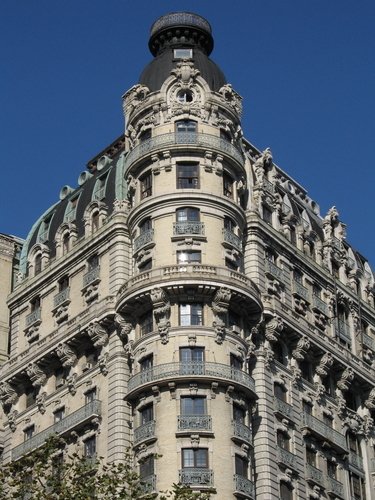
The other day, I posted a segment of a scene that takes place in Verdi Square, an actual location in Manhattan (see photo, left, looking toward the Ansonia Hotel at 73rd & Broadway). It parallels the stake-out scene in Brown's Chapters #93, #97 and #99 that takes place in Franklin Square, an actual location in Washington D.C. Now, in Brown, the address “8 Franklin Square” becomes a clue, though tracking down the location is a red herring since the actual reference is to an 8x8 Magic Square devised by Benjamin Franklin – finding that permits one to reassemble the diagram broken into 64 different little squares into something that becomes more of a metaphorical map.

Though it was wonderful to be able to include my parody of Abbott & Costello's “Who's on First?” with Yoda Leahy-Hu and her ICA agents in this scene, the actual role of Verdi Square was still a sticking point – or a point that had me stuck for ideas. Where to go from here?

I had no number prefacing Verdi to create something like an address. I didn't want my red herring to be as literal as the Brown herring. But what was the point of having the scene at Verdi Square if it didn't have a more effective role in reaching (or obscuring) the actual solution?

Instead of writing out “Verdi Square” as Brown did with Franklin, I had decided to make the clue an outline of a box with the name “VERDI” inscribed inside. At the lower right hand corner were the words, “Falstaff enters here.”

So far, I had figured my final clue – the answer to Brown's diagram on p.373 in Chapter 101 – would be a similar kind of matrix that needs to be “re-ordered” to discover its meaning, or at least get you one step closer to its possible meaning.

Serial composers – that is, those who write music based on Schoenberg's “system of composing with twelve tones” – use a 12x12 matrix or magic square where the 12 notes of the “row” (or source set for the piece's melodic and harmonic material) can be plotted in the “original” format (across the top, left to right) or in the “inversion” (down the side, top to bottom), which also allows you to follow the “retrograde” or “retrograde inversion” of these forms by following the “row” or column in the opposite direction.

But the connection of Verdi with a serial 12x12 matrix was more than a stretch. Verdi was not only not a serial composer, it would be difficult to imagine he even influenced a serial composer. I tried creating a matrix out of the “Enigmatic Scale” he used for the “Ave Maria” in the Four Sacred Pieces written at the end of his career, but that was only seven notes and led nowhere.

And then I remembered how Georges Perec built his novel “Life: A User's Manual” on the Knight's Tour, a classic chess puzzle: how do you get a knight with its L-shaped pattern to move across the chess-board and eventually hit every single square once and only once? In fact, I had already used this idea in setting up the structure for the different segments of another novel I had started (finally) to write in November of 2008 called “Echoes in and out of Time.”

Now, a chess board is an 8x8 square. Perec's square was 10x10 as was the one I used for “Echoes.” How could I construct one that was 12x12? Not only did I find a bunch I could model mine on, by several permutations I was able to get the knight to begin in the lower right-hand corner, just where I wanted Falstaff to enter. Where it landed 144 moves later, ending its gambit, would be a critical point in interpreting the final arrangement of the individual squares of the pictogram. Whatever would be on that square would essentially be the destination of this “map.” (That, I've already figured out but I don't want to give it away, you know, not just yet...)

Okay, so Verdi wrote an opera called “Falstaff,” about Shakespeare's fat knight from “The Merry Wives of Windsor.” That gives me the clue that the knight begins his “tour” on that particular square: the lower right-hand corner.

But the stake-out scene involves telling the villain Tr'iTone that he must enter Verdi Square at the southeast entrance. There are expectations perhaps for a scene like the one at Herne's Oak in Verdi's final scene.

While another clue – a limerick written out in mock-Greek – mentions Dante, the Fifth Circle (presumably of Dante's Inferno) and an entrance guarded by an immobile spider, most of this clue is ignored in typical red herring fashion. Buzz Blogster, for instance, is convinced it will lead to Shelob's Lair which means it's guarding the Two Towers as in Tolkein's “Lord of the Rings,” but alas New York City's two towers were destroyed on September 11th, 2001.

Supposedly saner heads overlook Dante and the Circle as well but suppose there must be a stone (immobile) spider on the base of the Verdi monument in Verdi Square (presumably near the carving of the character Falstaff) that will, like a secret entranceway, open to reveal the portal leading to the location of the “old secrets” (the equivalent of Brown's masonic “Ancient Mysteries” that sets “The Lost Symbol” in motion).

Two things happened in my trying to squirm my way out of this one.

One was I still lacked the prologue which introduces an important statement that comes back in one of the final chapters: Brown's villain, Ma'lakh, tells us “the important thing is to know how to die.” How would this work for a musician trying to achieve the ultimate in Creative Insight? Suddenly – literally an “aha!” moment – I was writing a line about a suffering artist when it occurred to me: Tr'iTone intones “the important thing is to know how to suffer [for one's art].”

The second thing was a parallel discovery to anything that might enhance my location at Verdi Square.

When I lived in New York City in the late-70s, Verdi Square was not a place you'd want to hang out. It was known better as “Needle Park” for its heavy drug traffic. In fact, I'm not even sure I knew it was named after Verdi and I never once saw the statue to Verdi that had been erected there in 1906 the whole time I lived there, walking through that neighborhood or using the 72nd Street subway station. Given that lack of awareness of the area, how would I ever come up with a building in the area that would be the equivalent of the bizarre Shriner's building on Franklin Square in Washington D.C. that becomes a major herring as this scene unfolds in Brown's original?

Now, I had tried to base everything I needed to do as far as research and fact-checking was concerned in this story by using the internet – mainly because Brown's hero, Robert Langdon, makes a snide remark that “googling is not research.” I have friends in New York City I could easily ask (read “pester”) for landmark details &c – and there are some I may still need to track down (and a few I know are just plain wrong but, hey, it's also fiction: I'm not writing a kind of tour guide like Brown did in his three Langdon novels).

So I started googling addresses around Verdi Square and found three buildings with musical connections in the immediate area.

On 73rd Street is a 14 story building called the Sherman Square Studios where the “apartments” were designed as sound-proofed musicians' studios. In 1934 one tenant could even install a pipe organ; in 1956, Samuel Barber held a party there to preview his new wind quintet “Summer Music.”

(Curiously, I discovered this is a building comparable to another one built by the same developer at 86th & Central Park West called Hotel des Artistes which included spacious studios for painters and sculptors back in the 1930s. A friend of mine lived there in an apartment once occupied by Alexander Calder who left behind a massive bronze sculpture when he moved out. When I lived in NYC, I often visited there: just inside the vestibule, Calder's grand lady had become a coat rack – telling this story incensed a friend of mine who complained about the trivialization of art until I reminded him how he liked to listen to my radio program while he read the paper. The living room, by the way, was two stories high and the bedrooms formed a kind of mezzanine overlooking it. An amazing space.)

Opposite the northwest corner of Verdi Square on 74th Street is the famous Ansonia Hotel, an ornate pile of French confection where some great names in the world of music once stayed, ranging from Caruso to Toscanini to Stravinsky. It was interesting that in several references to the hotel's history, musicians' names were the only ones mentioned. A friend suggested this was because of the proximity of Lincoln Center, ten blocks south, but I reminded him that Lincoln Center was opened in the mid-1960s, long after the reign of stars like Caruso or Toscanini would have been traveling to Carnegie Hall on 57th or the old Met on 39th in the early decades of last century.

But it was the building just next to it that caused me, quite literally, to gasp. Before I clicked on that link, I'd never heard of it, yet I walked near there quite frequently during the two years I lived in the area!

I was hoping to find something that could have some significance with a secret organization – presumably of musicians and hopefully with something better than the Sherman Square Studios or I'd have to make something up.

The “Level Club” was built in the 1920s as a private club for members of the local Masonic lodge. In fact, its “byzantine” or “neo-Romanesque” architectural style incorporates several secret masonic symbols into the building's façade.

The perfect red herring for this scene! The ICA agents (my equivalent of the CIA) are looking for something associated with “an order,” with “old secrets” and a mystical society. Having a masonic building right around the corner from Verdi Square was better than I could have imagined – the pun, of course, tying in with Brown's original secret organization – and probably better than something I might have created myself if I were concocting an imaginary cityscape.

So now, there was one last bit of “clue” to contend with, here: tying VERDI in with my 12x12 matrix which will be solved by figuring out a knight's tour.

In his own lifetime, Verdi's name became a rallying cry for Italians seeking independence from the Austrian Empire which controlled the northern half of the Italian peninsula. Those seeking independence wished to create an Italian kingdom led by the king of Sardinia, Victor Emmanuel. But any mention of his name or their cause was liable to result in arrest. Someone discovered that VERDI could be an acronym for “Victor Emmanuel, Re d'Italia” (Victor Emmanuel, King of Italy) and so people could run around screaming “Viva Verdi!” and the Austrian police could only assume they were just crazy about this guy who wrote operas.

Coming up with something musical that could be applied to a 12x12 serial matrix spelling out Verdi's name was another matter.

Scrolling through a few glossaries of serial terminology this afternoon, I quickly came up with

Vector-
Equivalent
Rows (of)
Dodecaphonic (i.e., 12-tone)
Integers (using numbers instead of pitches)

The fact that it makes no real sense is fine – like much technical gobbledegook, the point is to be as obfuscatory as possible. That someone into esoteric theoretical terminology would get this would be lost on people who love music but may not understand the technical details, the same way people who drive cars during the course of their every day existence might not be able to construct an internal combustion engine from scratch but can still manage to drive.

Thus VERDI inside a box doesn't mean “Verdi Square” after all – it points to a 12x12 square of numbers like a 12-tone matrix with a suggestion for Falstaff (a knight) to enter (to place 1) in the lower right-hand corner.

And so I'm now one step closer to finding “The Lost Chord.”

- Dr. Dick

Saturday, April 24, 2010

A Composer Makes Himself Perfectly Gliere

If you thought some of the names I've been coming up with for characters in my novel, “The Lost Chord,” were groaners - like Yoda Leahy-Hu and Wanda Menveaux - this post may explain a lot.

It was sometime in the mid-70s when I was teaching at the University of Connecticut that I first saw this and it was “old” then. It had been re-printed in something like the Musical Quarterly's “letters” section but since then I've stumbled on it a few times on-line, occasionally updated with newer composers' names.

So I've added a few more myself (including myself) to bring it up to 118 puns...

*** ***** ******** ***** ***

A Composer Makes Himself Perfectly Gliere

You can Telemann by where he likes to live. I just Toch a trip Orff into one of the Wilder areas Fauré Wieck, and to be Verdi Franck, it nearly drove Menotti.

I know opinion Varese, but even Vivaldi urban noises, the Bizet traffic, de Falla engines, as well as knowing there are Weill Mennin the streets Callas enough to knock your Bloch off, I couldn't resist the urge to Galuppi home early Satie, and I Haieff to say I Still prefer the Mitropoulos.

The Boyce were Sor that I had Gibbons up and succumbed to the Riegger of the Field so easily, but frankly, my dear, I don't give two Schütz.

I was practically Krein from my Severacs and all the Paine brought on by that brief time in the countryside! All the Tree Spohrs made me sneeze until my Brain Herz. When you're a Walker in the Wood, it can be a real Balbastre and get your Crotch all in a twist. For me, it was a Röntgen experience. My Buns were dragging Long before I was Abel to get home.

Even the sounds got my Dandrieu up. Let me Liszt some of them: the Rorem of the wind, the constant Birtwistle, the Lipatti-Patti-Tippett-Glinka-Poulenc of the rain on the roof, the Gluck-Gluck of the Hahn, and every morning a woodpecker or some other Byrd Chopin holes in a Thuille. It's all Grieg to me.

My only company was a Thorne Busch, a Partch of poison Ives, a Little Braun Babbitt, the occasional Biber and sometimes a Wolf, but not much Moore. It was scary when you Hurd the Ruehr of a distant mountain Lyon. Maybe for a Forrest Grainger it was Fine, Haydn up in a Tower somewhere - it may even be the Katz Milhaud, but I could have died of Borodin.

A friend suggested my making this Tureck. "Abegg your pardon," I said to him, "but what did I ever Dutilleux?" I will not go Offenbach to those Götterdämmerung Hills again. I would leave them Ligeti split! They Suk! I've had it with this Scheidt. What the Fux do I Care?

Another friend suggested next year I go to the Beach instead. So I gave him the Finger.

No, I don't like the Ruggles life, with nothing to Cooke on but a Coleman stove. It Puts the Carter before the horse. It's nice to stop by the Barber shop around the Koerner or visit the Baker down the Street. Plus I like a good Mehul - a little Suppè, some Szigeti, maybe Munch on some Salome while I raise a Glass at my local Taverner, then maybe have a little lime Schubert afterward (even if they don't always brush the Crumbs off the table). Plus I like to Locatelli while I'm Eaton Maderna at night. Is that Eskin for Egk in Meyerbeer?

Let me make myself Clare: for me, living the Pastoral life would be the Straw,ser, that Bruch the Kamal's Bach.

Friday, April 23, 2010

Busy Concert Weekend in Central PA

There are a number of concerts this weekend if you're looking for some classical music to help you enjoy the spring weather (of course, being April, it is scheduled to rain most of the weekend, but then we could actually use the rain, this time).

Either today or tomorrow is traditionally observed as the birthday of William Shakespeare. We know he was baptized on April 26th, 1564, so the assumption is he was born 2 or 3 days before; there is also the tradition that he died on his birthday, April 23rd, 1616. So, what perfect way to celebrate the Bard's Birth (or Observe his Death) than by attending a program of poetry and music by the Bard and his contemporaries with Market Square Concerts, Saturday at 8pm at Market Square Presbyterian Church?

Parthenia, one of the best regarded early music groups in New York City, will be joined by Jacqueline Horner (originally from the vocal quartet Anonymous4) and actor Paul Hecht who'll be reading the poetry.

The complete program is listed on my post at the Market Square Concerts blog, here.

In Lancaster, guitarist Ernesto Tamayo will be performing at the Pennsylvania Academy of Music, tonight (Friday) at 7:30pm, a program based on his latest recording, El poema de la rosa. The André Mehmari Trio performs at the Academy on Saturday night at 7:30 with a program of Brazilian-influenced jazz.

In York, pianist Gretchen Dekker will be joined by Harrisburg Symphony concertmaster Odin Rathnam for a recital Saturday at 7:30pm at the 1st Baptist Church of York that will feature sonatas by Mozart & Beethoven plus work by Piazzolla, Liszt, Mendelssohn and Kreisler.

And then on Sunday, there's more to choose from.

Violinist Carl Iba and pianist Randy Day will be presenting a program as part of the recital series at the United Methodist Church at 64 W. Chocolate Avenue in Hershey, Sunday at 3pm. The program will include music by Bach, Beach, Bruch and Kreisler, among others.

The State Street Academy will conclude its season of Sunday afternoon concerts with a program at 4pm in its home at the St. Lawrence Chapel on State Street near Front. Pianist Jonathan Kadar-Kallen will include works by Bach, Prokofiev and Liszt on his program. Kadar-Kallen, currently a sophomore at Messiah College where he is pursuing a Bachelor of Music degree in piano performance and composition, is also the organist and choir director for the Mater Dei Latin Mass at St. Lawrence Chapel.

*** ***** ******** ***** ***

If listening to music is important to you, support the arts in your area by attending live performances - and telling your friends about them. Next week, please take the time to write to your state legislators about the importance of the arts to you and to your community as we begin the annual state budget process which traditionally tries to eliminate all state funding for the arts from the budget before some eventual agreement is more or less reached.

- Dr. Dick

Thursday, April 22, 2010

The Lost Chord: The Stake-Out at Verdi Square

Considering it's Earth Day, I know I should post about something appropriate – like living with geothermal heating & cooling and how much money I've saved after not having to buy fuel oil all winter even though it has added to my electric bill, which is another but by no means nearly as economically engrossing (or grossing out) a detail. The plan is, after spending four hours trying to write a reply to a friend through Classmates.com where we'd just reconnected after 43 years, and running into numerous issues with length, cutting/pasting and various code and format errors, I just want to get out, enjoy the sun and plant some green things in my back yard – hopefully, green things the deer and the rabbits won't eat, if there is such a thing...

Anyway, last night, I wrote a scene for “The Lost Chord,” my Music Appreciation Thriller parody of Dan Brown's “The Lost Symbol,” so I thought I'd include some of it for you today.

By now, Dr. Dick (in Brown, that would be Robert Langdon) has uncovered some clues in an attempt to find some composers' “Old Secrets” – the equivalent of Brown's Masonic “Ancient Mysteries” – even though he actually hasn't figured any of them out, yet. Contact has been made with the villain, Tr'iTone (a.k.a. Dr. Iobba Dhabbodhú), who has agreed to meet his informant, the architect V.C. D'Arcy, at Verdi Square (instead of Franklin Square in Brown's story). We have already met the International Composer's Association's Director of Security, Yoda Leahy-Hu (the equivalent of Brown's CIA Chief, Inoue Sato) and several of the agents, many of whom are listed below.

This, then, is an excerpt from Chapter 14 of “The Lost Chord.”

*** ***** ******** ***** ***
There is a tiny patch of grass and trees between 72nd & 73rd Streets where Broadway and Amsterdam Avenue intersect that most people could easily overlook as they hurry to and from the subway station there. Even fewer might know it is called Verdi Square and that the statue hidden within its trees is a monument to the great Italian composers of operas like Aida or La Traviata.

... In the 1960s and '70s, the park had fallen on bad times, a frequent haunt of drug traffickers known better locally as “Needle Park.” Imagine what addicts shooting up in the statue's shadow would have thought if they were suddenly to hear strains from Verdi's most popular operas emanating from speakers suspended among the trees: that at least had been one of the plans bandied about to help make the area safer. It wasn't until 2002 that the park found renewed life with the building of a second entrance to the 72nd Street subway station and the park was redesigned and landscaped.

On this November night, the air was crisp and the park almost completely empty despite the steady post-midnight traffic coming and going nearby. In the hurried drive uptown, V.C. D'Arcy had been outfitted with a “wire” while wireless Cobra headsets, SWAT-team mics and receivers, were outfitted for Chief Leahy-Hu and several officers from the NYPD's WHACKO Division [an unofficial acronym for Weirdos, Hoods, Assholes, Crooks, Killers & Others] wearing scruffy night-camouflage and ready to take down someone already described as a Human Hulk [who so far fits into almost all of those various categories].

The van parked casually on 72nd just west of Broadway as various agents quietly fanned out across the park's immediate vicinity. Officer Jane Watt was sent to cover the corner by the old Renaissance fortress on 73rd Street that was now the Apple Bank along with [Dolly-Sue] Apache and [Emil] Tesorro while Agent Elise Eidonneau joined Officer Barb Dwyer who was hanging out with the late night crowd over at Gray's Papaya at 72nd & Amsterdam. Agent Tamara Bumdier went over to where Officers Wanda Menveaux and DePuis LeJour were posted in front of the Chase bank just below the Ansonia, one of the more ornate old buildings in the neighborhood. Basically, they had the place more or less surrounded: it would be very difficult for someone as large as Dr. Iobba Dhabbodhú was reported to be to slip through their efficiently executed net.

D'Arcy checked over the sheet of paper he'd been handed and took a deep breath before sauntering off toward the southeast entrance. Leahy-Hu was delighted to see such great cooperation between her ICA agents and the NYPD officers, seating herself discreetly on a bench by the subway station's entrance. There, she had a good view of much of the park before her. Detective Telly Ho stayed back in the van, coordinating things with ICA's dispatcher, Agent Aida Lott.

“Showtime,” Leahy-Hu said into her mic, “everybody's in place. Now – we just wait for the Big Guy.” She lit a cigarette and surveyed the scene with studied indifference.

Meanwhile, Detective Ho was trying to explain to Agent Lott the distribution of the various wireless headsets.

“You mean you can't remember which ones you assigned to which agents?” Lott was trying not to sound superior for all her organizational skills. “Who's on first?”

Ho checked his board. “Yes.”

“I mean the Agent's name.”

“Hu.”

“The one on first.”

“Hu.”

Agent Lott was getting more and more annoyed. “Right, what's the agent's name with the first headset?”

“No, Watt's on second.”

“I'm not asking you who's on second!”

“And I told you, Hu's on first!”

“You tell me – I don't know...”

“Eidonneau's on third.”

“Wait... what?”

“No, I've already told you Watt's on second.”

“Look,” she said, “you got a fourth headset?”

“Certainly.”

“Would you tell me the name of the Agent you've assigned to the fourth headset?”

“Tamara.” He smiled – he had a soft spot for the beautiful Tamara Bumdier.

“No, I need to know it tonight! Who's on the fourth headset?”

“Hu's on first – How many times have I told you that?”

“I dunno...”

“Eidonneau's still on third: it's too late to switch.” He was getting irritated, now.

“Look, the agent on the first headset should be the one giving the orders. So who's giving the orders tonight?

“Naturally.”

“Who?”

“Naturally!”

Leahy-Hu took a long slow drag from her cigarette, confident that everything was under control. She was still waiting for a call from [cryptographer] Haydn Plainview and hopefully Agent [Rhonda] Voo would be calling her soon from W.68th Street: they should have gotten there by now.

*** ***** ******** ***** ***

To be continued... some day...

Dr. Dick

Sunday, April 18, 2010

Brahms' Lullaby & his Symphony No. 2

When I was in 6th grade, I sat within arms' reach of the shelf where the encyclopedia was kept. If the teacher asked a question and I didn't know the answer, I would reach over, grab the appropriate volume and look it up. It didn't exactly make me Mr. Popular in the days before we had words like "geek," but it got me in the habit of thinking "no, I don't know the answer - hang on, let me check."

So tonight, at his pre-concert talk with the Harrisburg Symphony, conductor Stuart Malina was talking about the similarities between the 2nd Theme of Brahms' Symphony No. 2 and his overly familiar Lullaby. Then he asked me if I knew anything about Brahms ever publicly admitting to quoting the Lullaby in the symphony.

I hadn't, so of course, as soon as I got home, I dug out a few books, ranging from Grove's Dictionary to Jan Swafford's imminently readable biography.

1,149 words later, you can read it here on the Harrisburg Symphony Blog.

- Dr. Dick

Friday, April 16, 2010

Apres-15th Tax Day

As usual, I managed to finish my taxes with plenty of time to spare, dropping them off at the local post office by 6pm yesterday (this is actually earlier than most years).

I did have one problem, however, trying to figure out this form...

PA SCHEDULE FU - PART C

1. ______.00 Total Income Eligibility from Line 14 of PA Schedule IDK
2. _____ Number of Dependents claimed on Line 27c of PA Schedule BFF (include number of Icelandic refugees fleeing the bad economy there who were living with you between 12:01am and 5:59pm, December 31, 2009)
3. _____ Number of fruit-bearing mango trees growing in your back yard (see instructions for PA Schedule LMFAO)
4. _____ Number of dancing chickens you own (you will also need PA Schedule SNA-FU if number is greater than 2 but less than 15; if entering 16 or more, you will need PA Schedule NIMBY)
4a._____ Number of dancing chickens you own who also play the oboe (refer to Pa Schedule PWN, Part C3-PO) Do not enter number of dancing chickens you own who also play the viola as that is totally incongruent.
5. _____ Average number of hours spent daily on Facebook (multiply the number of hours you just sit there waiting for someone to comment on your status by the percentage found in Internet Overulitization Tables/Social Networking from p.41 of PA Schedule ST-FU)
6. _____ Number of times you have gone to Borders Books and Music only for coffee (use Worksheet found on p.134 of PA Schedule *$)
7. _____ Number of times you had to listen to some Right Wing Blowhard on a Radio Talk Show during your car-pooling commute (if you do not car-pool, please use PA Schedule FU-BAR)
8. _____ Adding only those positive numbers in lines 2-7, determine the percentage of your Empirical Continuability Allowance and enter it here (use tables on p.74b of instructions for PA Schedule WTF)
8b. ____ Multiply Line 1 by Line 8.
9. _____ If line 8b is greater than line 1, send it to us.
10. ____ If line 1 is greater than line 8b, send it to us.
11. ____ If line 8b is half the square root of the next prime number after the figure you entered on line 1, send it to us anyway.
12. ____ If you want the State Department of Revenue to determine your tax liability, send us everything you've earned and we will figure it out for you.

Monday, April 12, 2010

Listening to Jennifer Higdon's Violin Concerto

“ShaZAAM!"

Which actually sounds like it could be a title of one of Jennifer Higdon’s works but it was my initial reaction to hearing her Violin Concerto when it was first broadcast on-line from the BBC with the performance by the Royal Liverpool Philharmonic. The soloist was Hilary Hahn, the violinist for whom the work was composed, and that performance – officially the European premiere, as I recall – was recorded for Deutsche Grammophon and is scheduled to be released in September 2010, paired with the Tchaikovsky concerto.

Earlier today, it was announced that Jennifer Higdon's Violin Concerto won the Pulitzer Prize for Music in 2010!

You can read her own thoughts on winning a Pulitzer, posted at the New Music Box, here.

Going through some old files in my computer, I came across this unfinished post about the Violin Concerto which I'd started last June. I had blogged about it when it was announced the concert in England would be broadcast on-line - you can read it here - and it includes a video clip of violinist Hilary Hahn interviewing composer Jennifer Higdon about the piece.

Though I was unable to make the performance in Baltimore, I did get a chance to hear the British performance twice while it was available on-line at the BBC. And the following observations describe some of the most memorable passages of the work. Without a score, I'm guessing how things might be scored: she has a knack for finding ingenious sound-combinations and ways of writing something that blossoms (or explodes, depending on the tempo) from something that might seem “easy to figure out.”

The opening of the Percussion Concerto is a case in point. Low tremulous chords on the marimba gradually expand as other similar percussion instruments are introduced – without seeing the score or watching the performers, you might think “how is he DOING that?!” when in reality, it's part of an artful ruse. But it also incorporates the soloist into the orchestra – and vice versa – in ways that traditional concertos didn't always seek to explore. Traditionally the idea has been more often one of a “contest in sound between the soloist and the orchestra.”

The Violin Concerto is another such approach from its magical opening to the expansion of the soloist's cadenza back into the full orchestra before the first movement ends, through a gorgeous slow movement before ending with a driving finale that must be as close as a violinist can get to riding a racehorse to the finish line.

Here are my observations from last June's broadcast of Jennifer Higdon's Violin Concerto with Hilary Hahn and the Royal Liverpool Philharmonic, conducted by Vasily Petrenko:

- - - - - - -
... the toy-shop opening with the soloist’s harmonics and the (I’m guessing) glockenspiel (sounds like it’s being played with knitting needles, a very delicate wind-chimey sound, something I definitely wanna crib)

... I love how she creates a sound-world that draws you in without being adamant or narcissistic about it. The Percussion Concerto opened up in a similar way, with a low tremolo in the lowest register of the solo marimba – just the kind of sound to make you sit and go “what? How’d she do that?”

... under this, a long flowing line in the solo violin (so who’s playing the harmonics?) emerges and expands rhapsodically as more instruments join the texture – more with lines and sustained notes, but then the opening harmonic pattern becomes a backdrop in the woodwinds and percussion

... this being a concerto and one by Jennifer Higdon (whom one early critic described as “Bartok on speed”), it soon becomes rhythmic and lively, but still growing out of that opening sound and fabric, building gradually and taking you with it. She may alternate between these two moods, but however she Her timing is impeccable.

... However you view modern tonality versus modern non-tonality, one of the things I love about her style is not being afraid of spiky dissonance but always conscious of what makes standard classical music (whether it’s 18th Century classicism or 19th Century romanticism) move forward – the presentation of tension (the dissonance) and its resolution, a release that could be a seemingly normal major chord or maybe not but always moving further ahead under its own innate logic.

… there’s a passage at the end of the cadenza I’m wondering if it’s all in the solo violin part – playing over a sustained drone on a low string, I hear what would have to be left-hand pizzicatos alternating with an occasional bowed artificial harmonic, all set up in a rhythmic pattern that could be played by one person but sounds like 3 lines of different sonorities. Just when I thought “maybe it is possible – after all it’s part of a cadenza,” the solo violin extends into a long rhapsodic line with the sustained drone, the harmonics and the pizzicato notes all, clearly, played by other players and instruments, leading into a nocturnal rumination that brings the movement, for all its virtuosity, into a peaceful rhapsodic close, not unlike its opening.

...first movement is almost 15 minutes long. It's given a subtitle, “1726,” which seems like it must be commemorating some event in that year but in reality refers to the address of the Curtis School of Music on Rittenhause Square in Philadelphia where Ms. Higdon teaches and Ms. Hahn was a student.

…the ending of the slow movement is another of those moments: after long lyric lines surge to a climax as different strands begin to build a linearly dense texture, its resolution begins with an ascending line in the violin against descending block chords in the winds. This eventually settles on a sustained mid-range A Major triad while the violin pulls slowly higher through an A Minor scale to cadence on a high E, another jaw-dropping bit of magic worthy of a composer as sensitive as Schubert.

... the second movement, subtitled “Chaconnie,” is about 13 minutes long. The finale, subtitled “Fly Forward,” goes by quickly in slightly under 5 minutes.

(You can hear a 3-minute excerpt on NPR's web-site, here.)

As it turned out, I originally put this post aside to come back to it again the next day and listen to the music again, but between some mild computer trouble and then being unable to get the BBC clip to play the next day, the file was no longer available to listen to, so I was unable to finish writing about the concerto... Bummer! I am certainly looking forward to hearing the recording when it comes out this fall.

*** ***** ******** ***** ***

It's no secret I'm a big fan of Higdon's music, ever since I first heard her Concerto for Orchestra back in 2002 when it was premiered by the Philadelphia Orchestra during their Centennial Celebration. When she got the call asking her if she'd consider writing such a piece, she at first thought this was a joke: but it was very real and they were very serious about it. To add more pressure, it was scheduled for a concert that was to be attended by representatives from orchestras all over the country who were in town for the American Symphony Orchestra League conference (at some point, perhaps even before then, it changed its name to its current name, the League of American Orchestras).

Noting the passionately supportive audience response (long standing and cheering ovations at each performance) and the dazzling critical acclaim it was met with, many members at the conference took this news back to their orchestras and within the year, seven other orchestras were scheduled to perform Jennifer Higdon's Concerto for Orchestra, something very rare in the life of a new work, even by a major composer.

She quickly went from being a respected teacher at Curtis not well known outside the area to becoming the closest thing to a Superstar new music has had in decades.

I have since attended additional Philadelphia premieres of her Percussion Concerto and a concerto for violin, chorus and orchestra called “The Singing Rooms.” However, I was unable to make it Baltimore to hear the Violin Concerto when it was given its East Coast Premiere last June, nor could I make it to Washington to hear her Piano Concerto when it was premiered, either.

In Central Pennsylvania, the Harrisburg Symphony has played three works by her, most recently 'SkyLine' from “CityScape,” the Percussion Concerto and, before that, “Blue Cathedral.” The Lancaster Symphony gave her their Composers Award in March of 2008 and performed the middle movement from “CityScape,” called “river sings a song to trees.” This past January with Market Square Concerts, Harrisburg heard the Cypress Quartet play the string quartet she'd written for them called “Impressions.”

From her website, you can tell – just by looking at these three commissions – she is not resting on any laurels. She's certainly one of the busiest composers on the planet.

“Jennifer Higdon is writing a concerto for the group eighth blackbird and orchestra. The work, On a Wire will be premiered in June by the Atlanta Symphony Orchestra, Robert Spano, conducting, and will also be featured by the ASO during the 2010 National Conference of the League of American Orchestras. Other commissioning groups will be announced soon.

“The Grand Tetons Music Festival, Donald Runnicles, Music Director, has commissioned Higdon to write a work to be premiered during the 2011 Festival.

“The San Francisco Opera has commissioned Higdon to write an opera to be premiered in Fall of 2013.”

And those are just a few of the pieces on her desk for the near future...

- Dr. Dick

Photo credit: Candace DiCarlo

Jennifer Higdon Wins a PULITZER PRIZE

It was just announced today that Jennifer Higdon won the Pulitzer Prize for Music this year for her Violin Concerto which had been premiered by Hilary Hahn last season!

You can read about it here at New Music Box! I'll post more about it later.

The London performance had been broadcast on-line and I had a couple of chances to listen to it during the week it was available “on-demand.” It's a wonderful piece and I'm very much looking forward to the recording being released sometime late this year – hopefully sooner than later!

(So excited!)

- Dick Strawser 


Photo credit: Candace DiCarlo

Monday, March 29, 2010

Writing "The Lost Chord" - Parody of a Villain's Ritual

Though I haven't posted any of the material for “The Lost Chord” yet, the 'music appreciation thriller' I'm writing that's a parody of Dan Brown's novel “The Lost Symbol,” I thought I'd show you how it's going – and how I'm using the process of parody.

Having written some 64,000 words by the end of November toward NaNoWriMo's goal of 50,000, I was hoping, now that I've gotten back into it, to make it to 100,000 by the end of April, the second month I've been working on it. I could still make it. It's taken longer this time because (a) I'm not pushing myself as much as I was in November and (b) it needed more thought and research on details that I didn't have to deal with last fall, getting it started.

One of the biggest problems, of course, is finding musical equivalents of Brown's plot elements and props – especially the clues – and this scene stumped me when I first read it. I had thought of skipping it completely but I haven't done that with any of the other chapters so far and only with a few minor details. Then, over the weekend, it came time to do this scene or not. So I just plunged into it. And one by one, items started popping into my mind.

First, here's a preçis of Dan Brown's original scene, chapter 81 (p.301-303):

Mal'akh, the muscular tattooed villain of Brown's story, descends into the “subterranean space” that looked like a normal cellar – boiler, fuse box, wood-pile “and a hodge-podge of storage.” But “a sizeable area had been walled off for his clandestine practices,” a suite of smaller rooms, its sole entrance through a secret doorway in the living room.

The “largest room at the end of the corridor” of this suite was his “sanctum sanctorum,” a perfect 12-foot square (“12 are the signs of the zodiac. 12 are the hours of the day. 12 are the gates of heaven”) A 7'x7' stone table stood in the center (“7 are the seals of Revelation. 7 are the steps of the Temple”). Over the center of the table hung a “carefully calibrated light source” cycling every 6 hours through a specific ordering of colors according to the “sacred Table of Planetary Hours.” “The hour of Yanor is blue. The hour of Nasnia is red. The hour of Salam is white.”

Current time in Mal'akh's basement was Caerra – “the light in the room had modulated to a soft purplish hue.” He wore “only a silken loincloth wrapped around his buttocks and neutered sex organ” (this had been explained in a previous chapter about making sacrifices both of the blood and the personal variety). He is now ready to begin his ritualized preparations.

To sanctify the air, he mixes “the suffumigation chemicals” which he'll ignite later. He folds the silk robe he'll wear later as well, then purifies a flask of water.

(As I was reading this, I was so tempted to come up with a scene out of Julia Child...)

Then he opens an ivory box: nestled in “a cradle of black velvet” is the knife which cost him “$1.6 million on the Middle Eastern antiquities black market last year.” He doesn't at this point explain what the knife is, but I don't think I'll give anything away by explaining it will be revealed as the knife Abraham was prepared to slay Isaac with.

He polishes the blade with a silk cloth soaked in the purified water. Then Brown describes the Dark Arts that his villain is engaging in: “This primeval technology had once held the key to the portals of power” and so on.

(Mal'akh is after the “Ancient Mysteries” of the Masons; he knows of their stone pyramid which supposedly has a map guiding him to a location where these can be found: once in possession of them, he will become, essentially, Master of the Universe, or at least some god-like power beyond his wildest imagination.)

Then he turns to a piece of home-made vellum, a quill pen made from the feather of a crow, a silver saucer and three candles around a solid-brass bowl which contained an inch of “thick crimson liquid” (guess!).

This was the blood of Peter Solomon, the head of the American Masons and the man whose hand he had cut off to set both Brown's hero, Robert Langdon, and the plot in motion.

Mal'akh places his left hand on the vellum, dips the quill pen in the blood and traces the outline of his hand, adding the five symbols of the Ancient Mysteries on each fingertip:

The crown... the king he shall become
The star... the heavens which ordained his destiny
The sun... the illumination of his soul
The lantern... the feeble light of human understanding
The key... the one missing piece of information (the Lost Symbol) which, by the end of the night, he shall possess (if Robert Langdon is doing his job of deciphering the pyramid's map)

He then burns the vellum, adding the ashes to the remainder of the blood – see how well this'd work as a take-off of a cooking show?? – then stirred the mixture with the crow feather, creating a deep rich, nearly black ink.

Raising the bowl with the ink in it over his head, “intoning the blood eukharistos of the ancients," he pours it into a glass bottle, corks it and is now ready, when the time comes, to “inscribe the untattooed flesh atop his head and complete his masterpiece” (by which he means his body, every inch of which is covered from head to almost the crown of his shaved head with ritualistic tattoos).

Okay?

First of all, aside from resetting the story from Washington DC and the United States Capitol to New York City and Lincoln Center, in my parody, Mal'akh becomes a similarly power-hungry villain named Tr'iTone, taken from the name for the interval of two pitches an augmented fourth or diminished fifth apart – say, C and F-sharp – called a Tritone, a very unstable interval that even in the medieval days when music theory was just beginning to be codified was called “Diabolus in musica” or “The Devil in Music.”

Once I figured how to turn Brown's Masons into Musicians – especially composers – my villain's quest would be to find a way of becoming the Greatest Composer in the World, this generation's answer to Beethoven. And he thinks Robertson Sullivan (my version of Peter Solomon) has the answers. Instead of a stone pyramid, there's a plastic bobble-head doll of Mozart (minus its head, just as Brown's masonic pyramid is minus its capstone).

Since Mal'akh perverts Masonic rituals into satanic ones for his evil ends, my Tr'iTone takes the spiritual quest to uncover your Inner Artist from Julia Cameron's wonderful book called “The Artist's Way” (which I worked my way through back in the mid-'90s) and perverts it into something comparably evil.

So here's my parody of this scene. [My interpolated explanations will be italicized in brackets].

I should mention that many critics complained about Brown's excessive use of italics in the text but he employs them for the characters unspoken thoughts, which is how I use them here.

*** ***** ******** ***** ***

Into the basement of his brownstone home on West 68th Street, Tr'iTone now descended careful not to make a sound or unnecessary gesture lest he upset the karmic flow around him. The lighting was a warm pastel shade mixing tints of magenta and brown with the music's slow pulsation which had already begun its gradual increase in speed. This was his “holy of holies,” his shrine to the pale-skinned Sarasvati, Queen of Heaven, Mother of Waters, the Hindu goddess of sensual love, creativity, beauty, art and music, creator of poetry, inventor of music and science and also the beverage Amrita, the 'drink of bliss,' a glass of which he held in his left hand.

A large velvet painting of her – a crescent moon on her forehead, riding on a peacock against a starry sequin-studded background that flowed from the myriad eyes of the peacock's tail – hung at one end of a twelve foot square space, the floor a pattern of square-foot tiles of various colors – twelve across and twelve down. (Twelve are the pitches of the chromatic scale, one for each hour of the day and one for each hour of the night.) Within the center of the square was a smaller square of seven tiles across and seven down, these colors darker, more intense. (Seven are the pitches of the diatonic scale. Seven are the days of the week.) In the center of this central square stood a smaller five-foot square table. (Five are the lines of the staff. Five are the... uhm... days of a normal work-week...)

Directly over the table hung an old plastic color-wheel from the psychedelic '70s, twelve panels of rainbow hues blending one into the other, which Tr'iTone had devised to rotate slowly to the hour hand of a clock. When it was noon or midnight, the color was bright red; the panel gradually blended to orange, the color of 1:00, and then to yellow for 2:00 and so on through the spectrum of green, blue, purple, magenta and brown till it was back to red.

This clock was coordinated with a CD-player that played continuously one of his finest creations, a series of slow-moving chord progressions played on a synthesizer, pulsating chords around a tonic center that repeated various pitch and rhythmic patterns, expanding from the lowest registers until, in a gradual crescendo and accelerando, it climbed to the very highest registers where, during the last quarter of the hour, it gradually filled out to the widest possible range of man's hearing before modulating climactically to the next hour, the new key.

Even though, like perfect pitch, Tr'iTone himself did not possess it, he felt the power of synesthesia, the ability some people have to see colors when they hear music. Each hour was associated with a different color and a different tonality, beginning with a darker shade of its color, the chord progression starting in the minor mode of its key. But halfway through the hour, the color would lighten and the music changed to the major mode. And so his clock reflected this. 12:00 was red which to many synesthetes was the key of C; 1:00 was orange and the key of G; 2:00 became yellow and the key of D. And so on through the entire span of time, the entire range of keys.

He called this composition of his La belle horloge de couleurs cèlestes, “The Beautiful Clock of Celestial Colors.” He had thought of hiring a symphony orchestra to record the piece for him in its entirety but union regulations precluded a twelve-hour service without breaks and he didn't want to have any edits that would minimize its spiritual impact. So while settling for a midi-version of it, he found it also made it easier to record and connect the different sections on his computer. Like all of his latest music, it still awaited its first public performance. He had even made a shortened version where, if you didn't take all the repeats, it would be only two hours long. He had sent the score to John Tesh but never heard back from him, not even the courtesy of “thank you for your wonderful score but at this time we are not looking for a twelve-hour-long work for full orchestra.” Still, Tr'iTone was convinced it would have been an epic presentation on a PBS fund-raising special.

Now was the Hour of B-flat, still in the minor mode. Dressed in his ritual boxers with a pattern of crowns and stars and smiling suns, he took his glass of Amrita – the “drink of bliss” concocted from Sarasvati's recipe freshly and carefully prepared exactly a week ago and left to ferment in the refrigerator for the requisite seven days – and drank it slowly to begin his ritual.

On the table before him were a metal box, a little lantern, a small clay pot with a miniature rose bush growing in it, a small photograph in a black wooden frame, a piece of paper on a deep blue china plate and a small dark cup, like one you might use to wash your eye with. Next to that was a small glass bottle like one you might find in any old European apothecary shop, its glass stopper carefully held in place with a red ribbon. Last was a bowl, its exterior plated in gold and quite aged, possibly even cracked, but no matter: it was empty – for now. [A tangential reference to Henry James' final novel, The Golden Bowl.]

He did not yet open the metal box. He did not need to, to admire its contents.

The pen.

After spending nearly a decade tracking it down, he had paid over $1 million for it at the black market arts fair held in Vienna last year. He wondered when the last time was that it had been used to write anything down?

He opened the box and took out the pen that had been carefully wrapped in a square of rich red velvet and a swatch of ermine, wiping it clean with a small scrap cut from a pair of lederhosen dipped in tap-water he had brought back from Vienna years ago and kept in a special air-sealed bottle in his refrigerator until this very moment in time.

[The pen will turn out to be one of the first steel-tipped pens ever made. It was manufactured in Birmingham, England, in 1803, and was given as a gift by Prince Lichnowski to his friend (and tenant) Ludwig van Beethoven. After a spat with the prince, though, Beethoven threw the pen in his waste basket where it was rescued by his student Ferdinand Ries – the story will continue from there in a later segment... While the pen could've been real, that Beethoven had been given one is a fiction. But the timing and the characters involved are all real and thus create a probable context for this historical fiction.]

Next, he examined the sheet of paper on the china plate. This, he sighed, was not just any piece of paper: it was an ancient manuscript written on vellum, hand-made by monks from the skin of a baby calf. In turn, he checked the other items, giving the eye-cup a careful look, swirling it and sniffing its bouquet as if it were a fine red wine.

But it wasn't a centuries old vintage of wine. When he was in Vienna, he'd thought of trying to buy the last remaining bottle from the collection Beethoven's publisher had sent the dying composer in 1827, but it was Mosel wine, Beethoven's favorite white wine, and Tr'iTone would have preferred a deep, hearty red, himself. No, in many ways, this was even better.

[It is true that Beethoven's publisher had sent him a case of Mosel wine which arrived as he lay on his death bed: in fact, his final words were, seeing the wine, "A shame, a shame - too late." Mosel wine is a white wine and I was trying to find the name of a red wine that Beethoven might have been able to drink in the 1820s but it took me an hour to find this out which then required some fudging.]

The cup he held before him contained 1/8th of a cup of blood. Robertson Sullivan's blood.

After lighting the little lantern, he touched each item in turn, from the box with the pen to the little apothecary jar, muttering unintelligible incantations, repeating them each three times as he took out three candles, lit them and carefully placed them one at the center back of the table, the other two in the center of either side, creating a triangle within the square.

He took the last bit of Sarasvati's beverage and let it drip onto the potted plant, a miniature rose that he had nurtured from a rose bush that grew on Robertson Sullivan's estate in Cornwall-on-Hudson. More a scrawny sapling than a true miniature, It was just barely alive – just like Robertson Sullivan, now that he mentioned it – but alive enough to serve its purpose. He had cut a slip from it when he went back to sneak around the property, summer a year ago: no one had been home and he'd thought about breaking in again but figured, if the gizmo he'd been looking for [which contained the map to the Ancient Myseries] were there at all, it wouldn't be out in the open, now, would it? No, he probably kept it in a hidden wall safe, any way: besides, this was much more aesthetically pleasing than breaking and entering, an act of mere petty larceny.

He looked fondly at the photograph taken of him when he was a teen-ager with his faithful German shepherd, Fleck, his one truly understanding friend until the poor dog had gotten run over by a neighbor's truck backing out of the driveway. [Fleck is German for Spot...]

The little apothecary bottle was a treasured item, too, purchased a few years ago on E-Bay: Gustav Mahler's dying breath, a steal at only $557.

Lifting the feebly shining lantern, he spoke the lines he had planned for this ritual years ago. “This lantern represents the hornéd moon.” Holding it close to his face, he added “and I, the man in the moon. But soon, my goddess Sarasvati,” holding the lantern up toward the painting, “I will be like Lord Apollo, King of the Sun.” He hoped this meant no disrespect to her deityship.

He lifted the next two items and presented them lovingly to her.

“This thorn-bush is my thorn-bush; this dog, my dog...”

[Since much of this original scene is so over-the-top, I wanted something particularly silly, here. I've transposed Brown's crown, stars and sun to the boxers Tr'iTone wears instead of Mal'akh's loincloth, but the lantern was the ignition for Shakespeare's Wall from the rustics' play in the final act of “A Midsummer Night's Dream.”]

Then he reverently picked up the vellum on which an ancient monk had written in simple notation – very old, using a three-line staff – the chant for the DIES IRAE, the “Day of Wrath” from the Requiem liturgy for the Mass of the Dead that had been, for centuries, associated with the sounds of evil. After kissing it three times, he held it to his forehead and chanted the text's three lines in Latin, moving his lips as he recited it in his mind.

Dies irae! Dies illa
Solvet saeclum in favilla,
Teste David cum Sibylla.

Day of wrath, that day
Dissolves the world in ashes,
So spoke David and the Sibyl.

Then he rolled up the small piece of vellum like a spring roll and held it over the flame of the center candle, allowing it to burn into ashes – favilla: ashes of the dead, still glowing like embers – and he now placed the china plate in the center of the table.

Julia Child, he thought, eat your heart out!

With a small branch he'd broken off from the rose bush, he scraped the ashes into the golden bowl, then poured in Robertson Sullivan's blood, mixing them gently with the sprig of rose. The resultant mixture was a thick, black ink that he would use when he'd take the pen – (ah, the pen) – to inscribe the one remaining chord on the remaining space of bare flesh on his body – the very top of his head – long reserved for a very special chord that would make him complete.

That special chord was “The Lost Chord.” Possessing it would make him Master of the Composers' Universe.

[Instead of Mal'akh's Masonic symbols, Tr'iTone covers his body in tattoos of chords taken from Elliott Carter's “Harmony Book” and so becomes a walking compendium of thousands of possible pitch combinations. Elliott Carter himself becomes a character in the next scene of “The Lost Chord.”]

He held the bowl up before him, three times aloft to the heavens before the painting of Sarasvati, held it against the top of his head for thirty seconds while three times chanting

Holy Triad,
Mighty Trichord,
Immortal Ternary Form.
Find me worthy...

[This is taken from the Russian Orthodox prayer, the Trisagion: Holy God, Holy Mighty-One, Holy Immortal-One, Have mercy on me...]

Three, another sacred number found in most religions. The Trinity.

Three, the number of sharps in A Major, the number of flats in E-flat Major.

A and E-flat.

Together, they formed the interval of three whole steps – a tritone.

DIABOLUS IN MUSICA, he intoned with a roaring, indeed even diabolical laugh, and set down the bowl with a smile.

*** ***** ******** ***** ***

In this last bit, Tr'iTone's prayer, a Triad is a three-note chord based on major and minor thirds used in tonal music; a Trichord is a chord made from three pitches not all based on intervals of the third which would not create a consonant triadic sound or a traditionally tonal function; Ternary Form – usually diagrammed A-B-A – is the basis for the structure of much classical music, based on the premise of Statement – Digression – Restatement which is also the foundation of Sonata Form's Exposition – Development – Recapitulation.

The notes A and E-flat have already appeared as a clue. While pitches can be turned into letters to spell words and names (a key ingredient in “The Schoenberg Code”) and E-flat is “S” in German (as B-natural is “H”), these two pitches spell out the monogram for Arnold Schoenberg who also figures prominently in other clues in “The Lost Chord.” For many, Schoenberg is the Great Bugbear of the 20th Century, an appropriate Diabolus in musica.

And so there you have the first excerpt to be posted from “The Lost Chord.”

More (much more) to come... eventually.

- Dr. Dick

Thursday, March 25, 2010

Odds & Ends: Kizhe, the Devil & 'The Lost Chord'

This weekend, the Harrisburg Symphony is performing a program with four works on it – I've blogged about three of them over at the Harrisburg Symphony Blog, here (“The Sorcerer's Apprentice,” Prokofiev's “Lt. Kizhe” complete with a link to the entire 1934 film the suite is taken from, and Bernstein's suite from the film, “On the Waterfront”).

The other work on the program, Richard Strauss' tone poem, “Death and Transfiguration,” is included in this post.

Back in the late-'80s, when I worked for the Harrisburg Symphony as Assistant Conductor and Orchestra Manager, conductor Larry Newland had initially proposed Christopher Rouse's The Infernal Machine, Strauss' Death and Transfiguration and Dukas' Sorcerer's Apprentice for the same concert. Of course, I, never a fan of your typical marketing slogans, blurted out "Great: Rouse, Strauss and Mickey Mouse!"

I was later told that was NOT the real reason the program was changed - the Rouse was done in January, 1988, the Dukas the following season, in November, 1989, and the Strauss was either dropped or moved to a season after I'd quit and was no longer keeping records of their repertoire. Spoilsports...

*** ***** ******** ***** ***

Meanwhile, I'm working on a climactic scene (or at least the dramatic turning-point scene) of “The Lost Chord,” having just introduced composer Elliott Carter as a character helping the hero and his team-mates on their quest to solve the ancient mysteries also being sought by both the villain, Tr'iTone (a.k.a. composer Iobba Dhabbodhú), and the Chief of Security for the International Composers Alliance (who seems a bit villainous at times), Yoda Leahy-Hu.

Recent characters added to the cast list include code-cracker Haydn Plainview, police detectives Heidi Ho and two of her former colleagues on the NYPD Vice Squad, DePuis LeJour (called “Toots” when she's working) and Wanda Menveaux (think the famous aria from Massanet's Louise and, for the other, Musetta's Waltz with its opening line, “Quando m'en vo” - Whenever I walk alone on the street, men turn and look at me - not The Girl from Ipanema but from Puccini's La Boheme), plus Emil Tesoro y Tonto and his partner Dolly-Sue Apache (think of Don Ottavio's arias in Mozart's Don Giovanni).

There's also a brief appearance by the thief who stole Buzz Blogster's coat (bugged with a GPS unit by the ICA agent Kay Gelida Manina): Damien Johnson is a known thief around Lincoln Center and Carnegie Hall, having recently stolen four basses from musicians in the area in one night. Since the story takes place on November 4th, the night the Yankees defeated the Phillies to win the 2009 World Series, I should point out that Johnny Damon had stolen four bases during the series' 4th game a few nights earlier.

And now I've started Chapter 25 as I continue re-reading my way through Thomas Mann's “Doctor Faustus,” the climactic chapter with composer Adrian Leverkühn's transcript of his dialogue with the Devil during which the plot's Faustian bargain is sealed. It's written in a pseudo-old-fashioned (one could even say “fustian”) style, Leverkühn imitating the delivery of an equally old-fashioned (and similarly fustian) former theology professor of his since it essentially parallels (if not parodies) the debate between the Devil and Martin Luther centuries before.

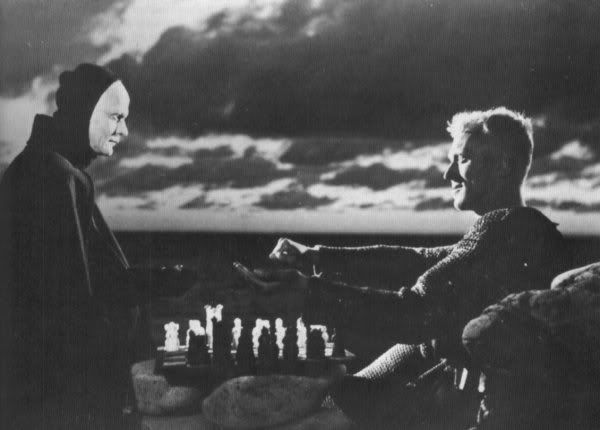
While, Schoenbergically speaking, this is going to be a tough row to hoe (or read), I admit I'm trying to think how I can use this in “The Lost Chord,” perhaps combining it with the chess game (which, admittedly, is with Death, not the Devil) from Bergman's “The Seventh Seal.” In this case, it would be during Tr'iTone's interrogation of Dr. Dick, which in addition will use my version of Abbott and Costello's “Who's on First” skit regarding the whereabouts of Yoda Leahy-Hu.

Thinking more of the film “Lt. Kizhe” than just Prokofiev's delightful music for it - a commenter at the Symphony Blog sent me this link to the original film – perhaps I should also include an almost true incident back when I worked for the orchestra either as assistant conductor or later as the personnel manager. A close friend, Vikki Moore, who'd been the personnel manager before I took over the job, and I used to joke about how we could easily confuse the conductor by inadvertently creating a musician with a well-placed typo, then wondering if we'd be able to bring it off in true Kizhean fashion.

There had been a concert, once, when the program and its personnel page had to go to print before we had decided upon hiring several key musicians after a series of auditions. So rather than leaving them blank, I decided I should make up some names figuring, you know, who would notice... Since this was a special fund-raising concert, though, and the theme was “The Orient Express,” I decided to go into Agatha Christie's wonderful mystery, “Murder on the Orient Express” and select seven different names for those players not yet hired. There were actually some people in the audience who noticed this and commented on it. I felt so much better, then, thinking the time it had taken to execute the idea (so to speak) was worth the extra effort.

- Dr. Dick

Wednesday, March 10, 2010

Back to Looking for "The Lost Chord"

It's not that there hasn't been anything going on, it's just that I haven't felt much like writing about it. In the past two weeks, I've finished the song cycle, “The Other Side of Air,” and now I'm in the process of copying it (by hand – none of that fancy computer software only because I've never gotten around to it, mostly because in addition to purchasing it, I'd need to get a newer, faster, bigger, better computer, none of which is in the budget, right now). And after I put up the “The End” sign on the songs, I got back into my musical parody of Dan Brown's “The Lost Symbol” which I call “The Lost Chord.” That doesn't mean it's a musical: it's just a parody of the story told from a musical perspective.

November was “National Novel Writing Month” and so I took the challenge to write 50,000 words in a month and wrote 64,038 words by the end of the month. Because I was nearing in on a climactic scene (but still not half-way through my outline of Brown's story), I kept going for a few more days till I'd done almost 70,000 words. Then I stopped.

Actually, during November, I did no composing: all my “creative” time was spent on the would-be novel. I didn't think I could do a whole parody in 50,000 – though “The Schoenberg Code” was more like 45,000 without even trying – but I had hoped I could get closer to the end than “not quite half-way through.” During December and January, I went back and did a little editing and threw out lots of words. I toyed around with outlines for a couple of scenes but the biggest problem, as the story progressed, was coming up with something that would be the equivalent of the seemingly impenetrable puzzle that Brown's hero, Robert Langdon, has to solve.

There was no sense even starting work on it without knowing what the equivalent of this clue or that character would be, but I had left the biggest issues for later, hoping they would fall in line along the way. Talk about “trusting in inspiration.” And certain smaller ideas have come up only to be solved in just that way. Implementing some of them is another matter.

If you haven't read Dan Brown's novel – and there are a lot less of you than read “The Da Vinci Code” – it won't make a lot of sense. That's how parodies work.

I knew my setting would be Lincoln Center rather than Washington D.C.'s Capitol complex and I knew (like Dan Brown's characters who are obsessing on the Washington Redskin's game the night everything takes place) it would take place the night of the final World Series game when the Yankees beat the Phillies, the perfect sports-obsessing equivalent. Curiously, when I started writing on November 1st, the Series had only just started so I waited a few days before filling in any of the details about things like the day of the week or what else may have been going on that was “day specific.” If the Yankees had lost, it would put a damper on the ending, I guess, but since most of the action takes place during the game, a lot of stuff goes unnoticed because everybody is wrapped up in the anticipation either watching the game or wishing they could be: this could be the night the Yankees win or the Phillies pull one out of the fire to prolong it.

A month later, the next scene I needed to write was a major climactic one, but not one that was an equivalent of anything in the original. Once I knew the story would take place on November 4th, I checked to see what would be happening at the Met – Rossini's Barber of Seville. Not only was it a favorite opera of mine, it was a production I had even seen, thanks to their new HD transmissions into movie theaters around the world. And I knew, given the timing, I would need a chase scene of some kind – like the CIA agents tracking Robert Langdon through the Library of Congress – about the time the first act finale of Rossini's comedy would be taking place. So obviously, my equivalent of symbologist Robert Langdon – that would be me, or rather a parody of myself as the musical know-it-all, Dr. Dick – would end up on the stage of the Metropolitan Opera House (not in the way I had always dreamed it would be).

It would have been a very different scene if they were performing Janáček's "From the House of the Dead" that night...

(And why did I put myself into this story? Well, when I wrote “The Schoenberg Code,” it seemed a logical self-parody and, since many beginning writers write something autobiographical, masquerading their lives in fiction, it seemed somewhat logical to continue this into the sequel. It isn't so much that I'm stuck on myself but rather that I'm stuck with myself. Given my dull life and duller life-style, to say this is autobiographical is only mildly true: what is fictional is wildly untrue, and the wilder, the better.)

Since it had a been a couple of years since I'd seen the Met's production, I was delighted to discover, courtesy of YouTube, a clip of the very finale I was looking for. Unfortunately it's since been taken down for copyright infringement (ooops). But at the time, it helped me place my scene-within-a-scene in what would also become a parody of the climax of the Marx Brothers film, “A Night at the Opera” (which I'd also found on YouTube and which has also been removed for similar transgressions).

Now, hearing the opera and seeing the scene was not the same as translating it into written words that are to be read. I had to give the reader enough visuals for it to make sense and for it to be funny. Just to say “it was a funny scene” was not enough.

And because I knew this would take a few days to work out – even though I could've just sketched it in and barreled on ahead, coming back to fill in the details later – I ended up putting it aside. I stopped writing just as Dr. Dick and his two fellow-fugitives found themselves, unbelievably, arriving in the middle of the stage, the elevator they'd taken from the sub-basement scene shop turning into the freight elevator that delivers the sets onto the stage. Ooops.

So when I came back to pick up where I'd left off three months ago, the video clips of both the Rossini and the Marx Brothers had disappeared. Since my inspiration from Harpo Marx's backstage antics during “Il Trovatore” was only in spirit, not a literal parody, this didn't really matter, though I enjoyed the laugh whenever I saw it and a good laugh is like good medicine.

As rapid-fire as the action was, it took several days for it to take shape.

Dr. Dick (a.k.a. Brown's Robert Langdon) has been abducted from the seemingly evil clutches of Security Chief Yoda Leahy-Hu (a.k.a. Brown's Inoue Sato) of the International Composers Alliance (a.k.a. the CIA) by an architect working on the Lincoln Center renovations named V.C. D'Arcy (a.k.a. Brown's Warren Bellamy, Architect of the Capitol). As they try to escape through the scene shop in the Met's basement, they are joined by LauraLynn Hardy Sullivan (a.k.a. Brown's Katherine Solomon), sister of Robertson Hope Sullivan (a.k.a. Brown's Peter Solomon) who's had his ear (a.k.a. Brown's hand – well, Peter Solomon's hand, not Brown's hand) cut off and who is herself trying to escape from her brother's captor, Tr'iTone (a.k.a. Brown's Mal'akh), the villain who is disguised at this point as Dr. Iobba Dhabbodhú (a.k.a. Brown's Christopher Abbadon). And so on.

They are being chased by three special agents from the ICA named Kay Gelida Manina, Oona Furtiva-Lagrima and Edie van Sierre. Like the architect, their names are all puns on famous arias: V.C. D'Arcy is “Vissi d'arte” from Puccini's Tosca; Kay Gelida Manina is “Che gelida manina” from Puccini's La Boheme; Oona Furtiva-Lagrima is from Donizetti's Elixir of Love; and Edie van Sierre is the line “e di pensier” that concludes “La donna é mobile” from Verdi's Rigoletto (and famously parodied on-line in the translation “Elephants, yeah!”).

While these agents are clad in skin-tight black body-suits like characters in a futuristic spy thriller or computer game, I've even made reference to their suits as the equivalent of the “little black dress” which caused famous soprano Deborah Voigt to be fired from a production of an opera because she would not fit into the “little black dress” that had been designed for that character. So, here, another agent, reassigned to a desk job because her weight gain meant she could no longer wear the regulation “little black body suit” was named Aïda Lott. (She will re-appear, quite transformed, at the end of the story.)

Many of my other characters' names also are based on musical terms, expressions or aria titles. In addition to people like Tom LeVay and P.K. Arabesk (from the ballet steps, temps levé and piqué arabesque), I am still trying to work in someone named Alice Vergenglikke, from the German “Alles vergängliche” – all things are transitory – a famous line from Goethe's Faust. I suspect she will be a temp...

There is also Lohimar May – from the medieval song, “L'homme armé” – who will become a famous musicologist specializing in early music and the inventor of the game “Where's Gesualdo?” (This last name was reworked from a suggestion by Facebook friend Steve Gregoropoulos who'd come up with something similar.)

After Dr. Dick and company find themselves in the middle of “Freddo ed immobile” (the ensemble starting “frozen and immobile like a statue,” not “Fred's in Mobile”), they see this wagon loaded with pumpkins (part of the actual Met production) being prepared to be brought on-stage. So they begin marching sideways, heel-to-toe then toe-to-heel, crab-like across the stage, the rest of their bodies not moving and taking up position behind a bunch of soldiers lined up on the opposite side of the stage. Confusion continues to mount when Almaviva and Figaro see the three black-clad secret agents with machine guns poised across their chests standing behind the wagon.

As the ensemble builds into its rapid-fire confusion (“my head is banging like it's being hammered on an anvil”), Agent Furtiva-Lagrima sees something hanging over them that's beginning to move – a large anvil that is supposed to descend slowly until it crushes the wagon. However, Agent van Sierre shouts and steps back, firing at the anvil, cutting one of its cables. Swinging dangerously by one cable, it now falls precipitously, destroying the wagon and smashing the pumpkins. The agents then slip and fall into what would have made an immense pumpkin pie, unable to apprehend the three fugitives before they escape backstage with the help of tenor Barry Banks (who actually was singing Almaviva that night) and one of the supers in the group of soldiers named Wyatt Zittipiano (later in the opera there is a whispered trio, “Zitti zitti, piano piano” - Quiet quiet, softly softly – and Wyatt = Quiet, get it?) after Banks recommends they hide in his out-of-the-way dressing room. Meanwhile, the rest of the soldiers do mock-skirmish with the three ICA agents during the bows – to great audience approval.

From there, it seemed logical to parody another scene from “A Night at the Opera,” the famous “crowded cabin scene” on board the ship where Groucho Marx is hiding with Chico and Harpo (who is sound asleep). One by one, various maids, a manicurist, a tourist looking for her aunt, two electricians and finally three waiters with trays of food all squeeze into this tiny little room. Then along comes the indefatigable Margaret Dumont as the matronly Mrs. Claypool who opens the door and everybody spills out into the hallway.

Meanwhile, back at “The Lost Chord,” Architect D'Arcy has gone off (as Bellamy had in Brown's novel) to be apprehended by the ICA as a decoy. LauraLynn and Dr. Dick run into usher Nandi Abbott, a diminutive and otherwise unassuming woman who's blocked their way but was sent off on a wild goose chase when Wyatt Zittipiano told her about the three armed intruders. He says “they don't call her 'Killer' Abbott for nothing.”

(Now, “Nandi” is the name of the White Bull who is the gatekeeper for the Hindu god Siva. Nandi is also the Tamil word for someone who blocks your path. 'Killer' Abbott refers to the killer rabbit in the scene from “Monty Python and the Holy Grail” with Tim the Enchanter and the harmless-looking rabbit who, in actuality, has nasty big pointy teeth.)

Once in the dressing room, Zittipiano tells them not to let anyone else in. So naturally, while they're trying to figure out an important clue, people start knocking at the door. First, it's the tenor, Barry Banks, coming back to enjoy the intermission break in his dressing room. Someone from Costumes arrives with Banks' 2nd Act disguise as the young music master, and just as Dr. Dick asks him what the password is, Banks asks LauraLynn if she'd like to join him for dinner afterwards. “I could really go for some swordfish.” Then Dr. Dick lets Guido in with the costume.

(There is another famous scene – from “Horse Feathers” – where Groucho is trying to get into a room but Chico won't let him enter unless he says the password. After much questioning, Chico says “you can't come in here unless you say 'Swordfish'...”)

This is followed by two people from Make-Up, one of them named Kensington Gore (which is the stock name for fake blood used in the theater), an electrician and later his burly assistant, a girl hoping to get an autograph from Juan-Diego Flórez (who was not singing Almaviva that night), two interior decorators sent to do a make-over of Mr. Banks otherwise shabby little dressing room (“could you make it look a little bigger?”) and then three guys from the Met commissary with trays of food.

Meanwhile, LauraLynn is trying to open a small box that has one of the major clues in it but she is constantly being interrupted by more and more arrivals.

When Dr. Dick realizes someone has left the door open – shouting “Mind that door!” (from Act II of Britten's Peter Grimes) – he ends up body-surfing over the crowd (as the sleeping Harpo did in the original scene) just as someone pulls the door shut. At that moment, Nandi Abbott has returned, irate that Mr. Banks has broken the rules about guests in the dressing room, accompanied by one of the ICA agents. When she yanks the door open, guests cascade out into the hallway and Barry Banks, disguised as a disheveled young music teacher, clambers out over them in time for the three-minute warning. When the ICA agent looks into the room, there is no sign of Dr. Dick or LauraLynn Sullivan.

- - - - - - -

There is an earlier scene that is not found or even suggested by anything in Dan Brown's original novel and it includes a recurring character from “The Schoenberg Code,” Dr. Dick's young assistant, Buzz Blogster.

In Brown's novel, Katherine Solomon has an annoying trait where she's frequently brushing a stray wisp of hair back behind her ear. In “The Lost Chord,” this has been transferred to my Yoda-like take-off of Chief Inoue Sato, though it's always associated with her talking to Buzz as if it becomes some kind of sexual nuance.

While I first introduced Security Chief Yoda Leahy-Hu speaking very much as Yoda did in “Star Wars,” I quickly decided to drop it as it became not only difficult to do but tiresome and distracting to read. More recently, however, she's taken on other characteristics as I find myself imagining the part played in the movie-version by Linda Hunt, or actually more like the character she plays on “NCIS: Los Angeles,” Hetty Lange.

The problem with Buzz, though, was what to do with him once the action of the plot started. When V.C. D'Arcy abducts our hero in the sub-basement level of Lincoln Center, there is no room to include a side-kick. Since he was now in the hands of the ICA Director of Security, it seemed logical he should be interrogated – but another question was “where?” Given the renovations going on at Lincoln Center, the Security Offices were currently (fictionally or actually, I have no idea) housed in a construction trailer in the underground area not far from the 62nd Street entrance. Since there wouldn't really be room for an interrogation room there, Leahy-Hu commandeers the men's room.

Now that I'm this far into it – and some 71,000 words total, at this point – I should just start posting it. Yet I'm only half-way through Brown's story. I estimate his novel to be about 230,000 words which would make mine, if the proportions hold out, to be about 2/3rds the length of the original – in fact, it would put it within the Golden Ratio: the Golden Section of c.230k is c.142k and uhm... double the words I've written up to the half-way mark would make it a total of c.142,000 words. Hmmm...

Well, anyway, I've got to get back to work. Two things must happen in the next scene: the equivalent of Brown's pyramid and capstone are to be reunited – in my case, it's a headless bobble-head doll of Mozart with the head in a separate and long separated container (plus there's also an old Seth Thomas metronome which looks a bit like a pyramid minus its capstone, though I haven't quite figured out how this really functions in the overall plot) – which will reveal further clues, including one leading them to another clue in the equivalent of Brown's use of Albrecht Dürer's 1514 “Melancholia” which I've figured will be found in Schoenberg's 1934 essay, “Problems of Harmony.” Not sure how that's going to happen.

Most of the details have already been worked out, as I've outlined Brown's story chapter-by-chapter (all 135 of them). But some of them still need clearer resolution and that's why I don't want to start posting the chapters I've already written, like a serial-novel-in-progress: I may need to go back and change some things as new details and possible solutions evolve. And then there's always the editing process, anyway.

Right now, I just want to write and get it down in a rough draft.

Meanwhile, I have officially been diagnosed with Spring Fever. I think another walk is in order, after four days of 60° weather. It's cloudier today with more clouds and some rain in the forecast through next Tuesday, so I think I'll go enjoy it while I can. One always hopes there's plenty of time to work, later...

- Dr. Dick