Sometimes, creativity can be as unpredictable as spring weather in May: rainy days may outnumber sunny ones but even on a cloudy, on-the-verge-of-a-dreary day, the sun can break through, burn off the day’s damp chill so those seeds you’d planted a week ago, wondering if they’ll ever start to germinate, suddenly sprout.
It may not have been the most productive 8-day weekend (though not the worst of past birthday vacations, either), but as I start shifting my lifestyle schedule to see if I can compose in the evening as well as in the early morning hours, on Tuesday night (Day 7) I finally made that breakthrough discovery how I can implement the basic structural idea for this new piece. By Wednesday morning (the last day of my vacation) I had worked out enough of the requisite variables to see yes, indeed, it does work – and now the composing process can actually begin.
This is a part of the process often referred to as “pre-compositional” or as a friend of mine at UConn used to call it, “the laundromat phase.” He could work out the structural details and other “figuring” while the sounds of washers and dryers blocked out other distractions. For me, great stretches of uncomplicated, undistracted (and ideally very quiet) time are very important, even though it might look (and feel) like nothing is getting accomplished. Sometimes, going for walks might help, if nothing else to rid the brain of the daily distractions that keep it from focusing, behind the scenes, on the creative work at hand.
My distractions the previous weeks were, the stress of daily life aside, focused mainly on imminent change, since I’ll become the new Afternoon Guy at WITF (giving up my evening time-slot) until we hire and train a replacement for John Clare who’s relocated to San Antonio. Losing a friend was one thing, though at least he got me started on Facebook where it will be easier to keep in touch (and speaking of distractions, yet another way to waste tons of time on the internet - thanks, John...).
One of my primary concerns about having to go to work earlier is losing that fresh, morning time to compose. After the long hiatus of not composing for some 16 years, I have fallen into the schedule of writing in the morning then going to the station in the early afternoon. Will I be able to work in the evenings? Will I be too brain-dead to function creatively? I’d forgotten that when I was teaching at UConn and faced with 8am theory classes, all of my composing was done in the evenings, often till late at night, after a full day’s teaching.
One of the ways I like to refocus energies is simply to read a book. Ordinarily, as much as I love to read, there isn’t much time that I can dedicate to it beyond a few pages (or maybe even a few paragraphs) before I go to bed. This may be, while looking through a list of 1,001 books to read before you die and discovering I’d read 118 of them, I can’t really remember much about many of them – the barrier of years aside, sometimes it just goes in one eye and out the other.
I’d wanted to reread Thomas Mann’s Doctor Faustus – I’d started the new John Woods translation a couple years ago and had to put it aside – but it took too much concentration and I opted for something easier, more direct in the line of story-telling, dragging out another new translation waiting for just such an event, Richard Pevear and Larissa Volokhonsky’s version of Tolstoy’s War & Peace. Ultimately, I decided on Harold Kushner’s Overcoming Life’s Disappointments which I finished on Monday, but that will be a whole blog-post in itself.
Needless to say, thinking about dreams and how they have a tendency not to come true – dreams here in the sense of life-goals, what we want to be when we grow up kind of dreams – then ultimately the affect those shattered dreams can have on how we view ourselves in an age when “you don’t win the silver, you lose the gold,” generated a lot of off-line thinking and had, overall, a very calming effect on what I can only describe as a stressful couple of months.
But I also found myself at my grandfather’s desk, slowly working on the score for the songs I’d recently completed, and copying over, once again, the opening setting of lines from Hebrews 11, “Now faith is the substance of things hoped for, the evidence of things not seen.”
The new piece was to be nothing complicated, just another piece for violin and piano. It was meant to be the last of a set that included the Nocturne which John Clare and I had performed in 2005, and two companion pieces written a year after that – a Theme and Variations which would be the opening piece and a light-hearted little scherzo I called “Blues Interruptus” which I’d blogged about before. Curiously, these last two pieces are still in the sketch stage – the Variations haven’t been written out in standard notation yet and the scherzo still has some finishing details that need to be filled in (it had been derailed by distractions from new neighbors just as I was completing it, followed by my mother’s death, when composing anything just didn’t seem suitable, much less a light-hearted little scherzo). Whether there are four pieces or five (another short, fast movement might work for the overall balance) ultimately, the ending was going to be more serious and fairly substantial, capable, like the others, of being performed on its own but still working into the overall fabric of the others (less, I think now, of an issue). I figured 8 minutes should be about right.
I had envisioned it as a chaconne, thinking how I would work out the harmonic pattern and how that relates to the overall structure. A month ago, I had scratched down some ideas, mostly text, and came up with a graph of the form, at least potentially.
When you put “chaconne” and “violin” in the same sentence, the inevitable result is Bach – and how ironic, as I work on this piece, I end up replacing John Clare as the pre-concert presenter for Odin Rathnam’s three century survey of solo violin music, ending with the Chaconne from Bach’s D Minor Partita, one of the greatest works for the violin (with or without further accompaniment) and the most familiar, if not the greatest, example of a chaconne.
Basically, a chaconne is a type of variation-form: rather than a theme in the bass (called a passacaglia) that repeats over and over with melodies and variations unfolding over it, a chaconne uses a harmonic pattern, often a very simple one involving a descending bass line that articulates a movement from tonic gradually to dominant, then back to tonic. Having played the cello forty years ago and twice had to play the Pachelbel Canon – which is really a chaconne – the idea of playing the same thing over and over (and over and over) again bores me to tears (listening to it is bad enough), so I decided I didn’t want it to be too literal.
Now, given my style which makes ‘free’ use of all twelve pitches (but is not serial and not necessarily atonal, either) - you can read more about that here and here - I wanted to create a harmonic progression that involves both standard triads and non-standard “trichords” (three-note chords that are not standard major or minor triads but could be built on other intervals than the third), moving in degrees of tension to cadence, ultimately, on a major or minor chord. But I also wanted each statement of the harmonic pattern to be “in a different key,” in a way, not repeating the same pitches. So the pattern needed to be open-ended and yet there had to be some sort of resolution at the end which would give it the same sense of closure you get in tonal music.
Tuesday night, then, I felt I was ready to sit down and schlog through a bunch of potential six-note sets (collections of pitches that can be used in any order or combination), ending up going back to one I’d used prominently in the string quartet and symphony. This set will give me a major and a minor triad a whole step apart; its complement (the other six pitches) will give me a major and a minor triad a tritone apart. But this time, I’ll use them differently than I did in the earlier works (keeping in mind the 4th sections of both works are also free-wheeling chaconnes).
When I realized that I’d already been there/done that, it occurred to me that was no reason not to do it again: after all, Bach wrote many chaconnes just as Brahms would later use the approach (either as a passacaglia or a chaconne, which by then had become almost interchangeable) in different works, like the finales of the Haydn variations and the 4th symphony, to name two. There are other ways to solve the same problem, just as I had taken the possibilities I hadn’t followed in the string quartet and applied the same structure to the symphony.
After a few hours of fussing, similar to other hours spent with the idea of not necessarily being productive, I came up with first one detail that worked and then another. How to “articulate” the progression so it made sense in nine chords, still sounded like it went somewhere but leaving it open so, in fact, the next statement of the pattern could resume, basically, in a different key; how to distinguish it, with a climax on the fifth chord, so that it’s more than just a movement to the dominant, then back to the tonic.
The idea of writing something that, because it uses all twelve notes constantly, sounds “atonal” to someone not used to the style but would use a kind of tonic-to-dominant motion means I’m going back to what drives that motion in standard tonality: not the fact they’re basic chords in a C major sequence, but because they follow a pattern of relative tension and release, things that underlie much of Western art music regardless of style or surface language.
So I thought, this time, I would try a “deceptive” resolution – like going from a D Major triad to an F major triad – which sets up the next half of the phrase to both resolve the tension to an extent but still continue pushing it forward (since it’s not closed, overall, by returning to D Major). This constant pushing away from and always returning so immediately to the same D Major chord, say, is what I find so boring about the standard form, locked in to simple four- or eight-bar patterns that takes a genius like Bach to circumvent. Not being a genius like Bach, I need to look elsewhere for my solutions to “variety” within a scope of overly obsessive “unity.”
So I had a progression that, by itself, seemed to work: it was satisfying and had potential (how I use it in the composition will be another issue). I ran it through the nine different pitch levels each pattern would require to make “tonal” sense of the combined statements, each phrase climax being on a chord that has at least one common tone with a D major or D minor triad. But since this pattern resolved, more or less, to a minor triad, I had to make sure I could end up in D major at the very end which would require a subtle change in the pattern: would it work, or would it involve just saying “oh, the heck with it, I’ll just write what sounds good once I get there”?
To do that, then, undermines the whole concept of organizing the pitches in the first place, if I’m just going to write what “feels good.” Beethoven, writing in a tonal idiom, was more organized than someone who just sits down and writes whatever comes to mind that sounds good.
Since it was getting late and I was feeling tired, I put it aside. The next day, I returned first thing in the morning – now getting to bed earlier, I was at the piano not long after 7am – and continued working out the different statements. This was a fairly mechanical process, like copying out a phrase first in E major and then in G Major. And then I was at the end: here we go.
No, it didn’t happen that easily: it was not mechanical. Nor was it arbitrary. What was sounding reasonable did not work with any logical, technical explanation. I tried to find ways of making it work, but it involved going outside the single set of six notes I’d been using consistently all along. Some were too remotely related to work and the ones that were close enough, technically, didn’t sound good.
Then I realized by switching two trichords around, I had a connection with that deceptive chord that used the same original set - eureka! That’s what I’d hoped for in the first place. Better yet, since this is the climactic last statement of the pattern, it created something different in that deceptive triad which points up the change and its imminent resolution (sort of like listening to Ravel’s Bolero until, near the very end, he swerves off onto a different chord than the one he’d been drumming into your head through the whole piece, what should be one of those wow moments).
And yet it was the same set of notes that I’d been using all along! I didn’t even have to fudge!
So when I tranpsoed it to resolve to the D major chord at the end, I realized it will, in fact, work. Now the composition can begin.
Of course, it was the last day of my vacation and there would be no time to do any more work that day, but at least the pre-compositional phase was over and now I can concentrate on filling in the rest of it during those times I do get to compose when I’ll have less time to focus in the midst of the distractions of reality.
A couple days ago, all I had was a pile of bones. Yesterday, after the skeleton of the piece had been arranged and connected – leg bone, thigh bone, hip bone, how the pattern would lay into the structure – the muscles were now in place and ready to go, how the music would move from one point to the next, giving it a sense of direction, just as bones aren’t going to do much without muscles to guide them.
Now all I have to do is add the rest of the body – the tricky part: crafting the skin, getting the blood to flow and, with any luck, blowing life into its soul so it connects with the performers and the listeners.
It could take weeks or months, depending on the time I can focus on writing it and how successfully that time works. But it’s easier when I think the piece is essentially “composed” – other structural and musical ideas already jotted down are like a collection of body-parts ready for use here or there – so that now all I have to do is fill in the notes.
- Dr. Dick
Thursday, May 29, 2008

Wednesday, May 28, 2008
Le sacre du nettoyage au printemps
Ah, the Rite of Spring Cleaning... with its culminating sacrificial dance of the Chosen Furball.
No, no cats were harmed in this annual event, though several were traumatized by the appearance of a rug-sucking behemoth imported by my friend N who volunteered to do the dirty work since I cannot abide the sound of a vacuum cleaner. Fortunately this one was not nearly as loud or piercing as the ones I have to contend with at work when the cleaning crew comes in during my shift three nights a week, nor is the frequency nearly as annoying as the white noise [sic] noise-masking system that runs 24/7 whether I’m the only person in the building or not (that it even runs during a power outage only confirms my belief it is, in fact, controlled by an alien life-force).
All but one of the cats spent the afternoon hiding in various locations or scooting from one hidey hole to another depending on the progress of the vacuuming. Murphy, who normally cannot abide the kittens, was happy enough sitting around watching the proceedings, perfectly content to ask “Can we let that thing run all the time?” The house, then, would once again be hers.
 So after the spring cleaning was done, I saw the black Chinese wool rug I’d put in the living room last year look as bright and beautiful as it did the day I bought it, now free of the overlay of orange, white and gray cat hair it automatically attracts. The cats, checking it out after the noise and the dust settled, realized they have their work cut out for them and I’m sure, in a few days, will be exhausted by all the shedding they’re going to have to do to get caught up.
Last weekend, we managed to get three more book cases assembled (purchased in early November and merely awaiting the right moment in our busy schedules) and so the past few days, I have slowly been working my way through boxes of books as yet unpacked since my mid-November move. About half way through the boxes, I see the book cases are already more than half filled. Hmmm...
 The kittens, of course, have turned a year old – officially 13 months last week. I rarely get a chance to catch them all in one picture from the time I aim the camera and the flash actually works. The photo on the left was taken when they were one month old and the one on the right was taken just a few days ago. The occasion was the discovery of a centipede on the flagstone floor of the foyer which immediately got their collected attention. That’s Baker looking up as if to say “Izza bug, you mind?”

The downpour the other night finished off the clematis on the front porch, leaving only a few hardy blossoms where once there was a mass of 110 pale lavender and white flowers. On the other hand, the new peony is blooming for the first time (see below), a brilliant white variety known as “Shirley Temple,” though why, I have no idea (I expected it to break into The Good Ship Lollipop when the first bud opened).

Seeds have finally germinated and I have another crop on the way of “Moon Glories” (night blooming morning glories with brilliant white blossoms 6" across) and regular morning glories (“Scarlet O’Hara” already sprouted, “Heavenly Blue” planted a few days later lagging appropriately behind). I’ve thrown in some white marigolds and black pansies plus a few other seeds for summer flowers which, hopefully, will not be eaten by the resident rabbits. If anything needs propitiated, by the way, it’s the resident rabbits in the back yard...
Well, I hear a cat shedding in the living room, gotta go...
No, no cats were harmed in this annual event, though several were traumatized by the appearance of a rug-sucking behemoth imported by my friend N who volunteered to do the dirty work since I cannot abide the sound of a vacuum cleaner. Fortunately this one was not nearly as loud or piercing as the ones I have to contend with at work when the cleaning crew comes in during my shift three nights a week, nor is the frequency nearly as annoying as the white noise [sic] noise-masking system that runs 24/7 whether I’m the only person in the building or not (that it even runs during a power outage only confirms my belief it is, in fact, controlled by an alien life-force).
All but one of the cats spent the afternoon hiding in various locations or scooting from one hidey hole to another depending on the progress of the vacuuming. Murphy, who normally cannot abide the kittens, was happy enough sitting around watching the proceedings, perfectly content to ask “Can we let that thing run all the time?” The house, then, would once again be hers.
 So after the spring cleaning was done, I saw the black Chinese wool rug I’d put in the living room last year look as bright and beautiful as it did the day I bought it, now free of the overlay of orange, white and gray cat hair it automatically attracts. The cats, checking it out after the noise and the dust settled, realized they have their work cut out for them and I’m sure, in a few days, will be exhausted by all the shedding they’re going to have to do to get caught up.
Last weekend, we managed to get three more book cases assembled (purchased in early November and merely awaiting the right moment in our busy schedules) and so the past few days, I have slowly been working my way through boxes of books as yet unpacked since my mid-November move. About half way through the boxes, I see the book cases are already more than half filled. Hmmm...
 The kittens, of course, have turned a year old – officially 13 months last week. I rarely get a chance to catch them all in one picture from the time I aim the camera and the flash actually works. The photo on the left was taken when they were one month old and the one on the right was taken just a few days ago. The occasion was the discovery of a centipede on the flagstone floor of the foyer which immediately got their collected attention. That’s Baker looking up as if to say “Izza bug, you mind?”
The downpour the other night finished off the clematis on the front porch, leaving only a few hardy blossoms where once there was a mass of 110 pale lavender and white flowers. On the other hand, the new peony is blooming for the first time (see below), a brilliant white variety known as “Shirley Temple,” though why, I have no idea (I expected it to break into The Good Ship Lollipop when the first bud opened).

Seeds have finally germinated and I have another crop on the way of “Moon Glories” (night blooming morning glories with brilliant white blossoms 6" across) and regular morning glories (“Scarlet O’Hara” already sprouted, “Heavenly Blue” planted a few days later lagging appropriately behind). I’ve thrown in some white marigolds and black pansies plus a few other seeds for summer flowers which, hopefully, will not be eaten by the resident rabbits. If anything needs propitiated, by the way, it’s the resident rabbits in the back yard...
Well, I hear a cat shedding in the living room, gotta go...
Tuesday, May 20, 2008
On the Verge of Vacation-Time
Today would be a good day to sit and read, if I had the time: perhaps tomorrow, when my vacation officially begins, I can do that, except I really want to spend the time writing down some sketches for a new piece or copying the score to my songs, now that they’re complete. Coming home from work later than I’d care to usually means I’m too brain-dead to concentrate. The cats also want to spend their time with me which usually means Murphy is kneading on my chest and either Max or Blanche is spread out on my lap, making it difficult to see the book, proving the old saying “You make a better wall than a window” or however my mother used to say her mother said it. (Door? maybe it was door, not wall...)
And then trying to get deeper into Thomas Mann’s Doctor Faustus is a bit of stretch on short bursts of reading time, trying to sort through the philosophical arguments of Good versus Evil that I’m mired down in, now. This would be my third time starting the book, having completed it only once (and that almost 30 years ago) but you can’t really read just a few paragraphs at a time. I think also the emotional stress it creates is not good for me, at the moment, so I’m putting it aside (again) for now. I’ll get back to Schlepfuss’ exegesis on the existence of evil when my life is a little less stressed.
Another book I’ve wanted to re-read is Tolstoy’s War & Peace. I have two new translations, one by the English writer Anthony Briggs which I’d bought before I’d read much of the criticism about it (like having low-class Russian soldiers chattering away in out-dated Cockney slang that in itself needs a translation in the footnotes) and the much-anticipated, long-awaited translation by the team of Richard Pevear and Larissa Volokhonsky (I’ve enjoyed other translations of theirs in recent years) but now I’m getting bogged down by reading all the original French which had always been translated in the other copies I’ve read. Tolstoy writes much of the aristocratic dialogue in French since at the time, between 1805 and 1812, most of the Russian aristocracy did not speak Russian themselves - so since my French is nearly nil, I find myself dozing off after breaking my concentration to peer down at the footnotes for the translations. In the past few days, I’ve gotten just 46 pages into it – only 1167 pages to go...
Even with the rain and other events of the past week, though, it has been relaxing at the house, despite the cats’ best efforts, watching spring unfold. Some of it was sad - finding the first wood thrush I’ve seen here in years, dead on my back porch after having slammed into the picture window; at least the little yellowthroat warbler managed to recuperate and eventually fly away, with or without a major headache. I decided to plant a few things down in the Great Bare Patch between the Japanese Maple and the Kousa dogwood, transplanting some moss, some of the old-fashioned bleeding hearts that are growing fairly profusely in some areas of the yard, not to mention a few violets. I was thinking of planting some may-apples and other shade-loving plants there, too. Good thing I didn’t – Thursday, the guy who does my lawn mowing came by and, great job that he always does aside, mowed right over them, so I’m back to a nice brown patch of bare earth...
 My mother had transplanted a rhododendron from her parents’ yard back in 1970, after they died. I remember this plant from my childhood and the story was it had been transplanted from their first home when they moved in 1946, whenever it may have been originally planted there (their first home was purchased in 1919). So regardless, it’s a fairly old plant. Much to my mother’s disappointment, it’s never really done well here, perhaps too shaded to produce lots of flowers, some years barely noticeable at all. This year, it’s spectacular, as you can tell by this picture I took a couple days ago. I can’t tell whether it’s actually a rhododendron or an azalea...
The one remaining peony – a red one – has come back again, but no buds on it this time, just a few spindly leaves. This too is an old plant originally from my grandmother’s garden, though from a set of peonies my mother remembers growing up with as a child in their back yard. They were well established by the time she was 5, from what I can tell in some family pictures, so this is an old peony, the original stock at least 89 years old.
 By the front porch is a clematis – the variety is called Nelly Moser (why I remember that, I don’t know) – that goes fitfully from year to year, sometimes a dozen flowers, sometimes a couple dozen or so but never too many at a time. Last week, I noticed it was covered with buds from top to bottom (also unusual) but when I took the 3rd picture of it this morning, I counted 110 open blossoms on the vine, from top to bottom.
 In the back yard, there was a more typical dark purple clematis but it died a slow death over the last few years and didn’t come back two years ago. Last spring, I replaced it with another similar vine which so far is doing nicely - it usually tends to bloom later and longer through the summer. It’s not at a place where I can see it from the house, though, but perhaps by the time I set up the back corner of the porch, it’ll have grown up over the railing.
Last Wednesday, as I was leaving for work, I looked down at the pond and saw three egrets. We often get the typical common egrets here but these looked larger. I couldn’t tell from here if they had black legs or yellow legs and I can never remember which means what. I guess it wouldn’t be a great white heron since they’re basically resident only in the Florida Keys though this one was photographed on Staten Island, so who knows.
Still, if this is the common egret, then from this distance, it could’ve been what I saw.
In the past, I’ve seen some kind of white egrets (that looked smaller than these) both here and all over Wildwood Lake in uptown Harrisburg. On City Island in the years before the baseball stadium and all that development, I’d seen birds like Night Herons and Least Bitterns as well as egrets and once a Great Blue Heron, not quite as close as the time when I was a kid and my dad dragged me along fishing to the Chesapeake Bay one morning, leaving in the dark of night to be there by daybreak: paddling along in a boat, we rounded a clump of grass and reeds and there was this Great Blue Heron - just huge – only a few feet from us. We both froze: in a few seconds, he gave a great yawping honk and took off with a roar of wings, skimming across the bay to a spot a little further out, just close enough so we could see that he was catching fish and we weren’t. I think I was 10 then, and wearing my J.S. Bach sweatshirt...
Other birds I’ve seen in the past few days, in addition to the catbirds who are now nesting in the mounds of forsythia, would include the bluebirds and a nuthatch out front; I hear the wrens but haven’t seen them anywhere, though I keep looking. They might be nesting in the yews or arbor vitae at the lower end of the house where it’s difficult to see them from the bedroom’s bunker-style windows.
The other day, there was a commotion of crows, lots of cawing and a great deal of motion as I looked up to see what was going on, perhaps a dozen of them outside my bedroom window by the big maple. Clearly they were upset about something so I peered out the window and saw a large red-tailed hawk on the ground that was being continually dive-bombed by them - one even hit it on the back of the head. While I’m no fan of hawks, still, I felt I should try to rescue it or perhaps rescue whatever it was it had caught. By the time I ran around to the side of the house, it flew off over the back of my neighbors’ yard, a squirrel tail trailing from its talons. I had wondered if it had caught a baby crow or maybe the ginger cat from the neighbors-across-the-street though that would probably be too big for this particular hawk.
In the days since then, I haven’t seen as many squirrels on my back porch and I wonder which nest this one had been from: there’s one in the oak tree east of my property, but most of the squirrels I see come from my north-side neighbor’s cherry tree, whether they nest there or not. My back yard is fairly overgrown with tall trees and lots of shrubs the birds can go hide in, but the front is wide open, making anything crossing from those neighbors easy prey to hawks. But they need to eat, too, so I try to be philosophical about it, reminding myself that Nature for all its beauty is often violent and cruel.
Meanwhile, the groundhog, a true DIY kind of guy, is renovating his burrow, throwing more dirt up on my porch: who needs a back-hoe? I remember when we first moved in here, my mother had borrowed a live-trap from somebody and caught the first groundhog who was burrowing in this spot, and she hauled this snarling and hissing mass of fur and teeth down the road to the stream about a half-mile away and let him go. Our one neighbor laughed when she told him about it – “He probably beat you back to the house!” I wonder if this one, whom I call LowPax Louie (or is it Louise?), is a direct descendant of the one Mother had attempted to transport?
Time to get to work – last day before the 8-day weekend of my vacation!
- Dr. Dick
And then trying to get deeper into Thomas Mann’s Doctor Faustus is a bit of stretch on short bursts of reading time, trying to sort through the philosophical arguments of Good versus Evil that I’m mired down in, now. This would be my third time starting the book, having completed it only once (and that almost 30 years ago) but you can’t really read just a few paragraphs at a time. I think also the emotional stress it creates is not good for me, at the moment, so I’m putting it aside (again) for now. I’ll get back to Schlepfuss’ exegesis on the existence of evil when my life is a little less stressed.
Another book I’ve wanted to re-read is Tolstoy’s War & Peace. I have two new translations, one by the English writer Anthony Briggs which I’d bought before I’d read much of the criticism about it (like having low-class Russian soldiers chattering away in out-dated Cockney slang that in itself needs a translation in the footnotes) and the much-anticipated, long-awaited translation by the team of Richard Pevear and Larissa Volokhonsky (I’ve enjoyed other translations of theirs in recent years) but now I’m getting bogged down by reading all the original French which had always been translated in the other copies I’ve read. Tolstoy writes much of the aristocratic dialogue in French since at the time, between 1805 and 1812, most of the Russian aristocracy did not speak Russian themselves - so since my French is nearly nil, I find myself dozing off after breaking my concentration to peer down at the footnotes for the translations. In the past few days, I’ve gotten just 46 pages into it – only 1167 pages to go...
Even with the rain and other events of the past week, though, it has been relaxing at the house, despite the cats’ best efforts, watching spring unfold. Some of it was sad - finding the first wood thrush I’ve seen here in years, dead on my back porch after having slammed into the picture window; at least the little yellowthroat warbler managed to recuperate and eventually fly away, with or without a major headache. I decided to plant a few things down in the Great Bare Patch between the Japanese Maple and the Kousa dogwood, transplanting some moss, some of the old-fashioned bleeding hearts that are growing fairly profusely in some areas of the yard, not to mention a few violets. I was thinking of planting some may-apples and other shade-loving plants there, too. Good thing I didn’t – Thursday, the guy who does my lawn mowing came by and, great job that he always does aside, mowed right over them, so I’m back to a nice brown patch of bare earth...
 My mother had transplanted a rhododendron from her parents’ yard back in 1970, after they died. I remember this plant from my childhood and the story was it had been transplanted from their first home when they moved in 1946, whenever it may have been originally planted there (their first home was purchased in 1919). So regardless, it’s a fairly old plant. Much to my mother’s disappointment, it’s never really done well here, perhaps too shaded to produce lots of flowers, some years barely noticeable at all. This year, it’s spectacular, as you can tell by this picture I took a couple days ago. I can’t tell whether it’s actually a rhododendron or an azalea...
The one remaining peony – a red one – has come back again, but no buds on it this time, just a few spindly leaves. This too is an old plant originally from my grandmother’s garden, though from a set of peonies my mother remembers growing up with as a child in their back yard. They were well established by the time she was 5, from what I can tell in some family pictures, so this is an old peony, the original stock at least 89 years old.
 By the front porch is a clematis – the variety is called Nelly Moser (why I remember that, I don’t know) – that goes fitfully from year to year, sometimes a dozen flowers, sometimes a couple dozen or so but never too many at a time. Last week, I noticed it was covered with buds from top to bottom (also unusual) but when I took the 3rd picture of it this morning, I counted 110 open blossoms on the vine, from top to bottom.
 In the back yard, there was a more typical dark purple clematis but it died a slow death over the last few years and didn’t come back two years ago. Last spring, I replaced it with another similar vine which so far is doing nicely - it usually tends to bloom later and longer through the summer. It’s not at a place where I can see it from the house, though, but perhaps by the time I set up the back corner of the porch, it’ll have grown up over the railing.
Last Wednesday, as I was leaving for work, I looked down at the pond and saw three egrets. We often get the typical common egrets here but these looked larger. I couldn’t tell from here if they had black legs or yellow legs and I can never remember which means what. I guess it wouldn’t be a great white heron since they’re basically resident only in the Florida Keys though this one was photographed on Staten Island, so who knows.
Still, if this is the common egret, then from this distance, it could’ve been what I saw.
In the past, I’ve seen some kind of white egrets (that looked smaller than these) both here and all over Wildwood Lake in uptown Harrisburg. On City Island in the years before the baseball stadium and all that development, I’d seen birds like Night Herons and Least Bitterns as well as egrets and once a Great Blue Heron, not quite as close as the time when I was a kid and my dad dragged me along fishing to the Chesapeake Bay one morning, leaving in the dark of night to be there by daybreak: paddling along in a boat, we rounded a clump of grass and reeds and there was this Great Blue Heron - just huge – only a few feet from us. We both froze: in a few seconds, he gave a great yawping honk and took off with a roar of wings, skimming across the bay to a spot a little further out, just close enough so we could see that he was catching fish and we weren’t. I think I was 10 then, and wearing my J.S. Bach sweatshirt...
Other birds I’ve seen in the past few days, in addition to the catbirds who are now nesting in the mounds of forsythia, would include the bluebirds and a nuthatch out front; I hear the wrens but haven’t seen them anywhere, though I keep looking. They might be nesting in the yews or arbor vitae at the lower end of the house where it’s difficult to see them from the bedroom’s bunker-style windows.
The other day, there was a commotion of crows, lots of cawing and a great deal of motion as I looked up to see what was going on, perhaps a dozen of them outside my bedroom window by the big maple. Clearly they were upset about something so I peered out the window and saw a large red-tailed hawk on the ground that was being continually dive-bombed by them - one even hit it on the back of the head. While I’m no fan of hawks, still, I felt I should try to rescue it or perhaps rescue whatever it was it had caught. By the time I ran around to the side of the house, it flew off over the back of my neighbors’ yard, a squirrel tail trailing from its talons. I had wondered if it had caught a baby crow or maybe the ginger cat from the neighbors-across-the-street though that would probably be too big for this particular hawk.
In the days since then, I haven’t seen as many squirrels on my back porch and I wonder which nest this one had been from: there’s one in the oak tree east of my property, but most of the squirrels I see come from my north-side neighbor’s cherry tree, whether they nest there or not. My back yard is fairly overgrown with tall trees and lots of shrubs the birds can go hide in, but the front is wide open, making anything crossing from those neighbors easy prey to hawks. But they need to eat, too, so I try to be philosophical about it, reminding myself that Nature for all its beauty is often violent and cruel.
Meanwhile, the groundhog, a true DIY kind of guy, is renovating his burrow, throwing more dirt up on my porch: who needs a back-hoe? I remember when we first moved in here, my mother had borrowed a live-trap from somebody and caught the first groundhog who was burrowing in this spot, and she hauled this snarling and hissing mass of fur and teeth down the road to the stream about a half-mile away and let him go. Our one neighbor laughed when she told him about it – “He probably beat you back to the house!” I wonder if this one, whom I call LowPax Louie (or is it Louise?), is a direct descendant of the one Mother had attempted to transport?
Time to get to work – last day before the 8-day weekend of my vacation!
- Dr. Dick
Sunday, May 18, 2008
My Dad's Birthday
 This morning, I realized, in the midst of the drilge of a steady rain, today would be my father’s 90th Birthday.
How does one mark a milestone like that? It is still difficult to imagine him as anything other than the man crippled by rheumatoid arthritis for the last 22 years of his life, a disease that had set in when he was still in his mid-40s.
Many of the photos here in the house, though, are from times before he became ill, when I was still a child, helping me think back to better memories.
This photograph, one of my favorites, was taken two years before I was born, when he was 29, recently moved into the house in Paxtang, their first home, playing a Hammond Organ that was a brand new addition to his life. It amuses me to realize that one of the pieces of furniture I had to dispose of last spring is the chair seen in the foreground: after 60 years or more, it had long outlived its usefulness but still, it was difficult to let it go. I still have that lamp, btw...
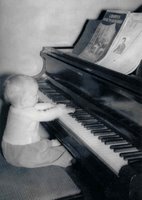
In addition to being a respected merchant in uptown Harrisburg, manager of Greenberg’s Boston Store at 3rd & Verbeke, Dad was one of the better known “cocktail organists” in the area. He was not really into classical music, though I still play from a collection of popular works by Chopin he had bought in 1944 – it’s sitting on my piano now, and it’s on the music rack of the piano in my profile photo, taken when I was not yet a year old.
My dad played for various restaurants and clubs – I remember the Blue Mountain, especially – and, as I’ve mentioned in previous posts, even had his own radio show when I was a child and allowed to stay up on Wednesday nights to listen to it, just 15 minutes broadcasting live from the Blue Mountain Hotel (now, Felicita). It didn’t phase me, having a dad who had a radio show: didn’t everybody’s dad have one? Funny how I should end up spending 18 years of my life working at a radio station. On Wednesday nights, my dad took requests from the audience and played them on his radio program; for 18 years, I’ve taken requests from WITF’s radio audience on Wednesday nights.
He didn’t read music – after I started taking piano and theory lessons in 1st Grade, he would often ask me what note this one was, three ledger lines above the staff – and had learned to play the piano by putting his fingers into the slots where the keys would go down on an old player piano. When he was in elementary school, he walked into an assembly program (as I remember the story) and everybody was already singing “Happy Birthday” to one of the teachers. He slipped over onto the piano bench and began to accompany them. One of the teachers asked him how he knew what key they were singing in: he just knew. That was when they realized he had perfect pitch - the ability to identify a pitch just by hearing it.
And yet, without any musical training – the best piano teacher in town, Mrs. Mullen, didn’t want to give him lessons because he had a talent she thought classical training might spoil it – he could listen to a song and play it back, harmony and all. Quite literally, if he asked someone to “hum a few bars” of something for a request, he could continue in the key they were singing, then play the whole song complete with all the chords.
After twelve years of piano lessons, then four years of college followed by two graduate degrees, and having composed operas and symphonies and string quartets – I still can’t do that!
One time, when I was living in New York City during a time my father’s health was rapidly declining and he was no longer able to play, I was playing piano for ballet classes and practicing late one evening. Dick Thomas, who ran the New York School of Ballet and is the father of actor Richard Thomas, came in and jokingly said, “play Melancholy Baby,” but I realized I couldn’t remember anything past the first phrase of the song. I had grown up listening to my dad play hundreds and hundreds of songs but I never heard the words and never really knew the titles – but very often I would hear something years later and think “I remember Dad playing that!” So when I wrote to him, joking about Melancholy Baby, he got out an old list he’d kept of the songs he knew by heart and there, at #1,000, was Melancholy Baby.
We also had a baby grand piano (you can see it in the background of this photo) which my folks had purchased for their new house in 1947, trading in my maternal grandparent’s old upright (purchased in 1919 – I still have the stool and use it today for my own upright piano). By the time I arrived, the organ and the piano were set up side-by-side: Dad would sit at the organ with the keyboard of the piano to his right so he could play harmony and bass on the Hammond and the melody on the piano. (It was an idea he’d gotten from hearing an incredible musician named Al Rondo: he would be surrounded by four different pianos and organs – he was also blind, btw.) I started playing the piano standing with my butt propped up against the organ bench (since there was no piano bench, in this set-up) so my feet could reach the damper pedal. It was such an odd adjustment to go to my piano lessons up the street with Mildred Goho and sit down on an actual piano bench.
I never did learn to play the organ: I simply could not coordinate my hands and feet and keep my backside on the bench! And yet my dad could play two instruments at once. Great peripheral vision? Well, it probably helped he didn’t have to sit there, eyes glued to a score since he couldn’t read music anyway...
When I was a child, I learned to play the Nocturne in E-flat, Op.9/2 by Chopin from this collection he’d bought when he was in the Air Force. I don’t know if he ever tried playing any of it or why he’d bought it in the first place – “Chopin To Remember,” it was called– but he always loved having me play this one piece. I would trot it out for visitors or when we’d go visiting friends who had a piano. I never really practiced enough to actually become a pianist, though at one time I had enough technical ability to get through Stravinsky’s Three Scenes from Petrushka, no mean feat (but that was 30 years ago): when I was 6, I’d already made up my mind I wanted to become a composer because, then, nobody else would know if I was making mistakes.
After I’d written a piece for orchestra, it was my dad who talked to another merchant and musician in town who also played percussion in the Harrisburg Symphony, Al Morrison, who told him to bring me in to a rehearsal to meet the conductor, Edwin McArthur. He invited me to attend any rehearsals I wanted to and took the piece I’d composed called, unimaginatively enough, “Concert Piece,” and performed it with the orchestra at a Young Person’s Concert in 1964. My dad, being the good salesman that he was, took me around to lots of radio stations, since he knew many of the DJs. He called friends of his at the Patriot-News, the local newspaper (then and now) who took pictures and did an interview for the front page of the paper the week before the concert. The Forum was packed, with people filling in the aisles, the biggest crowd I’d ever seen at the Forum, all because of my dad’s efforts.
A few months ago, I went to see the Met Movie-cast of Puccini’s La Boheme and found myself sitting next to Al Morrison who could be in his late-80s or 90s now himself. I told him the story of how he introduced my dad and me to McArthur and he remembered that, asking me if I was still composing. For once, it didn’t bother me, sitting next to him during the broadcast as he hummed along with so many of Puccini’s wonderful tunes. It was just nice to reconnect for that moment with someone from my dad’s past, and my own as well.
The only surviving member of my dad’s family is his youngest brother, Donald, who’s now 82, I believe, and living in Florida.
My mother’s sister, Clara, just turned 90 this past March and I haven’t been able to get in touch with her since she’d recently moved and I don’t know which of these addresses, phone-numbers and e-mails is the current one. She said she’d call me when she got back from Thailand where she went in January to visit her son who lives in Chiangmai. She was pushing 90 and flying to Asia!
And there was e-mail recently from my older brother who just moved into a new home up in the Finger Lakes, including a photograph of his new grandson born in April whom he was holding in his baseball glove. Life goes on.
I think I'll go play some Chopin...
- Dr. Dick
Tuesday, May 06, 2008
On hearing the world premiere of Carter's Clarinet Quintet
A week ago, John Clare and I went into New York City for a concert. It seems a long drive just to go to a concert – for me, at any rate: for John, having New York this close makes it a frequent destination. He blogged about it here (and discretely took some photos which he posted, too). We left Harrisburg around 3:00, got within shouting distance of the Lincoln Tunnel a little after 5, got out of the Lincoln Tunnel somewhere after 6:30 (sigh), found a parking place by 7:00 and barely had enough time to grab dinner before heading to the concert with a minute to spare at 8:00. Then turning around, we were back in Harrisburg around 2am. And why, you may ask?
This was no ordinary concert: it was the world premiere of the Clarinet Quintet by Elliott Carter with the legendary Juilliard Quartet and no less than Charles Neidich (whom I used to hear practicing years ago when he lived in the same building as a friend I would be visiting on my trips into The City then), a clarinetist who’d already inspired Carter to write a concerto for him.
As a fan of Elliott Carter’s music, this may not have been the “Must See” event hearing all five string quartets in one evening was, three months earlier (and then blogging about it), but it certainly was an important opportunity to hear a new work – twice – and to hear the composer talk about it in between performances. Considering Carter is 99 and the piece is barely seven months old – as he said, “and to think I have pieces that are even younger than this one!” – how many times will you get to hear a world premiere by a composer still writing as he pushes 100?
Ever-smiling and jovial, he seems the personal opposite of the complicated music he composes. However, as you become more acquainted with his music, especially the pieces he’s written in the last 15-20 years or so, you realize how much of this is simply intellectual and artistic curiosity blended with a sense of whimsy if not obvious humor. There are so many things to mention, here, but this is not complexity for the sake of being complicated: the sound he wants to achieve is very clear in his mind, the method of accomplishing it is complex only because it cannot be realized in a more traditional way.
Last Tuesday, the quintet was performed first - followed by a solo work from each individual performer – followed by an on-stage conversation between the Dean of Juilliard, Ara Guzelimian, and Carter with the musicians ready to play examples, and then the second performance of the quintet.
The first question was, after noting the long associations with the performers (the Juilliard Quartet had premiered most of his quartets, going back to the ‘50s with his 2nd Quartet), what inspired him to write a piece for clarinet and string quartet.
Carter looked at Guzelimian for a moment and said quite genuinely, “Well, I really don’t know.” Perhaps we were expecting some long convoluted technical exegesis from this man, considered “the greatest living composer” (certainly by seniority and accomplishments alone: it could be said with certainty he is “the oldest living composer still writing”). He continued that it was the sound of the clarinet and how it would work with the sound of the quartet – a fairly basic inspiration, perhaps, but nothing technical, all about how it sounded, nothing different, perhaps, than what might have inspired Brahms to write his Clarinet Quintet (for Richard Muhlfeld) or Mozart to write his (for Anton Stadler).
(Curiously, these are both late works also: Brahms was 58 and coming out of retirement for a series of pieces for clarinet; Mozart was 33 and writing about two years before his death – even combining those numbers doesn’t equal Carter’s age when he wrote his Clarinet Quintet!)
Because so much of his music reflects human personality traits – the 2nd Quartet in particular – whether it is conversational or argumentative, Carter was also asked if the individuals he was writing for inspired anything in the piece: was it, basically, a portrait of the intended players?
Again, he paused and looked quizzically at the dean and said “I didn’t have a picture of them on my desk while I was writing it, no,” but that basically the musical characteristics were the result of composites of performers over the years.
That being said, the work is less involved than a typical Carter conversational piece: rather than pitting each player with each other in various combinations, though this happens on a more microformal level, it is more the clarinet as one entity and the whole quartet as another, neither for or against each other. One of the most memorable “sounds” are the extremely long (and I mean extreeeeeemly long) tones Neidich would sustain against what the quartet was playing. In the conversation, Carter explained that, in an orchestra, a clarinetist can sustain these long pitches, so he wanted to use that in the background, here - and then he asked them to play this passage, starting at a certain rehearsal number “and just keep going until Charlie falls over,” or something like that. Through the magic of circular breathing, Charlie did not in fact fall over, but it was amazing to hear these two different sound layers and how they intersect in the piece.
On the more technical side, he mentioned how the opening notes of the first clarinet solo – or rather the intervals they formed – are the basis for much of the piece’s language: he asked Joel Smirnoff, the first violinist, to play another passage which was basically the same intervalic structure but inverted – a minor 2nd becoming a major 7th, a minor 3rd a major 6th. This chain of intervals, in one form or another, permeates much of the language that defines the individual roles within the ensemble.
Then he added, “though this is not something most listeners are going to hear - I don’t think anybody would actually hear that - I certainly can’t...”
Even as a composer, I would have assumed Carter would be able to hear something like that and that I, not being able to, was therefore somehow lacking. That it could be comprehended without being analyzed - the way one can appreciate poetry without knowing exactly what every word means - is one thing, but for a listener to hear a passage and know what it was, technically is another. Perhaps this music, which so many complain about must be written with a slide-rule, doesn't really need to be listened to with one, either.
Another hallmark of Carter’s style is the juxtaposition of layers of what sounds like different tempos, resulting in some very complex-looking cross-rhythms, trying to write this out in a common-denominator tempo rather than telling the clarinetist to play it with a metronome marking of quarter-note = 127 and the quartet to play it at quarter-note = 142 or something, just picking numbers at random.
(To explain, a slower tempo might sound like 1/4-note = 60 and another, a faster tempo might sound like 1/4-note = 120, but all that would be is a series of quarter notes moving against a series of eighth notes, something you hear all the time in Bach. In Carter, it’s more like 5 notes against 7 rather than 1 against 2, something that just looks horrendous to someone used to playing in a more four-square single tempo all the time.)
But here, he also said something that intrigued me: the way he works his intervals out, planning out what the possible pitches might be at any given point, if pitches coincide in a way he doesn’t like, he just changes it!
As complex as his music is, it is still the sound that is the determining factor – not the system, not the rules we associate with this presumably strict style. True, the premise of Schoenberg’s 12-tone style serialism, at least as practiced by a lot of his followers, is full of rules and regulations, but nothing much different in context than you would find in tonal music of the 18th and 19th Centuries (or for that matter Palestrina’s “species” counterpoint). Schoenberg may have devised an approach to music to help him approximate the sound in his inner ear, but it’s quite possible many of his devotees in the ‘50s and ‘60s allowed The System to rule what they wrote rather than the other way around. Carter doesn’t do that: he manipulates the system his own way – often, it’s more a starting-point than an end from a means – as if Beethoven could be sitting there to tell us, “Well, according to the rules, it should’ve been a B-flat chord, but really, I thought the G-flat chord was much more exciting.” (Though actually Beethoven, asked such a question, would probably just say “What? Who cares?!”)
Though I doubt Carter’s Clarinet Quintet will nudge Mozart’s or Brahms’ off the stage any time soon, it was a beautiful piece, given its own context (not to compare it to what we normally think of as “beautiful” with Mozart or Brahms), and remarkably clear and unfussy, that bit of stylistic clarification that happens with maturity.
When a friend of Carter’s was asked how the composer can be writing so much when he’s in his 90s, the interviewer was told “By now, he’s got it down.”
Another thing I’ve discovered, reading through what text is included in his “Harmony Book,” is that he is less concerned with ALL the possibilities a few notes might yield. Rather than exploring all the combinations these pitches might yield, how many new chords might be created by adding one or two additional pitches to it and then playing with all the intervalic possibilities, he tends to work with a couple of basic building blocks which contain the most variety within the fewest notes. In that sense, it’s like returning to the same friend and still finding new ways sound can be expressed from that friendship (much in the same way no less than Arnold Schoenberg once told his students “there’s a lot of good music still to be written in C Major”).
In between, each of the five players performed solo works by Carter, short pieces that might be difficult to fit in on a standard program but create a fascinating bridge from the complexity of the quintet with a sound-world challenging for a single player. In many cases, different characters appear in a solo piece as well: a high lyrical line interrupted by rapid or abrupt or declamatory notes in a lower register. In one solo violin piece, a third layer was added with sustained double-stops (two-note chords) in a middle register. This is no different than Bach writing a melody in one register against an accompaniment in another in his solo Sonatas and Partitas for the violin – or writing three-voiced fugues for an instrument with only four strings.
Some of these individual performances were more successful than others. One had to wonder, since the program had first been announced with only the quintet, if these were some kind of last minute addition. Not that these players, at this level of awesomeness, couldn’t handle the challenges. But it sounded like Joel Smirnoff, the 1st violinist, and Joel Krosnick, the cellist, were not quite as comfortable with their pieces yet or maybe had not gotten back into them after an absence. I didn’t know them beyond having heard them maybe once years ago, but they sounded scrambled or unfocused for some reason, like they were working too hard (yeah, the music is hard, but...). Perhaps, I was thinking, they are not as successful a piece as one might hope.
Meanwhile, Neidich played “Gra” which he’d been playing for a long time (and recorded it on the Bridge label), with all the flare as if he were a clarinet choir all by himself, but it was 2nd violinist Ronald Cope’s performance of a work written for the Juilliard Quartet’s founding 1st Violinist, Robert Mann (who was also in the audience) called Rhapsodic Musings (RM = Robert Mann, get it? And the pitches D & E, Re and Mi (R&M) are Frequently Heard Pitches within this short work) that was the most compelling, singled out not only by the audience’s applause but also by the composer’s remarks after intermission. Concluding the first half was the violist, Samuel Rhodes, playing a piece composed for him that was, by contrast, quiet and sustained that I wish could have been more, but then the nature of the piece suited both the instrument and the player.
Again, it was an all-Carter evening, not everybody’s cup of java, in a packed theater, met with enthusiasm and enjoyment. It might not be the same, hearing one work in the context of the usual, more traditional concert program where a daunting work like the Concerto for Orchestra, perhaps (a work I’ve never warmed up to, though I bought the full score at the Juilliard Book Store in January, hoping to come to terms with it), might not please an audience there to hear Mozart and Beethoven. But it is a style that has its own integrity – and, the more I hear it and hear Carter talk about it, the freedom to be nowhere near as didactic as it might look on the page. And it’s one closer to my own mind’s music. Like friends of mine who’ve followed Carter’s music over the last 30 years, I find myself liking (on first hearing) more of his latest works more readily than some of the works he composed 25 to 50 years ago, the string quartets aside. Even simplified, his style is still more complex than most of what is being written today, but you know what? I don’t care – I like it, and if it speaks to me, that’s all that matters.
Dr. Dick
This was no ordinary concert: it was the world premiere of the Clarinet Quintet by Elliott Carter with the legendary Juilliard Quartet and no less than Charles Neidich (whom I used to hear practicing years ago when he lived in the same building as a friend I would be visiting on my trips into The City then), a clarinetist who’d already inspired Carter to write a concerto for him.
As a fan of Elliott Carter’s music, this may not have been the “Must See” event hearing all five string quartets in one evening was, three months earlier (and then blogging about it), but it certainly was an important opportunity to hear a new work – twice – and to hear the composer talk about it in between performances. Considering Carter is 99 and the piece is barely seven months old – as he said, “and to think I have pieces that are even younger than this one!” – how many times will you get to hear a world premiere by a composer still writing as he pushes 100?
Ever-smiling and jovial, he seems the personal opposite of the complicated music he composes. However, as you become more acquainted with his music, especially the pieces he’s written in the last 15-20 years or so, you realize how much of this is simply intellectual and artistic curiosity blended with a sense of whimsy if not obvious humor. There are so many things to mention, here, but this is not complexity for the sake of being complicated: the sound he wants to achieve is very clear in his mind, the method of accomplishing it is complex only because it cannot be realized in a more traditional way.
Last Tuesday, the quintet was performed first - followed by a solo work from each individual performer – followed by an on-stage conversation between the Dean of Juilliard, Ara Guzelimian, and Carter with the musicians ready to play examples, and then the second performance of the quintet.
The first question was, after noting the long associations with the performers (the Juilliard Quartet had premiered most of his quartets, going back to the ‘50s with his 2nd Quartet), what inspired him to write a piece for clarinet and string quartet.
Carter looked at Guzelimian for a moment and said quite genuinely, “Well, I really don’t know.” Perhaps we were expecting some long convoluted technical exegesis from this man, considered “the greatest living composer” (certainly by seniority and accomplishments alone: it could be said with certainty he is “the oldest living composer still writing”). He continued that it was the sound of the clarinet and how it would work with the sound of the quartet – a fairly basic inspiration, perhaps, but nothing technical, all about how it sounded, nothing different, perhaps, than what might have inspired Brahms to write his Clarinet Quintet (for Richard Muhlfeld) or Mozart to write his (for Anton Stadler).
(Curiously, these are both late works also: Brahms was 58 and coming out of retirement for a series of pieces for clarinet; Mozart was 33 and writing about two years before his death – even combining those numbers doesn’t equal Carter’s age when he wrote his Clarinet Quintet!)
Because so much of his music reflects human personality traits – the 2nd Quartet in particular – whether it is conversational or argumentative, Carter was also asked if the individuals he was writing for inspired anything in the piece: was it, basically, a portrait of the intended players?
Again, he paused and looked quizzically at the dean and said “I didn’t have a picture of them on my desk while I was writing it, no,” but that basically the musical characteristics were the result of composites of performers over the years.
That being said, the work is less involved than a typical Carter conversational piece: rather than pitting each player with each other in various combinations, though this happens on a more microformal level, it is more the clarinet as one entity and the whole quartet as another, neither for or against each other. One of the most memorable “sounds” are the extremely long (and I mean extreeeeeemly long) tones Neidich would sustain against what the quartet was playing. In the conversation, Carter explained that, in an orchestra, a clarinetist can sustain these long pitches, so he wanted to use that in the background, here - and then he asked them to play this passage, starting at a certain rehearsal number “and just keep going until Charlie falls over,” or something like that. Through the magic of circular breathing, Charlie did not in fact fall over, but it was amazing to hear these two different sound layers and how they intersect in the piece.
On the more technical side, he mentioned how the opening notes of the first clarinet solo – or rather the intervals they formed – are the basis for much of the piece’s language: he asked Joel Smirnoff, the first violinist, to play another passage which was basically the same intervalic structure but inverted – a minor 2nd becoming a major 7th, a minor 3rd a major 6th. This chain of intervals, in one form or another, permeates much of the language that defines the individual roles within the ensemble.
Then he added, “though this is not something most listeners are going to hear - I don’t think anybody would actually hear that - I certainly can’t...”
Even as a composer, I would have assumed Carter would be able to hear something like that and that I, not being able to, was therefore somehow lacking. That it could be comprehended without being analyzed - the way one can appreciate poetry without knowing exactly what every word means - is one thing, but for a listener to hear a passage and know what it was, technically is another. Perhaps this music, which so many complain about must be written with a slide-rule, doesn't really need to be listened to with one, either.
Another hallmark of Carter’s style is the juxtaposition of layers of what sounds like different tempos, resulting in some very complex-looking cross-rhythms, trying to write this out in a common-denominator tempo rather than telling the clarinetist to play it with a metronome marking of quarter-note = 127 and the quartet to play it at quarter-note = 142 or something, just picking numbers at random.
(To explain, a slower tempo might sound like 1/4-note = 60 and another, a faster tempo might sound like 1/4-note = 120, but all that would be is a series of quarter notes moving against a series of eighth notes, something you hear all the time in Bach. In Carter, it’s more like 5 notes against 7 rather than 1 against 2, something that just looks horrendous to someone used to playing in a more four-square single tempo all the time.)
But here, he also said something that intrigued me: the way he works his intervals out, planning out what the possible pitches might be at any given point, if pitches coincide in a way he doesn’t like, he just changes it!
As complex as his music is, it is still the sound that is the determining factor – not the system, not the rules we associate with this presumably strict style. True, the premise of Schoenberg’s 12-tone style serialism, at least as practiced by a lot of his followers, is full of rules and regulations, but nothing much different in context than you would find in tonal music of the 18th and 19th Centuries (or for that matter Palestrina’s “species” counterpoint). Schoenberg may have devised an approach to music to help him approximate the sound in his inner ear, but it’s quite possible many of his devotees in the ‘50s and ‘60s allowed The System to rule what they wrote rather than the other way around. Carter doesn’t do that: he manipulates the system his own way – often, it’s more a starting-point than an end from a means – as if Beethoven could be sitting there to tell us, “Well, according to the rules, it should’ve been a B-flat chord, but really, I thought the G-flat chord was much more exciting.” (Though actually Beethoven, asked such a question, would probably just say “What? Who cares?!”)
Though I doubt Carter’s Clarinet Quintet will nudge Mozart’s or Brahms’ off the stage any time soon, it was a beautiful piece, given its own context (not to compare it to what we normally think of as “beautiful” with Mozart or Brahms), and remarkably clear and unfussy, that bit of stylistic clarification that happens with maturity.
When a friend of Carter’s was asked how the composer can be writing so much when he’s in his 90s, the interviewer was told “By now, he’s got it down.”
Another thing I’ve discovered, reading through what text is included in his “Harmony Book,” is that he is less concerned with ALL the possibilities a few notes might yield. Rather than exploring all the combinations these pitches might yield, how many new chords might be created by adding one or two additional pitches to it and then playing with all the intervalic possibilities, he tends to work with a couple of basic building blocks which contain the most variety within the fewest notes. In that sense, it’s like returning to the same friend and still finding new ways sound can be expressed from that friendship (much in the same way no less than Arnold Schoenberg once told his students “there’s a lot of good music still to be written in C Major”).
In between, each of the five players performed solo works by Carter, short pieces that might be difficult to fit in on a standard program but create a fascinating bridge from the complexity of the quintet with a sound-world challenging for a single player. In many cases, different characters appear in a solo piece as well: a high lyrical line interrupted by rapid or abrupt or declamatory notes in a lower register. In one solo violin piece, a third layer was added with sustained double-stops (two-note chords) in a middle register. This is no different than Bach writing a melody in one register against an accompaniment in another in his solo Sonatas and Partitas for the violin – or writing three-voiced fugues for an instrument with only four strings.
Some of these individual performances were more successful than others. One had to wonder, since the program had first been announced with only the quintet, if these were some kind of last minute addition. Not that these players, at this level of awesomeness, couldn’t handle the challenges. But it sounded like Joel Smirnoff, the 1st violinist, and Joel Krosnick, the cellist, were not quite as comfortable with their pieces yet or maybe had not gotten back into them after an absence. I didn’t know them beyond having heard them maybe once years ago, but they sounded scrambled or unfocused for some reason, like they were working too hard (yeah, the music is hard, but...). Perhaps, I was thinking, they are not as successful a piece as one might hope.
Meanwhile, Neidich played “Gra” which he’d been playing for a long time (and recorded it on the Bridge label), with all the flare as if he were a clarinet choir all by himself, but it was 2nd violinist Ronald Cope’s performance of a work written for the Juilliard Quartet’s founding 1st Violinist, Robert Mann (who was also in the audience) called Rhapsodic Musings (RM = Robert Mann, get it? And the pitches D & E, Re and Mi (R&M) are Frequently Heard Pitches within this short work) that was the most compelling, singled out not only by the audience’s applause but also by the composer’s remarks after intermission. Concluding the first half was the violist, Samuel Rhodes, playing a piece composed for him that was, by contrast, quiet and sustained that I wish could have been more, but then the nature of the piece suited both the instrument and the player.
Again, it was an all-Carter evening, not everybody’s cup of java, in a packed theater, met with enthusiasm and enjoyment. It might not be the same, hearing one work in the context of the usual, more traditional concert program where a daunting work like the Concerto for Orchestra, perhaps (a work I’ve never warmed up to, though I bought the full score at the Juilliard Book Store in January, hoping to come to terms with it), might not please an audience there to hear Mozart and Beethoven. But it is a style that has its own integrity – and, the more I hear it and hear Carter talk about it, the freedom to be nowhere near as didactic as it might look on the page. And it’s one closer to my own mind’s music. Like friends of mine who’ve followed Carter’s music over the last 30 years, I find myself liking (on first hearing) more of his latest works more readily than some of the works he composed 25 to 50 years ago, the string quartets aside. Even simplified, his style is still more complex than most of what is being written today, but you know what? I don’t care – I like it, and if it speaks to me, that’s all that matters.
Dr. Dick
Monday, May 05, 2008
Ah, Springtime!
Sunday was just such a beautiful sunny day. It’s days like that that make this my favorite time of year: cloudy, rainy, chilly, damp days like Saturday, not so much.
There have been Mays in the past where we might have 4 or 5 days with sunlight, the rest if not outright rain, then always the grim possibility of rain. April Showers bring May Showers... and still, by August, we’ll be in a drought. It happened several times back in the ‘80s, not something new with all the political buzz-words of today’s ecological scene: the effects of Global Warming did not begin just when somebody coined the term.
Unfortunately, most of the flowers I enjoy have already faded in between the April Showers. The mounds of forsythia in my back yard were brilliant yellow for about two weeks. My neighbor’s magnolia made it worth while to stand on my drive-way and take deep breaths to savor its aroma, always more striking late at night when I arrived home from work, but barely for a week. The neighbor behind me has a flowering cherry tree that was brilliantly pink for the past week, but yesterday morning much of that corner of my yard was covered with what looked like pink snow as the petals faded and dropped.
 This is the time of year, too late now, I think of trees and shrubs I’d like to plant in the yards – Redbud, Mock-Orange, another pink dogwood, perhaps. I look out and see the leaves coming out on my Japanese Red Maple and wonder how much longer I’ll have it – when we planted it in 1960 or so, we were told it might live 25-30 years. This year, there are a number of seedlings that survived the mild winter here in Central Pennsylvania, so I will transplant them to a bare patch of dirt that swings around behind the parent tree and the Kousa Dogwood (a shapely oriental variety with ivory-colored flowers that come out later in the season: it’s leaves, the first to show, are just now beginning to develop) so that perhaps, when the time comes, there will be other trees there to replace them.
When I was a kid and, like any teen-ager, detested the weekly ritual of grass-mowing, I joked that, if it were my house, I would plant trees all over the place, kill the grass and turn it into a woodland setting. My mother and I seriously thought of getting something called “Meadow-in-a-Can” and spreading the seeds out across the dry, sun-baked front yard where the summer grass was green only over the septic tank. It seemed such a waste of water to refresh the dandelions and plantains that proved far hardier than grass. A can of such seeds apparently was introduced in 1982. I remember, in the early-80s, walking past a house on one of the back country roads where a friend of mine had once lived but was now apparently empty, and seeing the whole back yard ablaze with cosmos, coneflowers, milkweed and numerous other colorful wildflowers. (Here's a forum about the topic, posted by someone living in New Jersey: some interesting things to consider.)
I was delighted, last week, to discover a New York Times article about a guy who hasn't mowed his yard since the Kennedy Administration - 45 years ago! He is an advocate of moss instead of grass, and moss is something I have in a number of places around my back-porch. There are areas where I don't need it, so I'm going to take a shovel and scoop it off, then transplant it to the Great Big Bare Spot between the maple and the kousa: perhaps it will take hold, there? I do not water my grass (it needs to be seriously reseeded and fertilized, anyway) but this article says a moss lawn “needs ‘a fraction, one percent or less’ of the 10,000 gallons (beyond rainwater) that the E.P.A. estimates a suburban grass lawn drinks annually.”
 Of course, the soil here is barely that – mostly shale and in dry spells, back-breaking to dig in. I planted a little garden last spring but what didn't die for lack of drainage, the rabbits mowed down - all the seedlings, the ferns pruned back to the point there was nothing higher than an inch or two. They apparently dislike bleeding heart, either the old fashioned variety which is thriving all over the place, or the pure-white variation of the standard form blooming under the maple (see photo). The pachysandra that I added where it had once flourished has held its own if not actually started spreading but I notice other patches nearby are now dying out. The new clematis, replacing one that had died after 40-some years of inattention, seems to be thriving, so far. The old one out front with its light and lacy lilac flowers is back for another year (it must be about as old) and covered with buds. The lone surviving red peony, from the original stock my grandmother had planted in her first garden in 1919, has finally sprouted but this time with no buds.
 Yesterday, I put the flamingo out – Floyd, a genuine cast-iron 1955-era Florida souvenir, not your (sniff) plastic, corner supermarket variety – and now the bench is back under the tree. There hasn’t been time to go running around to the usual nurseries – some of which would involve too much gas, as fuel hits $3.59-3.64 here – and at this point I’m not sure This Old Back, still a bother, is up for a lot of digging and planting (though, as usual, a friend will be doing most of that for me again this year). Perhaps later today, if I can lug a few planters and pots around with the help of my little red wagon (a hand-me-down from my brother who got it new, like, 65 years ago), I will plant the moon glory seeds (night blooming morning-glory-like vines with brilliant white flowers 6" across) for the back porch.
One of the things on the agenda is making daily use of the treadmill, currently housed in a corner of the living room and looking out on the back yard. It’s great to put bird feed out in the planter and watch them flock to it – the bag of seed lists 10-12 different birds that would be attracted to it and I get 8 or 9 of them, though the most frequent visitors, not mentioned by the seed company, are the squirrels (not even flying squirrels). The chipmunk (or chipnun, as the case may be) has resurfaced after a long hibernation, making use of the luxurious abode created by Low Pax Louie under the one euonymous and behind the iris. Louie himself has yet to be seen, not even surfacing on February 2nd, but his handiwork was much in evidence last month after he opened up the holes I’d filled shut and soaked until the plug became hard as adobe. It’s amazing how much used cat litter you can pour down a groundhog hole...
Later this morning, then, I hope to spend a little time sitting on the bench, reading, back permitting – though the book I’m currently trying to put a dent in, Thomas Mann’s Doctor Faustus, may not be the easiest spring reading material, now past the introductory chapters (a literary schlog in the best of times) of this fictional biography of an imaginary composer and now into the section how music came to be his calling. (At the moment, there is his first music teacher, a native of Ephrata PA with its description of a musical system that evolved around the cloisters there!) This will be my third time starting the book: I'd read the whole thing when I lived in New York City in the late-'70s, and started to read James Woods’ new translation when it first came out but, due to one thing and another, put it aside more out of time than interest. We'll see what happens this time around: since it was such a major facet of Alex Ross’ The Rest Is Noise, it seemed appropriate to reaquaint myself with its details.
 Yesterday, I also managed to catch two of the year-old kittens on the blue recliner: Baker had been firmly settled into the chair but Guy decided he liked that spot, too, since he curls up their frequently. Little brothers can be so annoying...
There are other things I need to tend to, also, vying for my time: having finished the short score draft of Evidence of Things Not Seen, I started the full score of the song cycle yesterday before I decided it was too beautiful outside to work inside: then it occurred to me, my old copying desk, a draft-table I’d bought at a Connecticut tag sale in 1975 for $5 is still in the basement. Maybe I can set it up in the sequestered portion of the back porch and work there?
Dr. Dick
There have been Mays in the past where we might have 4 or 5 days with sunlight, the rest if not outright rain, then always the grim possibility of rain. April Showers bring May Showers... and still, by August, we’ll be in a drought. It happened several times back in the ‘80s, not something new with all the political buzz-words of today’s ecological scene: the effects of Global Warming did not begin just when somebody coined the term.
Unfortunately, most of the flowers I enjoy have already faded in between the April Showers. The mounds of forsythia in my back yard were brilliant yellow for about two weeks. My neighbor’s magnolia made it worth while to stand on my drive-way and take deep breaths to savor its aroma, always more striking late at night when I arrived home from work, but barely for a week. The neighbor behind me has a flowering cherry tree that was brilliantly pink for the past week, but yesterday morning much of that corner of my yard was covered with what looked like pink snow as the petals faded and dropped.
 This is the time of year, too late now, I think of trees and shrubs I’d like to plant in the yards – Redbud, Mock-Orange, another pink dogwood, perhaps. I look out and see the leaves coming out on my Japanese Red Maple and wonder how much longer I’ll have it – when we planted it in 1960 or so, we were told it might live 25-30 years. This year, there are a number of seedlings that survived the mild winter here in Central Pennsylvania, so I will transplant them to a bare patch of dirt that swings around behind the parent tree and the Kousa Dogwood (a shapely oriental variety with ivory-colored flowers that come out later in the season: it’s leaves, the first to show, are just now beginning to develop) so that perhaps, when the time comes, there will be other trees there to replace them.
When I was a kid and, like any teen-ager, detested the weekly ritual of grass-mowing, I joked that, if it were my house, I would plant trees all over the place, kill the grass and turn it into a woodland setting. My mother and I seriously thought of getting something called “Meadow-in-a-Can” and spreading the seeds out across the dry, sun-baked front yard where the summer grass was green only over the septic tank. It seemed such a waste of water to refresh the dandelions and plantains that proved far hardier than grass. A can of such seeds apparently was introduced in 1982. I remember, in the early-80s, walking past a house on one of the back country roads where a friend of mine had once lived but was now apparently empty, and seeing the whole back yard ablaze with cosmos, coneflowers, milkweed and numerous other colorful wildflowers. (Here's a forum about the topic, posted by someone living in New Jersey: some interesting things to consider.)
I was delighted, last week, to discover a New York Times article about a guy who hasn't mowed his yard since the Kennedy Administration - 45 years ago! He is an advocate of moss instead of grass, and moss is something I have in a number of places around my back-porch. There are areas where I don't need it, so I'm going to take a shovel and scoop it off, then transplant it to the Great Big Bare Spot between the maple and the kousa: perhaps it will take hold, there? I do not water my grass (it needs to be seriously reseeded and fertilized, anyway) but this article says a moss lawn “needs ‘a fraction, one percent or less’ of the 10,000 gallons (beyond rainwater) that the E.P.A. estimates a suburban grass lawn drinks annually.”
 Of course, the soil here is barely that – mostly shale and in dry spells, back-breaking to dig in. I planted a little garden last spring but what didn't die for lack of drainage, the rabbits mowed down - all the seedlings, the ferns pruned back to the point there was nothing higher than an inch or two. They apparently dislike bleeding heart, either the old fashioned variety which is thriving all over the place, or the pure-white variation of the standard form blooming under the maple (see photo). The pachysandra that I added where it had once flourished has held its own if not actually started spreading but I notice other patches nearby are now dying out. The new clematis, replacing one that had died after 40-some years of inattention, seems to be thriving, so far. The old one out front with its light and lacy lilac flowers is back for another year (it must be about as old) and covered with buds. The lone surviving red peony, from the original stock my grandmother had planted in her first garden in 1919, has finally sprouted but this time with no buds.
 Yesterday, I put the flamingo out – Floyd, a genuine cast-iron 1955-era Florida souvenir, not your (sniff) plastic, corner supermarket variety – and now the bench is back under the tree. There hasn’t been time to go running around to the usual nurseries – some of which would involve too much gas, as fuel hits $3.59-3.64 here – and at this point I’m not sure This Old Back, still a bother, is up for a lot of digging and planting (though, as usual, a friend will be doing most of that for me again this year). Perhaps later today, if I can lug a few planters and pots around with the help of my little red wagon (a hand-me-down from my brother who got it new, like, 65 years ago), I will plant the moon glory seeds (night blooming morning-glory-like vines with brilliant white flowers 6" across) for the back porch.
One of the things on the agenda is making daily use of the treadmill, currently housed in a corner of the living room and looking out on the back yard. It’s great to put bird feed out in the planter and watch them flock to it – the bag of seed lists 10-12 different birds that would be attracted to it and I get 8 or 9 of them, though the most frequent visitors, not mentioned by the seed company, are the squirrels (not even flying squirrels). The chipmunk (or chipnun, as the case may be) has resurfaced after a long hibernation, making use of the luxurious abode created by Low Pax Louie under the one euonymous and behind the iris. Louie himself has yet to be seen, not even surfacing on February 2nd, but his handiwork was much in evidence last month after he opened up the holes I’d filled shut and soaked until the plug became hard as adobe. It’s amazing how much used cat litter you can pour down a groundhog hole...
Later this morning, then, I hope to spend a little time sitting on the bench, reading, back permitting – though the book I’m currently trying to put a dent in, Thomas Mann’s Doctor Faustus, may not be the easiest spring reading material, now past the introductory chapters (a literary schlog in the best of times) of this fictional biography of an imaginary composer and now into the section how music came to be his calling. (At the moment, there is his first music teacher, a native of Ephrata PA with its description of a musical system that evolved around the cloisters there!) This will be my third time starting the book: I'd read the whole thing when I lived in New York City in the late-'70s, and started to read James Woods’ new translation when it first came out but, due to one thing and another, put it aside more out of time than interest. We'll see what happens this time around: since it was such a major facet of Alex Ross’ The Rest Is Noise, it seemed appropriate to reaquaint myself with its details.
 Yesterday, I also managed to catch two of the year-old kittens on the blue recliner: Baker had been firmly settled into the chair but Guy decided he liked that spot, too, since he curls up their frequently. Little brothers can be so annoying...
There are other things I need to tend to, also, vying for my time: having finished the short score draft of Evidence of Things Not Seen, I started the full score of the song cycle yesterday before I decided it was too beautiful outside to work inside: then it occurred to me, my old copying desk, a draft-table I’d bought at a Connecticut tag sale in 1975 for $5 is still in the basement. Maybe I can set it up in the sequestered portion of the back porch and work there?
Dr. Dick
Friday, April 25, 2008
The Birthday Party
Without references to Harold Pinter, I'd just like to point out the kittens, who share a birthday with William Shakespeare and Sergei Prokofiev, turned a year old on Wednesday.
 The first picture I took of them, five hours after they were born, shows five little wet lumps of fur - three orange, one off-white and one black - which the mother, Frieda Farrell, was safely hiding behind the toilet in "the blue bathroom." She was a stray cat I'd been feeding for quite some time, since the summer of '06 when she and her brother Fred were not yet a year old herself. I had only caught her two days earlier, knowing she was very pregnant. How soon she would deliver was a big concern, since I'd moved out of my mid-town apartment two weeks earlier and didn't want to leave her there. She'd already had one litter (she had disappeared when she was very pregnant sometime between Labor Day '06, appropriately, then returned in early March '07), and I had no idea how they fared as street-born cats born before the onset of winter in a neighborhood with lots of dogs on the loose, not to mention cars whizzing up 2nd Street.
 Of all the other cats I've had in my life, I've never known exactly when they were born. These guys arrived by 9am on 4/23/2007: when I went to check on Frieda that morning after I crawled out of bed, I heard the mewing and whimpering of tiny little voices and knew the moment had arrived.
The three orange tabbies, like their mother and otherwise indistinguishable, were named Abel, Baker and Charlie. Of the hundreds of photos I took over the next several months, I look at them wonder if they're properly labeled. Looking at some of them now, I'm thinking "No, that's not Abel, that's Charlie." And then another picture labeled Abel is really Baker... The white one turned out to be a cream tabby originally named Blanche but, upon discovering his true gender is now named Guy Noir; the black one turned out to be a tortoise-shell (the only female in the litter), so she is now named Blanche Noir.
Here they are (right) at 1 day old.
They grew up rapidly. I rather hope they're done growing, since two months ago, they surpassed the older adults in size if not weight. But then their father, I'm guessing, was the big hulking tomcat, a black bruiser who used to hang around my back yard a lot, a galoot I used to call "Mr. Big," so they may have inherited his size genes.
When I lived in New York City, a couple who lived down the hall from me invited me and my two cats - Chaumleigh and Roquefort - to their cat's birthday party, complete with gifts and party hats. Knowing how territorial Chaumleigh was, I took Roquefort who immediately turned and ran down the hall (the wrong way) so, ultimately, we declined the invitation and I just presented the birthday cat with a couple of catnip mice from his neighbor cats. It just seemed a little odd, seeing a cat with a cone-shaped hat strapped around his chin, but hey...
So we didn't have that kind of party. But then with nine cats of my own, who needed guests?
It began at 9am with an attempt to take some pictures and then distributing the gifts: a collection of catnip mice, a small catnip pillow (quickly disembowled of its stuffing), a twisted orange mouse that looks like it's made from felt, and two twine-covered balls with rattles inside which proved the most successful, complete with spidery-looking appendages that allow for easy transport. Within a half hour, these had all disappeared into various Bermuda Triangles throughout the house.
 That evening, I brought home a "cat tree" (more accurately a "cat shrub") from Petsmart and they were thoroughly underwhelmed. They love their scratching post, often knocking it over when they attack it with leaps from yards away. They love the little two-story units I'd gotten. This one - eh... I've seen Charlie roosting on the top but the little tunnel (invisible in this side view) has gone largely unoccupied. In this picture, Charlie is trying to make sure it's all his. However, Uncle Max seemed quite taken with it but otherwise I would say it was a flop. Kids...
Yesterday was Take Your Sons & Daughters to Work Day at WITF. It was very tempting, but I thought there was enough havoc already in place without introducing five year-old kittens into the mix. Of course, at one year, now, they're hardly kittens anymore, are they!
So here are the obligatory kids pics.

This is Frieda with Charlie, Baker & Guy, taken when they're 3 weeks old.
 Right is Charlie taking the first step outside the Blue Bathroom, getting ready to explore the big new world of the Blue Bedroom, just two days shy of 1 month. Charlie has always been the most inquisitive of the kittens, kind of the leader of the pack which didn't always sit well with Abel.
 Blanche, the tortoise-shell, turns out to be difficult to photograph. Even looking at her, her markings are so dark around the face, it's hard to tell she has a nose and a mouth! She's a sweetheart and loves to curl up on my lap when I try to read. She's still the smallest of the bunch, but loves to curl up on the bed with me, usually behind the crook of my knees. The first photograph was taken when she was about 6 weeks old. The second one was taken on her birthday.

Abel is the "yellowest" of the three orange tabbies, though when he races by, depending on the lighting, it's still pretty difficult to tell him from Baker, who's a little more reddish. Their personalities sometimes are easier identifiers: Abel tends not to like being petted and Baker is just really shy. He usually was hanging out with Frieda who kept herself hidden much of the day. It took ten months before I could even pet the mother, by the way: she'd always run away from me whenever I'd approach her, even though she'll sit there and watch me play with her kittens. Now, I can pet her frequently, even give her the occasional belly rub, but I've never been able to hold her for more than a few seconds before she turns into a windmill, reminiscent of that night a year ago when I enticed her into my old apartment's kitchen and snagged her on her second orbit...

None of them have white on their paws, but Charlie's the only one who doesn't have a white patch on the chin. In order to tell Abel from Baker, I have to look at the patterns of lines and dots on the cheek: there's a wedge and Baker has two dots under the wedge - Abel's dots are inside the wedge. Try and figure that out when they're flying around... The picture of Abel on the left was taken when he was about 3 weeks old. The one of him sleeping on the pile of white and purple afghans was taken the morning of their birthday this week.
When I was trying to find a home for two of them -- I'd decided I wanted to keep Guy & Blanche from the day they were born but then Charlie was just so endearing -- the only real prospect was a stranger who sounded kind of suspicious. Friends of mine who'd been interested in one of them changed their minds -- too many cats already; not sure this is a good time to be taking in a kitten and so forth -- but I'd put a noticce up at my vets and got a call. There were just too many warning signs, going from wanting to take one kitten to volunteering to take all of my cats if I wanted to find homes for them, too. It just sounded like they were recruiting for a medical lab or something. By then, for any number of reasons, I'd decided I would keep all five of them.

 Baker (seen left at 3 weeks) was originally The Shy One, so I was surprised when he was about six months old that he'd start coming up to me, begging to be petted. He finally became more sociable. He's still the quietest of the batch (which is saying a great deal) and the least trouble -- the pissing contest between Charlie and Abel was pretty intense, there, for a while, and Guy may have been the official wire chewer, but Baker was really, on his own terms, quite the love. Here he is (right), stretched out on the old Victrola at the one living room window, looking very regal on his birthday, though he certainly doesn't act like a prima donna.

 Guy Noir, the cream tabby, lives up to his namesake. He is the most inquisitive, befitting a detective, though we had a few problems when he appointed himself the official Chewer of Wires. Thanks to him, I have no sound on my computer, having yet to replace the two sets of speakers he'd chewed through and disabled. I have a bag full of odds and ends of cords - an old answering machine, the cell-phone recharger, a connecting cable for a DVD player, a headset, various power packs for the old computer - and I have several cables around the house that are protected by strings of cardboard paper towel tubes or are wrapped in presumably cat-proof duct-tape. He seems to have outgrown this, finally.
He also likes to go under-cover: he's one of the few cats I've ever had who likes crawling under the bedspread. Many a night I'll feel him sneak down behind me and curl up tight against me though it's not as much fun to be awakened in the middle of the night when he decides to try out his accupuncture skills on my back.
 Charlie, meanwhile, is the one with the craving for plastic bags and wrappings: I've had other cats like this, who could chew their way through the handles of a grocery bag in 3 seconds flat. He also has this annoying habit of taking the toys over to the water dishes and soaking them, then dragging them around as if he's trying to wet-mop the kitchen floor. This is rarely successful and not much fun to discover in the dark in your bare-feet. Perhaps his father, Mr. Big, was part raccoon. He is also the loudest purrer of the litter. He can curl up beside me on the bed at night and suddenly it's like having a vibrating bed. Whenever I sit down on the couch, he hops up beside me and flops up against me, smiling contentedly and sounding like an outboard motor (the photo on the left, taken when he was 6 weeks old, is labeled "Charlie_HearMePurr").
 I just walked out into the vestibule and found him playing with one of the new toys from Wednesday, discovering the joys of the little tunnel - at least for a few minutes. Then he hopped down and stretched out on the flagstone and yawned.
In the past six months, we've been through their teen-aged years: according to one of the many cat books I have, 1 year old is the equivalent of a human who's 18. Pretty soon, they'll be looking into colleges: next year, at this time, they will be 25 in human years, on the sliding scale that is more complex, befitting a cat, than the idea of Dog Years since dogs only have to learn to multiply by 7. But they do grow up fast.
- Dr. Dick
 The first picture I took of them, five hours after they were born, shows five little wet lumps of fur - three orange, one off-white and one black - which the mother, Frieda Farrell, was safely hiding behind the toilet in "the blue bathroom." She was a stray cat I'd been feeding for quite some time, since the summer of '06 when she and her brother Fred were not yet a year old herself. I had only caught her two days earlier, knowing she was very pregnant. How soon she would deliver was a big concern, since I'd moved out of my mid-town apartment two weeks earlier and didn't want to leave her there. She'd already had one litter (she had disappeared when she was very pregnant sometime between Labor Day '06, appropriately, then returned in early March '07), and I had no idea how they fared as street-born cats born before the onset of winter in a neighborhood with lots of dogs on the loose, not to mention cars whizzing up 2nd Street.
 Of all the other cats I've had in my life, I've never known exactly when they were born. These guys arrived by 9am on 4/23/2007: when I went to check on Frieda that morning after I crawled out of bed, I heard the mewing and whimpering of tiny little voices and knew the moment had arrived.
The three orange tabbies, like their mother and otherwise indistinguishable, were named Abel, Baker and Charlie. Of the hundreds of photos I took over the next several months, I look at them wonder if they're properly labeled. Looking at some of them now, I'm thinking "No, that's not Abel, that's Charlie." And then another picture labeled Abel is really Baker... The white one turned out to be a cream tabby originally named Blanche but, upon discovering his true gender is now named Guy Noir; the black one turned out to be a tortoise-shell (the only female in the litter), so she is now named Blanche Noir.
Here they are (right) at 1 day old.
They grew up rapidly. I rather hope they're done growing, since two months ago, they surpassed the older adults in size if not weight. But then their father, I'm guessing, was the big hulking tomcat, a black bruiser who used to hang around my back yard a lot, a galoot I used to call "Mr. Big," so they may have inherited his size genes.
When I lived in New York City, a couple who lived down the hall from me invited me and my two cats - Chaumleigh and Roquefort - to their cat's birthday party, complete with gifts and party hats. Knowing how territorial Chaumleigh was, I took Roquefort who immediately turned and ran down the hall (the wrong way) so, ultimately, we declined the invitation and I just presented the birthday cat with a couple of catnip mice from his neighbor cats. It just seemed a little odd, seeing a cat with a cone-shaped hat strapped around his chin, but hey...
So we didn't have that kind of party. But then with nine cats of my own, who needed guests?
It began at 9am with an attempt to take some pictures and then distributing the gifts: a collection of catnip mice, a small catnip pillow (quickly disembowled of its stuffing), a twisted orange mouse that looks like it's made from felt, and two twine-covered balls with rattles inside which proved the most successful, complete with spidery-looking appendages that allow for easy transport. Within a half hour, these had all disappeared into various Bermuda Triangles throughout the house.
 That evening, I brought home a "cat tree" (more accurately a "cat shrub") from Petsmart and they were thoroughly underwhelmed. They love their scratching post, often knocking it over when they attack it with leaps from yards away. They love the little two-story units I'd gotten. This one - eh... I've seen Charlie roosting on the top but the little tunnel (invisible in this side view) has gone largely unoccupied. In this picture, Charlie is trying to make sure it's all his. However, Uncle Max seemed quite taken with it but otherwise I would say it was a flop. Kids...
Yesterday was Take Your Sons & Daughters to Work Day at WITF. It was very tempting, but I thought there was enough havoc already in place without introducing five year-old kittens into the mix. Of course, at one year, now, they're hardly kittens anymore, are they!
So here are the obligatory kids pics.

This is Frieda with Charlie, Baker & Guy, taken when they're 3 weeks old.
 Right is Charlie taking the first step outside the Blue Bathroom, getting ready to explore the big new world of the Blue Bedroom, just two days shy of 1 month. Charlie has always been the most inquisitive of the kittens, kind of the leader of the pack which didn't always sit well with Abel.
 Blanche, the tortoise-shell, turns out to be difficult to photograph. Even looking at her, her markings are so dark around the face, it's hard to tell she has a nose and a mouth! She's a sweetheart and loves to curl up on my lap when I try to read. She's still the smallest of the bunch, but loves to curl up on the bed with me, usually behind the crook of my knees. The first photograph was taken when she was about 6 weeks old. The second one was taken on her birthday.
Abel is the "yellowest" of the three orange tabbies, though when he races by, depending on the lighting, it's still pretty difficult to tell him from Baker, who's a little more reddish. Their personalities sometimes are easier identifiers: Abel tends not to like being petted and Baker is just really shy. He usually was hanging out with Frieda who kept herself hidden much of the day. It took ten months before I could even pet the mother, by the way: she'd always run away from me whenever I'd approach her, even though she'll sit there and watch me play with her kittens. Now, I can pet her frequently, even give her the occasional belly rub, but I've never been able to hold her for more than a few seconds before she turns into a windmill, reminiscent of that night a year ago when I enticed her into my old apartment's kitchen and snagged her on her second orbit...

None of them have white on their paws, but Charlie's the only one who doesn't have a white patch on the chin. In order to tell Abel from Baker, I have to look at the patterns of lines and dots on the cheek: there's a wedge and Baker has two dots under the wedge - Abel's dots are inside the wedge. Try and figure that out when they're flying around... The picture of Abel on the left was taken when he was about 3 weeks old. The one of him sleeping on the pile of white and purple afghans was taken the morning of their birthday this week.

When I was trying to find a home for two of them -- I'd decided I wanted to keep Guy & Blanche from the day they were born but then Charlie was just so endearing -- the only real prospect was a stranger who sounded kind of suspicious. Friends of mine who'd been interested in one of them changed their minds -- too many cats already; not sure this is a good time to be taking in a kitten and so forth -- but I'd put a noticce up at my vets and got a call. There were just too many warning signs, going from wanting to take one kitten to volunteering to take all of my cats if I wanted to find homes for them, too. It just sounded like they were recruiting for a medical lab or something. By then, for any number of reasons, I'd decided I would keep all five of them.

 Baker (seen left at 3 weeks) was originally The Shy One, so I was surprised when he was about six months old that he'd start coming up to me, begging to be petted. He finally became more sociable. He's still the quietest of the batch (which is saying a great deal) and the least trouble -- the pissing contest between Charlie and Abel was pretty intense, there, for a while, and Guy may have been the official wire chewer, but Baker was really, on his own terms, quite the love. Here he is (right), stretched out on the old Victrola at the one living room window, looking very regal on his birthday, though he certainly doesn't act like a prima donna.
 Guy Noir, the cream tabby, lives up to his namesake. He is the most inquisitive, befitting a detective, though we had a few problems when he appointed himself the official Chewer of Wires. Thanks to him, I have no sound on my computer, having yet to replace the two sets of speakers he'd chewed through and disabled. I have a bag full of odds and ends of cords - an old answering machine, the cell-phone recharger, a connecting cable for a DVD player, a headset, various power packs for the old computer - and I have several cables around the house that are protected by strings of cardboard paper towel tubes or are wrapped in presumably cat-proof duct-tape. He seems to have outgrown this, finally.
He also likes to go under-cover: he's one of the few cats I've ever had who likes crawling under the bedspread. Many a night I'll feel him sneak down behind me and curl up tight against me though it's not as much fun to be awakened in the middle of the night when he decides to try out his accupuncture skills on my back.
 Charlie, meanwhile, is the one with the craving for plastic bags and wrappings: I've had other cats like this, who could chew their way through the handles of a grocery bag in 3 seconds flat. He also has this annoying habit of taking the toys over to the water dishes and soaking them, then dragging them around as if he's trying to wet-mop the kitchen floor. This is rarely successful and not much fun to discover in the dark in your bare-feet. Perhaps his father, Mr. Big, was part raccoon. He is also the loudest purrer of the litter. He can curl up beside me on the bed at night and suddenly it's like having a vibrating bed. Whenever I sit down on the couch, he hops up beside me and flops up against me, smiling contentedly and sounding like an outboard motor (the photo on the left, taken when he was 6 weeks old, is labeled "Charlie_HearMePurr").
 I just walked out into the vestibule and found him playing with one of the new toys from Wednesday, discovering the joys of the little tunnel - at least for a few minutes. Then he hopped down and stretched out on the flagstone and yawned.
In the past six months, we've been through their teen-aged years: according to one of the many cat books I have, 1 year old is the equivalent of a human who's 18. Pretty soon, they'll be looking into colleges: next year, at this time, they will be 25 in human years, on the sliding scale that is more complex, befitting a cat, than the idea of Dog Years since dogs only have to learn to multiply by 7. But they do grow up fast.
- Dr. Dick
Wednesday, March 19, 2008
Echoes of Music Past
In the past few months, aside from not blogging a lot, I’ve had the opportunity of coming back into contact with two works that were very influential to my creative upbringing, works that I didn’t really hear for a long time, now. As if rediscovering these works, I also kept hearing things that I’d written “under their influence,” so to speak, in some cases music of mine I’d completely forgotten about.
This past weekend, I saw what is still one of my favorite operas, Benjamin Britten’s Peter Grimes, though I can’t say I’ve sat down to listen to it (much less see it) in probably a couple decades. I had discovered it through the recording at the Harrisburg Public Library when I was in high school, after my music teacher had introduced us to opera through an experience that involved first of all familiarizing yourself with the plot, listening to a recording with the score (good for a musician) and then seeing the opera, in this case in a film.
Before that, I can’t say I cared much for opera, having tried to deal with the Met Opera radio broadcasts but feeling totally lost because of the lack of the visual element and usually missing the plot synopsis given before each act by the radio host. So after being grounded a little better with my “first opera,” Puccini’s La Boheme, a bunch of us drove down to Philadelphia to see the Met on tour with Puccini’s Turandot (seeing Birgit Nilsson and Franco Corelli battling it out in the “Anything you can sing, I can sing higher” duet) and then Bizet’s Carmen (one of the operas I remember giving up on the year before).
I remember also reading about Schoenberg’s Moses und Aron which was actually the first opera recording I bought, the old Columbia LP conducted by Hans Rosbaud (I believe this was of a 1954 live radio broadcast performance, released in 1957 which I picked up in 1966 or so). Not familiar with Schoenberg’s language at the time, I found it a dramatic disappointment though not necessarily a musical one. It wasn’t until I started digging into Britten’s first opera that I discovered – aside from, aha! English, which I can understand – something that combined dramatic sense with appropriate music. That then allowed me to get the gist of what other composers were doing in their own languages and musical styles.
A few points struck me, while watching Peter Grimes on the big movie-screen in the Met’s HD broadcast at the local cinema:
In the first scene, the inquest investigating the death of fisherman Grimes' apprentice, the opening woodwinds clucking away personify the citizens of the Borough gossiping back and forth (as Nico Muhly described it in his essay on Grimes at the Met’s website, “like insects bothering a cow”). The questions to the witness are placed in straightforward recitative which Grimes then proceeds to answer at a slower tempo, interrupted by the lawyer continuing in his original tempo.
This musically represented the difference between Grimes’ own personality as opposed to the people of the Borough, the outsider versus his community, better than any statement that could have been sung by some character telling us “Grimes is an outsider, here: we don’t like him.” This is what writers are advised when they begin to write prose: show, don't tell.
Britten had used this device one other time to accentuate the separation between Grimes and the Borough. During the big storm, everyone has gathered at Auntie’s, the local pub, but after Grimes makes an unexpected entrance, someone tries to revive their spirits with a song, “Old Joe has gone fishing,” a round which Grimes then obliterates when he joins in, singing in a completely different key and slower tempo. On the surface, it’s as if somebody who can’t carry a tune or find a beat in a bushel basket wants to sing in the choir, but the division between protagonist and antagonist (depending on your viewpoint who is who) is musically clear.
It’s interesting that this is reversed in a climactic scene in the second act when Grimes comes to take his new apprentice out fishing on Sunday and his meeting with the schoolteacher Ellen Orford, one of two people in the Borough who wants to help Grimes, turns into a confrontation when Grimes’ temper flares: while fragments of this scene float disjointedly through Grimes’ “mad scene” in the final act, the turn-around actually comes in a sequence of lines where Ellen is asking Peter if they were wrong to, essentially, try rehabilitating him in the community’s eye: she sings long, lyrical lines, but he cuts her off with short declamatory counterattacks in a faster tempo - the reverse of the trial scene.
How many times had I used this musical trick? I thought it was my later discovery of Ives’ music and subsequently Elliott Carter’s that my interest in “contrapuntal time” evolved from, the idea of strands of music sounding as if they’re in different tempos. But perhaps it all began here, with Peter Grimes and his outsider-ness?
But this “trick” was not necessarily Britten’s own: he got it from Verdi – pick almost any ensemble in a Verdi opera where characters are defined by their independent rhythms and melodic lines – and also from Alban Berg’s Wozzeck, most obviously in the disparate worlds colliding in the opening of the third act, when the lively dance-music from inside Auntie’s pub intrudes on the slow, chilling night music of the moonlit sea interlude. Which, in turn, one could say came from Mozart’s three dance bands in Don Giovanni, each one a different dance and meter.
When I was in college, I began setting Ibsen’s drama “Ghosts” as an opera – for some reason, I had re-titled it “Through a Small Glass Darkly” until I decided I liked that title better for my next opera, and since I never got around to writing the second half of the Ibsen, it didn’t really matter. But there were several fingerprints from Peter Grimes that showed up: even though the self-righteous carpenter Engstrand is only one person, not a whole borough-ful of them, I used Britten’s nattering woodwinds and similar passages to represent the pettiness of characters like the Lawyer Swallow or the Rector Horace Adams to develop his musical characterization. In the discussion between the officious Pastor Manders and the free-thinking and strong-willed Mrs. Alving, I used differences of “perceived tempo” (keeping the actual beat the same but having it sound as if one was moving in a slower tempo, simply by expanding the pulse) to point up their differences of opinion.
Curiously, it was one of these scenes that I had copied out and actually sent to Britten in 1971 when I was thinking about emigrating to England and hoping perhaps to study with him or work for him (in much the same way he wanted to study with Alban Berg in Vienna). I got a very nice reply back from him which remains one of my treasured possessions: he was very kind in advising me how difficult it was in England to make a living as a musician though he would make every effort to meet me and offer what help he could, but “you must remember how very busy I am,” not saying “yes” but not saying “no” either. (At the time, he was perhaps already working on Death in Venice and, little did I know, the next year putting off heart surgery for fear of not being able to finish what would become his last opera: I keep the letter in my vocal score of that opera.) So here I was, fresh out of college and either going to Eastman or to England, but I wasn’t strong enough, money aside, for the unknown adventures that awaited me if I decided on England. Whatever may have happened to me there, it would be a different me sitting here now, and that game of “what if?” was something occasionally playing through my mind while watching Britten’s opera.
There was another moment that sent me into a swoon of recognition: when the men of the Borough leave to go to Grimes’ hut in Act II, Ellen Orford, Auntie and her two nieces (who usually sing as one voice just a little apart) are left behind to sing a quartet of rapturous beauty, full of freely interweaving, high arching lines with close harmonies producing delicious dissonances that resolve amazingly. The emotional impact of this music – which I had forgotten about – was something that I imitated in my Requiem: When Lilacs Last in the Dooryard Bloomed (which was also hugely influenced by his War Requiem), in passages in another opera, The Trojan Women, and frequently in instrumental music as well, in sections of the more recent String Quartet, the Symphony and now the climax of Evidence of Things Not Seen which I’m the process of realizing from sketches, where it’s more the solo voice sliding through the instrumental harmonies and rubbing up against them before their resolution. In fact, thinking about this piece, I would describe the voice part, singing against standard triads in the orchestra, as singing practically every pitch except those in that triad, something Britten often did not only in Grimes but also in Death in Venice. And so the influence persists and this continuity from the past (in fact, following a long hiatus, connecting my present with my past) was comforting.
These cribbings might be more integrated into my own style now, more successfully than some imitations I had committed in my earlier works when, infatuated with this piece or that piece, I went less for the detail and more for the overall effect, writing something that sounded a lot like Vaughan Williams (I had fallen in love with his 5th Symphony) or Bernstein (mostly his Jeremiah Symphony and the Chichester Psalms) or, in a more short-lived sense, Stravinsky (primarily Les Noces).
Sitting at the Kimmel Center for a concert by to the Philadelphia Orchestra – I had gone to hear Jennifer Higdon’s “The Singing Rooms” – I confronted another one of these past voices while listening to them play Bernstein’s first symphony, his “Jeremiah Symphony.” This is a work I also had not heard much in the past 20 years, maybe once or twice but not really “listened” to the way one sits in a concert to actively involve yourself in the music. Though I can’t recall too many specific moments where it cropped up in my own music – beyond, at least, the Requiem – I recalled several unfinished works or projects where I borrowed this bit or patterned something after that bit. I think mostly what I was recalling was how much I was listening to this piece then, back when I was in high school and college. But the elements I cribbed or that inspired me to write certain passages in the Requiem, oddly enough, where those more exotic details that define Bernstein’s sound as a Jewish composer – scales and turns of phrase borrowed from Jewish cantillation, the liturgical chant of the Temple, and dance rhythms (especially in the middle movement, “Profanation”) that prove Bernstein was Jewish and Saint-Saens, in his Bachannal from Samson & Delilah, was not. Not being Jewish myself, I had to laugh a little at this borrowing which has nothing to do with my own heritage, wondering how this made my own music sound.
Listening the other day to an interview with Elliott Carter in which he talked about his early influences from – surprisingly, I think, for most listeners – jazz, I suddenly realized I can hear this translation that continues to resonate in the music he’s writing now, getting ready for his 100th Birthday this December. And I wonder if a composer ever escapes these early influences or how he (or she) transforms them (or not) into what becomes an original voice?
This past weekend, I saw what is still one of my favorite operas, Benjamin Britten’s Peter Grimes, though I can’t say I’ve sat down to listen to it (much less see it) in probably a couple decades. I had discovered it through the recording at the Harrisburg Public Library when I was in high school, after my music teacher had introduced us to opera through an experience that involved first of all familiarizing yourself with the plot, listening to a recording with the score (good for a musician) and then seeing the opera, in this case in a film.
Before that, I can’t say I cared much for opera, having tried to deal with the Met Opera radio broadcasts but feeling totally lost because of the lack of the visual element and usually missing the plot synopsis given before each act by the radio host. So after being grounded a little better with my “first opera,” Puccini’s La Boheme, a bunch of us drove down to Philadelphia to see the Met on tour with Puccini’s Turandot (seeing Birgit Nilsson and Franco Corelli battling it out in the “Anything you can sing, I can sing higher” duet) and then Bizet’s Carmen (one of the operas I remember giving up on the year before).
I remember also reading about Schoenberg’s Moses und Aron which was actually the first opera recording I bought, the old Columbia LP conducted by Hans Rosbaud (I believe this was of a 1954 live radio broadcast performance, released in 1957 which I picked up in 1966 or so). Not familiar with Schoenberg’s language at the time, I found it a dramatic disappointment though not necessarily a musical one. It wasn’t until I started digging into Britten’s first opera that I discovered – aside from, aha! English, which I can understand – something that combined dramatic sense with appropriate music. That then allowed me to get the gist of what other composers were doing in their own languages and musical styles.
A few points struck me, while watching Peter Grimes on the big movie-screen in the Met’s HD broadcast at the local cinema:
In the first scene, the inquest investigating the death of fisherman Grimes' apprentice, the opening woodwinds clucking away personify the citizens of the Borough gossiping back and forth (as Nico Muhly described it in his essay on Grimes at the Met’s website, “like insects bothering a cow”). The questions to the witness are placed in straightforward recitative which Grimes then proceeds to answer at a slower tempo, interrupted by the lawyer continuing in his original tempo.
This musically represented the difference between Grimes’ own personality as opposed to the people of the Borough, the outsider versus his community, better than any statement that could have been sung by some character telling us “Grimes is an outsider, here: we don’t like him.” This is what writers are advised when they begin to write prose: show, don't tell.
Britten had used this device one other time to accentuate the separation between Grimes and the Borough. During the big storm, everyone has gathered at Auntie’s, the local pub, but after Grimes makes an unexpected entrance, someone tries to revive their spirits with a song, “Old Joe has gone fishing,” a round which Grimes then obliterates when he joins in, singing in a completely different key and slower tempo. On the surface, it’s as if somebody who can’t carry a tune or find a beat in a bushel basket wants to sing in the choir, but the division between protagonist and antagonist (depending on your viewpoint who is who) is musically clear.
It’s interesting that this is reversed in a climactic scene in the second act when Grimes comes to take his new apprentice out fishing on Sunday and his meeting with the schoolteacher Ellen Orford, one of two people in the Borough who wants to help Grimes, turns into a confrontation when Grimes’ temper flares: while fragments of this scene float disjointedly through Grimes’ “mad scene” in the final act, the turn-around actually comes in a sequence of lines where Ellen is asking Peter if they were wrong to, essentially, try rehabilitating him in the community’s eye: she sings long, lyrical lines, but he cuts her off with short declamatory counterattacks in a faster tempo - the reverse of the trial scene.
How many times had I used this musical trick? I thought it was my later discovery of Ives’ music and subsequently Elliott Carter’s that my interest in “contrapuntal time” evolved from, the idea of strands of music sounding as if they’re in different tempos. But perhaps it all began here, with Peter Grimes and his outsider-ness?
But this “trick” was not necessarily Britten’s own: he got it from Verdi – pick almost any ensemble in a Verdi opera where characters are defined by their independent rhythms and melodic lines – and also from Alban Berg’s Wozzeck, most obviously in the disparate worlds colliding in the opening of the third act, when the lively dance-music from inside Auntie’s pub intrudes on the slow, chilling night music of the moonlit sea interlude. Which, in turn, one could say came from Mozart’s three dance bands in Don Giovanni, each one a different dance and meter.
When I was in college, I began setting Ibsen’s drama “Ghosts” as an opera – for some reason, I had re-titled it “Through a Small Glass Darkly” until I decided I liked that title better for my next opera, and since I never got around to writing the second half of the Ibsen, it didn’t really matter. But there were several fingerprints from Peter Grimes that showed up: even though the self-righteous carpenter Engstrand is only one person, not a whole borough-ful of them, I used Britten’s nattering woodwinds and similar passages to represent the pettiness of characters like the Lawyer Swallow or the Rector Horace Adams to develop his musical characterization. In the discussion between the officious Pastor Manders and the free-thinking and strong-willed Mrs. Alving, I used differences of “perceived tempo” (keeping the actual beat the same but having it sound as if one was moving in a slower tempo, simply by expanding the pulse) to point up their differences of opinion.
Curiously, it was one of these scenes that I had copied out and actually sent to Britten in 1971 when I was thinking about emigrating to England and hoping perhaps to study with him or work for him (in much the same way he wanted to study with Alban Berg in Vienna). I got a very nice reply back from him which remains one of my treasured possessions: he was very kind in advising me how difficult it was in England to make a living as a musician though he would make every effort to meet me and offer what help he could, but “you must remember how very busy I am,” not saying “yes” but not saying “no” either. (At the time, he was perhaps already working on Death in Venice and, little did I know, the next year putting off heart surgery for fear of not being able to finish what would become his last opera: I keep the letter in my vocal score of that opera.) So here I was, fresh out of college and either going to Eastman or to England, but I wasn’t strong enough, money aside, for the unknown adventures that awaited me if I decided on England. Whatever may have happened to me there, it would be a different me sitting here now, and that game of “what if?” was something occasionally playing through my mind while watching Britten’s opera.
There was another moment that sent me into a swoon of recognition: when the men of the Borough leave to go to Grimes’ hut in Act II, Ellen Orford, Auntie and her two nieces (who usually sing as one voice just a little apart) are left behind to sing a quartet of rapturous beauty, full of freely interweaving, high arching lines with close harmonies producing delicious dissonances that resolve amazingly. The emotional impact of this music – which I had forgotten about – was something that I imitated in my Requiem: When Lilacs Last in the Dooryard Bloomed (which was also hugely influenced by his War Requiem), in passages in another opera, The Trojan Women, and frequently in instrumental music as well, in sections of the more recent String Quartet, the Symphony and now the climax of Evidence of Things Not Seen which I’m the process of realizing from sketches, where it’s more the solo voice sliding through the instrumental harmonies and rubbing up against them before their resolution. In fact, thinking about this piece, I would describe the voice part, singing against standard triads in the orchestra, as singing practically every pitch except those in that triad, something Britten often did not only in Grimes but also in Death in Venice. And so the influence persists and this continuity from the past (in fact, following a long hiatus, connecting my present with my past) was comforting.
These cribbings might be more integrated into my own style now, more successfully than some imitations I had committed in my earlier works when, infatuated with this piece or that piece, I went less for the detail and more for the overall effect, writing something that sounded a lot like Vaughan Williams (I had fallen in love with his 5th Symphony) or Bernstein (mostly his Jeremiah Symphony and the Chichester Psalms) or, in a more short-lived sense, Stravinsky (primarily Les Noces).
Sitting at the Kimmel Center for a concert by to the Philadelphia Orchestra – I had gone to hear Jennifer Higdon’s “The Singing Rooms” – I confronted another one of these past voices while listening to them play Bernstein’s first symphony, his “Jeremiah Symphony.” This is a work I also had not heard much in the past 20 years, maybe once or twice but not really “listened” to the way one sits in a concert to actively involve yourself in the music. Though I can’t recall too many specific moments where it cropped up in my own music – beyond, at least, the Requiem – I recalled several unfinished works or projects where I borrowed this bit or patterned something after that bit. I think mostly what I was recalling was how much I was listening to this piece then, back when I was in high school and college. But the elements I cribbed or that inspired me to write certain passages in the Requiem, oddly enough, where those more exotic details that define Bernstein’s sound as a Jewish composer – scales and turns of phrase borrowed from Jewish cantillation, the liturgical chant of the Temple, and dance rhythms (especially in the middle movement, “Profanation”) that prove Bernstein was Jewish and Saint-Saens, in his Bachannal from Samson & Delilah, was not. Not being Jewish myself, I had to laugh a little at this borrowing which has nothing to do with my own heritage, wondering how this made my own music sound.
Listening the other day to an interview with Elliott Carter in which he talked about his early influences from – surprisingly, I think, for most listeners – jazz, I suddenly realized I can hear this translation that continues to resonate in the music he’s writing now, getting ready for his 100th Birthday this December. And I wonder if a composer ever escapes these early influences or how he (or she) transforms them (or not) into what becomes an original voice?
Subscribe to:
Posts (Atom)