Sunday, October 29, 2006

Springing Forward, Falling Back: Cloud Atlas, resumed

It was a cold windy sometimes rainy almost-November kind of day yesterday and I didn’t feel like composing – or doing much of anything – when I woke up, oversleeping and already squandering my extra overnight hour. In effect I actually did “fall behind”... but it was one of those great days to curl up in a comfy chair and read, surrounded by cats.

Though not reading every day – or not much at a time, at that – I slowly worked my way through David Mitchell’s “Cloud Atlas.” I would like to read more or spend more time reading, yet my “to read” pile isn’t getting any smaller as I try to get caught up on the one’s I’ve already bought. How many times have I seen something that I just had to buy now and then realize it’s out in paperback before I’d even cracked the cover? It’ll probably be made into a film by the time I’d actually get around to it, the way things are going. Time, I’m telling myself, needs to be spent composing – I’ve got the back burner warming up faster than I can manage the front one – and sometimes the only thing reading does is stoke that burner even more.

One book still on the pile is the paperback edition of Jared Diamond’s “Guns, Germs, and Steel (The Fates of Human Societies)” (what would Lynn Truss say about that second comma in “Eats, Shoots & Leaves,” another book further down on the pile). Diamond's book had already been made into a PBS Documentary which I missed (no TV set and I work evenings so who can watch TV even if it is worth watching?) but I read that Diamond’s recounting the fall of the Moriori society, a gentle tribe conquered by the war-like Maori of New Zealand, inspired an episode in the first of the six stories making up Mitchell’s novel, “Cloud Atlas.”

At first, this just seemed to be the setting for a sea-faring adventure story (or part of one) and not much else. The second story was about a young composer working for (and stealing from) an old composer (much like the story of Frederic Delius – there’s a wonderful scene between the fictional old composer and the old factual Edward Elgar, chatting by the fireplace). The third was a mystery of anti-nuclear activism in the 1970s. The fourth, a comedy, pitted a publisher against a client’s rowdy relatives (though his own proved a more serious concern). The fifth took a while for me to get into, set in some future society, a science-fiction interview with a clone created to be a fast-food server (turns out, this one was inspired by “Fast Food Nation”).

The stories are told without much immediate background: you figure out where you are or what has happened almost in passing. If you are familiar with some names and languages, it doesn’t take long to figure out Sonmi-451 is a clone in Korea or what had once been Korea – it is now a corpocracy run by a dictator with a society dominated by the cloning of “fabricants” whose purpose is to serve the people (“purebloods”). Describing modern-day workers in a typical fast food restaurant as personality-devoid clones is clever, but it becomes scarier as you realize some of these clones actually begin to achieve elements of human awareness and development (no comment, thank you) and this, the people find frightening: the clone-type Sonmi was designed to clean tables and assist at the register, but the one known as Sonmi #451 is abducted by one political or social faction for use in scientific research, then presumably is captured by police from the opposite faction and about to be executed for her “ascendancy” into knowledge considered far too dangerous for a mere fabricant. A reference to hunting on the island of Hokkaido in Eastern Korea (if you know that Hokkaido is the northern island of Japan) or a passing reference to a scientist who specializes in dealing with the American boat-people problem gives you a sense of what has happened to the world’s balance, especially chilling given the current situation with North Korea’s recent nuclear test (the novel was published in 2004) and the less recent scandal about the South Korean university scientist who had claimed to have cloned human embryos in early 2004. It is now a land where society is even more divided by class and privilege than we care not to think about now, and where clones designed for specific tasks (and treated as sub-human slaves) are given names like models of cars but where the generic word for car is ford, where people view their world and communicate through an internet-like device called a sony, where they wear nikes rather than shoes, and where movies are called disneys. It is an act of sedition to read old books or view old movies, and it is while watching a classic 21st Century film – very old – about a British publisher (from a deadland far away and long ago) imprisoned against his will in a nursing home that Sonmi-451's story reaches its climax. Just as the old movie gets stuck where the protagonist is eating peas and realizing his predicament, the police burst in to arrest Sonmi-451. The previous story, by the way, ended abruptly as the British publisher, discovering he has been imprisoned in a nursing home from which there is no escape, realized his predicament in the midst of eating peas: very clever, turning this comic moment into a double cliff-hanger.

I thought, throughout the fifth story, how clever everything was, but cleverness is not art. It may be good story telling (and in this case, it was) but I’m not sure this really IS more than a collection of stories.

In a previous post, I blogged about the book’s structure, how the Golden Section of the book occurs where the sixth story ends and the other five stories resume but continue in reverse order. The sixth story is the only one not divided into two parts, with or without a cliff hanger. It was in the midst of this one I began realizing the continuing thread between the stories: not the seemingly incidental strands of a character here, a birthmark there or a work of art passing from one generation to another but the theme that is also behind Diamond’s book – the ways in which civilized societies create their own downfall.

Set in post-apocalyptic Hawaii generations after “the Fall,” this is the story told in a future dialect by Zachary, a valleyman on the Big Island of Hawaii, of the differences and difficulties of their civilization living with the ignorant savages of the north and the brutal barbarians, known as the Kona, of the eastern side of the island. Zachary’s people look down on the Hawi because they believe in a god for everything, unlike his own people who believe in one god named Sonmi (she has gone from being a fast-food clone to a goddess, though the valleymen are completely unaware of her early history). As he approaches manhood, Zachary receives a dream from Sonmi which the local leader interprets as three things he would be tempted to do but must not do.

Into Zachary’s village comes one of the Prescients, a mysterious dark-skinned tribe from a distant northern island who seem to have maintained the magic and wisdom of the world from before the Fall. This woman is there to study their life but Zachary is convinced she’s a spy sent to learn their secrets so the Prescients can conquer them, so he is determined to destroy her. Near the end of her stay, after he’s changed his mind about the Prescient outlander, he is tempted by the realization he could still easily destroy her, whether it’s his old customs and faith speaking to him or the devil (who’s known here as Old Georgie). At the point he decides to go against this temptation, remembering the first of the things from Sonmi’s Dream, the story takes a strong turn: it is not the “climax” of the crucial resolving event but it is the defining event that determines the nature of the ensuing climax.

That was when I decided to figure out where the Golden Section of this chapter would be: a little bit of math and guess what? It’s on the very same page as the story’s “defining moment.” The half-way point (which some might think could be significant) is only eight pages earlier, but that’s in the middle of a stretch of narrative that is not terribly decisive as far as the dramatic development is concerned. It’s that conscious decision of the narrator’s not to destroy the Prescient that changes the story, and that is structurally significant – and it occurs at the story’s Golden Section. Coincidence? Hmmm...

Now, the fact the end of this “last” story occurs at the novel’s Golden Section is more, I discover, than just the point where the stories resume in reverse order. Somewhere I’d read a critic who complained the ending of the novel lacked the kind of neat revelation tying all of these stories together, but I realize now he missed the boat, quite literally – that moment is not at the end of the novel – well, in the last pages of the book you’re reading: it’s at the end of the sixth story, at which point the previous stories, each having been dramatically interrupted only to resume in reverse order, turn back to the first story set on a Pacific Ocean journey of the 1850s, picking up where the ship’s crew is dealing with a “savage” from the islands of the Moriori who has stowed away hoping to reach America. The first story was told by Adam Ewing; this last one, by Zachary – we’ve gone from A to Z – and back again.

Zachary’s story, told as an old man spinning his tale to a young audience, describes his discovery that the Prescient woman had an egg-like device that, when warmed by the hands, revealed the image of a beautiful young woman talking in a language he could not understand that also allowed people to converse through sound and images across great distances. The beautiful young woman, he is told, is the historical Sonmi, giving her pre-execution interview recorded in Story #5. After some discussion about the rise and fall of civilizations (here, btw, is the main theme), the Prescient reveals she has just discovered a plague has wiped out all of her people except the five who have been studying the islands of Hawaii: in order to save her, Zachary must help her escape to reach the others, now gathered on Maui (why Maui? remember the Moriori and the Maori) just as the Kona barbarians have embarked on their war to conquer and enslave all the people on the Big Island, killing or carrying off all of Zachary’s people.

Once Zachary has concluded his tale, having survived the Kona’s attacks and escaped with the Prescient to Maui, a short postlude is offered by his son. Does he believe his father’s yarns about escaping the Big Island? Well, he explains, “most yarnin’s got a bit o’ true, some yarnin’s got some true, an’ a few yarnin’s got a lot o’ true.” He gathers much of it about the Prescient was true, because after he died, the son found the egg-like device where the “beautsome ghost-girl appears in the air an’ speaks in an Old-Un tongue what no un alive und’stands nor never will, nay. It ain’t Smart [ancient technology] you can use ‘cos it don’t kill Kona pirates” [in one generation they have evolved from being land to sea-faring marauders attacking the other islands] “nor fill empty guts,” but he tells how in the evenings sometimes, they’ll wake up the ghost-girl ”jus’ to watch her hoverin’n’shimm’rin’” because she’s beautiful and it amazes the little ones.

“Sit down a beat or two,” he says.

“Hold out your hands.

“Look.”

And then you turn the page to begin reading the rest of the first five stories in reverse order, taking you back to the old ship’s tale about the stowaway from the Moriori tribe escaping his ruined homeland.

It would be standard operating procedure to tell the future of human civilization in a series of interlocking stories that move in a logical, chronological progression. It is “clever” to tell them in such a way the end of the story actually happens in the middle of the book, as it were, and then have them unfold in a reverse order taking you back to the beginning of the story where it concludes. It is art to come up with an ending like that which so neatly wraps up the novel’s themes and sets you up to react entirely differently, now, to each preceding story’s conclusion, reading in the light of already knowing the outcome. These stories are like Sonmi’s egg – whether you understand them or not is not the point, but I will sit down and spend part of today resuming that journey.

Saturday, October 21, 2006

Cloud Patterns

The past week, I’ve tried to catch up on a little reading after getting home from work. I’ve been going through different translations of Aeschylus’ “The Persians” which piqued the interest of my cats until they found out it is, at almost 2500 years, the oldest surviving drama in Western literature and has nothing at all to do with long-haired cats. I was having trouble finding enough lines from the Queen’s various laments to come up with a potential concert aria, thinking of writing something for the voice again after all these years. But then I really don’t need to heat up the back burner with anything just yet. To counteract this “creative reading,” I polished off the first volume of “The Hitchhiker’s Guide to the Galaxy” in a few nights, and not even the idea of writing a duet for Zaphod Beeblebrox could entice me into anything even remotely operatic.

One of the books I’d cracked briefly during the summer, given the fact I may only read for an hour or so at night, kept shuffling itself to the top of this growing pile of new and as yet largely unread books: again, several people had recommended it to me and I had rummaged across the first few pages one night at the bookstore – a frequent weekend haunt – feeling perhaps I needed more time to dedicate to concentrated reading for David Mitchell’s “Cloud Atlas.” It’s earned high praise from many including those who like complex and often obtuse books. The main reason it was recommended to me concerns one aspect of the novel: it’s about a composer.

Well, 1/6th of it is about a composer. The author described it as a kind of “Russian nesting doll,” the famous Matryoshka dolls: you open it to find a smaller doll inside it that has another, even smaller one inside that one and so on until you’re down to some very tiny dolls that can be lined up in a tall-to-short sequence. Mitchell’s novel consists of six stories each set in a different time and written in a different style. To call these six stories interlocking may be a stretch – so far, the only connection I've seen is the reference to the previous one in an almost tangential way, clever but hardly a major plot element. It begins with a Robinson Crusoe-esque moment from the midst of a journal kept during a Pacific Ocean voyage during the 1850s, written in a style straight out of Melville’s “Moby Dick” (which, ironically, I had begun reading again over the summer). The second story is a series of letters written by a young composer in Belgium between the Wars, working for an old, syphilitic composer: while fleecing the old man of some rare books found in his library, he happens upon part of a journal written during a Pacific Ocean voyage in the 1850s, which appears to have been split in two and would explain the rather abrupt ending to the first story which cuts off mid-sentence. The third story (which I have now just begun) starts with the appearance 40 years later of the man the letters of the 2nd story were written to, setting off a noir-style mystery set in California in the 1970s. From there, it progresses to someone trying to sell this mystery to an ill-fated book dealer in #4 and so on, each one left incomplete until the 6th story, the futuristic ramblings of a post-apocalyptic Hawaiian. At that point, then, the remainder of each of these stories is told but in reverse order so it concludes – if that’s the proper use of the word – with the next segment of the ship’s journal from 1850.

As a composer always thinking how a piece of music is written, I’m also interested in how a novel is put together, too: are there parallel structures to music? Most often, a novel tells a story in the same “way” stories have been told for centuries: you begin at or near the beginning and end at or near the conclusion, and you don’t really veer from the chronological path except by way of devices like “flash-backs” or subsidiary plots to illuminate the main story.
Novels that do fall into that category, however, risk becoming “predictable” and yet if they become too unpredictable risk disappoint readers who are expecting certain things to happen in certain ways, depending on the genre or style.

Novels that don’t fall into that category may be highly regarded but less often read – like James Joyce’s “Finnegans Wake” which I managed to get 200 pages into before finally thinking, as beautiful and lyrical as it can be, “shouldn’t I be reading something that makes sense?”

So when Mitchell’s ship’s narrative cuts off abruptly mid-sentence, the first thing I did was flip through the rest of the book till I found the starting place of the last chapter – the continuation of the journal’s story – and discovered the rest of that sentence and how it continues in the sequence of journal entries. Now, if I were one to prefer linear stories told strictly chronologically (minus those deviations for cliches like flash-backs and side-plots), I would have just continued reading here, but that apparently is not the way the author wanted me to read it: there must be some reason to interrupt it with these other stories, so I dutifully went back to start Chapter 2 because, from a composerly standpoint, how a writer structures a novel is as interesting to me as its content. A book, as far as I’m concerned, can succeed or fail on any number of levels, and whether I liked Mitchell’s stories or his style – or in this case, his styles and his chameleon-like ability to imitate or absorb them – could be something completely different from the way he handles his material.

Two things occurred to me as soon as I realized the opening story continues several hundred pages later to conclude the book. The most obvious one was the kind of palindrome structure:

#1 - #2 - #3 - #4 - #5 - #6 - #5 - #4 - #3 - #2 - #1

As a musician, I was thinking “Bartok.” This is the standard arch structure he used in most of his mature works, usually five movements surrounding a long central slow movement:

Opening – Scherzo 1 – Slow Movement – Scherzo 2 – Finale

Another structural element that I’ve borrowed from Bartok is his use of the “Golden Section,” where structural subdivisions of the music are based on the proportions of the Fibonacci Series. This is a natural proportion that one can find almost anywhere in nature and it may very well show up, consciously or subconsciously, in a lot of art and music. It’s often described as the “ideal (or divine) proportion.”

Curiously, I figured out the number of pages in the first segment of Mitchell’s Pacific journal and the number of pages in its final segment appeared to be in a direct Fibonacci relationship. Noting there are 508 pages in the book (not counting a few lines on p.509), the Golden Section of the book would occur at p.314. Not that one can use page numbers as a reasonable structural guide in a book – different editions, different sized fonts and any number of other arbitrary factors might ruin the idea – but just as music can be subdivided into the number of measures of a piece or in the number of minutes in which it’s heard, can one use the number of pages (or words) in determining where the climax of a story could occur? So what happens at (or around) p.314 in “Cloud Atlas”?

The last page of Story #6 is p.309. The first page of the resumption of Story #5 – the point where the novel now goes into its mirror arch-like path – is p.314.

Coincidence?

I made a graph and determined the “nodes” for the different Golden Sub-Sections along a time-line (or in this case, a page-line) which I’ll arbitrarily label as starting at A and ending at O (for Alpha and Omega: since I use Greek letters in my own graphing, I’ll use English equivalents). Calling the climactic point PHI, the antecedent portion A-to-PHI (one can’t really call it “half”) divides at p.194... call that “B”. The line then further subdivides – In that way, I come up with something like this:
So what else happens along these “nodes”? At “B” (p.194)... eh, well, Story #5 begins at p.185, so that’s off by about 9 pages... Okay, but at G2 (p.268)? Uhm, well... Story #6 begins at p.239, so that's way off... Oh wait: D3 is p.240 – well, that’s VERY close! (I’m figuring if I’d be within, oh, say 5-6 pages – considering also, in this edition, there are 3-4 blank pages between each chapter, including a title page for each one – would be pretty close.) It would be “neater” if Story #6 began at G2, though...

Continuing in similar fashion, Story #4 begins on p.145 – and p.148 would be point E3. Story #3 (the mystery) begins at p.89 but the closest main point would be D1 which is p.74, hmmm... Okay, but Story #2, the letters about the composer, begins on p.43 – and point E1 is p.45. Again, pretty close.

For the second “half” – okay, portion – of the page-line, remember Story #5-b begins at p.314, the main PHI of the entire book. Story #4-b begins at p.353 and ends at p.387. Story #3-b, as the mirror continues, begins at p.391 and ends at p.436. Story #2-b resumes at p.439 and ends at p.471 and the Pacific Journal picks up in mid-sentence from p.39 at p.475. Without even thinking, I assumed the “mirror” of the chapters would include a “mirror” of the structural points where the proportions are reversed: in other words
But then look how these pages stack up: Chapter #5-b ends on p.349 – point G3 is p.342. Close. Chapter #4-b ends on p.387 – point B2 is p.388. Very close! Chapter #3-b ends on p.435 – and point G4 is p.433. Yeah, close. Chapter #2-b ends on p.471 – but point D8 is p.461 – not that close. As Chapter #1 ended close to E1, it resumes at p.475 and the mirror to E1 is E8, p.479, and that’s pretty close.
Then I had to laugh because I went back to check something and realized I made a mistake with the number of pages in the second segment of Story #1: they are in fact NOT in a Golden Section proportion! I was off by 10 – d’oh! Curiously, while the chapters themselves do not add up to the right number of pages, their placement on the “page-line” still rather amazingly corresponds to the Golden Sections. If I’d realized “ugh, no proportional relationship here,” I would not have gone to the trouble of checking out the overall structural subdivisions of the stories within the whole novel and missed that aspect of the book's structure. It's not strict enough to be an issue and it may be no more than me looking for something I can relate to - one critic found the use of the Letter B to be a major structural facet! - just another example of somebody reading whatever they want into it.

Now, does that mean David Mitchell planned it that way? No, not really – but there was a certain amount of planning going into the styles and inter-relations of the different stories, even before he started writing the first story, so you could assume perhaps there were other plans in the making, too. Certainly, the arch idea was a cognitive decision, but probably not the proportional one.

If he had never even thought of this idea as a structural tool, filling in the outline of his projected novel, he would not be the first artist to be amused (or annoyed) at what someone else found that he never knew existed in something he himself had created!

One special irony is the timing, here: these time-lines are exactly the process I’m using for the formal structure of the violin pieces I’m composing right now! As a composer, I know there are lots of things like this that go into my own music: it just intrigues me, sometimes, to wonder if it’s going on in somebody else’s mind, as well.

Will knowing this help you understand the book more? Probably not. But it might explain why certain aspects of it might work better for you – well-balanced, well-paced: those kind of elements could be the perceived result of employing (consciously or subconsciously) the “ideal proportion.” Of course, it still won’t matter if the book (or the music) itself isn’t very interesting.

I was amused to read comments on-line about “Cloud Atlas” from readers who found the lack of continuity getting in the way of enjoying the stories, especially the fact there is no “neat wrapping up” at the end to explain everything. Some people expect the author to do everything for them: a generation brought up on Clift Notes, I guess. Mitchell’s book isn’t designed to do that: each story is independent and could stand alone – more like short stories in a collection – but what you get out of their context is, aside from what you put into it, the result of intuitive responses to that context. I just appreciate the fact there are other things, sometimes, than just “plot summaries” one can notice in a good book. Gives you something to keep coming back to.

Saturday, October 14, 2006

Seeing Patterns

Yesterday morning – awaking to a very cold apartment (must remind new landlord heat would be appreciated, especially since I've been fighting the annual change-of-season cold for 2 weeks) – I started futzing around at the piano hoping to come up with some ideas for the next “pattern” with the rock motive I’m using in the scherzo, the 2nd of the pieces for violin and piano I’ve been posting about recently.

Recognizing patterns is something we do all the time, looking at a work of art or a building, the landscape we’re driving by (perhaps too much in a hurry to really appreciate the details) or perhaps even patterns of behavior in friends and co-workers.

The repetition of patterns is something we might sense rather than realize: the rhyming or rhythmic patterns of poetry or lines from Shakespeare, for instance.

In art, patterns may exist in the placement of objects in a realistic setting that may “comfort” us because they’re familiar or, in an abstract sense, amaze us in the way patterns are used to fill space: I’m thinking particularly of MC Escher and his tessellations.

In music, hearing “interval patterns or shapes” in a melody may help us trace that melody as it evolves or develops. Becoming aware of these helps us through a musical style that may not be readily familiar, if you miss the recognizable “musical landscape patterns” we associate with more traditional melodies, harmonies or forms. This is why I often talk about “gestures” and recognizing them as they recur rather than melodies, approaching a piece on its own terms rather than a previous century’s.

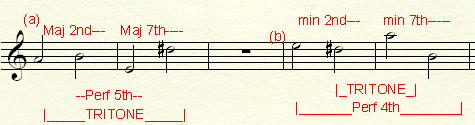
The Symphony I’d finished earlier this year grows out of a single four-note cell – see (a) – which consists of a rising major 2nd followed by a rising major 7th. Internally, there’s another pair of intervals, a perfect 5th and a tritone. By switching minor for major and reversing the pitches, there’s another shape that basically inverts the direction of the intervals – see (b).

I could also describe it as “a narrow interval followed by a wider interval” which might allow me to use a minor 3rd and a major 6th and so on to get a slightly different set of pitches, and by doing various things with directions and expansions create a fair bit of variety while sticking to a basically recognizable pattern. The pattern can become integrated into the texture as part of the line or the harmony until it’s almost subliminal, but it creates a consistency and cohesion to the music as it unfolds.

So I’m working on the next phrase of this rock-motive for the violin-and-piano piece which, as part of an inside joke, uses Shostakovich’s musical signature – DSCH – as a tag.

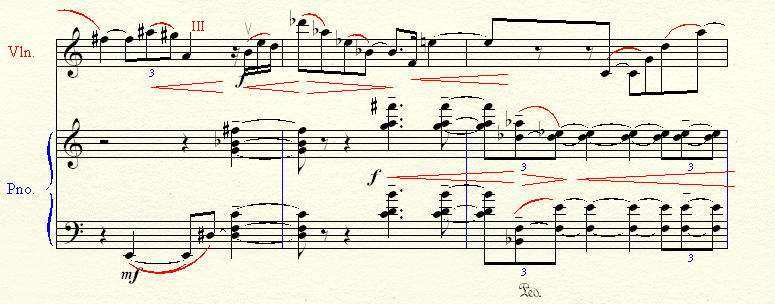
I was noodling at the piano – improvising on what I hoped might work – and came up with this:

That sounded cool, but I wasn’t sure if it “worked.” Then I started looking more closely at the pitches.

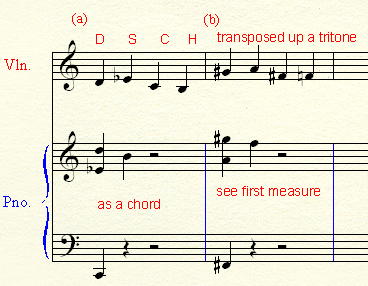
If I take the Shostakovich Signature and turn it into a chord, I get (a). If I transpose it up a tritone (my equivalent of tonic to dominant), I get (b).

Now, look at the pitches in the previous example... which I came up with purely spontaneously but which incorporates the DSCH-motive into the harmony. This became the opening of the next pattern – adding a violin “wail” to the rhythmic pattern turned rock-motive:
(Software disclaimer: since Finale NotePad doesn’t permit me to use meters like 7/8, I am stuck writing it out in 4/4 without the easier-to-read-and-play changing meters of 7/8 and 4/4...)

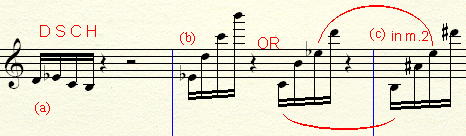
In the original motive, the violin played the 16th-note DSCH tag, but now that it was playing this counter-line, there wasn’t room for the tag, so I switched it to the piano part in measure 2. If you take the DSCH motive (a) – two minor 2nds a minor 3rd apart – turn them into Major 7ths (b) and then expand them in an outward direction, you get a shape – (c) – that is still a recognizable pattern because of its rhythm and its placement in the phrase but is also, more subtly, based on the same interval pattern.
In a neat analytical turn, all these pitches create hexachords that are the closest related sets to the primary set I’ve been using in the Theme & Variations and, so far, in the Scherzo. Which is good because otherwise, theoretically speaking, I would have to go back to the drawing board to find something that still sounds good but also works technically (like somebody’s going to say, “You know, Dr. Dick, there’s no relationship between the notes of the second chord and the notes of the first chord... minus 5 for you” - on the other hand, rules are made to be broken but first I like to make sure the rules don't come up with something better).

Anyway, recuperating from what has now turned into a cold (though not bad enough your computer is in any danger of catching a virus from me), it is time to get back to the piano.

Tuesday, October 10, 2006

From Draft to Sketch to... You

The morning was spent not so much trying to figure out my sketches for the first of these violin & piano pieces, but trying to figure out how to realize them into this NotePad version of Finale: true, it’s only meant for simple things – for instance, even as an example, it won’t let me write in 7/8 – but even just to hack out the first 20 measures of the Theme, it’ll give you an idea how it’s going.

So this is the first time I’ve published a real piece of my music on the web! (If you're hoping for audio, even in standard midi-ocrity, luddites move slowly when exposed to new forms of technology... give me time...)

Part of the problem I seem to be having with the notation software - beyond getting it all down in black-and-white - is consistency with triplets (especially on the 4th beat – argh!), but basically this is close to what I would be writing if I had the greater speed and flexibility of a paleopathetic pencil on premodern paper. That is, if my cat Murphy wasn't doing her Lassie impersonation ("what's the matter, Murphy, did Timmy fall down the well?")... It annoys me that it won't indicate a C-natural when there's a C-sharp up to a C-natural in another register, or that a G-sharp in the beat before a bar-line really becomes G-natural after it, but without it, it looks like it could still be a G-sharp, without the cancellation to prove it's not a mistake (fine in Mozart; hell in Schoenberg). But until I figure out certain details about printers and manscuript paper (can I find a printer that will handle the 12"x18" 30-stave paper I need for the Symphony?) as well as various other not-quite-FAQs, this is pretty much a WYSIWYG score...

The tempo is slow – 1/4 note = 60 – and it should be played flexibly and expressively. There are some bowing and phrasing things I need to work out for the violin and I can’t really work on the piano part AT the piano which is in a different room than the computer, of course, but short of some phrasings and pedal marks, that’s the idea of it, anyway.


From there, it moves into the First Variation... but that’s the work-load for today: now it’s time to head into the station. A beautiful fall day and it was a sacrifice to spend it cooped up on my computer getting this much done, but artists are made to suffer (and that's even before the premiere...).

Saturday, October 07, 2006

The Musical Joke Blues

"Oh I was listenin' to some Schoenberg..." may not be the best way to start off a blues song, but it reminded me of listening to some of Schoenberg’s “neo-classic serial” pieces like the 4th String Quartet with its Mozartean rhythms and starting an argument over the point of writing serial music still using “tonal rhythms” – since rhythms do not exhibit properties of tonality, what was I trying to imply? Well, basically that it’s the basic rhythmic fingerprints we associate with tonal music: if non-tonal music uses other surface elements of tonal music, doesn’t this create a kind of stylistic dissonance? One composer friend said “good point,” and another, a theorist, said under his breath something like “idiot.”

Novelists tell their students to “write what you know.” Composers, who as a rule were rarely given that same advice, have had access to a lot of different kinds of music, often “knowing” music that would not be considered classical. Just as composers in the 19th Century became inspired by folk-music, composers in the 1920s were inspired by jazz. When I was at Eastman, I don’t remember hearing too many composers influenced by rock music: that was not serious enough. I’m not even sure that many of us listened to it: jazz, certainly, but I don’t remember many evenings sitting around waxing euphoric about the merits of 1970s rock’n’roll.

My own musical tastes generally lie on the classical side of the spectrum. When I was playing a round of that once-popular game called “Trivial Pursuit: the Baby Boomer Edition,” I was appalled to find out 99% of the music questions that were coming up – aside from the one about Heifetz – were all about rock songs and performers. And that two classical musicians in the group could actually quote the fourth line of the third verse of some song by a group I’d never even heard of. What planet did I grow up on?

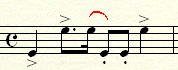
Anyway, listening to what’s going around me (“because it’s there” and virtually inescapable), I became aware how many times and in how many different contexts I was hearing this one persistent rhythm:

(It should probably be in 2/4 and I’m only indicating register rather than pitch, since it’s more of a percussive thing, anyway, but that’s basically it).

I’m sitting quietly in my living room when I hear it as some mobile boom-box serenades my street passing through long past midnight. On a sunny summer afternoon, the walls reverberate to it as my next-door neighbor fires up the sound-system (then fortunately turns the volume down). It’s in the background of commercials, it’s all over the urban soundscape. I cracked up when I was listening to the title song from Sondheim’s “Sunday in the Park with George,” in the razzle-dazzle spit-em-out lines, “well there are worse - things - than staring-at-the-water on a Sunnn-daaaay” (which is continually added to with more lines full of breathless 16th-notes) and there it was, in the orchestra. Boom! Chick-a-boom-boom chick!

But Sondheim got me to thinking: rather than being annoyed with it as I often am when I hear it in other contexts, this time I was smiling and my head was twitching to the rhythms. As predicted, it became the next day’s ear-worm and I found myself trying to figure out what to do about it.

Thinking back to Schoenberg writing a Mozartean string quartet, I wondered what it would sound like if I tried writing rock with my own harmonic language, using all 12 notes? Well, I found if I took these two hexachords

and used the first six notes (which Forte labels 6-Z3, inverted) for the first two chords, then took the other six notes (6-Z36, its complement) for the throw-away 16th note between the chords, what I had left over was a pattern of four notes spelling out the musical signature of Dmitri Shostakovich – D-S-C-H or D, E-flat, C and B-natural (using German note-names and spelling his last name with the German phonetic equivalent of the SH). Well, I cracked up on any number of accounts, here: it’s the Shostakovich Centennial, first of all, and John Clare’s been using the D-S-C-H motive as his ring tone, so it seemed a perfect fit: that became the violin part.

After all, this movement is going to be the “scherzo” (which is Italian for “joke”), so why not actually take it at face value?

So out of this, I got a one-measure pattern. Since I want it to grow into a progression rather than just sit there and go “boom-chick-a-boom-boom chick” forever, I wondered what else I could do with that. I looked for some transposition of the hexachord where I could still find the D-S-C-H motive (which also exists in the initial set of six notes) and I came up with a slightly different pattern but with the placement of the two hexachords switched. This produced chords built out of slightly different intervals and compressed its register. Now I have these two patterns.

Now, so to speak, I’m on a roll.

(Extra geekpoints to the ones who might have recognized 6-Z3/Z36 as the same hexachord for the harmonization of the open-strings motive in Example 7 from the Theme & Variations: it’s a closely related hexachord to the primary 6-Z25/Z47 hexachord, not just any old collection of pitches chosen at random.)

This is for the B-Section, but the problem was how to get there. There were various things I could do for the A-Section but nothing seemed to be suitable. It was either too fast, too virtuosic (hey, I have to be able to play this, myself) and above all too much the same high-energy level.

Then, as I mentioned in a previous post, my upstairs neighbor was playing his radio a little louder than usual one morning, some blues song, sweet and mellow. Then suddenly, erupting from next door, a blast of that “it’s-everywhere” rock rhythm – just a measure of it, then cutting out. Several seconds later, it cut in again, totally unrelated in key, rhythm or tempo to the blues song. Charles Ives would’ve been thrilled. That was when I got the idea to start the movement with a kind of bluesy ballad, then at one point the piano just starts flailing away with one measure of this rhythm, like “oops sorry, counted wrong, came in early” but then tries again a bit later before the violin just joins in and they let it rip.

That’s when I realized, looking at the hexachord (6-Z25/47) from the Theme & Variations, if I take the six-note set that gave me the first “open-string motive” and invert it

it becomes a blues scale – hmmm: well, if you start on D, actually, it is. Now, I’m not a frequent listener of jazz or blues, though I enjoy it (more than I can say for most rock music) nor am I conversant with its technical details: my intention is not to try to imitate blues or write real jazz (or for that matter, copy the Blues movement from Ravel’s Violin Sonata), but it seems kind of an appropriate gesture considering the violinist I’m writing it for enjoys playing folk music and blues with friends on a night out (but no, I don’t want to write for his pink electric violin).

Not so much as a sketch, then, but just an example of what I might be able to do with this idea, here’s a mock-bluesy line (the upper melody) which I thought I’d try “harmonizing” (my way) with the complement hexachord.

Then, for a second idea, a kind of standard blues cadence...

(“oh my pianist don’t understand me: I got the ol’ accompanist blues... oh-oh yeah...”)

True, Schoenberg wasn't trying to imitate Mozart's melodic and harmonic language using his serial techniques, but I find it interesting, given the pitch material I accidentally chose, that in this case I can - and some of it doesn't sound all that far-out (to me): not very good, maybe, but not all that far-out.

It’s a chilly autumn morning, the neighborhood is quiet (the houndentenor isn’t singing the blues this morning, either) and I’m going to hear the Billy Joel Piano Concerto tonight: I’m not ready to cross over just yet, personally, but it is time to get some work done.

Thursday, October 05, 2006

An Introduction to My Musical Language: Part 2

In yesterday’s post, I rambled about some of the basic details of the theory behind my musical style, what we usually describe as “language” though perhaps “dialect” would be more appropriate. Today, I wanted to get into a little bit about how this applies to the Theme & Variations I’ve just completed for the set of pieces for violin and piano which I’m composing for John Clare (he's all excited about it) and myself to perform some time next Spring.

Since Allen Forte lists 50 different hexachords, it’s difficult to limit yourself to just 2, so for this piece I decided to look at another pair and see what other kinds of possibilities I could find.

The first thing that came to mind would be something that would contain the notes and intervals of the open strings of the violin – G-D-A-E. I don’t use a lot of open 5ths or 4ths in my typical “language,” so I thought this would add a challenge for me. Part of the issue, basically, was my being attracted to the minor 2nd and its inversion, the major 7th, with whole steps, minor thirds and tritones next in frequency. In standard tonal language, the primary melodic intervals would be the perfect 5th, its inversion the perfect 4th, plus major and minor thirds since that also form the building blocks for the harmony, filled in by passing tones like major and minor 2nds as needed. So my melodic language also reflects the intervals used to build my harmonies as well, following the same logic. Now, with a lot of P4s and P5s (P4 = Perfect 4th), that will change my sound – subtly, to some listeners; hugely, to others.

So I found what Forte labels 6-Z25 and 6-Z47 (without explaining what the Z stands for, which marks other structural components that relate the two). The first one I tried has the open strings (Ex.1a) plus a major 7th (Ex.1b) (okay, let’s call that M7 - upper-case ‘M’ means “major”) which could also be inverted to a minor 2nd (m2 – small-case ‘m’ means “minor”). If I put that into an “abstract form like a scale,” you have the collection of pitches which I can now transpose to any other starting pitch (just like any scale) or create its inversion (but let's save that for another time).

Since I can put these in any order (just like the pitches of any scale), I can come up with a number of melodic possibilities: see Example 2. In (a), I’ve changed the open-strings motive to a series of P4s (same pitches, different order) and tagged it with (b), a descending M7 – it will sound different from the Ex.1a+b but they are the same pitches. This gives me a sense of unity but already some strikingly different variety. If I “mix up” the intervals (see c+d) or insert the M7 “tag” INTO the “open-strings motive” (see notes marked *), it’s still the same pitches but a different ordering and so it’s going to sound different. These can be transposed to other pitches just like any melodic idea could’ve been in 1800.

(By the way, don’t confuse “melody” with “melodic idea” or motive – Beethoven’s 5th starts with that famous “knock-at-the-door” motive but only after two statements of it does he actually build a melody out of it. Likewise, do not confuse “melody” with “tune” though we tend to think of them as synonyms these days.)

Now, if I form the “complement hexachord” from the other six pitches, I come up with Example 3a which still contains the open-strings motive (Ex.3b, now transposed to A-flat) but instead of the m2-M7 tag, it’s a P4-P5 (Ex.3c). This subtlety can come in handy later on. These two hexachords then become my basic “building blocks” just like a scale of a classical era piece, only here, rather than dealing with all the notes of the scale, I can focus on the attributes and potentiality of each half. In that sense, everything (more or less) grows out of six notes, not twelve (since the second half is really a different form of the first half).

If I haven’t lost you yet (and congratulations if you can follow this, whether you’re fluent in Classical Music Theory or not), let’s move on to Harmony.

If a “melody” is the linear aspect of the music, a “harmony” basically is a collection of pitches that form a vertical sonority. We’ve come to think of “harmony” or “harmonic” as meaning restful or pretty. Harmony is more, though, than just a chord: it’s really the language of how these different chords relate to one another, particularly to the tonal center of the piece (whether it’s in D Major or G Minor).

That was one of the things where people started getting lost even before the 20th Century: by weakening our awareness of that tonic center, we lose the element of resolution and so the other chords tend to become vaguer in what they’re “doing” there. Schoenberg did not invent this: in fact, the tonic centers in Wagner’s “Tristan und Isolde” move so flexibly when one resolution becomes a modulation to something else, people thought not only was the music “unhinged,” the composer was, too. But not even Wagner invented this: Mozart did it in the last movement of his Symphony No. 40 (I have read articles where authors discussed whether or not Mozart invented atonality) and Bach did it in something like his “Chromatic Fantasy & Fugue in D Minor” – in both cases, this being thrown out to sea (rather than to C Major) is an example of “extreme tension” which only strengthens the resolution finally to the home key.

So, if I group my six “abstract” pitches into “vertical aggregates” or chords, you will see or hear some that sound pretty gnarly and some which sound pretty familiar: in Ex.4, I list just six possibilities (and some of them the same with just the pitches relocated to create different “voicings” of the same chords), some of which can resolve to an A Major triad and others to a C Major triad. Or a chord built on P4s or another one all on M7s! But they’re all from the same six pitches, just different sounds.

In an earlier piece, I got the idea to start by focusing on the m2/M7-type sonorities but then, without changing the basic hexachord (or six-note scale, loosely speaking), refocusing it into more traditional sounding major and minor triads. In that way, the dramatic climax of my still un-named piece for violin and orchestra (originally inspired by the opening scene of Tolkien’s “Silmarillion” where the world is sung into existence) actually was a big loud C Major Chord – and then from there, the piece progressed back to the opening focus on the m2/M7s. That’s the idea, anyway.

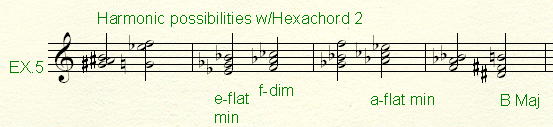
Example 5 does the same thing with the complement hexachord, where something that could work like a Dominant 7th chord in E-flat actually resolves to a B Major triad in the last example. The next to last one is interesting, too: the G-flat-to-F M7 would be an “active-sounding harmony” depending on how it’s used, but with whole-step motion in the outer voices, it resolves to an A-flat Minor triad: thus giving the G-flat-to-F chord an element of tension it might not have on its own, fulfilling itself into a “tonal-sounding” resolution.

Dissonance, after all, is in the ear of the beholder but just as “Harmony” doesn’t originally mean “pretty,” “dissonance” doesn’t originally mean “ugly” – played by itself, the major 7th could actually sound fairly resolved by comparison to what else might come before. That’s the point in the study of “Harmony” – the context is more important than the individual “harmony” or chord.

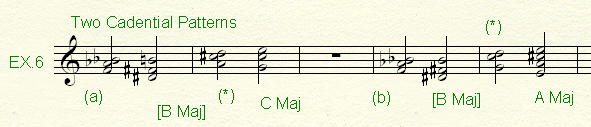
At the end of my previous post, I explained how I could create “harmonic progressions” out of cadences built out of all 12 notes, using one hexachord and its complement. Here, if I take the one resolution from the end of Ex.5 and follow it with either the C Major or the A Major resolution, I get two very different sounding cadences (see Example 6). Take particular notice of the next-to-last chord in each of them, marked with the (*). In (a), there’s a strong minor 2nd between the top note and the one directly beneath it: this makes it “more dissonant” or gives it “more tension” than the (*)-chord in (b) where it’s a MAJOR 2nd which gives it a less dissonant or active sound and makes (b) sound more final by comparison to (a).

Yet they’re the same pitches, just rearranged: and out of that I have the equivalent of either a half-cadence in the tonal sense (an A Major tonality with a cadence that doesn’t end on A, usually an E chord, its dominant) or a “Deceptive Cadence” where you expect it to end on A but suddenly it diverts to something unexpectedly foreign to A Major like an F Major Chord. That then strengthens my (b) cadence here as a more stable “tonic.” Depending on how I set up the context, of course, but out of an isolated example, you’re not going to sense that context (isn’t that what sound-bytes or examples are: taken “out-of-context”? And you know where THAT can lead you...).

Near the end of an earlier post, “Getting it to Work,” I mentioned one passage where I wanted that open-strings motive (melodic idea) played by the violin as harmonics on the open strings, supported by intervals underneath it (harmonic idea) played by the piano. So what I worked out was Example 7a. Later, I wanted to reverse the instruments’ roles, have the piano play the motive (in widely spaced octaves) with the violin playing double-stops in between. I also wanted the double-stops to include at least one open-string just to be kind to the violinist. What I came up with is Example 7b.

(By the way, if you’ve already noticed that the pitches of these six-notes do NOT form the same hexachord I was using in Examples 1 & 3, it’s actually a closely related one which is allowed as a kind of lateral-move, just as one could modulate to a particular key, but to explain that now would create more bamboozlement than it’s worth: suffice it to say, move to the Head of the Class, Geek, or, if you already know Allen Forte’s book “The Structure of Atonal Music” intimately, please keep in mind I’m not writing this blog for you...)

What I hadn’t noticed until the next day was the linear aspect of each strand of that passage in Ex.7b. Refreshing the “open-strings motive” in Example 8 and reducing it to an “abstract set” starting on D where the notes form a nicely symmetrical chain of intervals – M2, m3, M2 – then notice that the upper voice in the piano becomes the same chain transposed to F, the upper part of the violin’s intervals forms the same chain transposed to C-sharp, and the lower part of the violin is the same chain transposed to A.

Yeah, I know no one listening to it is going to go “oh wow, did you hear THAT?” That’s not the point: there are millions of comparable subtleties in music but it just means to me that the logic is much tighter than if I just arbitrarily chose a bunch of pitches to slam in there. Oh wait, basically that’s what I did: but it came out working logically as well as aesthetically and that, for me, is an important aspect of what strengthens it MUSICALLY.

Well, now I need to get started on the next piece, and I’ve already got some sketches started on that which I’ll save for a later post. As they say in radio, “stay tuned.”

(Or was it the conductor who said to the violinist, “stay tuned”?)

Wednesday, October 04, 2006

An Introduction to My Musical Language: Part 1

Since I’ve been writing here about the music I’m composing, I thought I’d take a few posts to write about my “musical language.” Yeah, there’s a Music Geek Alert here – caution: musical notation ahead – but I don’t have recordings I can excerpt to post on-line, an in-tune piano I can record sound-bytes on and I’m still trying to figure out the new music-writing software I just downloaded. So if you don’t read music, my apologies; if you have to drag your computer over to your piano to play them, sorry for that inconvenience, too.

First of all, my music is not “serial.” I don’t even like to call it “atonal” even though it uses all twelve pitches of the chromatic scale and forms chords and melodic lines that are full of major 7ths and tritones.

In a traditional tonal context, my music would be described as “dissonant” because it uses a lot of elements beyond the normal scope of the major-minor Common Practice system even as it’s used today. But in a serial context, it would sound “elementary” because it doesn’t go far enough in organizing the pitches into specific orders, combinatorial permutations (or at least consciously) or other technical details that are part of the technique.

After years of reading about composers abandoning serial music for tonality, I was least impressed by the observation that the system was too intellectualized and that the music was too devoid of anything remotely emotional. Coming from a composer, this tells me the composer is letting the system control the music. If the composer were controlling the system, the music would do whatever he or she wanted it to. You can be controlled by tonality just as much as you can be controlled by serialism, but there are certain ground-rules to each system and just as composers in the past have adapted and broken those rules to create the way they wanted to, a composer writing today should have the flexibility to adapt any other principals according to one’s own individual tastes. That’s what creates the composer’s voice or style which develops gradually over time, absorbing lots of different voices and experiences along the way.

But today we’re expected to be “original” from the beginning and any experimenting is dismissed as “imitation” before a young composer can even write enough music to allow those natural fingerprints to float to the surface.

It’s not like I’ve exactly chosen to “take my time.” After the Mother of All Writing Blocks, I’ve been struggling gradually to get back to that surface and see what’s left. Now I’m doing the work I didn’t feel like doing 20 years ago. It’s a slow process and it’s part of what this blog is all about, anyway.

Even though I never went so far as serialism, myself – more because I’m not intellectual enough for IT rather than vice-versa – I found I was missing things I could do if I were writing tonal music. Without a tonal context, things like sequences and modulations, deceptive resolutions and the frisson on a Neopolitan chord were lost to me. But I didn’t feel like I wanted to chuck it all and go back to writing like Schubert. I wanted to turn that strand-of-thought into the anti-thesis of my all-chromatic style’s thesis to come up with some kind of dialectic synthesis.

There must be a way, some common ground that would allow me to do this. And I thought perhaps if I go back to the pre-serial style of presumably “unorganized” atonality, I might find it. This would primarily be the music that composers like Schoenberg, Stravinsky, Scriabin and others were composing in the first two decades of the 1900s.

(Term clarification: atonal means "without reference to a tonal center" like C Major or D Minor; serial music is basically atonal but not all atonal music is serial.)

When I was still teaching at the University of Connecticut back in the late-70s when academic serialism still ruled the roost, I bought a copy of Allen Forte’s “Structure of Atonal Music.” Once I figured out his system of analyzing this music was not a serial one but only adapting serial methods and terminology (and this took a while, luddite that I am on more levels than the purely computorial), I became lost in the extreme mathematics of his approach. (I become easily lost in the extreme mathematics of any theoretical approach, I’m afraid...)

I began using some of his approach to unlock some new sounds and new ways of creating them, but not much of it: the results were very elementary, though a piano piece like “Poetries” which received its premiere at a Carnegie Recital Hall program by Rebecca Labreque in 1979 and which Galen Deibler performed at Susquehanna University in 2004, may not sound so elementary to the player or the listener.

To a full-fledged serialist, it would be comparable to taking the first few chapters of a traditional tonal harmony text book without getting into the refinements of modulation or even using secondary chords. (Come to think of it, that's comparable to what I did when I was 13 years old and just beginning to compose, before I’d had any theory lessons and didn’t know you could modulate, much less how to.)

Then, after more than a decade of total dormancy, I started writing again, quite unexpectedly, waking up at 50 and realizing I still wanted to be a composer when I grew up.

For some reason, I went back to Forte’s book and even though I still couldn’t make a lot of sense out of the more mathematical aspects of the second half of the book, I began realizing more about his method and how it could be applied to other composers but more importantly to myself. It is not, I need to point out, the system that those composers used: this is a theorist’s approach to how their music is organized but whether it follows the logic of the composers themselves or not is not the point. Whether Stravinsky and Schoenberg had “methods” to their seeming madness between 1911 and 1921, we’ll never know, but in examining their music, this is what Forte found and how he chose to describe it..

It's awkward to use old terms because that terminology is fraught with old definitions: "chord" brings with it the baggage of major or minor chords and the way they function from traditional tonal language, so this gives rise to more complex-sounding jargon like “pitch aggregates” or whatever.

So, Forte groups pitches together in various combinations and gives them codes to describe their content. While some listeners hearing Schubert might say “wow, listen to that Neopolitan 6th of V, there,” no one is going to say “wow, listen to that change to 6-Z47, there!” It’s an analytic tool and besides, everything has to be called something and it just makes more sense than calling them Fred, Betty, Ethel or George.

You can group six notes of the 12-note scale into a unit called a hexachord. If you take the “other” six notes left in the twelve-note chromatic scale, you come up with that hexchord’s complement. In that way, you've got all 12 notes but these pitches do not form a “12-tone row” in the traditional Schoenberg sense, where they maintain a specified order. Here, you can use them in any order you wish. You’re not even restricted to just those pitches, basically, since you can move from one starting pitch level (just as you can take a C Major scale and move it to F Major) or from one hexachord to another similar or related one. You can divide them to find various sub-groups and combinations.

At any rate, I realized that one of his hexachords which I particularly liked for some reason (see Example 1) could be subdivided into two of my favorite 3-note chords (it’s not a triad which is a chord built on thirds in the tonal system) which I used at the opening of “Poetries” plus another 3-note chord like it (see Example 1a). But those six notes could also be subdivided to come up with traditional major and minor triads, in this case a pair of triads a tritone apart (see Example 1b).


You can do the same thing with “the other six notes” or the complement hexachord (see Ex.2). This produces the same chords as Ex.1(a1) but transposed to different pitches and then inverted (Ex.2a) as well as major and minor triads a whole-step apart (Ex.2b).

This gave me an idea.

If I could start out with the non-traditional “atonal-sounding” trichords like Ex.1&2(a) and then move gradually to using the traditional tonal-sounding triads in Ex.1&2(b), I could use the same hexachord as my structural pitch source (the equivalent of saying “C Major Scale”) but write music that would sound, gradually, less and less “dissonant.”

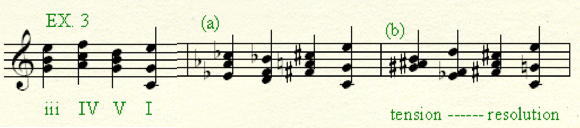
What I liked most, however, was that even though these triads sounded like tonal chords, they did not move in a tonal context: their roots moved in seconds and tritones, not seconds, fourths and fifths which form the backbone of Classical Era tonal harmony. In fact, if you take a C Major progression like iii-IV-V-I (see Ex.3) where the V-I is a primary relationship and the iii-IV and IV-V are secondary relationships, the IV-to-V is a whole step just like my first set, so if I consider the “secondary relationship” in this succession to be the chords of Ex.2b, then my primary relationship would be the tritone motion between the F-sharp Minor and the C Major triads of Ex.1b. This becomes Ex.3a.

If I wanted to go from a dissonant form of the secondary chords, I could use Ex.2a to create a certain amount of tension in this voicing, but resolve it to the triads of Ex.1b – which becomes Ex.3b. They’re all the same pitches, just re-arranged.

So, if that’s the equivalent of Dominant to Tonic motion in harmony, I could say C is my tonal center and F-sharp is my dominant. And suddenly I realized I not only had a chord “progression” on my hands (rather than just a “succession” of chords), something that could now move with the same inevitable sense of harmonic tension one senses in tonal music, I also had a substitute for the idea of tonal centers in traditional tonality.

How do I establish that sense in the listener’s ear? By repetition of the formulas and maintaining it logically in the course of the piece. Just like composers did 200 years ago.

And that was how I got back into composing again.

Next: how this works in the pieces for violin and piano I’m writing now: stay tuned.

*** ***** ******** ***** ***

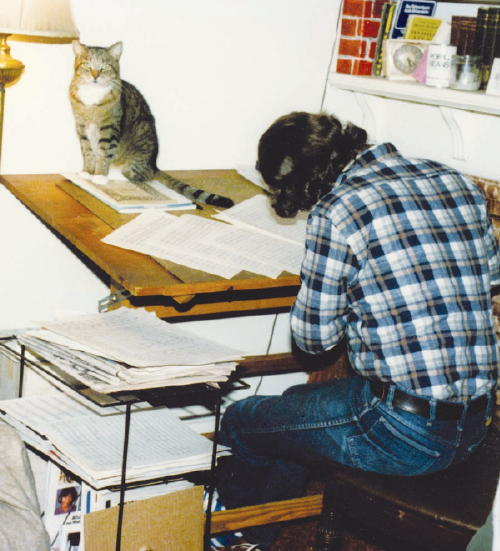
Image credit (from the private collection of Dr. Dick): the composer assisted by muse Roquefort, though it was actually taken during a spurt of creativity 20 years ago...

Thanks to John Clare for setting me onto Finale for their free music-writing "note pad" software which I downloaded last night and have just started trying to figure out. No, I'm not going to be doing full scores with this, but it works great for musical examples on the blog. Unfortunately, I can't get them to "play" for you just by the click of a coloratura mouse... sorry about that.

Saturday, September 30, 2006

The Next Step

After finishing the Theme & Variations that will open this set of pieces for violin and piano, my morning started off (once it officially started, cup of coffee in hand) by thinking about the next of the pieces. (I'll save copying out the finished one until I have a day when the creative juices aren't working that well: then it's time to get caught up on the paperwork.)

A composer’s mind needs to be receptive to any number of potential “next pieces” whether there’s a pile-up of commissions staring you in the face or just the free time to be able to concentrate on something new. My problem, after years of inactivity, is now dealing with all the things I want to write, a flood of possibilities for which (a) I have no performance outlet and (b) I may not have the luxury of time that I had when I was a grad student (without sounding too ominous, I’m not referring to “number of hours in a day” but more to “number of days in a life”). I should be so lucky to live long enough to write everything I'd like to write! If I could make it to 97 like Elliott Carter (who is currently finishing up a horn concerto before moving on to his next commission), that would be fine, depending. As it is, something tells me I might make it to January 18, 2038 – that would make me 88 then: nice round number for a piano-player – because I’ve gotten tons of spam ‘sent’ on that date (hey, if I’m going to look to modern technology for omens the way our ancestors looked to the heavens, gimme a break, okay?)...

The next piece is supposed to be the scherzo, something contrasting on the lighter side but not exactly what I’d consider a fall-down-funny kind of scherzo. Back in early August, in the midst of working out the details for the Theme, I kept hearing my neighbor’s rock music with its persistent beat. Then I was listening to some Sondheim – from “Sunday in the Park with George” – and heard that same beat in the background of the show’s title song. Noodling around at the piano, I found I could use that rhythm “my way” in a series of chords using 8 of 12 pitches and then realized, in one configuration, the remaining 4 pitches spell out Shostakovich’s musical signature, D-S-C-H! Well, to me, that was funny! Especially considering the violinist-in-question is using that motive as his ring-tone. But that’s where I’d left it at the time: come back to it, later.

Just the other day, wondering how to make that rhythmic pattern work as the middle section of the scherzo, my upstairs neighbor was playing the radio uncharacteristically loud, some mellow blues song just present enough to be noticeable. When suddenly, from the next door neighbor, I heard a loud burst of rock music in a completely different key – but it was just that rhythmic accompaniment warming up, then cutting out after a couple measures. At a different point in the blues phrase, the rock beat burst onto the scene again. And that was what I needed.

Before, I wasn’t clear what the opening section of this piece should be: too fast and scurrying meant I might also write something I couldn’t play (a very serious limitation to consider) and while various possibilities presented themselves peripherally, nothing really grabbed my attention. But the idea of something bluesy (and without being something borrowed, courtesy of Ravel’s sonata) was intriguing, especially since I’m not a listener of jazz or a lover of pop music in general to know how to do that. No, I don’t want to try to write real blues, just as I don’t want to write real rock music with that beat pattern: the idea will be to find some characteristics that I can use “my way” (without sounding artificial like One Big Tenor singing Sinatra) to create the mood, even if no one else really thinks of it as blues (not my point).

Years ago, I used to hear some natural sound and would automatically wonder how I could convert that into something musical, either recreating it with instruments as a special effect for a piece I’d be working on, or turning it into some kind of motive or theme. The high-point of this happened when a neighbor of mine inadvertently backed into my parked car and while she was apologizing profusely for the not terribly severe dent in my bumper, I was more interested in getting the right amount of percussion with the brass chord for the impact and a kind of rhythmic reverb with clarinets in the lower register. If she hadn’t known how weird musicians can be, she figured it out then.

But it’s no different than Beethoven watching a man galloping by on a horse and turning the rhythm of the horse and the bouncing of the rider into a musical pattern that became the last movement of what we know as the Tempest Sonata. Composers’ minds just work differently that way: anything is creative fodder.

So the A-Section of the scherzo will become some kind of bluesy melody that, near the end, will suddenly be attacked by this rock beat coming out of nowhere, as if a mistake (oops, sorry, counted wrong, came in early...). This may happen twice (more than that spoils the joke) before the violin just joins in. Then, after we’ve gone back to the bluesy melody, the piece ends with a quiet but taunting echo of the rock beat and the violin breaks off into a sudden “uh oh,” played pizzicato.

But part of the problem of free-associating when thinking about “something next” are the other ideas that distract you. While I’ve been toying with finding a soliloquy in Aeschylus’ “The Persians” and turning it into a vocal scene for mezzo and orchestra, the idea of what to do with these “Pieces for Violin & Piano” became more pressing. Now that there might be time to write four, I’m not sure the original idea of a central Chaconne/Aria works that well any more. There’s a span, here, that is spoiled by placing this scherzo second: but blues and the chaconne plus the opening variations and the closing nocturne then present too much of the same mood and tempo. Maybe I still need a contrasting faster section? Five pieces with the chaconne makes it too long, proportionally, given what's already composed – it would become a 21 minute work – but if I drop the chaconne and add the faster, shorter piece, it would now be 13 minutes and that might be more suitable. After all, it’s a collection of pieces, not a real sonata.

Then it occurred to me: the way I keep hearing the chaconne, I’m thinking it should be a violin solo with orchestra – it would be easier to sustain the chordal patterns and add variety to the variations – whether it’s 7 minutes or 12. Aaaakkk, put that aside – that’s way later! Let me finish these pieces first: then that... and the scene from Aeschylus... and then...

However, given the dreary day and the chill in the air, it’s time to turn domestic, do some chores and run some errands. Blah...

Friday, September 29, 2006

Getting It to Work

Yesterday, just around noontime, despite the best efforts of the neighbor’s houndentenor and the various distractions of an urban existence, I managed to fill in the last of the missing measures for the last of the variations in what is only the first piece of a set of three or four for violin and piano. It was a quiet and short-lived celebration – after all, it’s only part of the whole work and I had to leave soon for work – but that also means I’m ahead of my non-schedule which means I might also be able to consider the possibility of four instead of three pieces after all. Being out of practice in finishing pieces is one thing, but earlier in the month it looked like it would take forever just to get this one done (and it’s only supposed to be about six minutes long). I’ve already got some ideas for the next one – even the very ending is sketched out already!! – and this one, while shorter, is also less involved.

But the process is not done, yet, since I should now transfer the sketches into something a musician could actually play from – the scribblings in my notebook are only the first step from getting it out of my head and into your ear.

Every composer – and I’m beginning to feel that I can call myself that, again – works differently and at this point in my life, it’s working differently for me than it was when I first started to write music when I was a kid. Writing about Dmitri Shostakovich as a budding young composer or about the newest prodigy sensation, Jay Greenberg, hurrying to write the music down that he hears constantly in his head, I get kind of wistful for those days, myself, when it all seemed so much easier. I just sat down, maybe at the piano, maybe not, and started filling up the page: it was nothing, then, to write a song or a short piano piece or 20-30 measures of something for orchestra in one or two sittings, usually written directly into full score without need of sketches or rough drafts or writing it out for piano before orchestrating it into its final form.

Now, it’s more like work.

I don’t even really “hear” the music in my head to begin with, any more. I hear other people’s music in my head all the time – difficult to avoid, when your job is to program and play other people’s music at a radio station which is why I'm now a Morning Composer, writing my music while the brain is supposedly still fresh and uncontaminated before I need to hear other people's music at work (though this morning the music I’d like to tear out of my skull is the song “Edelweis” from The Sound of Music, who knows how it got there in the first place) – so now, rather than downloading my own music in what seems to have become slower than the slowest possible brain-to-hand dial-up connection ever, I try to find the ideas, sort out the musical shapes and “gestures” (not as in “yeah, well, gesture this!”) – those fragmentary possibilities that could give birth to a phrase, a melody or a well-placed chord – and translate them into something that works.

Perhaps that’s why artists call something they’ve created “a work” because it’s hard work getting a work to work...

I find myself deeply involved in the “language” of my style: whether it makes me Me or whether it’s just the consistencies of a style that I’m fitting into, I don’t know yet. At times, it seems every piece is a struggle to figure this out, but I’m beginning to notice that certain aspects of it are becoming more “second nature” now, leaving me time to concentrate on things I hadn’t time to notice before. After all, if you’re struggling with noun/verb relationships, it’s nice, suddenly, to sit back and contemplate, “let’s see, if I were to use the subjunctive, here...?”

There was a moment yesterday when I sat back in surprise at something written the day before. It’s from a “shape” that popped into my head while driving home from the station one night a couple of weeks ago.

The theme of this set of variations includes a motive based on the open strings of the violin – “perfect 5ths,” they’re called in the basic musical language. I can use these same pitches in different ways: to put them in some linear context (not that it’s much of a melody), you can turn this “shape” (from the bottom up, G-D-A-E) from 5ths into 4ths (ascending with E-A-D-G which is actually the same pitches in reverse) or, condensed into a closer framework and changing the order of them, to 2nds (D-E + G-A) or any combination or order (ascending or descending) or transposed (translated) to any starting pitch: the shape of it, the harmonic core of it becomes recognizable but maybe only sensed (or not) in different contexts. The whole point of variations is to take something and turn it into something else that is both the same and different: finding its recognizable elements and yet doing something with them to make it sound not-the-same.

(Speaking of shapes, one of the most famous melodies that Sergei Rachmaninoff ever wrote is from his “Rhapsody on a Theme of Paganini” which is really a set of variations on Paganini’s famous 24th Caprice: and yet all Rachmaninoff did to create that tune – the famous 18th Variation when everybody sits back and oohs-and-aahs at its natural beauty – was to take Paganini’s original, slow it down and turn it upside down. It’s probably more luck than genius, but I would loved to have been the fly on the wall at the moment Rachmaninoff, with his great granitic face, discovered what he found by simple, academic manipulation. Sorry if it takes the romance out of the idea of “inspiration,” but sometimes that’s how it begins.)

So, getting back to my paltry little shape which will create nothing that people are likely to swoon at, if the violin plays this little “open-string motive” as a 2nd (say, A-down-to-G) followed by a 7th, which is a 2nd inverted (say, E-up-to-D) and plays it in harmonics, giving it a particular sound, I can support that with simple chords in the piano that would be, like, really cool.

I was looking for something I could mirror that with, having used it a few times now in different ways already, only this time reversing the role between the violin and the piano – the piano plays the “open-string motive” in widely-spaced octaves while the violin plays two-note ‘chords’ in between. Given my harmonic language, I knew there were many combinations of pitches that could “work” here: the problem was finding the one that not only worked and was most easily playable but sounded best in the context of this passage. When I was done – and I don’t remember that it took very long to come up with this – I had something that sounded pretty good. I then went on to the next bit and forgot about it.

The next day, I’m looking back over this and discover, much to my surprise, that the three lines I had written – the piano line and the two lines of the violin’s double-stops – created three distinct statements of this “open-string motive,” each one transposed to different pitches and in different configurations, but all based on the same four notes and their intervals. Wow – okay, so it’s a purely Geek Moment, but still, that was, like, really cool!

Not that anyone’s going to sit there and go “Hey, listen to that: it’s that same melodic motive used linearly in each part!” It’s nice it works in terms of the language and sounds better than maybe a dozen other possibilities I could’ve tried. But now I know why it worked better: it was more a “part of the whole” rather than just a part.

Which means, I think, that the creative process is working internally again: I’m not doing all the work myself.

Wednesday, September 27, 2006

A Variation to Go

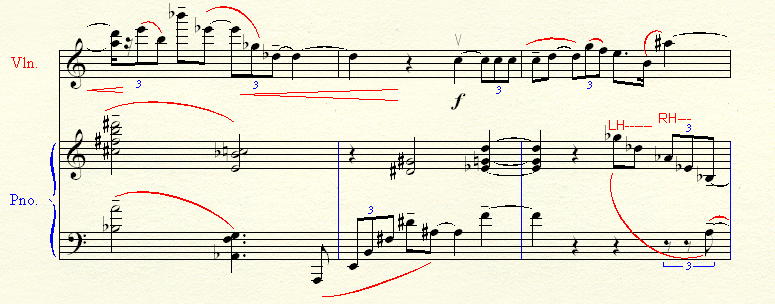
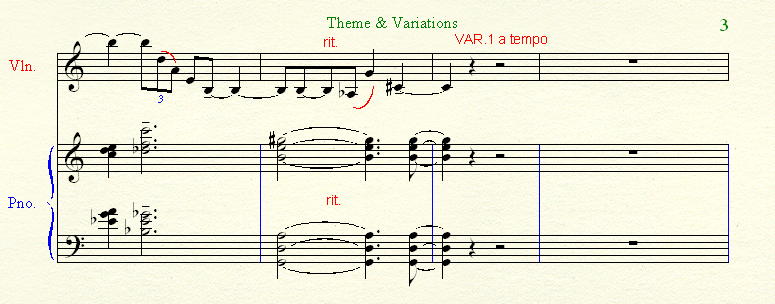
At the moment, I'm working on the first of three or four pieces for violin and piano. The first piece is a short set of “Theme & Variations” in an arch-like form where the 7th and last variation is a precis of the theme, more as a kind of reminiscence than a restatement. In that sense, the 1st and 6th variations become a pair, along with the 2nd & 5th and the 3rd & 4th – not mirrors or restatements, just more related to each other in some way (mood, certain motivic ideas) so the intensity builds up toward the end of the 3rd and beginning of the 4th but then decreases back to the opening’s calmness at the very end. The whole span is planned out so this climax occurs at the “golden section” and each pair of variations also falls into this proportional relationship. The whole piece is only about six minutes long, so the variations themselves are not fully formed, just little more than phrases, perhaps.

While it’s not tonal in the traditional sense, I’m using certain pitches that become “tonal centers” – and the harmony or melody can highlight those pitches in many ways similar to the standard tonal system of classical music. Though the chords may not sound like “tonic” and “dominant,” they serve a similar function where the harmonic motion is more or less intense, more or less resolved: in this way, I’ve come up with chord “successions” (if not progressions) that could still work like IV-V-I chords in C Major. It can also give me “deceptive resolutions” (IV-V-vi, where instead of resolving to C, it resolves to an A Minor chord, or IV-V-bVI, to a totally unexpected A-flat Major chord) once the pattern is set up enough so a listener can hear what is expected and what is not – or one possible resolution that prolongs the need to resolve followed (eventually) by a restatement of that chord succession with a more satisfying resolution.

For this piece, the tonal center is G, but for me the dominant is not the traditional perfect 4th or 5th, D, but a tritone, C-sharp or D-flat. This makes it a little tricky because the tritone to C-sharp is G which means both pitches are in the same relationship to each other which makes it difficult to move away from that to any other pitches or chords. Since the traditional system places chords built on different pitches of the major or minor scale in varying degrees of tension to the tonic (basically in the IV-to-V-to-I formula), part of the choice in finding the “right chord” or the “right pitch” here is discovering and developing similar relationships and logic in my non-traditional-sounding harmonies and melodic lines, not just throwing down pitches and chords here and there that, oh, sound pretty good I think.

So the 3rd Variation, I’d decided, would be a kind of recitative, an operatic formula where the vocal line is not necessarily melodic but is based on speech-like inflections (it developed from pure spoken lines) supported by chords that are used more like punctuation – musical commas and semicolons that only reach the final period at the end of the paragraph. The problem had been to find those chords in the right sequence and then once the framework was in place, “fill in” the violin part based on the main motivic elements of the original theme but not in a thematic way, just a linear one.

In opera, a recitative is an introduction to an aria, and so the plan was to have the next variation be a kind of aria, or at least more lyrical. But since the start of the 4th Variation is also the structural climax of the piece marking the high-point emotionally and from here, like a mirror, everything works its way back to the opening, I wanted to reverse the roles of the instruments. Since the piano starts out playing an entirely supportive role to the violin, at this point it is the piano that takes over the melodic function while the violin plays the harmonies (listen to any Mozart or Beethoven violin sonata and you’ll hear the same thing). And I wanted the piano playing widely spaced octaves with a melodic line that uses the main theme’s two basic motives but spins them out slightly differently.

So that’s where I am this morning. After spending the last two days blogging about Shostakovich, today’s the first morning I’ve had to compose since the weekend: so far, I’d sketched out the opening phrase’s melody, working out some harmonies for the main motive which can be played on natural harmonics on the violin’s open strings, and written in the mid-point’s “half cadence” and the ending’s “full cadence,” keeping in mind how this variation is supposed to fit in as the whole piece works its way back from the dominant center to the tonic center.

Back to the piano - one variation to go, please (you want fries with that?) - and the piece is done.

Tuesday, September 26, 2006

Update on a Cat

Just to let you know, Houdini - the stray cat who came into my life last weekend - has landed in a great home. He passed his vet's experience with flying colors (completely healthy as well as now no longer much of a ladies' man, so to speak) and found a doctor to live with, in what sounds like a very good match. He certainly knew how to put on the charm and didn't have to work too hard to convince them to adopt him. So now he's safe, in good hands and one hopes no more in need of showing off his escapist skills.

Now to catch the two wily street cats who've been coming to my back porch all summer, Farrell and Frieda. They've been showing up together every night for the past week or so, usually sitting there waiting for me to get home and feed them. Even though Farrell still tends to eat and run, Frieda has taken to hanging around afterwards and curling up on a shelf on the side of the porch after a good wash. Both of them have been pretty skittish, though, so I'm not sure what it will take to coax them in.

A neighbor called Sunday and left a message for me: seems she has a young female ("petite," probably not a year old yet) who's brought her two kittens on to her back porch, looking for hand-outs. Am I in the market for some new cats, by any chance? Well, uhm...

So I alerted my other neighbor who'd helped me with Houdini to get yet more wheels set in motion.

Meanwhile, between blogging about Shostakovich on his 100th Birthday Anniversary (not to mention looking into the harrowing events going on around him when he wrote the 5th Symphony) and a busy weekend with concerts to attend, I've been trying to get some more composing done: looks like I'm pretty close to being finished with the last variation, but then just as I say that, I'll look at it tomorrow and toss much of it out (this is part of the natural process we call 'decomposing'). Most of it is worked out "in prose," using descriptive text to remind me what I want to do musically. Perhaps tomorrow, I might post that just to let you know what's going on, here. But then I really need some music-writing software so I can post the final results or least scanning the original manuscript. Then you can see if the musical sketch bears any resemblance to the first ideas I'd jotted down. But that's part of the fun of composing (which makes up for much of the time when it isn't exactly fun).