Showing posts with label mozart. Show all posts
Friday, June 29, 2012
The Doomsday Symphony: Chapter 55
In the previous installment of The Doomsday Symphony, the conductor Rogers Kent-Clarke, his cohort Schweinwerfer and their hostage, Xaq, are trying to reach the Time-Gate so Kent-Clarke can return to Earth with Mahler's symphony when they run into the legendary 'Old Man of the Mines.' Meanwhile, we return to the Hague in 1765 as Klangfarben and Kedaver chase Mozart through the royal palace.
*** ***** ******** ***** ***
Chapter 55
*** ***** ******** ***** ***
No sooner had I motioned to our friend, Johan van Gyllenhaal, than he turned around to see Klangfarben and Kedaver glowering at us.
“What a bitch on skates she must be! Follow me,” he said, taking Mozart by the shoulder and guiding him forward. “Come, Master Mozart, I want to show you something special – it’s in the Music Room.”
A few words to a servant helped us skirt around the buffet table where Mozart picked up some crème-filled pastries and stuffed them into his pockets, munching on marzipan as we headed toward a back door.
In the hallway, we ran quite literally into the footman again who was about to call other servants to apprehend us and have us expelled, but Sauerbraten explained we were looking for him – to warn him.
“There’s a woman all in black, mounds of silver hair, with a tall thin man – we think they’re going to attack the prince!”
With a gasp, he thanked us, called after some servants who disappeared into the room. In seconds, there was the sound of a scuffle and Prince William was pushed through the door which slammed behind him.
“Ah, Gyllenhaal, there you are,” he said, straightening out his vest. “Does anyone know what’s going on? Brekkerman said something about an attack.”
I explained we weren’t sure what we’d overheard her saying, but she was out to kidnap someone, either the Prince or Mozart. Just in case, we thought it best to get both possible targets to safety.
“Kidnap? Right here in front of everybody? Those French agents are getting very bold – or very desperate.” The prince motioned us forward. “Follow me – if we’re going to hide, let’s hide somewhere good, like the kitchen!”
He explained how his family’s been dealing with threats like this ever since he became the Netherlands’ designated “Stadtholder” when he was three.
“One regent after another,” he said, “and the political issues, not just those inside the House of Orange, get nastier every year.”
Gyllenhaal looked at us in alarm: we’d told him Klangfarben was after Mozart’s father.
“Mmm, oranges,” Mozart said, his mouth full of candy.
“And I shall give you one in just a moment,” the prince smiled.
As we entered the kitchen, Gyllenhaal grabbed me and hissed, “what is going on?”
“My beautiful Katje,” the prince said, giving one of the maids a quick kiss, “how about an orange for the boy?”
Katje giggled.
I told Gyllenhaal how Sauerbraten overheard Klangfarben saying something about killing someone: we didn’t want to take any chances. After all, why kill a mere boy? Perhaps they were using Mozart to get to the prince?
Katje gave the prince the plumpest orange she could find which he then presented to Mozart who marveled at its size and roundness.
Making up some story about Klangfarben possibly representing some creditors from Augsburg, Leopold’s hometown, I mentioned we’d heard they must have run up quite a hotel bill before they left: perhaps it was really nothing more?
“But still,” the prince conjectured, “why would they talk of killing the boy,” whispering over Mozart’s head, “or for that, attacking me?”
“Maybe,” I hinted, “their plan is more sinister, Leopold Mozart’s debts merely a cover?”
Meanwhile, Mozart, eying up a trayful of those elegant crème-filled pastries, stuffed a few more into spare pockets. He pretended to ignore us.
The footman named Brekkerman, eyes bulging and chest heaving, dashed into the kitchen in great anxiety, pressing his back against the door. Everyone in the kitchen hid their amazement, focusing on the business of preparing dinner.
“Ah, Prince,” he barked between gulps for air, “escaped… chasing you… hide…”
Katje held a ladle of cold water to the footman’s lips.
“Come on, then!” The prince bounded off.
Gyllenhaal grabbed Mozart around the waist and raced off after the prince, Katje pointing the way.
Sauerbraten and I could barely keep up, afraid we’d easily lose sight of them.
Back into the maze of corridors, past walls filled with paintings and servants lighting candles against the growing gloom of the day, I assumed we were headed deeper into the center of this vast royal palace. Around the corner, we could hear the clatter of high heels on wooden floors and there, heading toward us, were Klangfarben and Kedaver.
Our only course was through the music room, then back into some other hallway. Could we reach the outside to make an escape or find some inner room to hide in until the footmen caught them?
They were gaining on us as we charged toward the music room. Mozart, balanced on Gyllenhaal’s hip, held his mirror medallion up and threw the crème-filled pastries back at her, one after the other, making explosion-like sounds as they landed on the floor in her path. Unable to stop, she slipped and fell, slamming headlong right into the harpsichord.
With a scream, Kedaver, leaping over Klangfarben, got tangled in her hair. Holding the syringe in his hand, he lunged at Mozart.
But instead of the boy’s arm, its deadly contents emptied harmlessly into the orange.
Nepomuk leaped forward just in time to tackle Kedaver around the knees, bringing him down with a great crash and a bone-shattering groan.
Before he could recover, I grabbed one of his time-devices, going through his pockets till I found the spare, leaving them with only one.
Immediately, each device began to beep their dire warnings.
“That sound,” Mozart said, “amazing!”
“Uh oh, time to leave, folks – your battery’s getting low.” I held Sauerbraten’s home-made device up to show them. “Mine has better batteries.”
Klangfarben struggled to her feet, lunged forward but once more slipped and fell.
“Don’t leave me here, you filthy bastard,” she screamed, barely able to grab hold of Kedaver’s foot before he pressed the Return button.
As a dozen servants barged into the room, seeing the mess, Klangfarben and Kedaver both disappeared, leaving behind one of Klangfarben’s shoes.
I apologized for their escape, but said there was nothing more to worry about.
Holding up the syringe, I tossed the orange to the wide-eyed prince, telling him to have it destroyed because they’d poisoned it. “It’s fun injecting them with vodka – like eating a screwdriver – but this’ll kill you.”
I also apologized – it was time we should be leaving.
“Vodka? Screwdriver?”
Glancing among themselves, they looked back only to discover we’d disappeared.
= = = = = = =
To be continued…
- Dick Strawser
The novel, "The Doomsday Symphony," a music appreciation thriller written between 2010 and 2011, is the sole supposedly intellectual property of its author, Richard Alan Strawser.
© 2012
Wednesday, June 27, 2012
The Doomsday Symphony: Chapter 53
In the previous installment of The Doomsday Symphony, Zoe Crevecoeur thinks back to various problems in her life, dealing with her career, her ex-husband, raising her son. Meanwhile, we return to the Hague in 1765 as Dr. Kerr and Sauerbraten sneak into the palace to avoid Klavdia Klangfarben.
*** ***** ******** ***** ***
Chapter 53
*** ***** ******** ***** ***
A courtly servant, closing the gate where coaches entered to stable their horses, assumed we were also servants and locked it behind us. Too casually dressed for the main entrance, we managed well enough until an officious-looking footman approached us, stopping us with some suspicion just as a small group of aristocratic yet equally casually dressed men walked past.
Identifying himself as the personal secretary to Count Henrik van Wassenaer, Gyllenhaal introduced Sauerbraten and me from the Imperial Court in Vienna, as friends of Johann Chrysostomus Wolfgang Theophilus Mozart, musician to the Archbishop of Salzburg.
“So many names for such a small musician,” one of the noblemen turned to us and said, waving the footman away.
I noticed how the footman, bowing obsequiously as he left, still eyed us with suspicion.
“Ah, my lord, perhaps a small person but already a great talent,” Gyllenhaal said, bowing courteously. “Who knows what the future may bring.”
“My lord,” I added, imitating Gyllenhaal’s bow as best I could, “few of us may knowingly comprehend that future, but young Mozart, here, I’m sure will become a man well known to many in the world.”
“Indeed, you think so? Such an unassuming little boy.”
Sauerbraten said, seeing Mozart flush, “You have not yet heard him play, I gather?”
“No, dear sir, I cannot say I have, though my wife has, when he first arrived in town over a month ago. She talks of practically nothing else, since. I was expecting somebody older, perhaps more… geniusy…”
With a hurried but luxurious bow, Gyllenhaal introduced us to the Prince of Nassau-Weilburg, Karl Christian, who, his own territories aside, was the husband of Princess Caroline, our hostess, his gesture encompassing the palace around us. As the older sister of Prince William, he told us, she served as regent until the Prince of Orange turned 18 next year.
Any further confusion on my part, unused to addressing royalty like Sauerbraten and, even for his tender years, young Mozart, was allayed by the hurried arrival of Count Henrik, apologizing for being late to the party.
“No problem, my dear Henrik.” The prince greeted him casually. “I have just been introduced to your little prodigy here, the one you and my wife have been filling my ear with, these past several weeks.”
“Oh yes, Herr Mozart,” the count said, extending his hand to the boy. “How is your poor sister feeling? Better, I have heard.”
“She improves daily, my lord,” Mozart answered, taking his hand, “and sends her best regards and deepest apologies for having caused such a mass of inconveniences which you have so graciously taken care of for us.”
For being only nine years old, Mozart was well versed in politeness. Small wonder he’d won the hearts of royalty across the continent.
Smiling, Count Henrik whispered something in van Gyllenhaal’s ear which did not, I noticed, make our friend smile, but rather a glance he darted at the boy made me think was not in his best interest.
“I hope your sister will soon be able to join you for a performance before the court, Herr Mozart,” Count Henrik continued. “When that event occurs, I’ve asked young Gyllenhaal to inform my uncle, Count Unico.” For the new arrivals’ benefit, he explains that Unico van Wassenaer loved music, even composed a good bit himself when he’d been younger.
“Unfortunately, once the weather gets colder, my uncle – he’s very frail, now,” he turned to tell Karl Christian, “just turned 73 – he’d be reluctant to leave his palace for the trip into town,” he told Mozart.
“I would like very much to meet him, sir, and perhaps hear some of his music, or at least study a few scores.”
“I think that could be arranged,” the count said. “Would you like to play a little for the Prince, today, so he’d have a chance to hear you?”
The prince, however, resisted, waving the idea away.
“Perhaps later,” he said, shrugging his shoulders apologetically toward the boy. “We are already late for my wife’s garden party. Come – please join us, since you are here. You, too,” he said, indicating Sauerbraten and myself.
“It is always good to have new players joining in the games.”
“Games?”
“She likes converting the winter ballroom into a summer garden.”
And that’s exactly what she’d done. All around us were pots of brilliantly colored flowers, mostly tulips of several varieties, with numerous trees of various sizes creating pathways between sculpted mounds of dirt and coffee beans.
In the midst of all this, strolling around, were several women and a few other noblemen, dressed “casually” mostly in shades of white or light brown, very summery looking despite the chill in the November air.
“Ah, Master Mozart,” the most elaborately dressed of the women said as she approached us. “What wonderful fun that you have joined us.”
This was Princess Caroline, we were told, who most graciously invited Sauerbraten and me to join them, though I demurred, excusing myself for being terrible at playing games.
“All the better,” she said. “No ceremony, here.”
A young man all in white with gold trim joined us whom the Princess introduced as her brother Prince William, Holland’s future ruler.
He greeted us warmly, bowing deferentially when the Imperial Court was mentioned, and clapped Mozart warmly on the back by way of welcome.
Taking her husband by the arm, Princess Caroline announced the game should now begin.
The indoor garden was set up with gaily painted wooden balls spaced around the different paths where I could see small iron hoops. Servants were passing out distinctive mallets, equally colorfully painted, to each of us.
“Croquet!” I blurted out but they regarded me like I spoke in tongues.
“What, pray tell, is this ‘crow kay’ you speak of?”
“Sorry, my lady,” I said, pausing to find an explanation. “It’s a game we played back home. What do you call it?”
“It’s called ‘paille-maille,’ all the rage now, but not the way we’ll play it.”
She proceeded to explain the rules-of-the-day: instead of working toward the final score, everybody began with a perfect score and worked backwards. Instead of earning a point, for a well-played stroke, you would lose a point.
“The winner, then, would be the first person to reach zero.”
“Everything is backwards!”
“Everything, my dear Mozart. And we play backwards, too.”
At her signal, the footman who had viewed us so suspiciously before now walked in holding a large ornate mirror, one tall enough to reflect the whole person. This, the Princess explained, would be held in front of us, like so, but we must hit the ball with our mallet, like so, so that it rolls behind us – backwards!
“A perfect game for the Kingdom of Back,” Mozart delightedly told us, mentioning the imaginary land he and his sister played in so often on this long journey of their childhood. “Wait till I tell Nannerl!”
“Considering Prince William is the first among us,” she continued, “this time, he should go last.”
He bowed deferentially, grinning broadly.
“That would mean,” he said, “the youngest should go first: clearly, that would be Mozart.”
Matching the color of mallet to ball, Mozart gallantly looked into the mirror and hit the ball backwards right through the nearest hoop.
Sauerbraten went next and muffed it, his ball curving to the left of his hoop. I followed and the footman holding the mirror raised his eyebrow in a look that said, “don’t pretend you’re an aristocrat.” I winked at him, making him stand back rather surprised as I tapped the ball which then didn’t go anywhere near my hoop.
The line then went through the court, from the youngest of the ladies to Prince William who, other than Mozart and van Gyllenhall, was the only one to score – or, more accurately, to deduct from their score.
After the second round, the Princess announced anybody who missed their hoop must drink a glass of wine – or in Mozart’s case, punch since she didn’t know if his father would quite approve his drinking wine. Though Mozart was disappointed, perhaps it was better not to promote incentives to start missing points. It was clear he wanted to win.
By the sixth round, some of us were rather tipsy, not caring we had so far failed to lose points at all. Mozart, meanwhile, was well ahead of the pack, the prince only slightly behind him.
The princess, slightly unsteady on her feet after having been disappointed to lose only one point, proclaimed Mozart the winner who, even without benefit of wine, professed to her she was the Queen of his Heart.
With great ceremony, Princess Caroline placed a small medallion around his neck, a gold-framed mirror honoring his victory in their game of “Backward-Ball.”
Prince William and Count van Wassanaer stood on either side of the young winner, holding their hands to their mouths and pretended to blast a trumpet fanfare in his honor which unnerved the boy at first.
I read somewhere that as a toddler, Mozart had been frightened by trumpets, so laughingly, I motioned for them to stop the fanfare.
The princess announced it was time for some food. Raising her glass, she saluted her guests: “Let them eat caca.”
Mozart giggled.
While many gathered around to admire his medallion, others left to investigate the buffet.
As Nepomuk and I stood with our backs to the ballroom’s grand entrance, I caught a glimpse in Mozart's medallion of a passing mass of platinum blond hair.
Grasping Sauerbraten’s arm, I whispered, “Klangfarben has arrived.”
Since she’d never seen Sauerbraten before, he wandered over toward her, hoping to catch whatever she and her companion, Abner Kedaver, were discussing.
Kedaver, leaning forward, was telling her he had the syringe prepped and ready to inject the boy if he could get close enough. As potent as the virus was, it would look like he had just come down with the same illness that was affecting his sister, only in his case, he would die in a matter of days.
She saw Mozart before realizing who’d moved in front of him to block her view. The look on her face – spitting rage – was worth all the day’s aggravation.
But now we had to leave – and quickly.
= = = = = = =
To be continued…
- Dick Strawser
The novel, "The Doomsday Symphony," a music appreciation thriller written between 2010 and 2011, is the sole supposedly intellectual property of its author, Richard Alan Strawser.
© 2012
Saturday, June 23, 2012
The Doomsday Symphony: Chapter 50
In the previous installment of The Doomsday Symphony, SHMRG's Man Kaye prepared his biographical feature on Mozart with a none-too-biased eye. Meanwhile, Dr. Kerr and Johann Nepomuck Sauerbraten have arrived - somewhere...
*** ***** ******** ***** ***
Chapter 50
*** ***** ******** ***** ***
"So I set the time-coordinates for a little bit earlier than Klangfarben's to give us more time to figure out where we are and who we're looking for," Sauebraten explained as we found ourselves standing in the middle of a busy street somewhere in 1765. "We'd have to arrive before she killed him, otherwise it'd be too late, right?"
"Wait, if we're looking for Mozart, that wouldn't be a problem: I mean, he's Mozart," I said, looking around trying to get my bearings. "We should be able to track him down without too much trouble."
"So, if we can remember him, now, that means we're in time." Sauerbraten gave me a high-five which must have looked strange to the good people of wherever we were, assuming anyone might have noticed us.
"Incidentally, there was a little more turbulence than I remember from the other times – you may want to make some adjustments for that."
Wherever we were, it was a chilly autumn day in 1765, judging from the feel of things in the air, looking at the way people were dressed. That meant Mozart was not yet ten and the family was somewhere in the northwest corner of Europe, between their trips to London, Paris and Amsterdam before heading back home to Salzburg.
"Let's just look around," I suggested, "and see where the Mozarts are giving concerts."
"There has to be some buzz happening..." Sauerbraten sighed.
Odd expression, coming from someone born only twenty years from where we stood now.
Given the time-device's instant translation technology, I could understand everybody around me, so we couldn't figure out our location just by listening to what the locals were speaking. Some of the signs were in German, French and Flemish, so we were probably somewhere in the Netherlands – let’s see, were they Spanish, Austrian or independent in 1765? I couldn't remember.
We stood in some kind of square not far from what looked like a large palace. Most of the people looked aristocratic – there were also a few soldiers standing around, making me feel a bit uneasy.
"We're not going to be in the midst of any battles, here, are we?" I wasn't keen on another adventure like Dresden in Wagner's day.
"No," he said, looking around, "things seem pretty peaceful, today, considering how violent the history'd been for centuries, here."
"Let's ask these guys over here: they look like they'd probably be interested in music."
"Mozart?"
Four gentlemen, all comfortably dressed, peered at us with some amazement.
"You haven't heard?"
"Heard what? We just arrived in town," I explained, "heard they might be here."
"Sad story, that," the older one nodded.
We were still too late? How could that be, if Nepomuk got the coordinates right?
Another one explained that he was a friend of the countess' physician who'd been called in to treat the daughter.
"Intestinal typhus," another said, shaking his head sagely.
“As soon as they arrived, the sister became terribly sick, right to the brink of death.”
The concerts they were planning had all been canceled. Even the private audiences they were to have with the prince were postponed.
"I'm afraid you've come to town for nothing, my friends." And with that they started to move away from us.
"Wait, please" I asked, perhaps a little too desperately, "does anyone know where we could find them?"
They seemed to buy my excuse that we were friends of their landlord's back in Salzburg, just wanting to pay our respects – maybe offer some help – as long as we were stopping by in the neighborhood.
Some horses clattered past, a little close for my comfort, making it difficult to hear what they'd said, but one pointed the way.
"Here comes my friend Johan van Gyllenhaal," the youngest of the four said. "He's with Count van Wassenaer's household – he’d know." And with that they introduced us to a personable young man with piercing blue eyes.
He bowed deferentially – did we look that foreign or that distinguished? – and explained he was just going to where the Mozarts were staying. The Count, a personal friend of the Princess Caroline's, had volunteered his best townhouse, closest to the palace, for their use while they're in town, though in one sense they'd already long overstayed their welcome. The count was impatient, hoping to occupy the place himself before the winter set in. If he were needed at court, young Gyllenhaal whispered, the last thing Count Henrik wanted was to be stranded in the country.
"This whole trip for them," he explained, referring to the Mozarts, "has been a disaster. First they leave London and arrive on the Continent to bad news their Emperor has died – he had been very kind to them in Vienna. The father had been ill in London and then the boy was sick with something – tonsils? I don't recall..."
Our new friend was a fount of information, explaining how the father became sick again, complaining of dizzy spells or something, but that despite a cold, the son must have played on every church organ from Lille to Antwerp and Rotterdam. Then no sooner did they arrive in The Hague than the daughter, now, comes down with a cold.
"What bad luck" he said, since she could not be presented at court. "It hurt her deeply, such a pretty girl, just becoming a woman..."
By this time, we'd arrived at the house: quite an imposing façade.
"And that's only the start of it," he concluded, indicating he would leave us now. "The Mozarts are on the second floor," he said quietly, pointing up the steps. "Despina can introduce you – she’s one of our maids, looking after the Mozarts."
A young dark-haired woman, plainly dressed and full of curiosity, appeared at the top of the steps.
"Excuse me," I said, hating to be such a bother, "but I was wondering if you could... well, tell us: what is the date, today?"
"Why, I believe it's the 14th," his brow furrowing in curiosity.
"I'm sorry," I laughed, "we've been so long on the road on our way to Amsterdam, I can't remember if this is October or November!"
"Trust me, it's already November," he smiled and turned to leave.
I thanked him for his generosity and all his news, bringing us up to date on our friends – well, friends-by-way-of-friends, I corrected myself.
"Ah, one more thing," I said, placing my hand on his arm, "you haven't by chance noticed a rather handsome woman, young despite her silvery hair...?"
He looked confused considering any respectable young women would be wearing the fashionable white powdered wigs.
"No, this," I emphasized, "would be unlike any wig. Well, if you do see her, uhm... how do I put this," trying to make it sound even more mysterious, "she is a secret emissary from Leopold's mother in Augsburg and there's some nasty business I've heard about, though I'm not sure what, exactly."
He looked shocked.
"Oh no, please, nothing like that," I assured him, whatever he thought "that" may have been. "But still, would you try to delay her from going up to see them? It could be very uncomfortable for the family to have to deal with, at a time like this? And she might be here any minute, now."
Looking worried, van Gyllenhaal said he would alert the footman not to let her in, since the child was too sick for the family to have more visitors today."
I smiled and thanked him profusely.
"What exactly was that all about," Sauerbraten wanted to know as we climbed the stairs to the waiting maid.
"Buying us time," I whispered.
I remembered it was in The Hague that Nannerl had fallen sick and nearly died but as she began to recover, then Wolfgang fell ill – and that was on November 15th. We were barely just in time.
“Are you the maid, Despina?” I asked.
The young girl curtsied, telling us that both parents were in with their daughter. Their son, meanwhile, could be heard practicing on the harpsichord in a room further down the hall.
Sauerbraten was clearly smitten. Despina stood about his same height and had thick auburn hair pulled back tightly under her cap.
“Are you from the Court,” she asked politely, eying up Nepomuk in particular.
“Actually, we’re friends of a friend of the Mozarts in Salzburg, Johann Hagenauer.”
“Yes,” Nepomuk added, “we’re just passing through and thought maybe…”
Leopold Mozart stuck his head through the door, looking somewhat annoyed.
“I was going to complain about the noise but then I heard Hagenauer’s name. You say you are friends of his?”
“Through business,” I nodded.
Introducing my companion as Herr Suaerbraten and myself as Herr Kränlich, I explained we were merchants employed by the Imperial Court in Vienna.
Leopold beamed at my mention of the Imperial Court, then immediately expressed his sadness over the recent death of the Emperor Franz, leaving Maria Theresa a widow. He had fond recollections of their friendship and support.
I explained how we were traveling to Amsterdam on court business and just happened to hear the Mozarts had arrived in The Hague.
With that, he ceremoniously ushered us into the room where his wife, Maria Anna, was sitting by the bed, holding the hand of their daughter who was still recuperating from a very serious case of typhus.
Both parents looked extremely worn-out from the constant vigil they’d been keeping day and night over their daughter’s sick-bed. Maria Anna patted the girl’s hand as her daughter looked up at her weakly, trying to smile.
“Poor Nannerl,” her mother sighed, “we even had the priest in for Last Rites three weeks ago but slowly she started to recover.”
“And your son – is he well,” I asked them. “We heard him practicing from the hall.”
Leopold quickly ushered us into the next room, proudly introducing us to his son, Wolfgang, who, by the grace of God, despite recent illnesses has been in good if not excellent health, he said while looking around for a wooden table to touch.
A small boy, looking younger than his nine years, glanced up briefly from the harpsichord, nodding to us as he turned boring scale passages into an improvisation of great dexterity even for someone twice his age.
We applauded enthusiastically when he finished his performance, standing up to take a formal bow despite the informality of our surroundings. It astounded me to know I was listening to a living, breathing Mozart, a true wunderkind. Sauerbraten, himself a wunderkind, looked equally astounded, realizing that he, given the time he had died, was exactly twice the boy’s age.
Leopold beamed, nodding his approval and appreciation, though considering how tired he was, it all appeared a bit forced, especially once he held his hand out behind his back in a familiar gesture that transcended centuries.
Rummaging through my wallet, I found nothing smaller than a twenty dollar bill and slipped one carefully into his hand, having no idea how it would translate through the time-space continuum like our language and dress. With considerable surprise and effusive thanks, Leopold crinkled it as if testing it, bowing deeply as he placed it ceremoniously in his pocket.
While Leopold explained to the boy how we knew the Hagenauers and whispered something else, Nepomuk whispered to me that a $20 bill fresh from an American MAC-machine translated into a healthy sum in 18th Century Vienna: considering Mozart earned about 225 florins for writing Don Giovanni, my little tip was then perhaps the equivalent of 1/8th of that. The Euro aside, different European currencies were as confusing to me then as now: I almost swooned to imagine going back to Vienna in 1788 and asking Mozart to write me an opera for a mere $160!
Sauerbraten was the first to remember we had a very serious project on our hands and no plan to implement it. We needed to get Wolfgang out of the house before Klangfarben would arrive. While the boy was showing me manuscripts of some violin sonatas he was composing the day before, Nepomuk chatted confidentially with Leopold in the corner.
He began his improvisation simply.
“I’m sorry you have had such a trying time with your daughter’s health. Perhaps we could help you out a little, since both you and your wife must be very tired.”
Raising his voice enough Wolfgang and I could hear him, Nepomuk offered to give the boy a chance to get out of the house and see a bit of the city, get some fresh air, take a walk in the square outside the palace, maybe indulge in a few of the city’s fine pastries, with his father’s permission, naturally.
Picking up on Sauerbraten’s generous suggestion, I immediately echoed the idea with an enthusiastic flourish, since we were planning on doing nothing more ourselves before leaving the next day, bound for the cheese markets of Amsterdam. No doubt the boy, looking pale enough and bored these long days of his sister’s illness, must be longing for some fresh air?
The boy ran over and tugged at his father’s coat, begging to be allowed to go out with us, especially for the pastries he’d heard everyone talking about, but adding in hind-sight, also the fresh air.
Leopold admitted they were all very tired after Nannerl’s illness – “two long months, poor little thing” – and how Wolfgang was bored with no one to play with.
“Yes,” he said, patting the boy on his head, “you may go, but,” he added, turning to us, “please be very careful with my son: he is very, very precious to us!”
With a great whoop that brought his mother running over to see what the fuss was, Wolfgang – a nine-year-old boy who would grow up to become one of the world’s greatest composers – ran to get his coat and cap like any nine-year-old would do, offered the chance to escape from the house he’d been cooped up in so long.
We dutifully promised both the parents we would look after their son’s safety – Maria Anna looked quizzically at us as we said that – and have him back safe and sound in time for their evening meal.
And with that, Despina happily led the little expedition down the back steps to the kitchen.
“You have no idea how good this is for the child. He’s had nothing to do but practice and compose. That’s no life for a little boy of seven!”
Sauerbraten was about to correct her when I waved at him to ignore it.
We each downed a hearty mug of warm punch before heading out into the maze of streets behind the count’s townhouse, asking Despina for directions to the nearest pastry shop.
Wolfgang clapped his hands in delight.
The boy was wonderful company, easy to talk to and full of tales about their travels, playing down his own role in the events but rich in detail about the kings and queens they met and that wonderful man, Johann Christian Bach in London, a man so very warm who treated him like an equal, not like a boy.
There had been many concerts and lots of time spent sitting in their coach, but there had been so much to see, also. He described Paris in not quite flattering terms – the women there wore too much make-up and his father thought they looked like over-painted dolls – and London, though vast, was quite different, not as grand as Vienna.
If there had been any complaints about his feeling like a “circus act” as many people would later say, it didn’t bother him. He enjoyed showing off but it did get a little tiresome after a while.
After downing a large croissant filled with vanilla custard that earned high praise from our new friend, we got directions to the palace square – the Plein, the proprietor called it – and walked through streets crowded with people and carts with horses heading in every direction.
Wolfgang laughed when Sauerbraten tried scraping off the horse-dung he had just stepped in.
In the Kingdom of Back, he explained, you would just walk backwards and your shoes would automatically become clean. Marveling at this unfortunately imaginary place, Nepomuk noticed van Gyllenhaal walking up behind us, waving his arms.
After greeting Mozart with a warm hug, the count’s secretary told us that woman we had mentioned had arrived, furious at being detained.
When I saw this great mass of platinum blond hair bouncing toward us, I urgently suggested perhaps we could drop in on the Princess. Gyllenhaal understood, agreeing that it was entirely possible and led the way.
= = = = = = =
To be continued…
- Dick Strawser
The novel, "The Doomsday Symphony," a music appreciation thriller written between 2010 and 2011, is the sole supposedly intellectual property of its author, Richard Alan Strawser.
© 2012
Wednesday, March 25, 2009
A Concert of Classical Proportions: Focus on Mozart
This weekend’s concert with the Harrisburg Symphony features Tanya Bannister as the soloist in one of the most popular – in many opinions, one of the finest – of Mozart’s piano concertos. The concert takes place at the Forum on Saturday at 8pm and on Sunday at 3pm with a pre-concert talk given by Truman Bullard an hour before each performance.Also on the program are Ravel’s Tombeau de Couperin, Richard Strauss’ Serenade for Winds and Shostakovich’s Symphony No. 9, all works inspired by the aesthetic ideals of the 18th Century (okay, officially Ravel’s memorial tribute is to a Baroque composer but it’s still mostly a “neo-classical” work). You can read my “up-close-and-personal” post about the Shostakovich here.
*** ***** ******** ***** ***
Mozart had recently turned 30 and was riding the crest of his popularity from a very good year the year before. Getting ready for the Lenten concert series of 1786 (the best times in Vienna for concerts were during Lent and Advent), he composed three new piano concertos between mid-December and the end of March. The Concerto on this program is the middle of these three works.The major work during this period of six months – both in terms of size and concentration – was the opera, The Marriage of Figaro, which he finished April 29th for a premiere two days later on May 1st. He had already taken time off from that project to quickly compose (and perform) The Impresario (completed February 3rd, with four whole days to spare before its premiere). A month later, he completed the A Major Piano Concerto, K.488 and on the 24th of March, the C Minor Piano Concerto, K.491.
Other works during these same few months included the Masonic Funeral Music, K.477, the E-flat Violin Sonata K.481 (completed 4 days before the Piano Concerto No. 22 in E-flat, K.482), several works either for Masonic services or Masonic friends’ parties, at least four “insert numbers” written for other composers’ operas and a revival of Idomeneo, with two new arias written on March 10th.
Volkmar Braunbehrens, in his now out-of-print book “Mozart in Vienna,” estimates that the “purely mechanical task of writing it all down – quite apart from the creative work of composition – required that he fill an average of six pages [of 12-stave manuscript paper] per day.” Comparing this to a similarly productive period during his last year, 1791, when he wrote the Clarinet Concerto, Clemenza di Tito, The Magic Flute and what he completed of the Requiem, would have amounted to only 3 pages per day.
Creatively, it was also one of Mozart’s happier times. The joy of Figaro certainly permeates the A Major Concerto which sounds like it could have been contemporary with his writing the Finale of Act II, though I have no way of knowing what part of the opera he was working on when he was also writing the concerto. The dark but soulful slow movement – the key of F-sharp Minor is rare in Mozart’s catalogue – could easily be turned into an aria.
Whether the intense concentration of trying to find the musical solutions to the opera’s dramatic complexities resulted in creative over-drive or not would be hard to tell: he needed concertos for the Lenten Season and he had other obligations to fill (the Masonic Music for one, the additional “opera inserts” for another), so perhaps it was fortuitous that the music just flowed even more effortlessly out of him than usual.
In addition to composing, he appeared as a performer or conductor on seven occasions, had his own students (including a young man from England, Thomas Attwood, whose lesson books have survived), had another refugee from Salzburg, the oboist Josef Fiala and one of his better pupils, both trying to make a go of it in Vienna and both staying with Mozart’s family for weeks at a time, and he was busy with his Masonic lodge which was undergoing reorganization following the negative impact of the Emperor’s Masonic Legislation the previous year. A silhouette of Mozart, incidentally, graced one of the more popular calendars of the year 1786, just one indication of his popularity.Ironically, after this outpouring of incredible music, his star faded quickly. Fighting against Salieri-inspired intrigues at Court, Figaro, based on a pre-Revolutionary French play that lampooned the aristocracy’s old-fashioned self-image and placed servants capable of out-witting them in the spot-light, played for only nine performances and wasn’t heard again in Vienna until 1789, by which time the French Revolution and the fate of the French nobility had erupted in the news.
At that first production, the Viennese nobility, for obvious reasons, didn’t care for it even though the Emperor thought highly enough of it to arrange a private performance at his summer palace and then for additional performances in Italy and in Prague, where it was sung at the wedding of his niece to the future King of Saxony.
Only in Prague was the work an immediate and lasting public success. As a result, Mozart agreed to write them an opera of their very own: the following year he would return with Don Giovanni.
Still, Mozart was able to give only one subscription concert that season instead of three – his best likely source of income – and the reaction against the more dramatic C Minor Concerto soured the public on his music which they regarded as too complex and ornate. Within months, he had become “yesterday’s news.” No wonder he would write his next great opera for another city and, meanwhile, start learning both French and English with the thought of leaving Vienna for new territories to conquer. It never happened, but that’s another story.
*** ***** ******** ***** ***
Another story that occurred while he was working on the bright and lively Piano Concerto in A Major involved a court nobleman and government official and an older woman he had promised to marry but whom he then murdered in an attempt to steal her fortune to pay off his debts. This was no worse a murder than might have occurred at other times, but it became the sensation of the day (akin to today’s scandalous “Trials of the Century”). What was more shocking was the vehemence with which the Emperor intervened, going against his own laws, including the repeals of torture and the death sentence (revoked ten years earlier). The murderer was sentenced to a public execution, the first stage of which involved red-hot pincers being applied to his torso, then being led to a second near-by location where his body was to be “broken on the wheel” (his bones broken one by one starting at the legs and working toward the neck). This was regarded as a terribly medieval reversion from the Enlightened views of the day: if the crime was one thing, the shock of this sentence was quite another.
In all, this execution took four hours and occurred only eight days after Mozart completed the A Major Concerto. The first stage of the execution took place just a few hundred yards from where Mozart lived. That day, he composed the two new arias required for the impending revival of Idomeneo. Two weeks later, he completed the C Minor Piano Concerto which is usually described as “dark,” “tragic” or “demonic” but whether it was a response to the news of the day or just his attempt to balance the light and beauty of the A Major Concerto, we’ll never know.
Suffice it to say, Vienna found the C Minor concerto not to their liking. And Mozart’s star quickly set.
So meanwhile, enjoy the A Major Concerto, written at the height of innocence and success without ever knowing what was, metaphorically if not literally, just around the corner.
- Dr. Dick
Sunday, March 15, 2009
Concertante: Arranging Mozart
Concertante's program last night began with a work by Mozart - or at least an arrangement of it. These are some of my notes intended for my pre-concert talk, along with those about Mendelssohn's youthful Quintet in A Major which you can read here.
*** ***** ******** ***** ***
In the days before there were copyright laws, the idea of arranging someone else’s music – what today would be called “copyright infringement” – was pretty normal. In one letter, Mozart apologized that he’d had no time to write because, in addition to the composing and performing he was involved in, he also had to arrange some highlights from his latest opera because if he didn’t do it, somebody else would – and beat him to the money that could be made with the amateur music market.
In the early 19th Century, long before there were TV sets or CD-players, people made their own music. It was part of a woman’s education, particularly, that she should be able to play the piano or sing pleasantly enough to entertain her husband and their guests after they’ve finished the dinner she’d cooked and put the kids to bed.
It wasn’t uncommon for cultured young men to be proficient on one or more instruments. Even a generation later, the household that Franz Schubert grew up in had a family string quartet – the father, a school-teacher, played the cello; the oldest son played 1st violin, another brother played 2nd violin and Franz, who also played the violin, usually played the viola.
As I’d been told in my student days, the Moravians – even after they set up their communities in Pennsylvania - might have a set of stringed instruments hanging on the wall of, say, the barber shop so that the men could take them down and make music together while waiting their turn – rather than reading magazines or watching TV, or playing with their iPods and iPhones.
And some of these amateurs must have obviously been of a very high quality. Most of Franz Schubert’s piano music, for instance (except for the last three piano sonatas) were written not for the concert hall but for the amateur, home-music-making audience – not just the reams of dances he turned out but also the impromptus and Moments Musicaux, the sonatas and, of course, one of the favorite forms of musical social interaction in those days, lots of piano duets.
Even late in the 19th Century, gentlemen would get together to play string quartets like these serious-looking men in 1889 (see left). Dvořák, for instance, played quartets with some of his neighbors. One summer, when I was living in Connecticut (more recently), I heard some wonderful sounding Brahms coming from the living room of a friend’s house: she explained it was her husband, a well-known doctor, getting together with some of the university’s medical students to play quartets!
In Mozart’s day, this “middle-class” market was just beginning to open up. Before then, it might have been the aristocratic court musicians – whether it was a small-time nobleman who might have a piano trio in his employment or a big-time nobleman like Prince Esterhazy who had a whole orchestra and an opera theater in his employ (with a fellow named Haydn to run it). Perhaps it was the change in the economy during (but especially after) a generation of Napoleonic Wars – probably that more than the French Revolution and the down-sizing of aristocrats across the continent – but by Schubert’s day, in the 1820s, there was an Esterhazy cousin, a Count, who hired Franz Schubert for a couple of summers to be their one-man music staff. Rather than conduct symphonies and write operas for his employer, he was expected to teach his two daughters to play the piano, to play for their evening’s after-dinner entertainment as well as compose works they could all perform, whether it was piano duets for the daughters, or part songs when they would gather ‘round the piano to sing songs written with 3 or 4 voice parts, especially pleasant when friends dropped by for visits. If a friend with a particularly pleasant voice was visiting for a week, Schubert was expected to produce a number of songs that would impress the guest and leave him feeling pleased enough to tell his friends how wonderful his experience was, visiting the Esterhazies. In fact, it was one of these visitors, a Baron Schönstein (with a fine baritone voice), who received the dedication of something Schubert composed that year, a set of 20 songs known as Die Schöne Müllerin.
So Schubert was a kind of status symbol – like having the best stereo speakers on an expensive sound system or the latest technology on your latest gadget. For Schubert, it was a kind of networking: hopefully the visitor would also spread his own name far and wide among his friends so they might go and buy his music to perform it for themselves. “Buying” was the operative word, here – the amateur market accounted for the largest part of Schubert’s meager income, and in fact many composers of his generation.
What does all this stuff about Schubert’s employment record have to do with Mozart?
Schubert was employed by the Esterhazies in the 1820s but Anton Steiner’s arrangement billed as Mozart “Grand Sestetto concertante” was published around 1808 - 17 years after Mozart’s death. A few years earlier, someone made a piano trio arrangement, as well. If no one was concerned about ripping him off when he was alive, who was going to bother with copyright infringement after he was dead?
And so while you’re listening to the members of Concertante playing this music tonight, imagine that 200 years ago, you might have been playing it yourself if technology hadn’t ruined the social interaction of friends making their own music!
*** ***** ******** ***** ***
Mozart composed his Symphonie Concertante for two soloists - violin and viola – with an orchestra. The idea of a symphonie concertante was a particularly French one – a combination Symphony-Concerto featuring two or more soloists. It was one of the most frequently composed “forms” in Paris in the 1770s and into the early 1800s. Even Johann Christian Bach wrote several symphonies concertantes for his London audiences, they were so popular. But really, it was nothing more than the old Baroque concerto grosso – exemplified by J.C. Bach’s father, Johann Sebastian Bach’s six “Brandenburg Concertos” – dressed up now in Classical Period clothes.
(Incidentally, the term symphonie concertante was used by the French to describe what they regarded as their creation. Across the rest of Europe – and in most modern-day writings, you’ll see it listed in the Italian as sinfonia concertante. It’s also that sense of “concerto-like” playing in an ensemble that gives the ensemble you’re going to hear play it its name.)
Presumably, Mozart wrote two of these symphonies concertantes while he was in Paris trying to find a job. There’s an interesting mystery behind the one he wrote for four winds which, even today, cannot be fully authenticated as Mozart’s but who else could have written it? It’s even available in two different versions but there is no copy of it in Mozart’s handwriting that’s survived.
Anyway, he wasn’t very successful with his job hunt – but then he wasn’t fully engaged in the search either since, free of his father’s ever-watchful eye for a change, Wolfgang, now in his early 20s (when his middle name might well have been changed to Randy), was more interested in finding a wife. Stopping in Mannheim on the way, Wolfgang fell in love with one of the opera singers there, Aloysia Weber. When his father got wind of this, he sent an urgent letter to his wife who had gone along as the official chaperone, to get their son off to Paris quickly before anything serious happened.
It was her one brief moment in the spotlight of her son’s biography – and she became ill and died while they were in Paris. Without a job, with no substantial income from the trip and with his mother’s body left behind in an unmarked grave, two months later Wolfgang returned to Salzburg to face his father’s wrath since it was clear – at least in Leopold’s mind – that his wife died through his son’s negligence. Wolfgang had been away from home for 18 months.
There is a question whether he wrote this Symphonie Concertante in Paris or on his return trip, having stopped in Mannheim where he had stopped to visit before, a court that had one of the finest orchestras in Europe where every player was capable of being a soloist, it was said. Certainly, he began composing a symphonie concertante for piano and violin there, but dropped it after 120 measures and left it incomplete. (By the way, his opera singer girl-friend had cooled considerably toward him by this return trip – ironically, Wolfgang would later marry her younger sister, Constanze.)
It’s also possible he may have written this work after he returned to Salzburg but that seems unlikely since by now he had been demoted – due to his long absence – from the court’s concertmaster to the chapel organist where his job was now to supply the brief “Church Sonatas” and short masses for the Archbishop’s service. He would have had little need for a concert vehicle for himself, especially where things in the French Fashion would have had little or no vogue.
His treatment of the two soloists – never really a solo “group” but a true “double concerto” with them each playing solos, answering each other’s lines – is however not typical of the French love of simplicity and more light-hearted entertainment. Certainly, the slow movement of this piece goes way beyond the emotional limits the French would have found acceptable. On the academic side, it can find its roots in the old-fashioned opera seria style of the day. In its heart-wrenching sadness, we might assume Mozart was thinking of his mother, but we’ll never know. To paraphrase Lucy Miller Murray’s notes, the irony in this piece is that we can listen to this work and know that while he couldn’t find a job, rejected by the successful composers of the day, his music survives today, regarded more highly than any work written by those who turned him down.
- Dr. Dick
- - - -
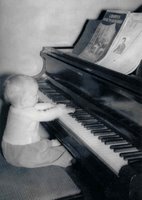
The third photograph above, by the way, is a print made from a famous family portrait of the Mozarts, painted the year after the disastrous trip to Paris when the mother, Maria Anna Pertl Mozart, died. Wolfgang shares the bench with his sister Nannerl, playing a duet (notice the hands crossing) while their father Leopold, a violinist, stands behind the piano. On the wall between them is their mother's portrait painted a few years earlier: no longer with them, she could at least be included in spirit.
*** ***** ******** ***** ***
In the days before there were copyright laws, the idea of arranging someone else’s music – what today would be called “copyright infringement” – was pretty normal. In one letter, Mozart apologized that he’d had no time to write because, in addition to the composing and performing he was involved in, he also had to arrange some highlights from his latest opera because if he didn’t do it, somebody else would – and beat him to the money that could be made with the amateur music market.
In the early 19th Century, long before there were TV sets or CD-players, people made their own music. It was part of a woman’s education, particularly, that she should be able to play the piano or sing pleasantly enough to entertain her husband and their guests after they’ve finished the dinner she’d cooked and put the kids to bed.
It wasn’t uncommon for cultured young men to be proficient on one or more instruments. Even a generation later, the household that Franz Schubert grew up in had a family string quartet – the father, a school-teacher, played the cello; the oldest son played 1st violin, another brother played 2nd violin and Franz, who also played the violin, usually played the viola.
As I’d been told in my student days, the Moravians – even after they set up their communities in Pennsylvania - might have a set of stringed instruments hanging on the wall of, say, the barber shop so that the men could take them down and make music together while waiting their turn – rather than reading magazines or watching TV, or playing with their iPods and iPhones.
And some of these amateurs must have obviously been of a very high quality. Most of Franz Schubert’s piano music, for instance (except for the last three piano sonatas) were written not for the concert hall but for the amateur, home-music-making audience – not just the reams of dances he turned out but also the impromptus and Moments Musicaux, the sonatas and, of course, one of the favorite forms of musical social interaction in those days, lots of piano duets.
Even late in the 19th Century, gentlemen would get together to play string quartets like these serious-looking men in 1889 (see left). Dvořák, for instance, played quartets with some of his neighbors. One summer, when I was living in Connecticut (more recently), I heard some wonderful sounding Brahms coming from the living room of a friend’s house: she explained it was her husband, a well-known doctor, getting together with some of the university’s medical students to play quartets!In Mozart’s day, this “middle-class” market was just beginning to open up. Before then, it might have been the aristocratic court musicians – whether it was a small-time nobleman who might have a piano trio in his employment or a big-time nobleman like Prince Esterhazy who had a whole orchestra and an opera theater in his employ (with a fellow named Haydn to run it). Perhaps it was the change in the economy during (but especially after) a generation of Napoleonic Wars – probably that more than the French Revolution and the down-sizing of aristocrats across the continent – but by Schubert’s day, in the 1820s, there was an Esterhazy cousin, a Count, who hired Franz Schubert for a couple of summers to be their one-man music staff. Rather than conduct symphonies and write operas for his employer, he was expected to teach his two daughters to play the piano, to play for their evening’s after-dinner entertainment as well as compose works they could all perform, whether it was piano duets for the daughters, or part songs when they would gather ‘round the piano to sing songs written with 3 or 4 voice parts, especially pleasant when friends dropped by for visits. If a friend with a particularly pleasant voice was visiting for a week, Schubert was expected to produce a number of songs that would impress the guest and leave him feeling pleased enough to tell his friends how wonderful his experience was, visiting the Esterhazies. In fact, it was one of these visitors, a Baron Schönstein (with a fine baritone voice), who received the dedication of something Schubert composed that year, a set of 20 songs known as Die Schöne Müllerin.
So Schubert was a kind of status symbol – like having the best stereo speakers on an expensive sound system or the latest technology on your latest gadget. For Schubert, it was a kind of networking: hopefully the visitor would also spread his own name far and wide among his friends so they might go and buy his music to perform it for themselves. “Buying” was the operative word, here – the amateur market accounted for the largest part of Schubert’s meager income, and in fact many composers of his generation.
What does all this stuff about Schubert’s employment record have to do with Mozart?
Schubert was employed by the Esterhazies in the 1820s but Anton Steiner’s arrangement billed as Mozart “Grand Sestetto concertante” was published around 1808 - 17 years after Mozart’s death. A few years earlier, someone made a piano trio arrangement, as well. If no one was concerned about ripping him off when he was alive, who was going to bother with copyright infringement after he was dead?
And so while you’re listening to the members of Concertante playing this music tonight, imagine that 200 years ago, you might have been playing it yourself if technology hadn’t ruined the social interaction of friends making their own music!
*** ***** ******** ***** ***
Mozart composed his Symphonie Concertante for two soloists - violin and viola – with an orchestra. The idea of a symphonie concertante was a particularly French one – a combination Symphony-Concerto featuring two or more soloists. It was one of the most frequently composed “forms” in Paris in the 1770s and into the early 1800s. Even Johann Christian Bach wrote several symphonies concertantes for his London audiences, they were so popular. But really, it was nothing more than the old Baroque concerto grosso – exemplified by J.C. Bach’s father, Johann Sebastian Bach’s six “Brandenburg Concertos” – dressed up now in Classical Period clothes.
(Incidentally, the term symphonie concertante was used by the French to describe what they regarded as their creation. Across the rest of Europe – and in most modern-day writings, you’ll see it listed in the Italian as sinfonia concertante. It’s also that sense of “concerto-like” playing in an ensemble that gives the ensemble you’re going to hear play it its name.)
Presumably, Mozart wrote two of these symphonies concertantes while he was in Paris trying to find a job. There’s an interesting mystery behind the one he wrote for four winds which, even today, cannot be fully authenticated as Mozart’s but who else could have written it? It’s even available in two different versions but there is no copy of it in Mozart’s handwriting that’s survived.
Anyway, he wasn’t very successful with his job hunt – but then he wasn’t fully engaged in the search either since, free of his father’s ever-watchful eye for a change, Wolfgang, now in his early 20s (when his middle name might well have been changed to Randy), was more interested in finding a wife. Stopping in Mannheim on the way, Wolfgang fell in love with one of the opera singers there, Aloysia Weber. When his father got wind of this, he sent an urgent letter to his wife who had gone along as the official chaperone, to get their son off to Paris quickly before anything serious happened.
It was her one brief moment in the spotlight of her son’s biography – and she became ill and died while they were in Paris. Without a job, with no substantial income from the trip and with his mother’s body left behind in an unmarked grave, two months later Wolfgang returned to Salzburg to face his father’s wrath since it was clear – at least in Leopold’s mind – that his wife died through his son’s negligence. Wolfgang had been away from home for 18 months.There is a question whether he wrote this Symphonie Concertante in Paris or on his return trip, having stopped in Mannheim where he had stopped to visit before, a court that had one of the finest orchestras in Europe where every player was capable of being a soloist, it was said. Certainly, he began composing a symphonie concertante for piano and violin there, but dropped it after 120 measures and left it incomplete. (By the way, his opera singer girl-friend had cooled considerably toward him by this return trip – ironically, Wolfgang would later marry her younger sister, Constanze.)
It’s also possible he may have written this work after he returned to Salzburg but that seems unlikely since by now he had been demoted – due to his long absence – from the court’s concertmaster to the chapel organist where his job was now to supply the brief “Church Sonatas” and short masses for the Archbishop’s service. He would have had little need for a concert vehicle for himself, especially where things in the French Fashion would have had little or no vogue.
His treatment of the two soloists – never really a solo “group” but a true “double concerto” with them each playing solos, answering each other’s lines – is however not typical of the French love of simplicity and more light-hearted entertainment. Certainly, the slow movement of this piece goes way beyond the emotional limits the French would have found acceptable. On the academic side, it can find its roots in the old-fashioned opera seria style of the day. In its heart-wrenching sadness, we might assume Mozart was thinking of his mother, but we’ll never know. To paraphrase Lucy Miller Murray’s notes, the irony in this piece is that we can listen to this work and know that while he couldn’t find a job, rejected by the successful composers of the day, his music survives today, regarded more highly than any work written by those who turned him down.
- Dr. Dick
- - - -
The third photograph above, by the way, is a print made from a famous family portrait of the Mozarts, painted the year after the disastrous trip to Paris when the mother, Maria Anna Pertl Mozart, died. Wolfgang shares the bench with his sister Nannerl, playing a duet (notice the hands crossing) while their father Leopold, a violinist, stands behind the piano. On the wall between them is their mother's portrait painted a few years earlier: no longer with them, she could at least be included in spirit.
Thursday, October 30, 2008
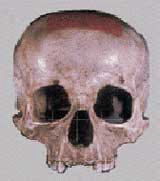
Tales from the Crypt: Mozart's Skull
Mark Twain writes about two skulls in a Havana museum, both, he is told, belonging to Christopher Columbus: one when he was a boy and the other, when he was a man.
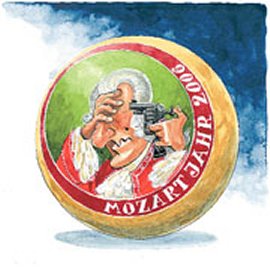
Just before the Mozart Year began in 2006, back when the world celebrated the 250th Anniversary of the birth of Wolfgang Amadeus Mozart, two musical skulls – fortunately belonging to two different composers – had been in the news. In November, 2005, just before his 135th birthday, it was announced testing on fragments of Beethoven’s skull indicate he died of extreme lead poisoning. Then, just after New Years’ Day, 2006, it was announced the results of DNA testing on a skull that since 1902 has been in the Salzburg Mozarteum (the museum founded to maintain the legacy of the city’s most famous son) could definitively prove if the skull is in fact Mozart’s. The results were scheduled to be revealed on a special television documentary being shown in Austria, a great way to kick off the Mozart Year, so to speak.
I have never been fond of the idea of relics, which may or may not have anything to do with my not being Catholic. On a European concert tour in 1970, when I walked into Italian churches that were old in the Renaissance and saw, for instance, the finger of a pope enclosed in a glass case would probably do nothing for my sense of faith. Standing in a museum and looking at the withered mummy of someone who once was close to a pharaoh four thousand years ago may be historically intriguing but perhaps I’m too squeamish to find it anything more than ghoulish. You couldn’t get me anywhere near that exhibit of cadavers going around called “Our Body: The Universe Within” which closes this weekend at Harrisburg’s Whitaker Center. But then, maybe I’ve seen too many horror movies when I was a kid, I don’t know...
Well, it’s Hallowe’en, so it seemed a good idea to revisit the Mystery of [insert weird, tremulous chord here] Mozart’s Skull.
*** ***** ******** ***** ***
In 1863, the remains of both Beethoven and Schubert were exhumed so the skulls could be examined and compared (you can read about it in this issue of the Beethoven Journal). This was an age when phrenology was being used to explain a lot of things like the relationship between a person's mental attributes and the shape of the head. Parts of Beethoven’s skull were already missing (?) and the rest of it apparently shattered in the 36 years since he’d died (yes, I’d heard the old joke about Beethoven decomposing when I was in third grade). Having removed both composers’ skulls for examination, it was decided, in the interest of science and the arts, not to return the skulls to the caskets upon reburial. This may seem odd to us today, but Vienna was part of a Catholic culture with a deep history of relics at a time when people thought nothing of making death-masks of the recently deceased or even, when the technology became available, photographs of them. (Speaking of photographs, you can see photos of Beethoven’s skull fragments here.)
The mystery, beyond the long involved story of how these fragments of bones ended up in southern California, now becomes how to explain the extremely high amounts of lead discovered in the bones, something that would explain his deafness and other illnesses leading up to his death at the age of 57. It was thought perhaps he drank a great deal from leaded cups, but as he was not known as an alcoholic like his father, the amount he drank and the quality of the cups leads one to wonder why other residents of Vienna in the early-19th Century may not also have gone deaf and suffered similar symptoms. (Will they discover 200 years from now, after digging up someone who’d suffered from Alzheimer’s, that high amounts of aluminum in the bones came from drinking sodas out of cans? Hmmm...)
Since Schubert was also reburied without his skull, I suspect there will be something in the news soon about it, too (hey, his 211th birthday is coming up on January 31st, 2009).
If these bones could speak, the stories they would tell us! Of course, the problem is not the bones or their stories but how we, the recipients, interpret them.
The questions I’d have about Mozart’s skull pertain to one of the oldest myths about Mozart and his death at the age of 35. The mystery continues and while it’s generally believed that Salieri had nothing to do with it (though it makes great theater), the circumstances of that death – and the eerily mysterious circumstances of the Requiem’s commission, left unfinished at the composer’s death – help sustain the mythology. Of course, there are those who would prefer the myth: peeling away old beliefs in the interest of scientific or historical accuracy sometimes is the antithesis of art.
The story goes that Mozart was buried in a pauper’s grave, too poor and unknown to warrant consideration of a proper burial (and that the weather was miserable so that no one attended the grave-side services of the burial). Consequently, no one knows where Mozart was buried. This is true to a point.
Volkmar Braunbehrens’ incredibly informative book, “Mozart in Vienna,” was published during the last Mozart Year, 1991, marking the bicentennial of Mozart’s death, though it now appears to be out-of-print. Near the end of over 400 pages covering the last decade of Mozart’s life, Braunbehrens discusses the burial policies of the emperor who once accused Mozart’s Abduction from the Seraglio as having “too many notes.” Joseph II was one of the more enlightened rulers of Europe, no tyrant (with or without his “puritan economics”) but sometimes a little removed from the feelings of his people who might not have found themselves quite as filled with the Age of Reason. In 1783, he decreed that all the cemeteries within Vienna’s then city limits should be closed and burials only allowed in those “a suitable distance from the city.” While funerals would continue their traditions up to the end of the church service, afterwards the remains would be “conveyed by the priest without ceremony to an outlying cemetery for interment.” It was not the custom for mourners to accompany the casket to the grave-site. The body would then be removed from the coffin (which could be recycled – one of the emperor’s cost-cutting reforms) and, still in its ”linen sack,” thrown into the grave which would be filled in with lime and earth and then marked by a simple cross. “Should several bodies arrive at one time, they may all be placed in the same grave.” Loved ones could erect monuments to the dead but not over the grave, only along the cemetery’s walls, because after six to eight years these graves would then be re-opened, the now decomposed bodies removed and the graves made ready for new, er... clients. It was not uncommon for the now skeletal remains to then be stored in “charnel houses,” the corpses piled on shelves like an ancient catacomb or simply reburied elsewhere in a mass jumble of bones, apparently. That would mean by 1799, Mozart’s body would’ve found, uhm... new lodgings.
Around 1807, then, Georg August Griesinger, who would later write the biography of Haydn, asked the now remarried widow of Mozart if she would go with him out to the St. Marx Cemetery where her husband had been buried. There was a monumental cross in the middle of the graveyard, Braunberhrens quotes in his account, but the gravediggers who would have worked there in 1791 presumably were long gone themselves. While the records would be able to tell us who Mozart would have been buried with, it tells us nothing where that grave may have been. Sixteen years after Mozart’s death, the current custodians could only say it was “three or four rows down” from the center cross. Griesinger remarked, however, that Constanze declared “if it were the custom here as it is in some places to collect and display the bones of the decomposed bodies, she would recognize her husband’s skull among the many thousands.” Apparently, it was not.
In the 2006 announcement, it mentioned that the grave’s “likely location was determined in 1855” and mentions the legend how a gravedigger “who knew which body was Mozart’s at some time sneaked the skull out of the grave,” possibly at the time it was disinterred in 1799 or so? (Unlikely he would’ve bothered to go dig it up right after the funeral.) Possible - but why? Had he been in the audience and enjoyed a performance of his new opera, The Magic Flute, which had a great popular success only ten weeks before Mozart's death: did he feel compelled to retrieve this artifact for posterity? Ah, Yorick... who knows?
Through various adventures, the skull (minus its lower jaw) arrived at the Mozarteum in Salzburg in 1902. What had it been up to in the intervening 105 years? So far, it has remained silent on this account.
But a French anthropologist, Pierre-François Puech, examined it in 1991 – the bicentennial of Mozart’s death – and noticed this skull has a fracture above its left temple, leading him to theorize that perhaps Mozart (or at least, the owner of this skull) had suffered a serious fall “which could explain the severe headaches Mozart suffered more than a year before his death.” I am not an expert on Mozart’s letters, but I am not aware of any reference in them to such a fall: if it were that severe, wouldn't he have complained of it or mentioned it even in passing, how it interfered with his work or dealing with those headaches (which are mentioned)? Of course, not all of his letters have survived, but maybe there’s something to look for in the ones we do have from, say, the fall of 1790?
While there have been many theories – Salieri aside – about the cause of Mozart’s death, a recent theory published in June of 2001 that he may have died of trichinosis – from eating under-cooked pork – can be substantiated by a quote from one of his letters to Constanze: 44 days before his illness began, he wrote “What do I smell? ... pork cutlets! Che Gusto (What a delicious taste). I eat to your health.” Symptoms of trichinosis, compatible with those Mozart would soon suffer, appear usually within 50 days of infection. Hmmm....
Mozart’s skull, now, awaited its official verification. What would it tell us?
*** *** ***
After all the hype with the aforementioned TV documentary in Austria, the results turned out to be... well, less that definitive. It seems the forensic scientists got great readings on the DNA they were able to extract from one of the teeth but unfortunately it doesn’t match anything they got from the two relatives exhumed from the Mozart mausoleum in Salzburg. In fact the two women’s DNA doesn’t even match each other which means... well, maybe they’re not the grandmother and niece they thought they were. Or maybe they’re not members of the Mozart family at all (then who else is buried in the old family crypt?).
Or... uhm... well, hey – maybe the skull just isn’t Mozart’s?
I love this one: when the skull showed up at the Mozarteum in 1902, “museum staff found it creepy. Prior to being pulled from view museum staff reported strange phenomena they believed emanated from it, staff claiming to have heard music even screams emanating from the cabinet in which it was displayed.” Now, that may be a way to get some young people interested in classical music...
This report, despite a few inaccuracies which make me wonder if the rest of it is true or not, mentions the skull’s career from the time it was exhumed – or can we say, “robbed” – by the gravedigger at the St. Marx Cemetery. But perhaps “robbed” is not accurate here, since the remains were being dug up to be reburied elsewhere (possibly even pulverized before re-internment: one could argue he in fact “saved” the skull from the same anonymous fate of the rest of the skeleton. Here, it seems, we find the gravedigger knew “what Mozart's ultimate fate would be[,] so [he] had tied wire around his corpse[‘s] neck to enable him to distinguish the remains from the others[;] knowing the exact location of the body[,] he sought it out and saved the skull from the bone crusher.” From there, he gave it to a friend who in turn gave it to a friend in 1842 who, after he died in 1868, bequeathed it to his brother, a Viennese phrenologist. When he died, his wife kept the skull until she died in 1901 after which it wound up at the Mozarteum.
Apparently some of the owners had the same creepy reports of eerie music and other manifestations coming from the skull. There’s still time for Hollywood to make a movie out of this, you know!
Okay, I’m being less than reverent here, mostly because I’m not into relics, the hype about the Mozart Year was one thing and the hype about the skull was quite another. Fortunately, Mozart’s music, whether it came from the genius possibly once encased in this skull or not, is far better than all of this circus combined.
I hear spooky music emanating from my study! Do I have some skull lurking on my bookshelves? Oh, no... it’s just my cat Murphy, parading up the piano keyboard: it’s past her feeding time.
*** ***** ******** ***** ***
It seems part of the problem with finding the DNA samples that could’ve verified the identity of the Mozart Skull might rest with the relatives chosen by the scientists. The assumption was the skeleton of a young woman was “apparently” that of Mozart’s niece Jeanette who died at the age of 16. So apparently they are not sure whose bones are whose? I had misunderstood earlier reports which seemed to describe either a crypt or some kind of vault, but in reality the “Mozart Family Grave” in Salzburg’s St. Sebastian Cemetery is a typical burial plot as can be seen from these two photographs, posted at findagrave.com and mozartforum.com.
The tombstones at the plot indicate there are six people buried there. Maynard Solomon, in his excellent biography “Mozart: A Life” (1995) mentions seven but does not include one name clearly visible on the tombstones, nor does he mention her in his biography at all. The news reports mention there were nine bodies found in the grave.
Solomon mentions (on p.502) the following residents of the Mozart grave in Salzburg's St. Sebastian's Cemetery:
Leopold Mozart, the composer’s father
Euphrosenia (Eva Rosina) Pertl (mother of Anna Maria Pertl Mozart, Mozart’s mother)
Jeannete von Berchtold, daughter of Nannerl Mozart von Berchtold (died at 16)
Georg Nikolaus Nissen, 2nd husband of Constanze
Constanze, Mozart’s widow (died 1842, at 80)
Aloysia Weber, sister of Constanze (died 1839, in her late-70s)
Sophie Weber, sister of Constanze (died 1846, at 83)
Not mentioned in Maynard Solomon’s “Mozart” is Genofeva Weber, Constanze’s aunt and mother of Carl Maria von Weber: she died 1798 while her son studied with Michael Haydn in Salzburg. Yet her name is clearly identified on the one marker beside the central monument.
Now, keep in mind that Leopold Mozart despised the Weber family: after he managed to quash his son’s interest in marrying Aloysia Weber, he was convinced Frau Weber was determined to snare Mozart for one of her two remaining unmarried daughters, Sophie or Constanze, especially after Mozart rented a room from the Webers once he settled permanently in Vienna in 1781, far away from Leopold’s daily control. He refused to give Wolfgang his blessing regarding his impending wedding and only reluctantly granted his permission for him to marry her, a letter that arrived in Vienna the day after the wedding which Mozart had been very careful not to mention to his father.
It is interesting to note that Leopold Mozart had his own family problems as a young man: after dropping out of school and then being expelled once he decided to resume his studies, he also was in love with a young woman, the daughter of an impoverished family in Salzburg, whom his mother back home in Augsburg did not approve of. Without her official permission (and before he had obtained the necessary license from the city of his birth), he secretly married Anna Maria Pertl. When his mother discovered this, she refused to grant him the ‘dowry’ she had given her other children upon their marriages (it was the equivalent of a year’s salary at the time) and they remained estranged for the rest of her life, though she lived till her grandson, the composer, was 10 years old. During one of their numerous tours around Europe, Leopold returned home with both his children for a series of performances but no one from the Augsburg branch of the Mozart family bothered to attend. In fact, Leopold’s mother never even saw her two grandchildren. Considering the parallels with his son’s marriage to Constanze Weber, I wonder if Leopold appreciated the irony?
This may also explain the episode near the end of his life with "Little Leopold," Nannerl's first-born son, whom he demanded to have live with him rather than with his mother so he could raise him and turn the boy into another amazing prodigy, a plan that was cut short by the elder Leopold's death! Poor Nannerl, first sacrificing her own musical talent to the greater glory of her brother, and then giving up her own son for two years to see the whole scheme ostensibly played out again!
Though Constanze, Mozart’s wife, had never been accepted into the Mozart family by Leopold or Nannerl, she later petitioned to have her second husband buried in the Mozart family grave in Salzburg. A year later, Nannerl changed her will to announce her intention not to be buried there. Ultimately, Constanze allowed her two sisters to be buried there as well, so ultimately Leopold Mozart found himself resting eternally amidst the whole lot of the Weber Family he despised – speaking of turning over in one’s grave...
Since the DNA has to be traced through the female line, the only ones who might possibly yield anything conclusive would be Mozart’s maternal grandmother and his niece. Since neither of the two subjects taken from the family grave even matched each other, it’s possible the scientists might have gotten one of the Weber sisters (both of whom were elderly when they died) and, perhaps, Constanze’s aunt-by-marriage (and therefore no blood-relation to either the Mozarts or the Weber sisters).
By the way, it should be pointed out – since many people dislike Constanze even today, considering her self-centered and condemning her for turning her widowhood into a kind of cottage industry – the fact her marker is the focus of the grave is not her doing as is often mentioned: in 1855, in advance of the centennial of his father's birth, Karl Thomas Mozart had a new monument built to replace the original and much decayed tombstone at his mother's grave.
Apparently the plan was then to exhume Mozart’s sister Nannerl who, after deciding she didn’t want to share the family plot with Constanze after all, chose to be buried at St. Peter’s Cemetery, near the grave of family friend Michael Haydn, a court composer at Salzburg and perhaps better known as the younger brother of Franz Josef Haydn. Apparently Michael Haydn’s heart was buried separately from the rest of him, encased in this shrine (though hopefully he was able to hang on to his skull). Curiously, there is an old tradition that Nannerl’s grave is actually empty. Mysteriouser and mysteriouser...
*** ***** ******** ***** ***
Image credits: Image credit: Some Skull that could be the one they think is Mozart’s skull (or maybe not) from the Mozarteum, unless it’s just clip art, found at http://www.castleofspirits.com/mozartskull.html.
If you’re familiar with the famous Mozart Bullets, those delicious candies that are a must-have souvenir of Salzburg, you’ll enjoy the “Mozartkugel take-off” (see above) which I found posted at a truly amusing but now long gone blog where I also found a link to Mozart’s Own Blog (once more, a healthy dose of “suspension of disbelief,” maestro, if you please).
Dr. Dick
Just before the Mozart Year began in 2006, back when the world celebrated the 250th Anniversary of the birth of Wolfgang Amadeus Mozart, two musical skulls – fortunately belonging to two different composers – had been in the news. In November, 2005, just before his 135th birthday, it was announced testing on fragments of Beethoven’s skull indicate he died of extreme lead poisoning. Then, just after New Years’ Day, 2006, it was announced the results of DNA testing on a skull that since 1902 has been in the Salzburg Mozarteum (the museum founded to maintain the legacy of the city’s most famous son) could definitively prove if the skull is in fact Mozart’s. The results were scheduled to be revealed on a special television documentary being shown in Austria, a great way to kick off the Mozart Year, so to speak.I have never been fond of the idea of relics, which may or may not have anything to do with my not being Catholic. On a European concert tour in 1970, when I walked into Italian churches that were old in the Renaissance and saw, for instance, the finger of a pope enclosed in a glass case would probably do nothing for my sense of faith. Standing in a museum and looking at the withered mummy of someone who once was close to a pharaoh four thousand years ago may be historically intriguing but perhaps I’m too squeamish to find it anything more than ghoulish. You couldn’t get me anywhere near that exhibit of cadavers going around called “Our Body: The Universe Within” which closes this weekend at Harrisburg’s Whitaker Center. But then, maybe I’ve seen too many horror movies when I was a kid, I don’t know...
Well, it’s Hallowe’en, so it seemed a good idea to revisit the Mystery of [insert weird, tremulous chord here] Mozart’s Skull.
*** ***** ******** ***** ***
In 1863, the remains of both Beethoven and Schubert were exhumed so the skulls could be examined and compared (you can read about it in this issue of the Beethoven Journal). This was an age when phrenology was being used to explain a lot of things like the relationship between a person's mental attributes and the shape of the head. Parts of Beethoven’s skull were already missing (?) and the rest of it apparently shattered in the 36 years since he’d died (yes, I’d heard the old joke about Beethoven decomposing when I was in third grade). Having removed both composers’ skulls for examination, it was decided, in the interest of science and the arts, not to return the skulls to the caskets upon reburial. This may seem odd to us today, but Vienna was part of a Catholic culture with a deep history of relics at a time when people thought nothing of making death-masks of the recently deceased or even, when the technology became available, photographs of them. (Speaking of photographs, you can see photos of Beethoven’s skull fragments here.)
The mystery, beyond the long involved story of how these fragments of bones ended up in southern California, now becomes how to explain the extremely high amounts of lead discovered in the bones, something that would explain his deafness and other illnesses leading up to his death at the age of 57. It was thought perhaps he drank a great deal from leaded cups, but as he was not known as an alcoholic like his father, the amount he drank and the quality of the cups leads one to wonder why other residents of Vienna in the early-19th Century may not also have gone deaf and suffered similar symptoms. (Will they discover 200 years from now, after digging up someone who’d suffered from Alzheimer’s, that high amounts of aluminum in the bones came from drinking sodas out of cans? Hmmm...)
Since Schubert was also reburied without his skull, I suspect there will be something in the news soon about it, too (hey, his 211th birthday is coming up on January 31st, 2009).
If these bones could speak, the stories they would tell us! Of course, the problem is not the bones or their stories but how we, the recipients, interpret them.
The questions I’d have about Mozart’s skull pertain to one of the oldest myths about Mozart and his death at the age of 35. The mystery continues and while it’s generally believed that Salieri had nothing to do with it (though it makes great theater), the circumstances of that death – and the eerily mysterious circumstances of the Requiem’s commission, left unfinished at the composer’s death – help sustain the mythology. Of course, there are those who would prefer the myth: peeling away old beliefs in the interest of scientific or historical accuracy sometimes is the antithesis of art.
The story goes that Mozart was buried in a pauper’s grave, too poor and unknown to warrant consideration of a proper burial (and that the weather was miserable so that no one attended the grave-side services of the burial). Consequently, no one knows where Mozart was buried. This is true to a point.
Volkmar Braunbehrens’ incredibly informative book, “Mozart in Vienna,” was published during the last Mozart Year, 1991, marking the bicentennial of Mozart’s death, though it now appears to be out-of-print. Near the end of over 400 pages covering the last decade of Mozart’s life, Braunbehrens discusses the burial policies of the emperor who once accused Mozart’s Abduction from the Seraglio as having “too many notes.” Joseph II was one of the more enlightened rulers of Europe, no tyrant (with or without his “puritan economics”) but sometimes a little removed from the feelings of his people who might not have found themselves quite as filled with the Age of Reason. In 1783, he decreed that all the cemeteries within Vienna’s then city limits should be closed and burials only allowed in those “a suitable distance from the city.” While funerals would continue their traditions up to the end of the church service, afterwards the remains would be “conveyed by the priest without ceremony to an outlying cemetery for interment.” It was not the custom for mourners to accompany the casket to the grave-site. The body would then be removed from the coffin (which could be recycled – one of the emperor’s cost-cutting reforms) and, still in its ”linen sack,” thrown into the grave which would be filled in with lime and earth and then marked by a simple cross. “Should several bodies arrive at one time, they may all be placed in the same grave.” Loved ones could erect monuments to the dead but not over the grave, only along the cemetery’s walls, because after six to eight years these graves would then be re-opened, the now decomposed bodies removed and the graves made ready for new, er... clients. It was not uncommon for the now skeletal remains to then be stored in “charnel houses,” the corpses piled on shelves like an ancient catacomb or simply reburied elsewhere in a mass jumble of bones, apparently. That would mean by 1799, Mozart’s body would’ve found, uhm... new lodgings.
Around 1807, then, Georg August Griesinger, who would later write the biography of Haydn, asked the now remarried widow of Mozart if she would go with him out to the St. Marx Cemetery where her husband had been buried. There was a monumental cross in the middle of the graveyard, Braunberhrens quotes in his account, but the gravediggers who would have worked there in 1791 presumably were long gone themselves. While the records would be able to tell us who Mozart would have been buried with, it tells us nothing where that grave may have been. Sixteen years after Mozart’s death, the current custodians could only say it was “three or four rows down” from the center cross. Griesinger remarked, however, that Constanze declared “if it were the custom here as it is in some places to collect and display the bones of the decomposed bodies, she would recognize her husband’s skull among the many thousands.” Apparently, it was not.
In the 2006 announcement, it mentioned that the grave’s “likely location was determined in 1855” and mentions the legend how a gravedigger “who knew which body was Mozart’s at some time sneaked the skull out of the grave,” possibly at the time it was disinterred in 1799 or so? (Unlikely he would’ve bothered to go dig it up right after the funeral.) Possible - but why? Had he been in the audience and enjoyed a performance of his new opera, The Magic Flute, which had a great popular success only ten weeks before Mozart's death: did he feel compelled to retrieve this artifact for posterity? Ah, Yorick... who knows?
Through various adventures, the skull (minus its lower jaw) arrived at the Mozarteum in Salzburg in 1902. What had it been up to in the intervening 105 years? So far, it has remained silent on this account.
But a French anthropologist, Pierre-François Puech, examined it in 1991 – the bicentennial of Mozart’s death – and noticed this skull has a fracture above its left temple, leading him to theorize that perhaps Mozart (or at least, the owner of this skull) had suffered a serious fall “which could explain the severe headaches Mozart suffered more than a year before his death.” I am not an expert on Mozart’s letters, but I am not aware of any reference in them to such a fall: if it were that severe, wouldn't he have complained of it or mentioned it even in passing, how it interfered with his work or dealing with those headaches (which are mentioned)? Of course, not all of his letters have survived, but maybe there’s something to look for in the ones we do have from, say, the fall of 1790?
While there have been many theories – Salieri aside – about the cause of Mozart’s death, a recent theory published in June of 2001 that he may have died of trichinosis – from eating under-cooked pork – can be substantiated by a quote from one of his letters to Constanze: 44 days before his illness began, he wrote “What do I smell? ... pork cutlets! Che Gusto (What a delicious taste). I eat to your health.” Symptoms of trichinosis, compatible with those Mozart would soon suffer, appear usually within 50 days of infection. Hmmm....
Mozart’s skull, now, awaited its official verification. What would it tell us?
*** *** ***
After all the hype with the aforementioned TV documentary in Austria, the results turned out to be... well, less that definitive. It seems the forensic scientists got great readings on the DNA they were able to extract from one of the teeth but unfortunately it doesn’t match anything they got from the two relatives exhumed from the Mozart mausoleum in Salzburg. In fact the two women’s DNA doesn’t even match each other which means... well, maybe they’re not the grandmother and niece they thought they were. Or maybe they’re not members of the Mozart family at all (then who else is buried in the old family crypt?).
Or... uhm... well, hey – maybe the skull just isn’t Mozart’s?
I love this one: when the skull showed up at the Mozarteum in 1902, “museum staff found it creepy. Prior to being pulled from view museum staff reported strange phenomena they believed emanated from it, staff claiming to have heard music even screams emanating from the cabinet in which it was displayed.” Now, that may be a way to get some young people interested in classical music...
This report, despite a few inaccuracies which make me wonder if the rest of it is true or not, mentions the skull’s career from the time it was exhumed – or can we say, “robbed” – by the gravedigger at the St. Marx Cemetery. But perhaps “robbed” is not accurate here, since the remains were being dug up to be reburied elsewhere (possibly even pulverized before re-internment: one could argue he in fact “saved” the skull from the same anonymous fate of the rest of the skeleton. Here, it seems, we find the gravedigger knew “what Mozart's ultimate fate would be[,] so [he] had tied wire around his corpse[‘s] neck to enable him to distinguish the remains from the others[;] knowing the exact location of the body[,] he sought it out and saved the skull from the bone crusher.” From there, he gave it to a friend who in turn gave it to a friend in 1842 who, after he died in 1868, bequeathed it to his brother, a Viennese phrenologist. When he died, his wife kept the skull until she died in 1901 after which it wound up at the Mozarteum.
Apparently some of the owners had the same creepy reports of eerie music and other manifestations coming from the skull. There’s still time for Hollywood to make a movie out of this, you know!
Okay, I’m being less than reverent here, mostly because I’m not into relics, the hype about the Mozart Year was one thing and the hype about the skull was quite another. Fortunately, Mozart’s music, whether it came from the genius possibly once encased in this skull or not, is far better than all of this circus combined.
I hear spooky music emanating from my study! Do I have some skull lurking on my bookshelves? Oh, no... it’s just my cat Murphy, parading up the piano keyboard: it’s past her feeding time.
*** ***** ******** ***** ***
It seems part of the problem with finding the DNA samples that could’ve verified the identity of the Mozart Skull might rest with the relatives chosen by the scientists. The assumption was the skeleton of a young woman was “apparently” that of Mozart’s niece Jeanette who died at the age of 16. So apparently they are not sure whose bones are whose? I had misunderstood earlier reports which seemed to describe either a crypt or some kind of vault, but in reality the “Mozart Family Grave” in Salzburg’s St. Sebastian Cemetery is a typical burial plot as can be seen from these two photographs, posted at findagrave.com and mozartforum.com.The tombstones at the plot indicate there are six people buried there. Maynard Solomon, in his excellent biography “Mozart: A Life” (1995) mentions seven but does not include one name clearly visible on the tombstones, nor does he mention her in his biography at all. The news reports mention there were nine bodies found in the grave.
Solomon mentions (on p.502) the following residents of the Mozart grave in Salzburg's St. Sebastian's Cemetery:
Leopold Mozart, the composer’s father
Euphrosenia (Eva Rosina) Pertl (mother of Anna Maria Pertl Mozart, Mozart’s mother)
Jeannete von Berchtold, daughter of Nannerl Mozart von Berchtold (died at 16)
Georg Nikolaus Nissen, 2nd husband of Constanze
Constanze, Mozart’s widow (died 1842, at 80)
Aloysia Weber, sister of Constanze (died 1839, in her late-70s)
Sophie Weber, sister of Constanze (died 1846, at 83)
Not mentioned in Maynard Solomon’s “Mozart” is Genofeva Weber, Constanze’s aunt and mother of Carl Maria von Weber: she died 1798 while her son studied with Michael Haydn in Salzburg. Yet her name is clearly identified on the one marker beside the central monument.
Now, keep in mind that Leopold Mozart despised the Weber family: after he managed to quash his son’s interest in marrying Aloysia Weber, he was convinced Frau Weber was determined to snare Mozart for one of her two remaining unmarried daughters, Sophie or Constanze, especially after Mozart rented a room from the Webers once he settled permanently in Vienna in 1781, far away from Leopold’s daily control. He refused to give Wolfgang his blessing regarding his impending wedding and only reluctantly granted his permission for him to marry her, a letter that arrived in Vienna the day after the wedding which Mozart had been very careful not to mention to his father.
It is interesting to note that Leopold Mozart had his own family problems as a young man: after dropping out of school and then being expelled once he decided to resume his studies, he also was in love with a young woman, the daughter of an impoverished family in Salzburg, whom his mother back home in Augsburg did not approve of. Without her official permission (and before he had obtained the necessary license from the city of his birth), he secretly married Anna Maria Pertl. When his mother discovered this, she refused to grant him the ‘dowry’ she had given her other children upon their marriages (it was the equivalent of a year’s salary at the time) and they remained estranged for the rest of her life, though she lived till her grandson, the composer, was 10 years old. During one of their numerous tours around Europe, Leopold returned home with both his children for a series of performances but no one from the Augsburg branch of the Mozart family bothered to attend. In fact, Leopold’s mother never even saw her two grandchildren. Considering the parallels with his son’s marriage to Constanze Weber, I wonder if Leopold appreciated the irony?
This may also explain the episode near the end of his life with "Little Leopold," Nannerl's first-born son, whom he demanded to have live with him rather than with his mother so he could raise him and turn the boy into another amazing prodigy, a plan that was cut short by the elder Leopold's death! Poor Nannerl, first sacrificing her own musical talent to the greater glory of her brother, and then giving up her own son for two years to see the whole scheme ostensibly played out again!
Though Constanze, Mozart’s wife, had never been accepted into the Mozart family by Leopold or Nannerl, she later petitioned to have her second husband buried in the Mozart family grave in Salzburg. A year later, Nannerl changed her will to announce her intention not to be buried there. Ultimately, Constanze allowed her two sisters to be buried there as well, so ultimately Leopold Mozart found himself resting eternally amidst the whole lot of the Weber Family he despised – speaking of turning over in one’s grave...
Since the DNA has to be traced through the female line, the only ones who might possibly yield anything conclusive would be Mozart’s maternal grandmother and his niece. Since neither of the two subjects taken from the family grave even matched each other, it’s possible the scientists might have gotten one of the Weber sisters (both of whom were elderly when they died) and, perhaps, Constanze’s aunt-by-marriage (and therefore no blood-relation to either the Mozarts or the Weber sisters).
By the way, it should be pointed out – since many people dislike Constanze even today, considering her self-centered and condemning her for turning her widowhood into a kind of cottage industry – the fact her marker is the focus of the grave is not her doing as is often mentioned: in 1855, in advance of the centennial of his father's birth, Karl Thomas Mozart had a new monument built to replace the original and much decayed tombstone at his mother's grave.
Apparently the plan was then to exhume Mozart’s sister Nannerl who, after deciding she didn’t want to share the family plot with Constanze after all, chose to be buried at St. Peter’s Cemetery, near the grave of family friend Michael Haydn, a court composer at Salzburg and perhaps better known as the younger brother of Franz Josef Haydn. Apparently Michael Haydn’s heart was buried separately from the rest of him, encased in this shrine (though hopefully he was able to hang on to his skull). Curiously, there is an old tradition that Nannerl’s grave is actually empty. Mysteriouser and mysteriouser...
*** ***** ******** ***** ***
Image credits: Image credit: Some Skull that could be the one they think is Mozart’s skull (or maybe not) from the Mozarteum, unless it’s just clip art, found at http://www.castleofspirits.com/mozartskull.html.
If you’re familiar with the famous Mozart Bullets, those delicious candies that are a must-have souvenir of Salzburg, you’ll enjoy the “Mozartkugel take-off” (see above) which I found posted at a truly amusing but now long gone blog where I also found a link to Mozart’s Own Blog (once more, a healthy dose of “suspension of disbelief,” maestro, if you please).
Dr. Dick
Subscribe to:
Posts (Atom)