And now for something a little lighter, placing composers in surreal plot situations like a Classical Music Radio Station that would be staffed by the composers themselves? Though WLVB is actually a country music station in Vermont, it seemed the logical place where the station manager would be a guy named Beethoven.
(Incidentally, any resemblance to characters in the story and my former colleagues at WITF 89.5 is purely accidental, and the fact they're looking for an evening announcer had no bearing that I was aware of at the time concerning WITF's former evening announcer.)
*** ***** ******** ***** ***
The phone rang, the little blinking light barely catching his attention. He picked up the receiver and snapped, “Ja, Beethoven here,” and soon slammed it back down. “Another hang-up!”
He had gotten a letter the other day from somebody in Hollywood wanting to know if he could recommend someone to compose music for the studio’s next big hit, “American Pie VIII,” but he tossed it in the trash. “What do I know about music for dumplings and pies,” he muttered. He thought maybe it was them calling him, now. The last time he had tried writing for Hollywood, these idiots kept trying to change everything: “Keep it simple,” they told him, “don’t ramble.” Infuriating!
He returned to the e-mail he was almost ready to send his program director, Richard Wagner, about the latest ratings book. Things were not going well at WLVB lately, the classical music station where he had long been the station manager. But then, classical music on the radio was always a problem in this country. “People these days prefer American Idol,” he sniffed, “but then it wasn’t much different in Vienna, either.”
The morning guy, Bach, was always complaining about what it had been like battling the Philistines in Leipzig. Brahms, in between cigars, would say how much he loved a good Strauss waltz but now and then, something a little serious was good for the soul yet a lot of listeners kept complaining about all the old-fashioned music he was playing in the afternoon. “This is America in the 21st Century,” they’d grouse, but turning to Beethoven, he’d say “Have you heard any of this so-called music they’re writing today?” Beethoven just looked at him and Brahms went back to his cigar.
Beethoven sighed as he looked out the window of his office before he remembered it was only a photograph of a window looking out onto the Vienna Woods which he missed so much. He had gone against Wagner’s objections about bringing in a woman to host the weekend’s Old & New Age show, but Hildegard of Bingen had proven to be a wise choice on his part. If nothing else, her numbers were very good and she didn’t hang out at the station much except on Fridays for a little while.
Now Wagner was complaining about the guy they recently hired to host the opera program. Verdi certainly had his credentials, but he rarely ever did any German operas and how could you have an opera program without good German opera? “No wonder the ratings were in trouble,” he argued!
The problem, Wagner said, whatever he might have been hinting at in his obtuse e-mails about the Direction of Art and the Role of the Artist in Society, had nothing to do with ratings but with the purity of the message. “Spare me the philosophy, Herr Wagner,” Beethoven grumbled as he hit the Send key. Or thought he hit the Send key: it disappeared from his screen so fast, he was sure he must have hit the wrong key instead and deleted it.
Clara, his new secretary, brought in another cup of coffee for him. He just knew she was going to start in about hiring her husband Robert Schumann for that development position that always seemed to be open. The other day he noticed her and Brahms hanging around the coffee machine a little longer than necessary, like he needed that kind of trouble on his staff anyway. He found it difficult making small talk with her, asking about the kids and all. “Ja, ja, thank you,” waving his hand in her general direction, pretending to be lost in another article about the competition with satellite radio.
She put the afternoon mail on his desk, mostly applications for the evening position. Since Wagner had finally succeeded in switching Mendelssohn to the overnight spot, they needed someone in a hurry, but nobody was quite right. This guy Schubert was too quiet; Mahler was too loud. Tchaikovsky was just too depressing and Mozart, you could tell, was always going to be asking for time off because it would interfere with his social life. We could use somebody French, he thought, but Wagner was pushing for this friend of his named Bruckner. Paging through the latest edition of the classical radio trade journal, The Courant, Beethoven wondered if there was a composer out there like this Howard Stern: maybe that was what they needed, someone who could shake things up a bit – and play the violin, as well.
Bach had given up explaining he must be thinking of Isaac Stern. Brahms just chuckled into his beer.
At the last staff meeting, Bach thought maybe Handel would be a worthwhile candidate – at least his hair was neater than Stern’s. Brahms thought surely Johann Strauss – the younger one, that is, who had great hair – would get all the young listeners dancing.
Wagner just rolled his eyes. He knew all about the Music of the Future, and Johann Strauss, he assured them, was not it.
“What about Schoenberg, then,” Beethoven had asked, looking from one to the other. “Or maybe Stravinsky?” No one responded. He thought maybe they were all suddenly deaf.
That was when Mendelssohn, bleary-eyed from his late-night shift, suggested Berlioz. He’d met him in Rome and though he didn’t care for his music much, himself, it was certainly consistent with the personality and spoke directly to a younger generation: maybe that was what WLVB needed in the evening?
Bach sneered at him. “We need a drug bust? To hell with Berlioz,” waving his hand in disgust.
Ravel, one of the new guys in sales, slapped his fist down on the table, wincing at the sudden pain. “That’s it,” he shouted, “that’s exactly it! ‘To Hell with Berlioz,’ the new evening show at WLVB!”
“Hmmm,” Beethoven thought, looking over the scrap of paper Mendelssohn had passed his way, “I like it. Clara, give him a call and see if he’s available to come in for an interview, ja?”
She took the scrap of paper warily between her fingers as if it were crawling with cooties and left the room.
There had also been a letter asking about the possibility of an internship from a student named Juan Chrisostomo Arriaga, so Beethoven dutifully passed his resume around for their inspection. Some felt he was too young or too inexperienced, sounded too much like Mozart but Beethoven just glowered at them. “It’s an internship,” he grimaced. “Dummkopfs,” he muttered not quite under his breath.
They were also talking about some kind of gimmick that could help the next ratings book. Bach thought a marathon of great pianists playing his Goldberg Variations back to back would do the trick, but Wagner just started to snore.
“If you wanted a Marathon, I’ve already written the ultimate Marathon,” Wagner tossed out into the conversation but just thinking about it, Brahms began to snore.
Mendelssohn, who enjoyed cooking, was wondering about a take-off on “The Iron Chef” but with symphonists instead. Brahms was wary of the quality of anything that could be composed that quickly: “you couldn’t improvise a symphony,” he grumbled.
Wagner thought he could get Liszt to arrange another series of “Dueling Pianists” but Beethoven liked the idea of a grudge match between two soccer teams, pitting the Russian Five against the French Six. Ravel said it would be too expensive to pull off and wasn’t really suited to radio, for that matter. True, hadn’t they learned their lesson with “Celebrity Bowling with Mozart” which didn’t even last three weeks?
Beethoven sat at his desk, sipping his coffee when he saw the light blinking on the phone again. Once more, he picked it up with a sigh but as usual no one was there. “What good is all this technology if it doesn’t work, ja?” he stormed, slamming it down, then thought about writing another e-mail to his Immortal Beloved.
- - - - - - -
Dr. Dick
© 2007
Wednesday, February 07, 2007

Thursday, February 01, 2007
The Care & Feeding of the Creative Spirit: Part 2
Continuing from Part 1:
When I was in school, I had weekly lessons in composition and occasionally we’d talk about “the teaching of composition.” But nowhere was there any kind of “creative psychology,” preparing students for changes to their creativity as we mature, if we would have even listened (the “I’ll never change, that won’t happen to me” argument) other than the occasional wink-wink about any impending mid-life crisis.
When I was a composition student, I could sit in a practice room at school surrounded by other students who’d be practicing or running up and down the hall like a bunch of idiots: nothing really seemed to bother me. Now, listening to the soft rock beat of my neighbor’s stereo through my walls (thump thump thump) or the barking doberman next door sends me into a tailspin: how can I possibly write with all this racket?!
Then there’s that new voice you may have just discovered, one inside yourself that’s louder than all your neighbor’s stereos and dogs put together, the one that keeps saying “Who cares what you write? You think someone’s going to like that shit? What orchestra do you think is going to have the rehearsal time to learn to play this? You think you’re Beethoven or something?”
It’s the kind of voice that, when you look in the mirror and think “I look nice,” is saying to you, “Are you kidding? You look fat!”
This is what some writers call “The Inner Critic.”
Kill him!
In the old cartoons, they used to depict this voice as the little devil sitting on your shoulder, urging you to do things you knew were wrong, before the little angel would pop up on your other shoulder, the voice of your conscience, telling you you shouldn’t do that. The only problem with the Inner Critic is there’s no little angel around to talk you out of it. Pretty soon, you begin to believe that voice and if you’re not able to kill him off or at least drown him out (I know – white noise!!), it can kill your creativity faster than anything else in the world.
For the typical student – high school or college – long-range planning is generally “how do I make it through to the weekend?” When you become a senior, then there are either plans for grad school or career choices that need to be made. If that wasn’t a big enough change, there’s getting married and the even bigger change and responsibilities that take precedence with children.
From a creative (and selfish) standpoint, there are distractions and new responsibilities that reorganize your life, change your priorities. As the Bible says, “When I was a child, I spake as a child” and so on... “But now that I am a man” (it would be too complicated to diversify this quote politically correctly: but now that I am a man or a woman? Well, these days, anything is possible) “I have put away these childish things...” Okay, maybe “now that I am an adult”...
Art is a form of play. You let your imagination play. At one point, you have the freedom of youth to play anything you feel like playing – you experiment with possibilities, you take risks and it doesn’t matter: you can always try again – there’s plenty of time!
What happens when you turn 21, other than being able to vote and drink (legally)? Everyone expects you to act “like an adult.” (Let’s leave the immature adult who’s acting like a child out of the equation for the moment.)
Creativity is Play but now you have to Work. You get a job, hopefully earn a living, support yourself, have a family – these all take time from the creative play and sometimes sap the energy from it. And you find you don’t have plenty of time any more. If you’re a mother trying to hold down a job and raise a family, you have NO time.
Your employer isn’t going to be too concerned about your plans for the Great American Novel or Symphony. “You do that on your own time.” And that’s if you have a job that doesn’t require more than an 8-hour day. Who would have time, if you’re like Toru Takemitsu, to sit down and play through the St. Matthew Passion just to get inspired?
Play is for children – that’s the image. Now that you’re an adult, it’s time to put the toys away.
Don’t.
At least not in some remote corner of the brain where you allow society to throw away the key.
How do you keep play in your life so your creativity can be nurtured by it? Well, there ARE weekends, but if you own a home, play is not exactly mowing the grass or cleaning the garage. If you have children, play can suddenly open up the whole world of your own childhood again like a kind of magic. If artists have been inspired by romance, may have been inspired by the birth of a child, though there are different responsibilities, from diapers and beyond.
Creativity is the work of play, the imagination free of the Everyday. Give your creativity something to keep the everyday reality out for a while.
When I was in my early-30s, I spent a month at a writer’s colony called Yaddo (the MacDowell Colony is another one and there are several in other parts of the country as well). There was a routine: breakfast was served at before 9am and lunch was handed to you in a box – then between 9 and 5, you stayed in your room and wrote. No one could go into anyone else’s room without prior arrangement and bother them. You could escape to eat your lunch downstairs or on the patio or you could stay in your room and eat while you’re working. The TV set in the parlor could only be on after 5pm (they made an exception: I was there the day President Reagan was shot). Dinner was served at 5. The rest of the evening was yours – you could socialize or continue to work, but no one was supposed to bother you in your room. One thing that helped was the recognition that creativity was the equal of work – not that it was “work,” because any artist knows how hard creative work is, but because it was being equated with that 9-to-5 sense of work.
Around the houses and cabins that comprise this colony in the woods were 50-60 acres with several different paths. Some of us would take brisk walks along the shorter path, a kind of inner circle around the mansion; other times maybe you wanted to spend more time and take the longer, outer circle. Rather than a brisk walk, perhaps it was a day to linger and look at the new spring growth (I was there in mid-March) or watch the birds. You could take as long as you liked or needed, but once you were back in your room, it was now time to work.
These walks were a double form of exercise: more than just cardiovascular, it got the blood flowing through the brain. And it eliminated the build-up of stress, sweeping out the day’s reality and allowing your creativity to stop and smell the roses.
It doesn’t have to be a full workout at the gym: all you need is a little just to dust off the brain and give it a little fuel so you’re good to go for the rest of the day.
So if you feel you have trouble, suddenly, being creative – take a walk. And tell that Inner Critic to take a hike! Go somewhere that relaxes you or energizes you, whatever works for you. You may have to drive somewhere, but the drive is not enough. In the winter if it’s too cold to get out and walk, maybe it’s time to turn that coatrack back into a stationary bike...
For some writers, reading other people’s words can inhibit the flow of your own. For others, it may inspire them or give them something to “take off” from. For composers, it’s not just a matter of not listening to someone else’s music. For instance, I have music spilling through my head all the time. I work at a radio station and play classical music in the evening, but there can be music all around you, not just from the radio but everywhere else you turn – the ubiquitous Muzak. And nothing is worse than getting some inane phrase stuck in your head you can’t get rid of, something that just repeats over and over again. They call these “ear worms” (kill them, too).
One thing that several writers about creativity have suggested is keeping a journal. Unfortunately mine becomes more a report on what happened rather than what I’m thinking about. Sometimes, it’s therapeutic to get issues off your mind (“off your chest” is the standard expression) – problems at work, trouble with a relationship. Julia Cameron, in her popular book “The Artist’s Way,” suggests you write first thing after you wake up: it’s not WHAT you write but THAT you write, and this works whether you’re a writer or a painter or a composer. You clear the stuff out of your brain, maybe writing about a dream or just nonsense just to get the mind moving. Eventually this will lead to ideas or something that can lead to ideas, something that could be the creative light-bulb you need to get the real creative work started.
Occasionally, I find myself just simply asking “Why am I stuck?” I might get into a question why I like one composer over another and maybe discover something that piques my creative curiosity (or leads me down the Red Herring Road). Maybe I’ll start hearing sound-images in my head – not necessarily themes but maybe musical shapes (or “gestures”), instrumental colors or kinds of texture which I then try to describe in prose or drawings. It is my dialogue with my self. It helps to activate my inner self, freeing it up for... PLAY!
After several years of not having composed anything (nor even trying to), I heard the concertmaster of the Harrisburg Symphony play Ernest Chausson’s “Poeme.” It’s a piece I’ve never really cared for. But at the end of the piece, in the very last measures, there’s a chain of very high trills over a long sustained chord before everything resolves. Even though I’ve heard this piece many times and often found this passage unsettling because it’s so hard to play in tune, this time I sat up like I’d never heard it before. I’m not sure it was just the performance (which was very good) but I found this, now, very mysterious and before long (actually, I think, days later) a very mysterious piece started forming in my head. Now keep in mind, I had not completed a single piece of music in something like over 12 years, so this was definitely unexpected.
Some years before, I had read the opening of Tolkien’s “Silmarillion” where the world is sung into existence by a chief deity and a committee of sub-deities. It’s one of the most beautiful creation stories I’ve read, everything willed into being through a kind of astral music. One of these “sub-deities” brings in a note of discord, introducing evil into the world – and this theatrical aspect is what set the piece in my mind in motion. What exactly this had to do with the trills at the end of Chausson’s “Poeme,” I have no idea, but there it was.
It evolved into a piece for violin and orchestra about 12 minutes long which took 6 months to write but (several years later) still doesn’t have a title. I didn’t want it to become the Silmarillion Piece. But it worked for me and became the first piece I’d completed in about 16 years or so. Later, I began to see it as a conflict between my creativity (the solo violin) with the introduction of evil from my own Inner Critic.
In the process of working on this, it occurred to me it was taking soooo long getting back into the swing of composing again. It had been years, of course, and it wasn’t quite like “getting back on the bicycle” (a cliche I hate because, truthfully, I never learned to ride a bicycle in the first place) There were whole new things to learn, it seemed, things I hadn’t been doing for 16 years. Discipline was a big thing to have to learn, the idea of “showing up at the page,” the equivalent of going to work and working regardless of productivity or success. It was difficult not to be discouraged by how long this was taking. That “Inner Critic” was constantly reminding me that I once wrote a very complex 9-minute choral work basically in one day.
Perhaps you remember the claymation film that came out in 2000 (around the time I was working on this piece) called “Chicken Run”? One night, I happened to catch one of those “Making Of...” TV shows, how they put this stop-action animated film together. They take little figures made out of clay... set it up, take a shot, then move an arm a smidge, adjust the facial expression a bit, take another shot and so on – a very tedious process. They realize that with computers today it would be so much easier to make an animated film but they were committed to the look and feel of their claymation process. It didn’t bother them that, at the end of a very long working day, usually 8 or 9 strenuous hours on the set (which was basically the size of a kid’s Christmas train platform) they had... 3½ seconds of film footage. Let me say that again – 8 or 9 hours of work, 3½ seconds of film!
So I sat down to figure out how much music I was basically averaging in the process of composing, keeping track of the number of hours and then timing what I’d actually composed in that period of time. Though I could never manage 8 or 9 hours of composing time in a day (too fatiguing, mentally) even though much of that could be spent staring at what I’d written the day before, it still averaged out to about 3½ minutes of music for every 8 hours of clock-time spent working. So I figured if they couldn’t be discouraged at “Chicken Run” with that kind of progress, why should I? It’s a matter of having a vision and believing in it. It was a kind of revelation – like “poultry in motion” – that helped kill (for a time) that nasty little inner voice.
Several composers have told me, in one way or another, “the piece you finish is never the piece you started.” It takes on a life of its own, in most cases, and becomes something else from that initial idea. Sometimes this is a problem; sometimes it becomes a better piece. But life is like that, too.
We all have distractions: you have a job, now, and maybe a family to support and raise. Many people can’t always manage to get up an hour earlier to write that novel, but some can figure out what things to do to accommodate that dream: set up a special room in a quiet part of the house (if there is such a thing), a place you won’t be disturbed while the door is shut. Maybe ask the spouse to take the kids out for an hour – turn off the phone. Spend an hour concentrating on what you’re writing, composing, painting, practicing. One hour. You’d be surprised how much, once you get used to it, you can accomplish in an hour.
Of course it takes me sometimes almost that much time before I even realize where I need to start, figuring out where things were going when I left off the last time, but now my hour is up and I need to leave for work. So I started looking for other ways of prepping my time: before I stop, jot down some ideas where I need to begin. Spend as much time, when inspiration strikes, getting something down on paper that will jog the memory the next time, even if it’s drawings or squiggles or descriptive words. If you just think “yeah, I’ll remember that tomorrow,” chances are you won’t.
Take stock of yourself. I am not a morning person but I can’t work late at night after I get home from my second shift job: the neighbors are asleep, my brain is fried. I am also basically a lazy person. I spent years writing spontaneously with a facility that allowed me to sit down and write a 30-minute chamber opera over Thanksgiving vacation. If inspiration isn’t popping up any more on its own, prepare yourself with back-up – other things to work on, perhaps abstract things that might be the equivalent of a cross-word puzzle but could jog the mind into creating something.
Following some of the advice from Julia Cameron's “Artist’s Way,” I would do my “morning pages” and take those “Artist Dates,” things you do for yourself by yourself. I tried to avoid those “crazy-makers,” as she called them, the friends who would come by and complain about their problems until you’re just as miserable as they are (it’s not legal to kill them, but you get the idea).
There are some distractions you can’t get away from: children need you when they need you. Your spouse may understand but there are limits. Being an artist in a relationship means trying to find the balance between love and selfishness, in a way. Perhaps somebody is ill – illness is never anything you expect. These are often the most difficult to accommodate because they require immediate attention and can be the most spiritually draining.
Basically, you learn what you have to do – I have to make money, I have to do this job – also, I have to be with my family because there are also things you need to do – I need to be with my family just as I need to compose. I don't need this and could do with a little less of that. You learn to compensate but you also learn to put the different aspects of your life into some kind of perspective. You find some time when you can sit down and say to your inner child, “can you come out and play?”
If you don’t find these adjustments between your life as a student and as you grow older, you will find yourself stuck in Middle Age with a job you may or may not like but chances are “may not like.” Perhaps the kids are now grown and off to college or on their own and maybe your focus has shifted from taking care of your kids to taking care of your parents. At some point, you will realize you are the age your parents were when YOU were a kid going off to college and you thought they were so old. You couldn’t imagine it before, but there may come a time when you might actually prefer to stay home and read a book rather than go out and party.
The worst thing about Middle Age, life changes that make puberty look like child’s-play, is “The Rut.” The same stuff at work, the same stuff for dinner, the same problems at home, the same stuff on TV. You find yourself in a rut that gets deeper and deeper until you can no longer see up out over the top of it and you find it impossible to climb out of. It doesn’t mean running off and having an affair, buying a snazzy red sports car to reclaim your youth (cars that can be regarded as penis extenders) or dying your hair so you won’t look 50 but more like a 30-something who’s led a hard life. If you didn’t have the discipline to exercise before, chances are you won’t discover that discipline trying to work off the extra pounds when you start feeling stiff in the joints or when those 6-pack abs you always dreamed of have turned into a keg...
There are lots of ways to stave this off or turn things around before it’s too late, or before you run headlong into a wall – like a heart attack – where you have to change everything, or else! Eating right and living right all help your being happy, being engaged in your life, and vice versa. You need to recognize there is a problem and then figure out how to solve it. Big problems are easier to solve if you break them down into smaller issues that can be addressed with greater potential for success. It’s too easy to be overwhelmed by the sheer immensity of everything that’s happening (or not happening) to you!
This is a Left Brain thing, looking at the details and working at it bit by bit. If you’re too Right Brained about it, you’ll see the Big Picture but react emotionally – and that emotion could be fear.
The dreams and goals you have today – and you should have them, no matter where you are in life – are just as important to someone who’s a student now as they will be 35 years from now. If career choices and circumstances beyond your control take you in other directions, don’t think of yourself as a failure. Look at what you’re doing, think about what you’d like to do and figure out some way of keeping that involved in your life.
Maybe I won’t write the Great American Symphony. Just because a pianist never quite made it to Carnegie Hall doesn’t mean she’s not a good pianist. There are ways your creativity can help you find some meaning in your life and enrich your family and community.
Without dreams and goals, life has no direction. Figure out where you want to go and what you need to do to get there. Can you always reach that destination? Maybe not – there are lots of twists and turns on those paths and you have to be prepared to react to them, maybe retrace your steps and find a different one. You need to be able to adapt, you need to be able to accept change, not be paralyzed by it. And this something can happen in your home-life, in your work-life as well as in your creative-life.
Everything you do is a risk: it’s the only way you move forward. If you don’t, you’re stuck. Don’t be afraid to take risks – but don’t be depressed if this one didn’t work. Maybe the next one will.
In a relationship, they tell you to “communicate.” You have problem? Talk them out. It’s the same thing with your inner-self, your creativity: you have problems? I’m not saying “talk to yourself” in that way (though with people on cell phones all the time, there’s less stigma attached to it), but yes, you need to communicate with your Self and listen to what the good inner voice is trying to tell you.
- Dr. Dick
When I was in school, I had weekly lessons in composition and occasionally we’d talk about “the teaching of composition.” But nowhere was there any kind of “creative psychology,” preparing students for changes to their creativity as we mature, if we would have even listened (the “I’ll never change, that won’t happen to me” argument) other than the occasional wink-wink about any impending mid-life crisis.
When I was a composition student, I could sit in a practice room at school surrounded by other students who’d be practicing or running up and down the hall like a bunch of idiots: nothing really seemed to bother me. Now, listening to the soft rock beat of my neighbor’s stereo through my walls (thump thump thump) or the barking doberman next door sends me into a tailspin: how can I possibly write with all this racket?!
Then there’s that new voice you may have just discovered, one inside yourself that’s louder than all your neighbor’s stereos and dogs put together, the one that keeps saying “Who cares what you write? You think someone’s going to like that shit? What orchestra do you think is going to have the rehearsal time to learn to play this? You think you’re Beethoven or something?”
It’s the kind of voice that, when you look in the mirror and think “I look nice,” is saying to you, “Are you kidding? You look fat!”
This is what some writers call “The Inner Critic.”
Kill him!
In the old cartoons, they used to depict this voice as the little devil sitting on your shoulder, urging you to do things you knew were wrong, before the little angel would pop up on your other shoulder, the voice of your conscience, telling you you shouldn’t do that. The only problem with the Inner Critic is there’s no little angel around to talk you out of it. Pretty soon, you begin to believe that voice and if you’re not able to kill him off or at least drown him out (I know – white noise!!), it can kill your creativity faster than anything else in the world.
For the typical student – high school or college – long-range planning is generally “how do I make it through to the weekend?” When you become a senior, then there are either plans for grad school or career choices that need to be made. If that wasn’t a big enough change, there’s getting married and the even bigger change and responsibilities that take precedence with children.
From a creative (and selfish) standpoint, there are distractions and new responsibilities that reorganize your life, change your priorities. As the Bible says, “When I was a child, I spake as a child” and so on... “But now that I am a man” (it would be too complicated to diversify this quote politically correctly: but now that I am a man or a woman? Well, these days, anything is possible) “I have put away these childish things...” Okay, maybe “now that I am an adult”...
Art is a form of play. You let your imagination play. At one point, you have the freedom of youth to play anything you feel like playing – you experiment with possibilities, you take risks and it doesn’t matter: you can always try again – there’s plenty of time!
What happens when you turn 21, other than being able to vote and drink (legally)? Everyone expects you to act “like an adult.” (Let’s leave the immature adult who’s acting like a child out of the equation for the moment.)
Creativity is Play but now you have to Work. You get a job, hopefully earn a living, support yourself, have a family – these all take time from the creative play and sometimes sap the energy from it. And you find you don’t have plenty of time any more. If you’re a mother trying to hold down a job and raise a family, you have NO time.
Your employer isn’t going to be too concerned about your plans for the Great American Novel or Symphony. “You do that on your own time.” And that’s if you have a job that doesn’t require more than an 8-hour day. Who would have time, if you’re like Toru Takemitsu, to sit down and play through the St. Matthew Passion just to get inspired?
Play is for children – that’s the image. Now that you’re an adult, it’s time to put the toys away.
Don’t.
At least not in some remote corner of the brain where you allow society to throw away the key.
How do you keep play in your life so your creativity can be nurtured by it? Well, there ARE weekends, but if you own a home, play is not exactly mowing the grass or cleaning the garage. If you have children, play can suddenly open up the whole world of your own childhood again like a kind of magic. If artists have been inspired by romance, may have been inspired by the birth of a child, though there are different responsibilities, from diapers and beyond.
Creativity is the work of play, the imagination free of the Everyday. Give your creativity something to keep the everyday reality out for a while.
When I was in my early-30s, I spent a month at a writer’s colony called Yaddo (the MacDowell Colony is another one and there are several in other parts of the country as well). There was a routine: breakfast was served at before 9am and lunch was handed to you in a box – then between 9 and 5, you stayed in your room and wrote. No one could go into anyone else’s room without prior arrangement and bother them. You could escape to eat your lunch downstairs or on the patio or you could stay in your room and eat while you’re working. The TV set in the parlor could only be on after 5pm (they made an exception: I was there the day President Reagan was shot). Dinner was served at 5. The rest of the evening was yours – you could socialize or continue to work, but no one was supposed to bother you in your room. One thing that helped was the recognition that creativity was the equal of work – not that it was “work,” because any artist knows how hard creative work is, but because it was being equated with that 9-to-5 sense of work.
Around the houses and cabins that comprise this colony in the woods were 50-60 acres with several different paths. Some of us would take brisk walks along the shorter path, a kind of inner circle around the mansion; other times maybe you wanted to spend more time and take the longer, outer circle. Rather than a brisk walk, perhaps it was a day to linger and look at the new spring growth (I was there in mid-March) or watch the birds. You could take as long as you liked or needed, but once you were back in your room, it was now time to work.
These walks were a double form of exercise: more than just cardiovascular, it got the blood flowing through the brain. And it eliminated the build-up of stress, sweeping out the day’s reality and allowing your creativity to stop and smell the roses.
It doesn’t have to be a full workout at the gym: all you need is a little just to dust off the brain and give it a little fuel so you’re good to go for the rest of the day.
So if you feel you have trouble, suddenly, being creative – take a walk. And tell that Inner Critic to take a hike! Go somewhere that relaxes you or energizes you, whatever works for you. You may have to drive somewhere, but the drive is not enough. In the winter if it’s too cold to get out and walk, maybe it’s time to turn that coatrack back into a stationary bike...
For some writers, reading other people’s words can inhibit the flow of your own. For others, it may inspire them or give them something to “take off” from. For composers, it’s not just a matter of not listening to someone else’s music. For instance, I have music spilling through my head all the time. I work at a radio station and play classical music in the evening, but there can be music all around you, not just from the radio but everywhere else you turn – the ubiquitous Muzak. And nothing is worse than getting some inane phrase stuck in your head you can’t get rid of, something that just repeats over and over again. They call these “ear worms” (kill them, too).
One thing that several writers about creativity have suggested is keeping a journal. Unfortunately mine becomes more a report on what happened rather than what I’m thinking about. Sometimes, it’s therapeutic to get issues off your mind (“off your chest” is the standard expression) – problems at work, trouble with a relationship. Julia Cameron, in her popular book “The Artist’s Way,” suggests you write first thing after you wake up: it’s not WHAT you write but THAT you write, and this works whether you’re a writer or a painter or a composer. You clear the stuff out of your brain, maybe writing about a dream or just nonsense just to get the mind moving. Eventually this will lead to ideas or something that can lead to ideas, something that could be the creative light-bulb you need to get the real creative work started.
Occasionally, I find myself just simply asking “Why am I stuck?” I might get into a question why I like one composer over another and maybe discover something that piques my creative curiosity (or leads me down the Red Herring Road). Maybe I’ll start hearing sound-images in my head – not necessarily themes but maybe musical shapes (or “gestures”), instrumental colors or kinds of texture which I then try to describe in prose or drawings. It is my dialogue with my self. It helps to activate my inner self, freeing it up for... PLAY!
After several years of not having composed anything (nor even trying to), I heard the concertmaster of the Harrisburg Symphony play Ernest Chausson’s “Poeme.” It’s a piece I’ve never really cared for. But at the end of the piece, in the very last measures, there’s a chain of very high trills over a long sustained chord before everything resolves. Even though I’ve heard this piece many times and often found this passage unsettling because it’s so hard to play in tune, this time I sat up like I’d never heard it before. I’m not sure it was just the performance (which was very good) but I found this, now, very mysterious and before long (actually, I think, days later) a very mysterious piece started forming in my head. Now keep in mind, I had not completed a single piece of music in something like over 12 years, so this was definitely unexpected.
Some years before, I had read the opening of Tolkien’s “Silmarillion” where the world is sung into existence by a chief deity and a committee of sub-deities. It’s one of the most beautiful creation stories I’ve read, everything willed into being through a kind of astral music. One of these “sub-deities” brings in a note of discord, introducing evil into the world – and this theatrical aspect is what set the piece in my mind in motion. What exactly this had to do with the trills at the end of Chausson’s “Poeme,” I have no idea, but there it was.
It evolved into a piece for violin and orchestra about 12 minutes long which took 6 months to write but (several years later) still doesn’t have a title. I didn’t want it to become the Silmarillion Piece. But it worked for me and became the first piece I’d completed in about 16 years or so. Later, I began to see it as a conflict between my creativity (the solo violin) with the introduction of evil from my own Inner Critic.
In the process of working on this, it occurred to me it was taking soooo long getting back into the swing of composing again. It had been years, of course, and it wasn’t quite like “getting back on the bicycle” (a cliche I hate because, truthfully, I never learned to ride a bicycle in the first place) There were whole new things to learn, it seemed, things I hadn’t been doing for 16 years. Discipline was a big thing to have to learn, the idea of “showing up at the page,” the equivalent of going to work and working regardless of productivity or success. It was difficult not to be discouraged by how long this was taking. That “Inner Critic” was constantly reminding me that I once wrote a very complex 9-minute choral work basically in one day.
Perhaps you remember the claymation film that came out in 2000 (around the time I was working on this piece) called “Chicken Run”? One night, I happened to catch one of those “Making Of...” TV shows, how they put this stop-action animated film together. They take little figures made out of clay... set it up, take a shot, then move an arm a smidge, adjust the facial expression a bit, take another shot and so on – a very tedious process. They realize that with computers today it would be so much easier to make an animated film but they were committed to the look and feel of their claymation process. It didn’t bother them that, at the end of a very long working day, usually 8 or 9 strenuous hours on the set (which was basically the size of a kid’s Christmas train platform) they had... 3½ seconds of film footage. Let me say that again – 8 or 9 hours of work, 3½ seconds of film!
So I sat down to figure out how much music I was basically averaging in the process of composing, keeping track of the number of hours and then timing what I’d actually composed in that period of time. Though I could never manage 8 or 9 hours of composing time in a day (too fatiguing, mentally) even though much of that could be spent staring at what I’d written the day before, it still averaged out to about 3½ minutes of music for every 8 hours of clock-time spent working. So I figured if they couldn’t be discouraged at “Chicken Run” with that kind of progress, why should I? It’s a matter of having a vision and believing in it. It was a kind of revelation – like “poultry in motion” – that helped kill (for a time) that nasty little inner voice.
Several composers have told me, in one way or another, “the piece you finish is never the piece you started.” It takes on a life of its own, in most cases, and becomes something else from that initial idea. Sometimes this is a problem; sometimes it becomes a better piece. But life is like that, too.
We all have distractions: you have a job, now, and maybe a family to support and raise. Many people can’t always manage to get up an hour earlier to write that novel, but some can figure out what things to do to accommodate that dream: set up a special room in a quiet part of the house (if there is such a thing), a place you won’t be disturbed while the door is shut. Maybe ask the spouse to take the kids out for an hour – turn off the phone. Spend an hour concentrating on what you’re writing, composing, painting, practicing. One hour. You’d be surprised how much, once you get used to it, you can accomplish in an hour.
Of course it takes me sometimes almost that much time before I even realize where I need to start, figuring out where things were going when I left off the last time, but now my hour is up and I need to leave for work. So I started looking for other ways of prepping my time: before I stop, jot down some ideas where I need to begin. Spend as much time, when inspiration strikes, getting something down on paper that will jog the memory the next time, even if it’s drawings or squiggles or descriptive words. If you just think “yeah, I’ll remember that tomorrow,” chances are you won’t.
Take stock of yourself. I am not a morning person but I can’t work late at night after I get home from my second shift job: the neighbors are asleep, my brain is fried. I am also basically a lazy person. I spent years writing spontaneously with a facility that allowed me to sit down and write a 30-minute chamber opera over Thanksgiving vacation. If inspiration isn’t popping up any more on its own, prepare yourself with back-up – other things to work on, perhaps abstract things that might be the equivalent of a cross-word puzzle but could jog the mind into creating something.
Following some of the advice from Julia Cameron's “Artist’s Way,” I would do my “morning pages” and take those “Artist Dates,” things you do for yourself by yourself. I tried to avoid those “crazy-makers,” as she called them, the friends who would come by and complain about their problems until you’re just as miserable as they are (it’s not legal to kill them, but you get the idea).
There are some distractions you can’t get away from: children need you when they need you. Your spouse may understand but there are limits. Being an artist in a relationship means trying to find the balance between love and selfishness, in a way. Perhaps somebody is ill – illness is never anything you expect. These are often the most difficult to accommodate because they require immediate attention and can be the most spiritually draining.
Basically, you learn what you have to do – I have to make money, I have to do this job – also, I have to be with my family because there are also things you need to do – I need to be with my family just as I need to compose. I don't need this and could do with a little less of that. You learn to compensate but you also learn to put the different aspects of your life into some kind of perspective. You find some time when you can sit down and say to your inner child, “can you come out and play?”
If you don’t find these adjustments between your life as a student and as you grow older, you will find yourself stuck in Middle Age with a job you may or may not like but chances are “may not like.” Perhaps the kids are now grown and off to college or on their own and maybe your focus has shifted from taking care of your kids to taking care of your parents. At some point, you will realize you are the age your parents were when YOU were a kid going off to college and you thought they were so old. You couldn’t imagine it before, but there may come a time when you might actually prefer to stay home and read a book rather than go out and party.
The worst thing about Middle Age, life changes that make puberty look like child’s-play, is “The Rut.” The same stuff at work, the same stuff for dinner, the same problems at home, the same stuff on TV. You find yourself in a rut that gets deeper and deeper until you can no longer see up out over the top of it and you find it impossible to climb out of. It doesn’t mean running off and having an affair, buying a snazzy red sports car to reclaim your youth (cars that can be regarded as penis extenders) or dying your hair so you won’t look 50 but more like a 30-something who’s led a hard life. If you didn’t have the discipline to exercise before, chances are you won’t discover that discipline trying to work off the extra pounds when you start feeling stiff in the joints or when those 6-pack abs you always dreamed of have turned into a keg...
There are lots of ways to stave this off or turn things around before it’s too late, or before you run headlong into a wall – like a heart attack – where you have to change everything, or else! Eating right and living right all help your being happy, being engaged in your life, and vice versa. You need to recognize there is a problem and then figure out how to solve it. Big problems are easier to solve if you break them down into smaller issues that can be addressed with greater potential for success. It’s too easy to be overwhelmed by the sheer immensity of everything that’s happening (or not happening) to you!
This is a Left Brain thing, looking at the details and working at it bit by bit. If you’re too Right Brained about it, you’ll see the Big Picture but react emotionally – and that emotion could be fear.
The dreams and goals you have today – and you should have them, no matter where you are in life – are just as important to someone who’s a student now as they will be 35 years from now. If career choices and circumstances beyond your control take you in other directions, don’t think of yourself as a failure. Look at what you’re doing, think about what you’d like to do and figure out some way of keeping that involved in your life.
Maybe I won’t write the Great American Symphony. Just because a pianist never quite made it to Carnegie Hall doesn’t mean she’s not a good pianist. There are ways your creativity can help you find some meaning in your life and enrich your family and community.
Without dreams and goals, life has no direction. Figure out where you want to go and what you need to do to get there. Can you always reach that destination? Maybe not – there are lots of twists and turns on those paths and you have to be prepared to react to them, maybe retrace your steps and find a different one. You need to be able to adapt, you need to be able to accept change, not be paralyzed by it. And this something can happen in your home-life, in your work-life as well as in your creative-life.
Everything you do is a risk: it’s the only way you move forward. If you don’t, you’re stuck. Don’t be afraid to take risks – but don’t be depressed if this one didn’t work. Maybe the next one will.
In a relationship, they tell you to “communicate.” You have problem? Talk them out. It’s the same thing with your inner-self, your creativity: you have problems? I’m not saying “talk to yourself” in that way (though with people on cell phones all the time, there’s less stigma attached to it), but yes, you need to communicate with your Self and listen to what the good inner voice is trying to tell you.
- Dr. Dick
Sunday, January 28, 2007
The Care & Feeding of the Creative Spirit: Part 1
You may feel “a lot of this has nothing to do with me.”
If you are under-30, chances are you feel things are not going to change that much: “What’s getting older got to do with me?” You look at your parents and cannot understand why they’re different from you, and usually not in a positive way: “I’m not going to let that happen to me!”
Aside from the obvious fact it beats the alternative, we all age – and this is not about getting older but about dealing with changes as we age. If you are over-30, you may feel I’m speaking directly to you, that you’re still trying to figure how that change happened to you. If you are now retired, you may find yourself nodding wistfully and agreeing with me: there may be nothing new here for you, but there may be some ideas you would agree with even if you hadn’t thought of them before – “been there/didn’t do that.”
Basically, my topic is creativity – which is not just being a composer. Or writer, painter, poet or anyone else in the arts. We’re all creative to some degree or another. If it’s not part of our “job,” it’s part of what keeps the “job” interesting. If it’s not, that may be the problem.
While I’m primarily dealing with music here – and largely from my own perspective as a composer (or perhaps “would-be composer”) – in many ways, you can “insert your art” here, or your situation: teacher, business person, perhaps other situations on more everyday, non-artistic levels that still require creativity that may not necessarily result in something others would call “Art” (after all, much of what artists create is often not considered “Art” by a lot of people, anyway) but which engages a sense of creative play. Part of the problem, as people age, is that “sense of creative play” becomes not only more difficult to engage but often loses its sense of play.
In music, performers are generally “re-creative,” not just recreating the music someone else wrote long ago, but in needing to come up with creative solutions to interpretive questions. Sometimes understanding creativity helps to figure out why a composer wrote something this way and not that way.
Teachers had better be creative if you expect to engage your continually changing students and expect to grow along with them.
One of the most important things you need to discover is how to teach yourself when there’s no one there to turn to to ask the questions you used to ask. Once you’ve absorbed everything you’ve been taught, you assimilate it into your own personality and pass it on to the next round: your students, your audience.
Music is not an exact science. In fact, we’re discovering that even science is not an exact science. How could all those amazing discoveries have been made if it weren’t for the unpredictable imagination? True, a lot of that happens “by accident,” but it’s the imagination that allows us to discover that we DID discover something by accident.
To those who consider themselves “non-creative,” the ability to compose music or write a novel is a big mystery. It’s not rational, we can’t explain it – we call it a “God-given Talent.” Frankly, people who understand computer programs or excel in sports are a mystery to me. Whatever it is, if you’re creative, to you this is normal; what somebody else does that you can’t is therefore a mystery.
In the United States today, everything has to be explained. Answers are True/False, Yes/No, Black/White with little tolerance for Gray (I’m speaking metaphorically, here), or at least maybe multiple choice. Everything has to be neatly pigeon-holed.
And succinct. When you fill out your income tax forms, there’s a tiny little space for your occupation – I’m a music director at a public radio station: how do I write all that in something that’s barely an inch long? One time, I just wrote in “radio” but that looked very weird – I’m a radio? There was barely room to write in “Communications” since neither Media or Entertainment seemed any more accurate. I couldn’t put “Composer” because they want to know how I earn my money and everybody knows most people don’t make any money as a composer.
So how does creativity work? Honestly, if I knew the answer to that, I wouldn’t be working at a radio station: I would be making my money as a composer and I’d be one of the most sought-after teachers in the world! The problem for many people is “so what do you do when creativity no longer works?” If it’s a God-Given Talent, then can’t God take it away? We often find ourselves worrying about this: will it be there tomorrow? Next year? I just had a big success – will there be another one? What do I do if I can’t repeat that success? Now I have a reputation: people expect great things from me now. And creativity takes on a whole new dimension.
Nobody can really teach you to be creative. Teachers can give you hints and suggestions along the way, coaching you to develop the talent you may already have, but chances are if you don’t have the talent, they’re not going to turn you into a composer just by sheer force of will. It takes time to develop this talent – and it takes time for the public to accept the fruits of that talent as “Art.” It’s not the same as mastering a skill to perform a job but in the long-range scheme of things, that’s still the basic idea. Kind of.
Whittling it down, there are two approaches to Art – you can learn the craft, learning how to put it together by rules and logic, more abstract skills that you develop before you really begin creating; or you do it “naturally” and by repetition figure out what works, replacing craft with intuition.
It amuses me, wandering through those summer “Arts & Craft” shows, looking at some of the booths to see who’s an artist and who’s a craftsman. Here’s a pot – it does everything a pot needs to do to be a pot. There are those who make very practical pots and there are those who make pots that are very appealing to the eye. One may not be very pretty, the other may not be very useful. Perhaps they’re there for different purposes. Perhaps the one potter doesn’t have the imagination to create the beautiful pot; perhaps the other one doesn’t want to make just practical pots because other potters can do that. One isn’t better than the other though we can all be snobs about pots, if we wanted to, since we can be snobs about anything else.
When I was in graduate school, earning two degrees in composition, I didn’t learn a lot of craft, turning out exercises in counterpoint, for example, which might be to music what cross-word puzzles are to novels. I had some kind of “innate” talent that worked on a mostly intuitive level: I wrote what I felt like. My teacher, Sam Adler, didn’t try to force me into the Craft Corner – probably because he knew I’d rebel – though he’d give me some assignment that was meant to solve some kind of creative issue. We’d go through the piece I brought in for my lesson and he’d say “that note – it should be an F-sharp” (it always seemed to be an F-sharp) and I would play it with the F-sharp and, yeah, it sounded better. Why does it sound better? He’d just shrug his shoulders. I would continue composing, trying to find “the right note” by “what sounded right.”
There’s a lot of discussion in the past decade or so about the Two Personality Types – are you Type A or Type B? Scientists also talk about Right Brain and Left Brain – not just as sides of the brain and how they function but how these functions reflect the personality of the... uhm, Brain-Holder. (Let’s not get into the No-Brainer.)
This is not entirely a recent discovery: through the history of Art, we have classified the style of the era as either Classical or Romantic – in music, the second half of the 18th Century is the Classical Era and the 19th Century is the Romantic Era. Basically that means “classical” is dominated by concepts of form and craft but “romantic” is ruled by emotions.
These two seemingly opposite poles have been described in terms of Greek stereotypes, which may have been the way the Greeks explained the difference between certain kinds of people (since a culture creates a mythology in order to explain itself and make sense of the world around it). Among the many facets of his job description, in addition to being in charge of the sun, Apollo was the god of order. Dionysos (or Dionysus in the Latinized form), also known as Bacchus, gave us wine and may not be as impressive as Apollo on the deity scale, but wine, an important feature of everyday life, was a means to achieving freedom from the rigidity of order.
On Apollo’s side, there is order, design, form – logic. Things can be analyzed rationally, objectively. You can look at different parts to come up with the whole. Ritual in the sense of a routine exists to inspire order. You respond to it intellectually.
On Dionysos’ side, by comparison, there is – well, chaos. Thing are random, non-sequential, intuitive and subjective. You usually respond to the whole experience before looking at its components. Ritual is something that inspires you, opens you to the choice of possibilities. You respond to it emotionally.
Apollo is your Left Brain and Dionysos is your Right Brain. Curiously we each have a brain that is divided into a right hemisphere and a left hemisphere, each one in control of certain functions that make us humans (or, in another sense, human). Some people may be dominated by the Right Brain more than the Left; others, by the Left Brain more than the Right – some, more of a mix dominated by one or the other. So curiously, with all this talk of gray matter, it’s not entirely black or white after all.
Greeks worshiped in temples of Apollonian symmetry (the most famous example being the Parthenon). Greek dramas, a mix of poetry and drama as well as choral singing and dancing, grew out of religious festivals dedicated to Dionysos.
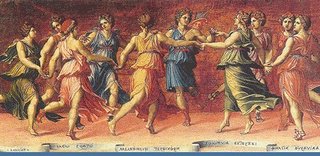
The Greeks had muses – one for each of what they considered the arts (and some of that seems open to interpretation these days) – divine spirits (daughters of Zeus and Mnemosyne or Memory) who would come down from Olympus (or the Heavens) to inspire the artist. If the artist wasn’t feeling particularly inspired, there was a ritual to encourage a visit from your particular muse: libations and prayers.
In today’s scientific world, this may seem silly, though dozens of the “self-help” books on creativity issues that I’ve read or paged through contain, in one way or another, prayers directly to God and think nothing of it. (We think nothing of children putting out milk and cookies for Santa Claus either, for that matter...)
Many of these books also suggest certain kinds of rituals, preparing your mind for creativity by first of all removing anything too mundane that distracts or ruins your focus. If you’ve set aside a private space and time in your schedule so you can write that novel, even if it’s only an hour a day, you’re not going to be receptive to fresh ideas if you’re still concentrating on what you have to make for dinner, how you’re going to present that business contract to the boss or how terrible the news is from the Middle East. You need to cleanse the mind (or the soul), and these rituals help sweep away the surface level intrusions so you can function better at a deeper level of consciousness (or allow the subconscious to percolate to the surface).
Igor Stravinsky is a good example of a Left Brain Apollo (he even composed a ballet about Apollo and the Muses) – at least from the 1920s on. In the middle of his career, after changing creative gears following “The Rite of Spring” which is almost pure Dionysos, he went back to earlier eras, finding models in the 18th Century that inspired him with their clean lines, neat textures and if not exactly unemotional, less messy emotions. When Stravinsky would sit down at his desk to compose, he would carefully sharpen his pencils, put all his pens in another place, lined up according to colors (late in life, he tended to use colored pens to write), clean paper handy – a well-ordered space that wasn’t ready for him to compose until it was all in order.
Toru Takemitsu may not be the best example of a Right-Brain Dionysian composer – his music is inspired by a Japanese sense of order and design, after all – but his ritual was to sit down at the piano and play through Bach’s St. Matthew Passion. When he was done, THEN he would begin work on a new piece. He was responding emotionally to a piece of music totally foreign in outward style and concept to the music he would be composing himself as well as to his own national culture, cleansing the mind with spiritual and timeless beauty before his spirit, like a slate swept clean, was ready to compose something new.
Artists sitting around waiting for inspiration might be “musing.”
And muse is also the root word for Music, even though all nine muses covered a variety of often overlapping art forms that would be less specific pigeon-holes than we might think useful today.
May Sarton, poet, novelist and a writer of deeply insightful journals, wrote how she might begin her day listening to music, finding Mozart’s Clarinet Quintet a particularly inspiring piece. I wonder if she would have written something different if she would have preferred Berlioz’ Symphonie fantastique?
I’ve heard from several listeners who tell me they were painting or writing poetry while listening to something I was playing on the radio that night, and how it inspired them to some creative solution they may not have been thinking of when they sat down to create (not so much “to work” but “to play”).
The word “muse” is often transferred to a person, usually someone the artist is in love with but who may be unobtainable, who becomes either a direct inspiration or someone to whom only the best creative efforts would be worthy of their dedications.
An Apollonian composer might be inspired by a form – whether it’s Haydn returning to the symphonic form to write 104 of them or Brahms writing “only” four, finding different solution for each one of them. A Dionysian composer with inspiration generating from an emotional response might be inspired by an event – like Shostakovich writing his 10th Symphony following the death of Stalin.
But what causes Creativity to change? What do you do when you find yourself abandoned by your muse?
– To Be Continued...
Picture credit: Baldassare Peruzzi’s “Muses Dancing with Apollo”
If you are under-30, chances are you feel things are not going to change that much: “What’s getting older got to do with me?” You look at your parents and cannot understand why they’re different from you, and usually not in a positive way: “I’m not going to let that happen to me!”
Aside from the obvious fact it beats the alternative, we all age – and this is not about getting older but about dealing with changes as we age. If you are over-30, you may feel I’m speaking directly to you, that you’re still trying to figure how that change happened to you. If you are now retired, you may find yourself nodding wistfully and agreeing with me: there may be nothing new here for you, but there may be some ideas you would agree with even if you hadn’t thought of them before – “been there/didn’t do that.”
Basically, my topic is creativity – which is not just being a composer. Or writer, painter, poet or anyone else in the arts. We’re all creative to some degree or another. If it’s not part of our “job,” it’s part of what keeps the “job” interesting. If it’s not, that may be the problem.
While I’m primarily dealing with music here – and largely from my own perspective as a composer (or perhaps “would-be composer”) – in many ways, you can “insert your art” here, or your situation: teacher, business person, perhaps other situations on more everyday, non-artistic levels that still require creativity that may not necessarily result in something others would call “Art” (after all, much of what artists create is often not considered “Art” by a lot of people, anyway) but which engages a sense of creative play. Part of the problem, as people age, is that “sense of creative play” becomes not only more difficult to engage but often loses its sense of play.
In music, performers are generally “re-creative,” not just recreating the music someone else wrote long ago, but in needing to come up with creative solutions to interpretive questions. Sometimes understanding creativity helps to figure out why a composer wrote something this way and not that way.
Teachers had better be creative if you expect to engage your continually changing students and expect to grow along with them.
One of the most important things you need to discover is how to teach yourself when there’s no one there to turn to to ask the questions you used to ask. Once you’ve absorbed everything you’ve been taught, you assimilate it into your own personality and pass it on to the next round: your students, your audience.
Music is not an exact science. In fact, we’re discovering that even science is not an exact science. How could all those amazing discoveries have been made if it weren’t for the unpredictable imagination? True, a lot of that happens “by accident,” but it’s the imagination that allows us to discover that we DID discover something by accident.
To those who consider themselves “non-creative,” the ability to compose music or write a novel is a big mystery. It’s not rational, we can’t explain it – we call it a “God-given Talent.” Frankly, people who understand computer programs or excel in sports are a mystery to me. Whatever it is, if you’re creative, to you this is normal; what somebody else does that you can’t is therefore a mystery.
In the United States today, everything has to be explained. Answers are True/False, Yes/No, Black/White with little tolerance for Gray (I’m speaking metaphorically, here), or at least maybe multiple choice. Everything has to be neatly pigeon-holed.
And succinct. When you fill out your income tax forms, there’s a tiny little space for your occupation – I’m a music director at a public radio station: how do I write all that in something that’s barely an inch long? One time, I just wrote in “radio” but that looked very weird – I’m a radio? There was barely room to write in “Communications” since neither Media or Entertainment seemed any more accurate. I couldn’t put “Composer” because they want to know how I earn my money and everybody knows most people don’t make any money as a composer.
So how does creativity work? Honestly, if I knew the answer to that, I wouldn’t be working at a radio station: I would be making my money as a composer and I’d be one of the most sought-after teachers in the world! The problem for many people is “so what do you do when creativity no longer works?” If it’s a God-Given Talent, then can’t God take it away? We often find ourselves worrying about this: will it be there tomorrow? Next year? I just had a big success – will there be another one? What do I do if I can’t repeat that success? Now I have a reputation: people expect great things from me now. And creativity takes on a whole new dimension.
Nobody can really teach you to be creative. Teachers can give you hints and suggestions along the way, coaching you to develop the talent you may already have, but chances are if you don’t have the talent, they’re not going to turn you into a composer just by sheer force of will. It takes time to develop this talent – and it takes time for the public to accept the fruits of that talent as “Art.” It’s not the same as mastering a skill to perform a job but in the long-range scheme of things, that’s still the basic idea. Kind of.
Whittling it down, there are two approaches to Art – you can learn the craft, learning how to put it together by rules and logic, more abstract skills that you develop before you really begin creating; or you do it “naturally” and by repetition figure out what works, replacing craft with intuition.
It amuses me, wandering through those summer “Arts & Craft” shows, looking at some of the booths to see who’s an artist and who’s a craftsman. Here’s a pot – it does everything a pot needs to do to be a pot. There are those who make very practical pots and there are those who make pots that are very appealing to the eye. One may not be very pretty, the other may not be very useful. Perhaps they’re there for different purposes. Perhaps the one potter doesn’t have the imagination to create the beautiful pot; perhaps the other one doesn’t want to make just practical pots because other potters can do that. One isn’t better than the other though we can all be snobs about pots, if we wanted to, since we can be snobs about anything else.
When I was in graduate school, earning two degrees in composition, I didn’t learn a lot of craft, turning out exercises in counterpoint, for example, which might be to music what cross-word puzzles are to novels. I had some kind of “innate” talent that worked on a mostly intuitive level: I wrote what I felt like. My teacher, Sam Adler, didn’t try to force me into the Craft Corner – probably because he knew I’d rebel – though he’d give me some assignment that was meant to solve some kind of creative issue. We’d go through the piece I brought in for my lesson and he’d say “that note – it should be an F-sharp” (it always seemed to be an F-sharp) and I would play it with the F-sharp and, yeah, it sounded better. Why does it sound better? He’d just shrug his shoulders. I would continue composing, trying to find “the right note” by “what sounded right.”
There’s a lot of discussion in the past decade or so about the Two Personality Types – are you Type A or Type B? Scientists also talk about Right Brain and Left Brain – not just as sides of the brain and how they function but how these functions reflect the personality of the... uhm, Brain-Holder. (Let’s not get into the No-Brainer.)
This is not entirely a recent discovery: through the history of Art, we have classified the style of the era as either Classical or Romantic – in music, the second half of the 18th Century is the Classical Era and the 19th Century is the Romantic Era. Basically that means “classical” is dominated by concepts of form and craft but “romantic” is ruled by emotions.
These two seemingly opposite poles have been described in terms of Greek stereotypes, which may have been the way the Greeks explained the difference between certain kinds of people (since a culture creates a mythology in order to explain itself and make sense of the world around it). Among the many facets of his job description, in addition to being in charge of the sun, Apollo was the god of order. Dionysos (or Dionysus in the Latinized form), also known as Bacchus, gave us wine and may not be as impressive as Apollo on the deity scale, but wine, an important feature of everyday life, was a means to achieving freedom from the rigidity of order.
On Apollo’s side, there is order, design, form – logic. Things can be analyzed rationally, objectively. You can look at different parts to come up with the whole. Ritual in the sense of a routine exists to inspire order. You respond to it intellectually.
On Dionysos’ side, by comparison, there is – well, chaos. Thing are random, non-sequential, intuitive and subjective. You usually respond to the whole experience before looking at its components. Ritual is something that inspires you, opens you to the choice of possibilities. You respond to it emotionally.
Apollo is your Left Brain and Dionysos is your Right Brain. Curiously we each have a brain that is divided into a right hemisphere and a left hemisphere, each one in control of certain functions that make us humans (or, in another sense, human). Some people may be dominated by the Right Brain more than the Left; others, by the Left Brain more than the Right – some, more of a mix dominated by one or the other. So curiously, with all this talk of gray matter, it’s not entirely black or white after all.
Greeks worshiped in temples of Apollonian symmetry (the most famous example being the Parthenon). Greek dramas, a mix of poetry and drama as well as choral singing and dancing, grew out of religious festivals dedicated to Dionysos.
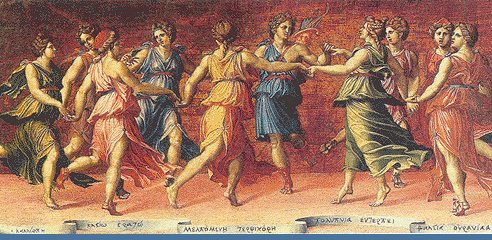
The Greeks had muses – one for each of what they considered the arts (and some of that seems open to interpretation these days) – divine spirits (daughters of Zeus and Mnemosyne or Memory) who would come down from Olympus (or the Heavens) to inspire the artist. If the artist wasn’t feeling particularly inspired, there was a ritual to encourage a visit from your particular muse: libations and prayers.
In today’s scientific world, this may seem silly, though dozens of the “self-help” books on creativity issues that I’ve read or paged through contain, in one way or another, prayers directly to God and think nothing of it. (We think nothing of children putting out milk and cookies for Santa Claus either, for that matter...)
Many of these books also suggest certain kinds of rituals, preparing your mind for creativity by first of all removing anything too mundane that distracts or ruins your focus. If you’ve set aside a private space and time in your schedule so you can write that novel, even if it’s only an hour a day, you’re not going to be receptive to fresh ideas if you’re still concentrating on what you have to make for dinner, how you’re going to present that business contract to the boss or how terrible the news is from the Middle East. You need to cleanse the mind (or the soul), and these rituals help sweep away the surface level intrusions so you can function better at a deeper level of consciousness (or allow the subconscious to percolate to the surface).
Igor Stravinsky is a good example of a Left Brain Apollo (he even composed a ballet about Apollo and the Muses) – at least from the 1920s on. In the middle of his career, after changing creative gears following “The Rite of Spring” which is almost pure Dionysos, he went back to earlier eras, finding models in the 18th Century that inspired him with their clean lines, neat textures and if not exactly unemotional, less messy emotions. When Stravinsky would sit down at his desk to compose, he would carefully sharpen his pencils, put all his pens in another place, lined up according to colors (late in life, he tended to use colored pens to write), clean paper handy – a well-ordered space that wasn’t ready for him to compose until it was all in order.
Toru Takemitsu may not be the best example of a Right-Brain Dionysian composer – his music is inspired by a Japanese sense of order and design, after all – but his ritual was to sit down at the piano and play through Bach’s St. Matthew Passion. When he was done, THEN he would begin work on a new piece. He was responding emotionally to a piece of music totally foreign in outward style and concept to the music he would be composing himself as well as to his own national culture, cleansing the mind with spiritual and timeless beauty before his spirit, like a slate swept clean, was ready to compose something new.
Artists sitting around waiting for inspiration might be “musing.”
And muse is also the root word for Music, even though all nine muses covered a variety of often overlapping art forms that would be less specific pigeon-holes than we might think useful today.
May Sarton, poet, novelist and a writer of deeply insightful journals, wrote how she might begin her day listening to music, finding Mozart’s Clarinet Quintet a particularly inspiring piece. I wonder if she would have written something different if she would have preferred Berlioz’ Symphonie fantastique?
I’ve heard from several listeners who tell me they were painting or writing poetry while listening to something I was playing on the radio that night, and how it inspired them to some creative solution they may not have been thinking of when they sat down to create (not so much “to work” but “to play”).
The word “muse” is often transferred to a person, usually someone the artist is in love with but who may be unobtainable, who becomes either a direct inspiration or someone to whom only the best creative efforts would be worthy of their dedications.
An Apollonian composer might be inspired by a form – whether it’s Haydn returning to the symphonic form to write 104 of them or Brahms writing “only” four, finding different solution for each one of them. A Dionysian composer with inspiration generating from an emotional response might be inspired by an event – like Shostakovich writing his 10th Symphony following the death of Stalin.
But what causes Creativity to change? What do you do when you find yourself abandoned by your muse?
– To Be Continued...
Picture credit: Baldassare Peruzzi’s “Muses Dancing with Apollo”
Saturday, January 20, 2007
Noise
Did you ever have one of those assignments – mine was in a junior high school health class, I think – where you were supposed to pick a handicap and act out for a day what it would be like dealing with that in your daily life? As I recall, the teacher jokingly expressed it as “pick your favorite handicap” or at least that’s what it seemed like to me.
I refused. I didn’t want to “pretend” I was blind or deaf or crippled (someone in the class threw out “or retarded” as another option – everyone laughed). I didn’t want to play-act to experience what it might be like, living that way, whether it was because I felt it was making fun of those who already were or simply out of fear: what do mothers around the world say when kids make faces, “keep doing that and your face will stay that way”? Someone later would put it as “Don’t tempt God.”
Noise has always been a particular problem for me. When I was a kid, someone at a family reunion set off a firecracker under my seat because I was just sitting there reading and not having any fun. They thought it just scared me, but my heart was pounding and I could barely catch my breath for what seemed like hours. In college, I was walking along the street when a car backfired (it sounded like a gunshot to me) and I kind of passed out, going into a state of semi-conscious shock that lasted for several hours. It was later discovered I had a slight heart murmur which might explain those reactions, but I don't ever remember being treated for it.
I have never been comfortable around factory and machine noise: it’s physically painful to me. It is not the volume – I can enjoy listening to Mahler full-blast, let’s say, and not have a problem – but the steady exposure. While Mahler might be beautiful and exciting, there is nothing aesthetically redeeming about listening to the constant shriek of a vacuum cleaner.
This past couple of months, things suddenly have been changing and I’ve become terrified of damaging my hearing. As a would-be musician and composer, losing my hearing is my biggest fear. Not that the problems indicate “sudden deafness,” more like “continued exposure to annoying noises may result in hearing damage,” and in the past month or so, I’ve become more conscious of background noises and noticing that foreground sounds are “compromised.” I now suddenly find myself having to turn the radio or stereo up more than before. I get frequent headaches after a few hours’ exposure to the steady hum of the “noise-masking system” at work and in fact find it becoming painful even after a few minutes (they’ve toned it down a bit, I’m told, but it’s still annoying: I can rarely go five or ten minutes before needing to put in ear-plugs). It’s like listening to someone vacuuming in the next cubicle only they’re there for hours at a time, not even moving, the machine just running (“you’ll get used to it”). This past week, there were industrial strength fans roaring in the atrium, drying out the carpeting after a sprinkler malfunctioned over the weekend: walking past them was like having someone holding a high-speed drill to my head.
I’ve always been aware I had a “keen” sense of hearing – it comes in handy for a musician. For me, this is what normal is. But I’d never really been aware how “sensitive” it was. However, it had been 20 years since I last had a hearing examination, so I made an appointment with a hearing specialist – for this past Thursday.
Not that I expected them to find anything because they had nothing to compare their results to. According to the examination and the tests, my hearing is “perfect.” If anything, I have an increased level of hearing and there seemed to be some wonder why I would even be concerned about that. I couldn’t seem to impress on the doctor that it was at the expense of other, more important sounds. Music, for example. Yes, I could still hear an audiologist saying certain words against the pumped-in backdrop of a steady hum of noise, but it may have been easier to do that a few months ago, before these problems manifested themselves. That’s not a very productive way to listen to and appreciate music if there’s the steady hum of a vacuum cleaner, say, in the midst of the cello section.
So now I wait until April to return for a comparison follow-up.
The question, then, is do I spend the next three months not trying to protect my hearing just to see if it WILL do any damage or do I continue wearing my “ear-protectors”? That’s an earphone-looking thing that blocks out loud frequencies but still lets me know someone is talking to me (or trying to). It turns the roar of the noise-masking noise into a bearable drone.
Working in a radio station, most of my co-workers assume I’m wearing some cool radio receiver unit. “What are you listening to,” one of them asked me yesterday.
“Silence!” I said.
So if I don’t wear it (them?), I wonder am I possibly allowing my hearing to be damaged just to prove a point? If I do wear them, there’s almost no point in going back for the follow-up because I would expect if it’s working, protecting my hearing from potential harm, the test results should still indicate my hearing is “perfect” – or perhaps “good enough” by other people’s normal standards.
Meanwhile, I sit down at my writing table by the piano, look at the music I’m trying to compose and wonder: Can I continue being a composer? Why am I a composer? Why bother trying to compose? What’s the point? Who am I if I can’t compose, even if nobody else hears my music?
As if the sense of fear about my hearing weren’t enough, now I’m sent into a creative tailspin by the “inner critic” who has turned these fears into a panic. I know Beethoven managed to compose despite his deafness. I know Smetana did not. I also know I am no Beethoven, nor even a Smetana.
No one will notice if I stop composing. (Actually, probably very few people would notice if 90% of our composers today would stop composing, but that’s another issue.) It’s not like I have a “reputation” to maintain: I’d spent maybe 15 miserable years not composing before. I have no career as a composer. But it IS how I identify my self and it’s important to me, despite other people saying things that are the equivalent of “deal with it.”
Because I know I have to but I don’t know if I can accept that loss of identity again. I am learning to accept the pain in my back (yeah, that’s another issue: also awaiting test results to see if it’s anything more than “just” arthritis) and taking measures to compensate for it (like not sitting in chairs that feel uncomfortable no matter how ergonomically perfect they’re supposed to be). But my hearing is different, a more vital part of me – and it’s not like I have a choice, or at least an easy one.
I refused. I didn’t want to “pretend” I was blind or deaf or crippled (someone in the class threw out “or retarded” as another option – everyone laughed). I didn’t want to play-act to experience what it might be like, living that way, whether it was because I felt it was making fun of those who already were or simply out of fear: what do mothers around the world say when kids make faces, “keep doing that and your face will stay that way”? Someone later would put it as “Don’t tempt God.”
Noise has always been a particular problem for me. When I was a kid, someone at a family reunion set off a firecracker under my seat because I was just sitting there reading and not having any fun. They thought it just scared me, but my heart was pounding and I could barely catch my breath for what seemed like hours. In college, I was walking along the street when a car backfired (it sounded like a gunshot to me) and I kind of passed out, going into a state of semi-conscious shock that lasted for several hours. It was later discovered I had a slight heart murmur which might explain those reactions, but I don't ever remember being treated for it.
I have never been comfortable around factory and machine noise: it’s physically painful to me. It is not the volume – I can enjoy listening to Mahler full-blast, let’s say, and not have a problem – but the steady exposure. While Mahler might be beautiful and exciting, there is nothing aesthetically redeeming about listening to the constant shriek of a vacuum cleaner.
This past couple of months, things suddenly have been changing and I’ve become terrified of damaging my hearing. As a would-be musician and composer, losing my hearing is my biggest fear. Not that the problems indicate “sudden deafness,” more like “continued exposure to annoying noises may result in hearing damage,” and in the past month or so, I’ve become more conscious of background noises and noticing that foreground sounds are “compromised.” I now suddenly find myself having to turn the radio or stereo up more than before. I get frequent headaches after a few hours’ exposure to the steady hum of the “noise-masking system” at work and in fact find it becoming painful even after a few minutes (they’ve toned it down a bit, I’m told, but it’s still annoying: I can rarely go five or ten minutes before needing to put in ear-plugs). It’s like listening to someone vacuuming in the next cubicle only they’re there for hours at a time, not even moving, the machine just running (“you’ll get used to it”). This past week, there were industrial strength fans roaring in the atrium, drying out the carpeting after a sprinkler malfunctioned over the weekend: walking past them was like having someone holding a high-speed drill to my head.
I’ve always been aware I had a “keen” sense of hearing – it comes in handy for a musician. For me, this is what normal is. But I’d never really been aware how “sensitive” it was. However, it had been 20 years since I last had a hearing examination, so I made an appointment with a hearing specialist – for this past Thursday.
Not that I expected them to find anything because they had nothing to compare their results to. According to the examination and the tests, my hearing is “perfect.” If anything, I have an increased level of hearing and there seemed to be some wonder why I would even be concerned about that. I couldn’t seem to impress on the doctor that it was at the expense of other, more important sounds. Music, for example. Yes, I could still hear an audiologist saying certain words against the pumped-in backdrop of a steady hum of noise, but it may have been easier to do that a few months ago, before these problems manifested themselves. That’s not a very productive way to listen to and appreciate music if there’s the steady hum of a vacuum cleaner, say, in the midst of the cello section.
So now I wait until April to return for a comparison follow-up.
The question, then, is do I spend the next three months not trying to protect my hearing just to see if it WILL do any damage or do I continue wearing my “ear-protectors”? That’s an earphone-looking thing that blocks out loud frequencies but still lets me know someone is talking to me (or trying to). It turns the roar of the noise-masking noise into a bearable drone.
Working in a radio station, most of my co-workers assume I’m wearing some cool radio receiver unit. “What are you listening to,” one of them asked me yesterday.
“Silence!” I said.
So if I don’t wear it (them?), I wonder am I possibly allowing my hearing to be damaged just to prove a point? If I do wear them, there’s almost no point in going back for the follow-up because I would expect if it’s working, protecting my hearing from potential harm, the test results should still indicate my hearing is “perfect” – or perhaps “good enough” by other people’s normal standards.
Meanwhile, I sit down at my writing table by the piano, look at the music I’m trying to compose and wonder: Can I continue being a composer? Why am I a composer? Why bother trying to compose? What’s the point? Who am I if I can’t compose, even if nobody else hears my music?
As if the sense of fear about my hearing weren’t enough, now I’m sent into a creative tailspin by the “inner critic” who has turned these fears into a panic. I know Beethoven managed to compose despite his deafness. I know Smetana did not. I also know I am no Beethoven, nor even a Smetana.
No one will notice if I stop composing. (Actually, probably very few people would notice if 90% of our composers today would stop composing, but that’s another issue.) It’s not like I have a “reputation” to maintain: I’d spent maybe 15 miserable years not composing before. I have no career as a composer. But it IS how I identify my self and it’s important to me, despite other people saying things that are the equivalent of “deal with it.”
Because I know I have to but I don’t know if I can accept that loss of identity again. I am learning to accept the pain in my back (yeah, that’s another issue: also awaiting test results to see if it’s anything more than “just” arthritis) and taking measures to compensate for it (like not sitting in chairs that feel uncomfortable no matter how ergonomically perfect they’re supposed to be). But my hearing is different, a more vital part of me – and it’s not like I have a choice, or at least an easy one.
Monday, January 01, 2007
New Years Resolutions
Happy New Year to everybody with best wishes for a healthy, happy, prosperous and hopefully sane year in 2007. It's a time for making New Year's Resolutions, something I don't often do, but this year was different and I thought I'd share some of them with you.
If you've ever studied music, you know that a scale - let's use the white-rat garden-variety key of C Major - is a collection of available pitches out of which you can construct a melody (the linear element of music) or chords (the vertical element of music.) Putting chords together creates harmony, which is mostly about how chords move from one to another. A cadence is a series of chords that act as punctuation for a musical phrase.
As an example, here's a C Major scale and the different chords you can create out of that scale:
 Now, if I take a different collection of pitches – a group of six notes – I can create a “set of available pitches” that can act basically the same way. Theorist Allen Forte labels this particular set or “hexachord” 6-30. If you take the other six notes of the 12 available pitches, its mirror, you come up with its complement, a hexachord that is, in this case, the inversion of 6-30 which I write as 6-30'.
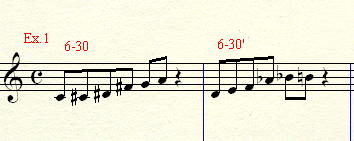 Like a C Major scale, I could use these pitches in any order I want to create a melody and I can create different kinds of chords from them, too. If I take the first three notes and turn it into a chord (I don’t want to call it a “triad” because that implies it’s built on thirds rather than is a chord consisting of three notes, so we tend to call it a “trichord”), then the second three notes and so on, I get this progression of chords built on major and minor seconds.
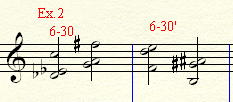 So now I have four chords created out of all 12 pitches of the chromatic scale. It’s also not terribly interesting because everything is moving in parallel directions, sort of like playing those major and minor triads from a C Major scale exactly as I wrote them in my little example above.
If you notice that the first two chords consist of a major 7th with a major 2nd above the lower note and that the second two chords consist of a major 7th with a major 2nd below the top note, you could also switch around some of the pitches to create chords that would have a minor 3rd above or below the outer notes.
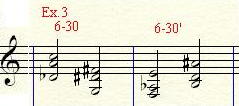 The all-parallel motion is still pretty boring, basically just a “succession” of chords. But if you start changing the direction of some of these voices within the chords, you could get something like this:
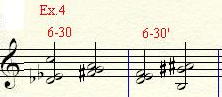 An “open” chord moving to a chord in a tighter or “close” position now gives you a sense of a chord progression – there’s a feeling of increased tension and, by reversing that order for the end of these four chords, of the release of that tension. This basically creates a kind of cadence, one that may be open-ended or one that may sound more-or-less resolved.
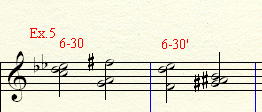 These two are really my first two resolutions. Ex.5 may sound more open-ended, like the tension still needs to resolve, because of the compact nature of the final dissonance with its Major and Minor 2nds. To listeners used to chords built on Major and Minor 3rds – a C Major or D minor triad, say – a chord like any of these will sound “dissonant,” but dissonance only means there’s unresolved tension. In a collection of non-traditional non-tonal chords, dissonance becomes fairly relative.
But looking at the set of notes in 6-30, you can also group them to create chords built on 3rds that have a look of familiarity about them. If I spelled the F-sharp as a G-flat, that would legally be a C Diminished triad, but I wanted to get the idea of the upward half-step motion to the G-natural in the next chord. It resolves to what would function in the key of D Major as Dominant 7th Chord and because of our familiarity with that sound we sense the way it could (or maybe “ought to”) resolve.
In the second hexachord, these could resolve any number of ways, including chords that sound like they could be “augmented 6th” chords (German 6ths and French 6ths, without getting into a whole raft of discussion from Sophomore Theory class) resolving to Dominant 7th chords. The point is, while they “sound” like those chords, they don’t “act” like those chords, resolving in the same expected ways.
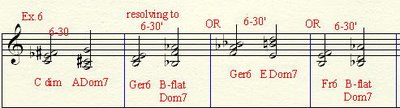 That may be interesting but I find it sounding too close to traditional harmony to be too useful in my own style. It could be used at some half-way point before a full-blown, more final resolution, though, so I’ll keep it in mind as a possibility.
But what is the point of all this? For centuries, composers have built their harmonic structure on a series of chords perceived as “consonant.” Yet a Dominant 7th, a diminished triad or an augmented 6th chord are all dissonant because they imply forward and, as yet, incomplete motion needing resolution. The art of creating a satisfying harmonic progression (or forward motion) is the result of blending the right amount of consonance with the right amount of dissonance.
If it’s all consonant, it will sound very bland (“it doesn’t ‘go’ anywhere”). If it’s all dissonant, it will sound too chaotic and unsettled (“it still doesn’t ‘go’ anywhere, just sits there churning”).
So in a more-or-less dissonant style, you still want to mix in aspects of consonance and dissonance. You can do that by resolving to chords that are “less dissonant” and therefor by comparison “consonant.” Or you can use old-fashioned “consonant” harmonies like C Major or D Minor triads.
In Ex.7, you can see the pitches of 6-30 will create two minor triads – C Minor and F-sharp minor. Its complement, 6-30', will create two major triads – E Major and B-flat Major. But play them together, they don’t sound like a “tonal consonant progression” because they’re a tritone apart, that augmented 4th interval that for centuries was called “the devil in music” because it sounded so unsettling. The more chromatic music became – following the progression from Bach and late-Mozart to Wagner to Schoenberg and so on into the 20th Century – the impact of a tritone has lessened until it’s just another interval.
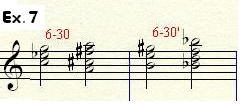 And with the right kind of intervallic motion in the outer voices, it lessens the tritone’s impact if the bass line, for instance, isn’t jumping a tritone. Ex.7 sounds very smooth, actually. Here’s another example with the same triads but I reverse the order of the last two: in some context, the motion from B-flat to E might sound better than E to B-flat.
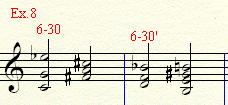 Now, if I want to use a “consonant” motion resolving to a “dissonant” motion, I could mix the two by using standard triads in an un-standard way resolving to non-tonal, non-traditional trichords creating a sense of tension that leaves this phrase “open-ended.”
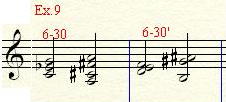 It could be more open-ended if I reversed the last two chords to end on the chord in “close” position. Or I could switch the two hexachords, then opening with dissonant motion resolving to consonant motion (and I’m speaking simplistically, here), cadencing on the F-sharp minor triad.
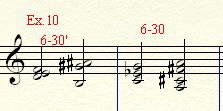 Or I could use the hexachords in their original order and come up with this possibility:
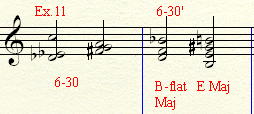 I find this a very satisfying resolution, personally. I also notice that the top-line of each chord scrambles the letters in the name BACH (using the Old German Notation where B=B-flat and H=B-natural). So if I wanted to, I could "partition" these chords in such a way, I could come up with something slightly different. By taking the two middle chords for my first pair and the two outer chords for my second pair, I now have a different progression of chords, harmonizing Bach's Name!
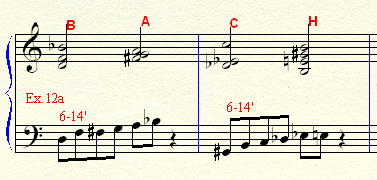 Each pair of chords now consists of one major triad and a trichord built on seconds. These create a different hexachord, which is the inversion of the hexachord Forte labels as 6-14: the complementary hexachord (its mirror) is just another transposition - a tritone away - of the same set, so both of them are inversions.
However, I didn't care as much for the E-Major cadence, so I thought if I switched out the G-sharp for the last chord with the G-natural in the second, I don't really change the structure of the chords but I get a subtle variation that also gives me a less-final-sounding resolution to E Minor. That could come in handy, perhaps. These chords, then, form the hexachord 6-15 and its complement. And it becomes a way of “modulating” between one hexachord and another.
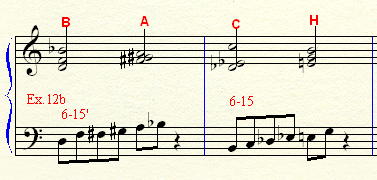 So, basically, with a mix of consonant and dissonant chords, it all comes back to Bach...
If you've ever studied music, you know that a scale - let's use the white-rat garden-variety key of C Major - is a collection of available pitches out of which you can construct a melody (the linear element of music) or chords (the vertical element of music.) Putting chords together creates harmony, which is mostly about how chords move from one to another. A cadence is a series of chords that act as punctuation for a musical phrase.
As an example, here's a C Major scale and the different chords you can create out of that scale:
 Now, if I take a different collection of pitches – a group of six notes – I can create a “set of available pitches” that can act basically the same way. Theorist Allen Forte labels this particular set or “hexachord” 6-30. If you take the other six notes of the 12 available pitches, its mirror, you come up with its complement, a hexachord that is, in this case, the inversion of 6-30 which I write as 6-30'.
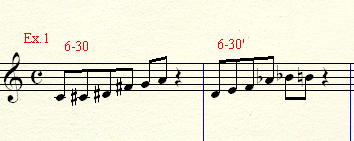 Like a C Major scale, I could use these pitches in any order I want to create a melody and I can create different kinds of chords from them, too. If I take the first three notes and turn it into a chord (I don’t want to call it a “triad” because that implies it’s built on thirds rather than is a chord consisting of three notes, so we tend to call it a “trichord”), then the second three notes and so on, I get this progression of chords built on major and minor seconds.
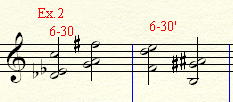 So now I have four chords created out of all 12 pitches of the chromatic scale. It’s also not terribly interesting because everything is moving in parallel directions, sort of like playing those major and minor triads from a C Major scale exactly as I wrote them in my little example above.
If you notice that the first two chords consist of a major 7th with a major 2nd above the lower note and that the second two chords consist of a major 7th with a major 2nd below the top note, you could also switch around some of the pitches to create chords that would have a minor 3rd above or below the outer notes.
 The all-parallel motion is still pretty boring, basically just a “succession” of chords. But if you start changing the direction of some of these voices within the chords, you could get something like this:
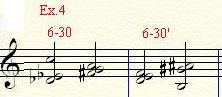 An “open” chord moving to a chord in a tighter or “close” position now gives you a sense of a chord progression – there’s a feeling of increased tension and, by reversing that order for the end of these four chords, of the release of that tension. This basically creates a kind of cadence, one that may be open-ended or one that may sound more-or-less resolved.
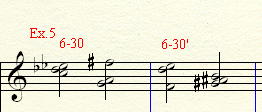 These two are really my first two resolutions. Ex.5 may sound more open-ended, like the tension still needs to resolve, because of the compact nature of the final dissonance with its Major and Minor 2nds. To listeners used to chords built on Major and Minor 3rds – a C Major or D minor triad, say – a chord like any of these will sound “dissonant,” but dissonance only means there’s unresolved tension. In a collection of non-traditional non-tonal chords, dissonance becomes fairly relative.
But looking at the set of notes in 6-30, you can also group them to create chords built on 3rds that have a look of familiarity about them. If I spelled the F-sharp as a G-flat, that would legally be a C Diminished triad, but I wanted to get the idea of the upward half-step motion to the G-natural in the next chord. It resolves to what would function in the key of D Major as Dominant 7th Chord and because of our familiarity with that sound we sense the way it could (or maybe “ought to”) resolve.
In the second hexachord, these could resolve any number of ways, including chords that sound like they could be “augmented 6th” chords (German 6ths and French 6ths, without getting into a whole raft of discussion from Sophomore Theory class) resolving to Dominant 7th chords. The point is, while they “sound” like those chords, they don’t “act” like those chords, resolving in the same expected ways.
 That may be interesting but I find it sounding too close to traditional harmony to be too useful in my own style. It could be used at some half-way point before a full-blown, more final resolution, though, so I’ll keep it in mind as a possibility.
But what is the point of all this? For centuries, composers have built their harmonic structure on a series of chords perceived as “consonant.” Yet a Dominant 7th, a diminished triad or an augmented 6th chord are all dissonant because they imply forward and, as yet, incomplete motion needing resolution. The art of creating a satisfying harmonic progression (or forward motion) is the result of blending the right amount of consonance with the right amount of dissonance.
If it’s all consonant, it will sound very bland (“it doesn’t ‘go’ anywhere”). If it’s all dissonant, it will sound too chaotic and unsettled (“it still doesn’t ‘go’ anywhere, just sits there churning”).
So in a more-or-less dissonant style, you still want to mix in aspects of consonance and dissonance. You can do that by resolving to chords that are “less dissonant” and therefor by comparison “consonant.” Or you can use old-fashioned “consonant” harmonies like C Major or D Minor triads.
In Ex.7, you can see the pitches of 6-30 will create two minor triads – C Minor and F-sharp minor. Its complement, 6-30', will create two major triads – E Major and B-flat Major. But play them together, they don’t sound like a “tonal consonant progression” because they’re a tritone apart, that augmented 4th interval that for centuries was called “the devil in music” because it sounded so unsettling. The more chromatic music became – following the progression from Bach and late-Mozart to Wagner to Schoenberg and so on into the 20th Century – the impact of a tritone has lessened until it’s just another interval.
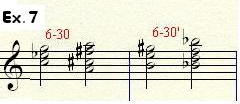 And with the right kind of intervallic motion in the outer voices, it lessens the tritone’s impact if the bass line, for instance, isn’t jumping a tritone. Ex.7 sounds very smooth, actually. Here’s another example with the same triads but I reverse the order of the last two: in some context, the motion from B-flat to E might sound better than E to B-flat.
 Now, if I want to use a “consonant” motion resolving to a “dissonant” motion, I could mix the two by using standard triads in an un-standard way resolving to non-tonal, non-traditional trichords creating a sense of tension that leaves this phrase “open-ended.”
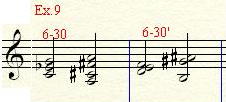 It could be more open-ended if I reversed the last two chords to end on the chord in “close” position. Or I could switch the two hexachords, then opening with dissonant motion resolving to consonant motion (and I’m speaking simplistically, here), cadencing on the F-sharp minor triad.
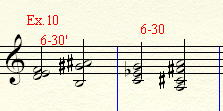 Or I could use the hexachords in their original order and come up with this possibility:
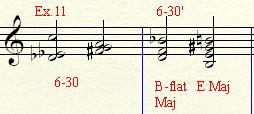 I find this a very satisfying resolution, personally. I also notice that the top-line of each chord scrambles the letters in the name BACH (using the Old German Notation where B=B-flat and H=B-natural). So if I wanted to, I could "partition" these chords in such a way, I could come up with something slightly different. By taking the two middle chords for my first pair and the two outer chords for my second pair, I now have a different progression of chords, harmonizing Bach's Name!
 Each pair of chords now consists of one major triad and a trichord built on seconds. These create a different hexachord, which is the inversion of the hexachord Forte labels as 6-14: the complementary hexachord (its mirror) is just another transposition - a tritone away - of the same set, so both of them are inversions.
However, I didn't care as much for the E-Major cadence, so I thought if I switched out the G-sharp for the last chord with the G-natural in the second, I don't really change the structure of the chords but I get a subtle variation that also gives me a less-final-sounding resolution to E Minor. That could come in handy, perhaps. These chords, then, form the hexachord 6-15 and its complement. And it becomes a way of “modulating” between one hexachord and another.
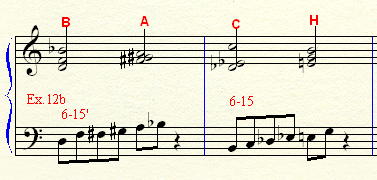 So, basically, with a mix of consonant and dissonant chords, it all comes back to Bach...
Monday, December 25, 2006
The 12 Days of Theory
To anybody who's ever been a music student and their teachers everywhere, some Christmas Cheer for this holiday break (something I presented to my own theory students long ago in a galaxy far, far away):
On the first day of Christmas, my students gave to me:
a mess in the figured bass.
On the second day of Christmas, my students gave to me:
two doubled thirds...
and a mess in the figured bass.
On the third day of Christmas, my students gave to me:
three French sixths, two doubled thirds...
and a mess in the figured bass.
On the fourth day of Christmas, my students gave to me:
four tritones, three French sixths, two doubled thirds...
and a mess in the figured bass.
On the fifth day of Christmas, my students gave to me:
FIVE PARALLEL FIFTHS!!!!!
four tritones, three French sixths, two doubled thirds...
and a mess in the figured bass.
On the sixth day of Christmas, my students gave to me:
Six foul inversions, FIVE PARALLEL FIFTHS!!!!!
four tritones, three French sixths, two doubled thirds...
and a mess in the figured bass.
On the seventh day of Christmas, my students gave to me:
seven rising sevenths, six foul inversions, FIVE PARALLEL FIFTHS!!!!!
four tritones, three French sixths, two doubled thirds...
and a mess in the figured bass.
On the eighth day of Christmas, my students gave to me:
eight bad suspensions, seven rising sevenths, six foul inversions,
FIVE PARALLEL FIFTHS!!!!!
four tritones, three French sixths, two doubled thirds...
and a mess in the figured bass.
On the ninth day of Christmas, my students gave to me:
nine tenors screaming, eight bad suspensions, seven rising sevenths, six foul inversions,
FIVE PARALLEL FIFTHS!!!!!
four tritones, three French sixths, two doubled thirds...
and a mess in the figured bass.
On the tenth day of Christmas, my students gave to me:
ten altos droning, nine tenors screaming, eight bad suspensions, seven rising sevenths, six foul inversions,
FIVE PARALLEL FIFTHS!!!!!
four tritones, three French sixths, two doubled thirds...
and a mess in the figured bass.
On the eleventh day of Christmas, my students gave to me:
eleven basses leaping, ten altos droning, nine tenors screaming, eight bad suspensions, seven rising sevenths, six foul inversions,
FIVE PARALLEL FIFTHS!!!!!
four tritones, three French sixths, two doubled thirds...
and a mess in the figured bass.
On the twelfth day of Christmas, my students gave to me:
twelve rotten discords, eleven basses leaping, ten altos droning, nine tenors screaming, eight bad suspensions, seven rising sevenths, six foul inversions,
FIVE PARALLEL FIFTHS!!!!!
four tritones, three French sixths, two doubled thirds...
and a mess in the figured bass.
Merry Christmas, everybody!
On the first day of Christmas, my students gave to me:
a mess in the figured bass.
On the second day of Christmas, my students gave to me:
two doubled thirds...
and a mess in the figured bass.
On the third day of Christmas, my students gave to me:
three French sixths, two doubled thirds...
and a mess in the figured bass.
On the fourth day of Christmas, my students gave to me:
four tritones, three French sixths, two doubled thirds...
and a mess in the figured bass.
On the fifth day of Christmas, my students gave to me:
FIVE PARALLEL FIFTHS!!!!!
four tritones, three French sixths, two doubled thirds...
and a mess in the figured bass.
On the sixth day of Christmas, my students gave to me:
Six foul inversions, FIVE PARALLEL FIFTHS!!!!!
four tritones, three French sixths, two doubled thirds...
and a mess in the figured bass.
On the seventh day of Christmas, my students gave to me:
seven rising sevenths, six foul inversions, FIVE PARALLEL FIFTHS!!!!!
four tritones, three French sixths, two doubled thirds...
and a mess in the figured bass.
On the eighth day of Christmas, my students gave to me:
eight bad suspensions, seven rising sevenths, six foul inversions,
FIVE PARALLEL FIFTHS!!!!!
four tritones, three French sixths, two doubled thirds...
and a mess in the figured bass.
On the ninth day of Christmas, my students gave to me:
nine tenors screaming, eight bad suspensions, seven rising sevenths, six foul inversions,
FIVE PARALLEL FIFTHS!!!!!
four tritones, three French sixths, two doubled thirds...
and a mess in the figured bass.
On the tenth day of Christmas, my students gave to me:
ten altos droning, nine tenors screaming, eight bad suspensions, seven rising sevenths, six foul inversions,
FIVE PARALLEL FIFTHS!!!!!
four tritones, three French sixths, two doubled thirds...
and a mess in the figured bass.
On the eleventh day of Christmas, my students gave to me:
eleven basses leaping, ten altos droning, nine tenors screaming, eight bad suspensions, seven rising sevenths, six foul inversions,
FIVE PARALLEL FIFTHS!!!!!
four tritones, three French sixths, two doubled thirds...
and a mess in the figured bass.
On the twelfth day of Christmas, my students gave to me:
twelve rotten discords, eleven basses leaping, ten altos droning, nine tenors screaming, eight bad suspensions, seven rising sevenths, six foul inversions,
FIVE PARALLEL FIFTHS!!!!!
four tritones, three French sixths, two doubled thirds...
and a mess in the figured bass.
Merry Christmas, everybody!
Tuesday, December 19, 2006
Christmas Project 3: Ave Maria
With a few days before Christmas, composition has slowed down considerably, unfortunately, now that I’m back to work, but I managed to finish one layer of the opening section of this “Christmas Project” of mine I’ve been posting about, otherwise known generically as “A Christmas Story” for lack of a better working title (see previous two posts). There’s a narration (sung by a tenor soloist) which is one line, and there’s the voice of the angel (sung by a high soprano soloist) which is another line that leads into a setting of the Ave Maria (sung by a three-part men’s chorus) which then continues as other lines and layers resume or begin: there will be a mezzo-soprano solo singing a verse of the Magnificat which will overlap with a chant-like setting of another verse of the Magnificat in the women’s voices. These weave in and out of each other in the course of this “Advent” section I've been working on.
Here, basically, is the “Ave Maria” written out as best I could manage without spending lots of time in this notepad software I’m trying out just for examples on the blog. Here’s the first verse which opens with the chant-like “incipit” sung by tenors:
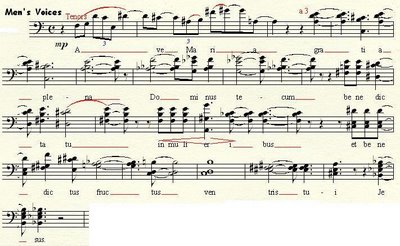 Here’s the second verse which opens with a comparable “incipit” sung by baritones:
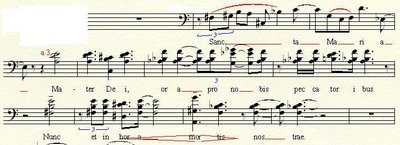 Though it’s not part of the Ave Maria text, I close the section with the men singing the Doxology, which essentially becomes the second half of Verse 2:
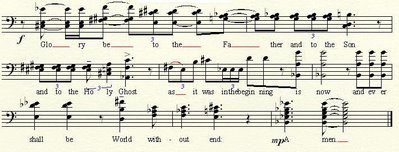 In this sense, it becomes (musically) a two-part form but with slight alterations between the first and second parts, primarily in the final cadence.
The whole thing uses three hexachords: 6-8 (which is the Angel’s six-note ‘set’ of pitches), 6-20 (which is associated with God or heaven) and 6-30 (with earthly or human associations). The chords are not, basically, standard triads but combinations of pitches that mix major and minor 2nds and more open intervals like 4ths and 5ths (the occasional tritone or augmented 4th), with less prominent major or minor 3rds, differently than one hears them in a standard major or minor triad. So it comes as a surprise to hear – at the end of each part – a progression of standard triads, but not exactly in a standard progression. The first verse cadences from an A Major to an E-flat Major triad. In the Doxology, on the words “Holy Ghost,” what should be A Major to E-flat like the first verse becomes a deceptive resolution from A Major to F Minor (from the set, 6-20), extending the phrase which then ends with a progression of four chords: B Minor to F Minor, A Major now resolving to E-flat Major, each pair of chords a worldly tritone apart and each pair the complement of the other – in all, a progression of four chords consisting of all 12 chromatic notes of the scale.
These three segments are placed to fit into the overall structure of the other layers: together, they make the whole, but the Ave Maria, for example, exists individually as a complete unit in itself. If counterpoint is the juxtaposition of melodic lines against each other to create (vertical) harmony out of their (linear) melodies, I’m doing the same thing here but with complete little pieces.
I had done this, on a more complex scale, thirty years ago when I was teaching at the University of Connecticut and writing a piece for the excellent choir we had there. Called “Whispers of Heavenly Death,” it set two different texts in three different languages and styles: and it was also spaced around the auditorium. On stage were the women’s voices singing a rather English (quasi-Britten) style setting of the Nunc dimittis in English with two soprano soloists who sang lines from Walt Whitman. In the stage-left balcony was a small madrigal choir singing the Nunc dimittis in Latin (but with changing meters and independent of the choir on stage). In the stage-right balcony was the men’s choir singing the Nunc dimittis in Russian in a style more similar to Penderecki in the 1970s: not only was it stylistically independent of the others, it was in a wholly different tempo! Along with this was a brass quintet and a vibraphone: the vibraphone was on stage with the two soloists and the horn on stage with the women’s choir, but the tenor trombone was up with the madrigal choir on the left and the bass trombone with the men on the right. At the very end, the two trumpets came in from the very back of the hall for the benediction.
Not only was it a polyphonic piece with different layers (instead of just lines) moving independently, it was a poly-stylistic and poly-temporal piece that required three conductors. As complex as it sounds, it all fit together very well and sounded great (though I only heard it from my place, conducting the men’s choir in the balcony: I was the only one who could conduct 1/4 note = 45 against the main conductor’s 1/4 note = 60). More amazing, to me, was the fact that on that Thanksgiving morning back in 1976, I had a vague idea of what I wanted to do but not sure how to go about it: by dinner time that evening, the entire piece was complete! So it’s annoying to realize now I’m trying to work out something infinitely simpler but it’s taking several weeks just to get started and who knows how long to complete! (Ah, those were the days, my friend...)
This new piece, however, is nowhere near as complicated as all that: everything works comfortably for one conductor: anything that might sound like it’s a different tempo will be written out in the general one-conductor tempo. And in two weeks, I have about 2 minutes of it done. But at least, it’s a start. Now we’ll see whether I get any more done as Christmas comes and, eventually, goes...
Here, basically, is the “Ave Maria” written out as best I could manage without spending lots of time in this notepad software I’m trying out just for examples on the blog. Here’s the first verse which opens with the chant-like “incipit” sung by tenors:
 Here’s the second verse which opens with a comparable “incipit” sung by baritones:
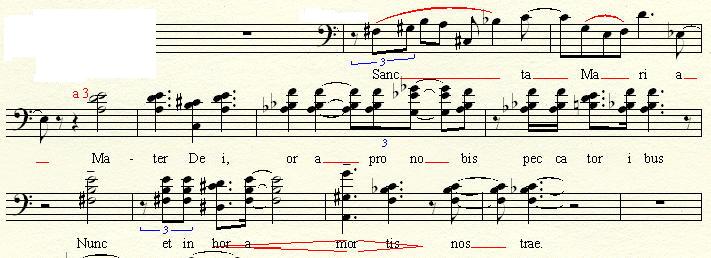 Though it’s not part of the Ave Maria text, I close the section with the men singing the Doxology, which essentially becomes the second half of Verse 2:
 In this sense, it becomes (musically) a two-part form but with slight alterations between the first and second parts, primarily in the final cadence.
The whole thing uses three hexachords: 6-8 (which is the Angel’s six-note ‘set’ of pitches), 6-20 (which is associated with God or heaven) and 6-30 (with earthly or human associations). The chords are not, basically, standard triads but combinations of pitches that mix major and minor 2nds and more open intervals like 4ths and 5ths (the occasional tritone or augmented 4th), with less prominent major or minor 3rds, differently than one hears them in a standard major or minor triad. So it comes as a surprise to hear – at the end of each part – a progression of standard triads, but not exactly in a standard progression. The first verse cadences from an A Major to an E-flat Major triad. In the Doxology, on the words “Holy Ghost,” what should be A Major to E-flat like the first verse becomes a deceptive resolution from A Major to F Minor (from the set, 6-20), extending the phrase which then ends with a progression of four chords: B Minor to F Minor, A Major now resolving to E-flat Major, each pair of chords a worldly tritone apart and each pair the complement of the other – in all, a progression of four chords consisting of all 12 chromatic notes of the scale.
These three segments are placed to fit into the overall structure of the other layers: together, they make the whole, but the Ave Maria, for example, exists individually as a complete unit in itself. If counterpoint is the juxtaposition of melodic lines against each other to create (vertical) harmony out of their (linear) melodies, I’m doing the same thing here but with complete little pieces.
I had done this, on a more complex scale, thirty years ago when I was teaching at the University of Connecticut and writing a piece for the excellent choir we had there. Called “Whispers of Heavenly Death,” it set two different texts in three different languages and styles: and it was also spaced around the auditorium. On stage were the women’s voices singing a rather English (quasi-Britten) style setting of the Nunc dimittis in English with two soprano soloists who sang lines from Walt Whitman. In the stage-left balcony was a small madrigal choir singing the Nunc dimittis in Latin (but with changing meters and independent of the choir on stage). In the stage-right balcony was the men’s choir singing the Nunc dimittis in Russian in a style more similar to Penderecki in the 1970s: not only was it stylistically independent of the others, it was in a wholly different tempo! Along with this was a brass quintet and a vibraphone: the vibraphone was on stage with the two soloists and the horn on stage with the women’s choir, but the tenor trombone was up with the madrigal choir on the left and the bass trombone with the men on the right. At the very end, the two trumpets came in from the very back of the hall for the benediction.
Not only was it a polyphonic piece with different layers (instead of just lines) moving independently, it was a poly-stylistic and poly-temporal piece that required three conductors. As complex as it sounds, it all fit together very well and sounded great (though I only heard it from my place, conducting the men’s choir in the balcony: I was the only one who could conduct 1/4 note = 45 against the main conductor’s 1/4 note = 60). More amazing, to me, was the fact that on that Thanksgiving morning back in 1976, I had a vague idea of what I wanted to do but not sure how to go about it: by dinner time that evening, the entire piece was complete! So it’s annoying to realize now I’m trying to work out something infinitely simpler but it’s taking several weeks just to get started and who knows how long to complete! (Ah, those were the days, my friend...)
This new piece, however, is nowhere near as complicated as all that: everything works comfortably for one conductor: anything that might sound like it’s a different tempo will be written out in the general one-conductor tempo. And in two weeks, I have about 2 minutes of it done. But at least, it’s a start. Now we’ll see whether I get any more done as Christmas comes and, eventually, goes...
Wednesday, December 13, 2006
A Christmas Project Part 2
As the saying goes, “what a difference a day makes,” no to mention taking the age-old advice about sleeping on it. Most writers and probably a good many composers will tell you the benefit of “sleeping on a problem.” Somehow, the subconscious works things out in your sleep so when you awake the next morning, suddenly there’s the solution that had been so elusive the night before.
Of course, it also helped to feel brighter and refreshed the next morning, too (despite the fact I was up till 3am blogging), even though I still would not consider myself a morning person. Over the years, I find I am less able to do creative work at night – even blogging goes more smoothly in the morning, something I dislike because it takes away so much of what little creative time there is in my schedule. Working second shift at the station, I often find programming and research there can go much better after I’m off the air, but that uses, I guess, a different part of the brain, though in a way it’s creative, too, just in a different way.
Anyway, on Saturday morning, things in general just looked better: not to so much what I’d written and scribbled over and crossed out the night before, but that I now saw things that I could do and – wait, that looks kind of interesting, so if I... YES! That note, that’s the one – it works! I must have filled three pages with attempts at finding that note – and all I did, really, was take one note in this chord and exchange it for one note in that chord: not only did it sound better, the harmonies it created worked much better (or rather, worked period!) theoretically as well as just sounded better.
(My apologies for all the technical mumble-jumble that follows: I know it’s about as exciting as reading computer programming texts for non-Geeks or all those blah-blah EULAs or whatever they’re called – you know, the on-line agreements for your downloaded free software that you never scroll all the way down to find out that the third Tuesday of every month is your day to go clean out Bill Gates’ cat-litter boxes, right? But bear with me: if it’s not your thing and your eyes are already rolling, check in later for another post.)
What I’d started with was this, the opening chords from the 2003 sketch:
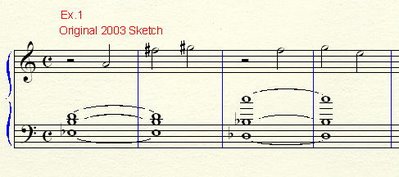 It doesn’t really do anything and doesn’t present a lot of potential. It may have been one reason why I suddenly stopped working on it a couple of weeks later: it wasn’t going anywhere and I didn’t feel like I wanted to take the time to sort it out. At the time, I was working on the Symphony and what I was looking for was some seasonal relaxation, not another major complication!
Thinking back to the magical sound that opens one of my favorite works (and one that I first discovered in high school), I decided to get out my score of Arnold Schoenberg’s “Moses und Aron” (yes, after going into New York City to see two different productions at the Met and at City Opera, I broke down and bought the full score, convinced that $100, these days, really was a bargain for such a masterpiece...) and check out the first two chords which represent the “Voice of God” calling out of the Burning Bush.
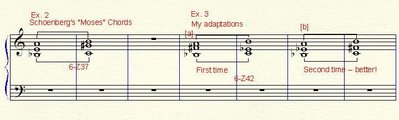 They’re just two parallel major 7ths a whole step apart: it’s the middle note that defines them, gives them their “color.”
I didn’t want to use the same ones (and wanted them to start on different pitches, anyway), just use them as a kind of reference point and a kind of ‘hommage’ – my first attempt (see ex.3a above) made a subtle alteration: the first of the two Schoenberg chords consists of 4ths – well, officially a Perfect 5th which is the inversion of a Perfect 4th and a tritone or augmented 4th (the “Devil in Music” as they always say – at least that’s how they described it centuries ago) – and the second one is built on 3rds, basically: a minor 3rd below the top note, but also a minor 6th (the inversion of a Major 3rd) above the lower note. My first chords are just based on 3rds – a 3rd below the top note and then, symmetrically, a 3rd above the bottom note for the second chord. Eh... However, if I just switch those two inner notes, I get two very different sonorities, going back to the first of Schoenberg’s chords: this time, they’re both based on Perfect 4ths and Tritones, and have a more open and, I thought, more interesting sonority for what I was looking for.
That was when things started to roll.
Anyway, I’m writing a Christmas Piece, okay? This is supposed to be, I guess, the Voice of God sending the Angel Gabriel to Nazareth to tell Mary the Good News. So how can I have intervals like “The Devil in Music” in God’s Chords? Hmmmm...
Now, it’s curious, but composers have often dealt with symbolism in their selections of chords and pitches and keys – I mentioned in the last post the idea of using E-flat and A Major chords because of the three flats or sharps in their respective key signatures representing The Trinity and I have to admit that’s really simplistic: I mean, shouldn’t all religious pieces then be in either E-flat or A Major? Regardless, I thought I should use something a little less dependent on the tritone, at least for these particular chords.
I also wanted to find some kind of “contrapuntal” symmetry beyond just two chords sitting there on a piece of paper. It’s amazing, when you think about it, how those two chords from the Burning Bush actually ignited Schoenberg's whole opera, just from those six notes – well, okay, not a whole opera, since he never figured out how to end the opera: he stopped working at it after the end of the 2nd Act, but that’s another issue.
So I have two chords (now transposed to begin on E-flat in the bass) – six pitches, which is a hexachord of a particular number of notes and intervals. Allen Forte labels this one 6-Z42. Its complement – the other six pitches – will either be the inversion of the first six or some other form from a closely-related hexachord (represented in Forte’s language as a Z-related pair), in this case, 6-Z13. By arranging these six notes into two pairs of three – two sub-motives or linear cells – I got an arpeggiated chord similar to the harmony: instead of perfect 4ths & tritones, it’s a major 7th with a minor third below the top note and a major 7th with a minor third above the lower note: now I have both sonorities from Schoenberg’s Burning Bush. Curiously, I found that the linear aspect of each set produced 6-Z13/42 but looking harmonically at it, the first 3 notes of the upper line and the first chord produced a different set: 6-5. Because they’re symmetrical, the second 3 notes and its chord is the first one’s complement.
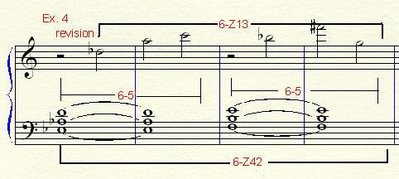 Now, one set of six notes and some other set of six notes could be related by the number of pitches or the number of intervals they have in common – or perhaps, don’t have in common. In this case, the relationship between 6-5 and 6-Z13/42 is kind of weak. I wanted to find something stronger. Or more outstanding.
A few transfigurations later and I’ve changed the opening chords a little and found different notes for the upper line. But now it started evolving into other possibilities: Schoenberg used to call his style a “continuous variation” where everything grows organically out of a set of notes, one way or another. In this next example, I found I could take the six notes of the harmony (lower line) and stretch them out linearly in the 2nd half of the example (ignore the rhythms, it was only for spacing), and then also take the first half’s upper line and bunch them together in three-note chords. They look pretty different from each other but they’re really “the same.” This is one way a composer can get variety and yet still maintain “unity.” On a less artistic level, we might just call it “getting more mileage.”
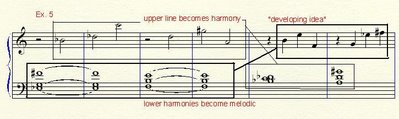 Now, another transformation (see below) shows this contrapuntal harmony/linear thing: while the vertical analysis of the 12 pitches is still a form of 6-Z13/42, the linear analysis – the upper line and then the lower line – create a new set, 6-20.
This is a very curious set. First of all, most of these groupings of pitches can be transposed to start on any note of the chromatic scale, each of which can, usually, be inverted to create a slightly different collection. But here, there are only four such transpositions possible with 6-20 before it starts duplicating itself. This sense of limitation intrigued me: more intriguing was the fact it’s almost entirely made up of major and minor thirds and minor (but not major) seconds – and no tritones! It is a set that is also known as “Genus tertium” which basically means “Third Race” but which I was looking at (since it seems to do this on its own) as a “generator of thirds,” which is basically what I liked about it: the symbolism of the Trinity and the fact it had no “devil in the music.”
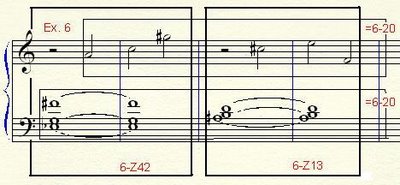 But the relation between 6-Z13/42 and 6-20 was even weaker than it was with 6-5. Could I find something better? Then I arbitrarily took one pitch in one segment and interchanged it with one pitch in the other segment and got this:
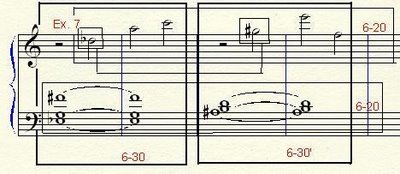 ...which doesn’t seem vastly different. But it creates not only a different vertical sonority, it creates a set with a much more striking relationship with the linear sonority, 6-20. Now, 6-30, the new set, is one that’s closely related to 6-Z13/42, but what I found so interesting was that there is an almost minimal amount of pitches and intervals in common between these two sets. It struck me as odd, in my naive way of looking at things, to think that two sets that are hardly related at all could actually coexist in the same musical passage.
But this was what got me going: 6-20 was one principal set with its own intervalic sonorities, and 6-30 was another one which, if you look carefully, consists of three tritones! The D-flat in the upper voice & the G in the first chord; the A & the E-flat in the bass; the C and the F-sharp. So now I had a new symbolism to go by: 6-20 was my spiritual realm (if not specifically God’s Voice) and 6-30 was my earthly realm (if only to have God’s Word [or Music] made flesh).
And from there, I was scribbling away.
Now granted, after an 8-hour day on Saturday and a nearly 10-hour day composing on Sunday – including a successful late-night shift for two hours before midnight – and a less successful but still productive day on Monday, you’d think I’d have more than about 28 measures done by the time I had to go back to work at the end of my vacation Tuesday afternoon. But I prefer to judge it on the quality of that productivity rather than its quantity and the realization that, whether a listener could hear some of these relationships or not (it’s arguable that most listeners today are aware of the fairly obvious ones in traditional tonal music whether they’re listening to Beethoven or the Beatles), this makes it inherently a stronger (if not a better) piece, one that sounds better to me and one that makes more theoretic or logical sense, as well.
If nothing else, the past few days have been exciting just to realize how quickly I was able to get myself, somehow, over the hump that was so depressing on Thursday night when I was almost ready to chuck the whole piece (again). But a little more perspiration helped ignite a little bit of inspiration and I’m pretty happy with what I’ve done so far, 28 measures (just shy of 2 minutes) all coming out of those first six notes.
And just in time: I wanted to use this week’s vacation to get a good strong start on this new piece, whether I finish it in six weeks or six months. I needed to get this much down now because, as I mentioned before, the upstairs apartment has been empty for almost a month. Who knows who the new neighbors will be, if their schedule will work with mine so I can compose uninterrupted or without being self-conscious of disturbing them (what a treat to think “It’s midnight, but I can go compose at the piano now because there’s no one upstairs to worry about waking up!”). The “For Rent” sign came down today: I have no idea who it will be or when they’ll move in, but at least I got a good week’s worth of work in beforehand.
And tomorrow is another day: at least I can still work in the mornings, for a while longer.
Of course, it also helped to feel brighter and refreshed the next morning, too (despite the fact I was up till 3am blogging), even though I still would not consider myself a morning person. Over the years, I find I am less able to do creative work at night – even blogging goes more smoothly in the morning, something I dislike because it takes away so much of what little creative time there is in my schedule. Working second shift at the station, I often find programming and research there can go much better after I’m off the air, but that uses, I guess, a different part of the brain, though in a way it’s creative, too, just in a different way.
Anyway, on Saturday morning, things in general just looked better: not to so much what I’d written and scribbled over and crossed out the night before, but that I now saw things that I could do and – wait, that looks kind of interesting, so if I... YES! That note, that’s the one – it works! I must have filled three pages with attempts at finding that note – and all I did, really, was take one note in this chord and exchange it for one note in that chord: not only did it sound better, the harmonies it created worked much better (or rather, worked period!) theoretically as well as just sounded better.
(My apologies for all the technical mumble-jumble that follows: I know it’s about as exciting as reading computer programming texts for non-Geeks or all those blah-blah EULAs or whatever they’re called – you know, the on-line agreements for your downloaded free software that you never scroll all the way down to find out that the third Tuesday of every month is your day to go clean out Bill Gates’ cat-litter boxes, right? But bear with me: if it’s not your thing and your eyes are already rolling, check in later for another post.)
What I’d started with was this, the opening chords from the 2003 sketch:
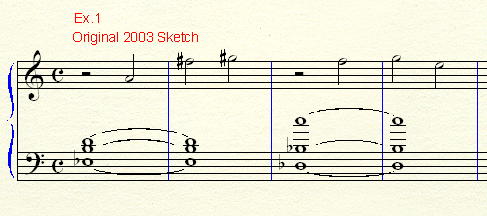 It doesn’t really do anything and doesn’t present a lot of potential. It may have been one reason why I suddenly stopped working on it a couple of weeks later: it wasn’t going anywhere and I didn’t feel like I wanted to take the time to sort it out. At the time, I was working on the Symphony and what I was looking for was some seasonal relaxation, not another major complication!
Thinking back to the magical sound that opens one of my favorite works (and one that I first discovered in high school), I decided to get out my score of Arnold Schoenberg’s “Moses und Aron” (yes, after going into New York City to see two different productions at the Met and at City Opera, I broke down and bought the full score, convinced that $100, these days, really was a bargain for such a masterpiece...) and check out the first two chords which represent the “Voice of God” calling out of the Burning Bush.
 They’re just two parallel major 7ths a whole step apart: it’s the middle note that defines them, gives them their “color.”
I didn’t want to use the same ones (and wanted them to start on different pitches, anyway), just use them as a kind of reference point and a kind of ‘hommage’ – my first attempt (see ex.3a above) made a subtle alteration: the first of the two Schoenberg chords consists of 4ths – well, officially a Perfect 5th which is the inversion of a Perfect 4th and a tritone or augmented 4th (the “Devil in Music” as they always say – at least that’s how they described it centuries ago) – and the second one is built on 3rds, basically: a minor 3rd below the top note, but also a minor 6th (the inversion of a Major 3rd) above the lower note. My first chords are just based on 3rds – a 3rd below the top note and then, symmetrically, a 3rd above the bottom note for the second chord. Eh... However, if I just switch those two inner notes, I get two very different sonorities, going back to the first of Schoenberg’s chords: this time, they’re both based on Perfect 4ths and Tritones, and have a more open and, I thought, more interesting sonority for what I was looking for.
That was when things started to roll.
Anyway, I’m writing a Christmas Piece, okay? This is supposed to be, I guess, the Voice of God sending the Angel Gabriel to Nazareth to tell Mary the Good News. So how can I have intervals like “The Devil in Music” in God’s Chords? Hmmmm...
Now, it’s curious, but composers have often dealt with symbolism in their selections of chords and pitches and keys – I mentioned in the last post the idea of using E-flat and A Major chords because of the three flats or sharps in their respective key signatures representing The Trinity and I have to admit that’s really simplistic: I mean, shouldn’t all religious pieces then be in either E-flat or A Major? Regardless, I thought I should use something a little less dependent on the tritone, at least for these particular chords.
I also wanted to find some kind of “contrapuntal” symmetry beyond just two chords sitting there on a piece of paper. It’s amazing, when you think about it, how those two chords from the Burning Bush actually ignited Schoenberg's whole opera, just from those six notes – well, okay, not a whole opera, since he never figured out how to end the opera: he stopped working at it after the end of the 2nd Act, but that’s another issue.
So I have two chords (now transposed to begin on E-flat in the bass) – six pitches, which is a hexachord of a particular number of notes and intervals. Allen Forte labels this one 6-Z42. Its complement – the other six pitches – will either be the inversion of the first six or some other form from a closely-related hexachord (represented in Forte’s language as a Z-related pair), in this case, 6-Z13. By arranging these six notes into two pairs of three – two sub-motives or linear cells – I got an arpeggiated chord similar to the harmony: instead of perfect 4ths & tritones, it’s a major 7th with a minor third below the top note and a major 7th with a minor third above the lower note: now I have both sonorities from Schoenberg’s Burning Bush. Curiously, I found that the linear aspect of each set produced 6-Z13/42 but looking harmonically at it, the first 3 notes of the upper line and the first chord produced a different set: 6-5. Because they’re symmetrical, the second 3 notes and its chord is the first one’s complement.
 Now, one set of six notes and some other set of six notes could be related by the number of pitches or the number of intervals they have in common – or perhaps, don’t have in common. In this case, the relationship between 6-5 and 6-Z13/42 is kind of weak. I wanted to find something stronger. Or more outstanding.
A few transfigurations later and I’ve changed the opening chords a little and found different notes for the upper line. But now it started evolving into other possibilities: Schoenberg used to call his style a “continuous variation” where everything grows organically out of a set of notes, one way or another. In this next example, I found I could take the six notes of the harmony (lower line) and stretch them out linearly in the 2nd half of the example (ignore the rhythms, it was only for spacing), and then also take the first half’s upper line and bunch them together in three-note chords. They look pretty different from each other but they’re really “the same.” This is one way a composer can get variety and yet still maintain “unity.” On a less artistic level, we might just call it “getting more mileage.”
 Now, another transformation (see below) shows this contrapuntal harmony/linear thing: while the vertical analysis of the 12 pitches is still a form of 6-Z13/42, the linear analysis – the upper line and then the lower line – create a new set, 6-20.
This is a very curious set. First of all, most of these groupings of pitches can be transposed to start on any note of the chromatic scale, each of which can, usually, be inverted to create a slightly different collection. But here, there are only four such transpositions possible with 6-20 before it starts duplicating itself. This sense of limitation intrigued me: more intriguing was the fact it’s almost entirely made up of major and minor thirds and minor (but not major) seconds – and no tritones! It is a set that is also known as “Genus tertium” which basically means “Third Race” but which I was looking at (since it seems to do this on its own) as a “generator of thirds,” which is basically what I liked about it: the symbolism of the Trinity and the fact it had no “devil in the music.”
 But the relation between 6-Z13/42 and 6-20 was even weaker than it was with 6-5. Could I find something better? Then I arbitrarily took one pitch in one segment and interchanged it with one pitch in the other segment and got this:
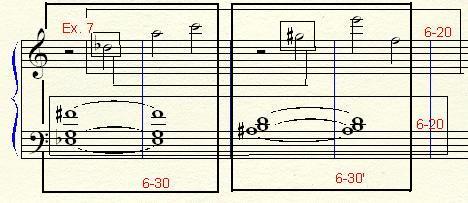 ...which doesn’t seem vastly different. But it creates not only a different vertical sonority, it creates a set with a much more striking relationship with the linear sonority, 6-20. Now, 6-30, the new set, is one that’s closely related to 6-Z13/42, but what I found so interesting was that there is an almost minimal amount of pitches and intervals in common between these two sets. It struck me as odd, in my naive way of looking at things, to think that two sets that are hardly related at all could actually coexist in the same musical passage.
But this was what got me going: 6-20 was one principal set with its own intervalic sonorities, and 6-30 was another one which, if you look carefully, consists of three tritones! The D-flat in the upper voice & the G in the first chord; the A & the E-flat in the bass; the C and the F-sharp. So now I had a new symbolism to go by: 6-20 was my spiritual realm (if not specifically God’s Voice) and 6-30 was my earthly realm (if only to have God’s Word [or Music] made flesh).
And from there, I was scribbling away.
Now granted, after an 8-hour day on Saturday and a nearly 10-hour day composing on Sunday – including a successful late-night shift for two hours before midnight – and a less successful but still productive day on Monday, you’d think I’d have more than about 28 measures done by the time I had to go back to work at the end of my vacation Tuesday afternoon. But I prefer to judge it on the quality of that productivity rather than its quantity and the realization that, whether a listener could hear some of these relationships or not (it’s arguable that most listeners today are aware of the fairly obvious ones in traditional tonal music whether they’re listening to Beethoven or the Beatles), this makes it inherently a stronger (if not a better) piece, one that sounds better to me and one that makes more theoretic or logical sense, as well.
If nothing else, the past few days have been exciting just to realize how quickly I was able to get myself, somehow, over the hump that was so depressing on Thursday night when I was almost ready to chuck the whole piece (again). But a little more perspiration helped ignite a little bit of inspiration and I’m pretty happy with what I’ve done so far, 28 measures (just shy of 2 minutes) all coming out of those first six notes.
And just in time: I wanted to use this week’s vacation to get a good strong start on this new piece, whether I finish it in six weeks or six months. I needed to get this much down now because, as I mentioned before, the upstairs apartment has been empty for almost a month. Who knows who the new neighbors will be, if their schedule will work with mine so I can compose uninterrupted or without being self-conscious of disturbing them (what a treat to think “It’s midnight, but I can go compose at the piano now because there’s no one upstairs to worry about waking up!”). The “For Rent” sign came down today: I have no idea who it will be or when they’ll move in, but at least I got a good week’s worth of work in beforehand.
And tomorrow is another day: at least I can still work in the mornings, for a while longer.
Friday, December 08, 2006
A Christmas Project
Three years ago, something inspired me at Christmas time to begin writing a Christmas piece. I usually don’t get “into” the Christmas Holiday Spirit until Christmas Day itself, if I’m lucky, given the incessant barrage of commercialism that is commonly mistaken for Christmas these days (when someone says “don’t you wish Christmas could last all year long,” I look at them and say in my best curmudgeonly graveltones, having seen Christmas ornaments for sale in mid-September and hearing Christmas carols in the stores in mid-November, “don’t you think it does already?”). In past lives, after spending the 4th of July weekend orchestrating Christmas carols for symphony concerts and then programming WITF’s Christmas music by mid-October when the listings still appeared in the magazine – different times, now, different deadlines – I was pretty much sick of Christmas by the time Black Friday even showed up on the horizon. I still get out my Bah Humbug scarf, but this year I was wearing it a week earlier since, for all intents and purposes, the shopping season that is the equivalent of Lent had likewise begun earlier.
So last week, sorting through some papers piled up on the piano, I found the sketches I had begun that Christmas Day of 2003 and wondered what possessed me to do this and then, just as quickly, abandon it. This was not, like “The Christmas Carillon” of the mid-80s, a collection of familiar carols I’d arranged: it was my own version of what would become “The Christmas Story.” Having just seen the Waverly Consort’s medieval version of “The Christmas Story” again (at Gretna Music’s Leffler Chapel performance on Dec. 2nd), it occurred to me I should come back to this and see what I can make of it. I have been wanting to get back to writing something vocal or choral again after several years of purely instrumental and largely abstract music – the scene from Aeschylus’ The Persians not likely to materialize – and certainly, ‘tis the season. Plus, I needed to take a break from the violin and piano “Blues” piece: it was just getting to me, after a while. It’s done, mostly, but I’ll get back to it in January.
Another reason, not to be taken too lightly: my upstairs neighbors had moved out last month and the apartment is still empty. So before new tenants arrive, I have this rare opportunity for an expanse of quietude that I should take advantage of, getting some serious work done on a new piece. Even though it was inconvenient to take vacation time on short notice, I was able to work out a week off, much of which can be spent composing. I set about reacquainting myself with these three-year-old sketches.
One of the things I liked about them was the different texts and overlapping elements of the story. Given my preference for arch-forms and subdivisions according to the Golden Section, there was not much needed to convince me to consider taking this up again: there are seven sections around the central panel that would basically be a meditation on the Holy Family and the text, possibly, “Hodie Christus natus est (This day Christ is born)” – bounded by the Gloria of the Angels and the visit of the Shepherds on one side, then by the visit of the Three Kings and the scene at Herod’s Court on the other side. The Nativity scene and the Birth of Christ (“O magnum mysterium”) is balanced on the other side of the graph by the Slaying of the Innocents (reworking the same material as the lament on the death of the children, “Vox in Rama”). The opening segment for Advent, covering the Annunciation of the Archangel with its “Ave Maria” and “Magnificat” is balanced by the concluding “Nunc dimittis,” St. Simeon’s prayer when Jesus is presented at the temple (“Lord, lettest thou thy servant depart in peace”). It’s all very neat, reminding me of an icon screen in several panels, self-contained musical images of the story, complete with the narration of an Evangelist (in the old Baroque sense of the term).
If I could map out the structure with its various details, I could then “fill in the notes” at a later time, the way a painter might outline the figures and their placement in the foreground before going back to paint in the details of the background, the features of the faces, the colors of the clothes and so on. With any luck, if I can get the Advent portion done before Christmas, work on the Nativity and the Shepherd and the Holy Family’s panels ON Christmas, sketch out the Kings by Epiphany (first week of January) and then the conclusion (later in the month, perhaps), I might be able to have enough to go on to get the work done before summer, not that it might be ready to perform at Christmas 2007. On the other hand, considering I could just as easily do one segment per year – or every three years, the way it’s been going – I’m only hoping I can get it to jump off the drawing board before another decade has passed...
It’s scored for fairly light forces – so far, at least: I’m thinking primarily in terms of organ, since I’m not inclined to get into a large chorus-and-orchestra piece, here. While the Evangelist appears throughout and would ordinarily be a tenor (I’m wondering about using different voices at different segments), there are two incidental solos in this opening section: a high soprano who would sing the wordless “angel solo” that is counterpoint to the recitative describing the appearance of Gabriel to Mary; and a mezzo who then sings the Magnificat in Part 1 (I’m not sure if these solos will continue with any crucial roles in subsequent sections or not). It is primarily a work for chamber choir and so could be done in a church as part of a concert or a non-liturgical service.
The narration becomes one layer with the voice of the angel (wordless) and then the men’s voices singing a chant-like Ave Maria (the angel’s words), three layers in all. Having mapped out the text’s syllables according to the Golden Section (and not surprisingly discovered that each of the texts I’d chosen so far divide fairly well according to these natural proportions), these were then mapped onto the overall structure of the piece, placing certain points to match the individual texts’ structures and arranging them in such a way the climaxes of the Evangelist’s narration (“Behold, a virgin shall conceive”) and the first verse of the “Ave Maria” coincide on the word “Jesus” in a luminous E-flat major triad. At this point, the Magnificat (in English in the mezzo solo) begins and at the climax of the first verse, the women’s voices begin singing the second verse (in Latin), so the two overlap, each continuing under the narration. At the end of the segment, the men’s voices return with the Doxology, chanted to a progression of four triads that will include all twelve pitches before cadencing on E-flat.
While my basic language may not sound traditionally tonal (I’ve posted about this before), it will, at points, open up into standard major and minor triads, though not used in the traditional tonal ways. My “tonic” and “dominant” keys are tritone-related, so the E-flat Major of the opening is answered by the A Major of the central panel. Just as Bach or Mozart might have worked with musical symbolism, I’ve chosen these two keys for the trinity of flats or sharps in their respective key signatures: coincidentally, the birth of Jesus will occur in pure, unadulterated C Major (without sharps or flats, a kind of virgin key, if you will) like a burst of light; the death of the Holy Innocents will focus around a darker F-sharp minor (three sharps). That, basically, is my tonal scheme, before the final segment’s return to E-flat Major.
Unfortunately, it took longer than I had hoped to do what I thought might be fairly mechanical mapping. It was like each text was suddenly fluid and I could expand or contract them proportionally according to how well they might place on the framework. So many possibilities! It was like writing out the rhythms and textures of the piece before even thinking about a specific pitch, finding out how much space between this text and that text, or where this overlap should begin and what the organ might be doing here or there (thinking in terms of “gestures”).
This was finished on the third day of my vacation which has, unfortunately, turned into a kind of half-sick/half-working holiday as I try to rest my back after Thanksgiving’s move and try to get rid of the headaches that have been bothering me for the past week. It has been difficult to concentrate, even though I was only working a few hours in the morning and then a few hours again in the evening. Today, finally getting down to the last basic preparatory phase – what collection of pitches will be the basic source-set for the notes that go onto this framework? – nothing satisfactory was coming up and everything else started acting up until I found myself annoyed by, for instance, the ticking of a clock in another room, the refrigerator running out in the kitchen, the neighbor Doberman barking incessantly (honestly, he’ll bark almost constantly for 20 minutes and then take 10 minutes off, just like a union break, off and on for most of the day) and the rushing sound that is probably only the blood flowing through my head.
Looking at the notes I’d written three years ago to open the piece, they didn’t seem (pardon the pun) pregnant enough, lacking developable ideas and not creating the relationships between pitch-sets I would like to have, now. Ironically, what I had was similar to the opening chords of Schoenberg’s Moses und Aron, one of my favorite works, that magical sonority that begins the opera with the Voice of God out of the Burning Bush. By reworking my two chords, prefacing the arrival of the Archangel, I managed something closer to Schoenberg’s sonority, more by way of homage rather than plagiarism. This may have created a greater pressure than I needed because everything from here on out couldn’t measure up to the homage. Finally, I had to put the pen down and go do something else. Tomorrow is another day.
So last week, sorting through some papers piled up on the piano, I found the sketches I had begun that Christmas Day of 2003 and wondered what possessed me to do this and then, just as quickly, abandon it. This was not, like “The Christmas Carillon” of the mid-80s, a collection of familiar carols I’d arranged: it was my own version of what would become “The Christmas Story.” Having just seen the Waverly Consort’s medieval version of “The Christmas Story” again (at Gretna Music’s Leffler Chapel performance on Dec. 2nd), it occurred to me I should come back to this and see what I can make of it. I have been wanting to get back to writing something vocal or choral again after several years of purely instrumental and largely abstract music – the scene from Aeschylus’ The Persians not likely to materialize – and certainly, ‘tis the season. Plus, I needed to take a break from the violin and piano “Blues” piece: it was just getting to me, after a while. It’s done, mostly, but I’ll get back to it in January.
Another reason, not to be taken too lightly: my upstairs neighbors had moved out last month and the apartment is still empty. So before new tenants arrive, I have this rare opportunity for an expanse of quietude that I should take advantage of, getting some serious work done on a new piece. Even though it was inconvenient to take vacation time on short notice, I was able to work out a week off, much of which can be spent composing. I set about reacquainting myself with these three-year-old sketches.
One of the things I liked about them was the different texts and overlapping elements of the story. Given my preference for arch-forms and subdivisions according to the Golden Section, there was not much needed to convince me to consider taking this up again: there are seven sections around the central panel that would basically be a meditation on the Holy Family and the text, possibly, “Hodie Christus natus est (This day Christ is born)” – bounded by the Gloria of the Angels and the visit of the Shepherds on one side, then by the visit of the Three Kings and the scene at Herod’s Court on the other side. The Nativity scene and the Birth of Christ (“O magnum mysterium”) is balanced on the other side of the graph by the Slaying of the Innocents (reworking the same material as the lament on the death of the children, “Vox in Rama”). The opening segment for Advent, covering the Annunciation of the Archangel with its “Ave Maria” and “Magnificat” is balanced by the concluding “Nunc dimittis,” St. Simeon’s prayer when Jesus is presented at the temple (“Lord, lettest thou thy servant depart in peace”). It’s all very neat, reminding me of an icon screen in several panels, self-contained musical images of the story, complete with the narration of an Evangelist (in the old Baroque sense of the term).
If I could map out the structure with its various details, I could then “fill in the notes” at a later time, the way a painter might outline the figures and their placement in the foreground before going back to paint in the details of the background, the features of the faces, the colors of the clothes and so on. With any luck, if I can get the Advent portion done before Christmas, work on the Nativity and the Shepherd and the Holy Family’s panels ON Christmas, sketch out the Kings by Epiphany (first week of January) and then the conclusion (later in the month, perhaps), I might be able to have enough to go on to get the work done before summer, not that it might be ready to perform at Christmas 2007. On the other hand, considering I could just as easily do one segment per year – or every three years, the way it’s been going – I’m only hoping I can get it to jump off the drawing board before another decade has passed...
It’s scored for fairly light forces – so far, at least: I’m thinking primarily in terms of organ, since I’m not inclined to get into a large chorus-and-orchestra piece, here. While the Evangelist appears throughout and would ordinarily be a tenor (I’m wondering about using different voices at different segments), there are two incidental solos in this opening section: a high soprano who would sing the wordless “angel solo” that is counterpoint to the recitative describing the appearance of Gabriel to Mary; and a mezzo who then sings the Magnificat in Part 1 (I’m not sure if these solos will continue with any crucial roles in subsequent sections or not). It is primarily a work for chamber choir and so could be done in a church as part of a concert or a non-liturgical service.
The narration becomes one layer with the voice of the angel (wordless) and then the men’s voices singing a chant-like Ave Maria (the angel’s words), three layers in all. Having mapped out the text’s syllables according to the Golden Section (and not surprisingly discovered that each of the texts I’d chosen so far divide fairly well according to these natural proportions), these were then mapped onto the overall structure of the piece, placing certain points to match the individual texts’ structures and arranging them in such a way the climaxes of the Evangelist’s narration (“Behold, a virgin shall conceive”) and the first verse of the “Ave Maria” coincide on the word “Jesus” in a luminous E-flat major triad. At this point, the Magnificat (in English in the mezzo solo) begins and at the climax of the first verse, the women’s voices begin singing the second verse (in Latin), so the two overlap, each continuing under the narration. At the end of the segment, the men’s voices return with the Doxology, chanted to a progression of four triads that will include all twelve pitches before cadencing on E-flat.
While my basic language may not sound traditionally tonal (I’ve posted about this before), it will, at points, open up into standard major and minor triads, though not used in the traditional tonal ways. My “tonic” and “dominant” keys are tritone-related, so the E-flat Major of the opening is answered by the A Major of the central panel. Just as Bach or Mozart might have worked with musical symbolism, I’ve chosen these two keys for the trinity of flats or sharps in their respective key signatures: coincidentally, the birth of Jesus will occur in pure, unadulterated C Major (without sharps or flats, a kind of virgin key, if you will) like a burst of light; the death of the Holy Innocents will focus around a darker F-sharp minor (three sharps). That, basically, is my tonal scheme, before the final segment’s return to E-flat Major.
Unfortunately, it took longer than I had hoped to do what I thought might be fairly mechanical mapping. It was like each text was suddenly fluid and I could expand or contract them proportionally according to how well they might place on the framework. So many possibilities! It was like writing out the rhythms and textures of the piece before even thinking about a specific pitch, finding out how much space between this text and that text, or where this overlap should begin and what the organ might be doing here or there (thinking in terms of “gestures”).
This was finished on the third day of my vacation which has, unfortunately, turned into a kind of half-sick/half-working holiday as I try to rest my back after Thanksgiving’s move and try to get rid of the headaches that have been bothering me for the past week. It has been difficult to concentrate, even though I was only working a few hours in the morning and then a few hours again in the evening. Today, finally getting down to the last basic preparatory phase – what collection of pitches will be the basic source-set for the notes that go onto this framework? – nothing satisfactory was coming up and everything else started acting up until I found myself annoyed by, for instance, the ticking of a clock in another room, the refrigerator running out in the kitchen, the neighbor Doberman barking incessantly (honestly, he’ll bark almost constantly for 20 minutes and then take 10 minutes off, just like a union break, off and on for most of the day) and the rushing sound that is probably only the blood flowing through my head.
Looking at the notes I’d written three years ago to open the piece, they didn’t seem (pardon the pun) pregnant enough, lacking developable ideas and not creating the relationships between pitch-sets I would like to have, now. Ironically, what I had was similar to the opening chords of Schoenberg’s Moses und Aron, one of my favorite works, that magical sonority that begins the opera with the Voice of God out of the Burning Bush. By reworking my two chords, prefacing the arrival of the Archangel, I managed something closer to Schoenberg’s sonority, more by way of homage rather than plagiarism. This may have created a greater pressure than I needed because everything from here on out couldn’t measure up to the homage. Finally, I had to put the pen down and go do something else. Tomorrow is another day.
Subscribe to:
Posts (Atom)