Friday, September 12, 2008

The Impact of "War and Peace": On Reading Tolstoy in the 21st Century

On my desk are three copies of Leo Tolstoy’s epic novel, War & Peace. It is considered one of the greatest novels of all times though the author himself argued it was not, in fact, a novel at all. I would tend to agree with him but lacking any better term to describe it, “novel” it remains.

My oldest copy, one my father purchased before I was born, is the “Inner Sanctum Edition,” using the translation by Louise and Aylmer Maude originally published in the 1920s with a preface, here, dated 1942 (1351 pages). I have read this copy twice, starting it the first time during the summer between 5th and 6th grades during the Eisenhower years (I was a precocious little twit); the second time, while a graduate student at Eastman during the Viet-Nam War.

The other two copies, each weighing in at four pounds, are more recent purchases of my own: Anthony Briggs’ translation (at 1358 pages) came out in 2006; and the one by Richard Pevear and Larissa Volokhonsky (a.k.a. P/V), was new as of the fall of 2007 (at a mere 1215 pages), just a month or so after I bought the Briggs. I had made up my mind, for some reason, that it was time to read it again, and now I had two choices.

I began the P/V translation some time in mid-May. Curled up in a chair on a rainy day surrounded by sleeping cats, I managed to finish it on September 6th, the eve of the 196th Anniversary of the Battle of Borodino which forms the climax of War & Peace.

Without getting into a comparison of the translations, at this point, I would certainly recommend this edition to anyone approaching the novel for the first time. Be warned: Tolstoy includes a great deal of French in his original and while most other editions translate the French as well, P/V have followed Tolstoy’s own example by using footnotes for the translation. At first I found this bothersome, constantly glancing back and forth from the text down to the bottom of the page, especially when English (therefore originally Russian) phrases are interspersed within the French. But you begin to see a reason for this: historically, most of the aristocracy (the main characters of the novel) spoke French because it was felt Russian itself was too low class for their cosmopolitan viewpoint. During the course of the war, Tolstoy relates, several characters hired tutors to learn how to speak Russian. At parties, guests fined each other for speaking French in public. While it helped the occupying French forces to identify members of the nobility, it also allowed one of them, wearing a captured French uniform, to infiltrate a French army camp and gather information that helped the Russian partisans in the next day’s battle.

Some writers have said Tolstoy used French when the conversation was more superficial. As the book progresses, there is less and less of it. What that says, though, about the main character Pierre Bezukhov (who is always referred to by his French name rather than Pyotr Kirilovich), I'm not sure.

If the translator's intent was to capture Tolstoy's style as close to the original as a translator could get, then I was willing to put up with it. But I'll save that for a later post: this one is about my reactions to the novel after reading this translation.

The last 35 pages may have been the hardest schlog I’ve ever had to finish a book but having gotten that far, I wasn’t about to give up. It probably took me longer to read those seemingly soporific 35 pages than it did to plow through the previous 300: I kept putting off picking up the book to continue reading. And yet, they proved to be some of the most thought-provoking pages in the entire book, placing a great deal of it in perspective.

*** ***** ******** ***** ***

Whatever possessed me to pick up my dad’s copy of War & Peace the summer of 1960, I have no idea. I spent many hours sitting on the back porch – the same porch I sat on while reading it again this summer – untangling its 500 characters, many of whom could be called by any number of variations on their names (Prince Andrei Bolkonsky could be Andrei Nikolaievich or Andryusha; or in French, André), several of them, like Marya Dmitrievna Akhrosimova, were mouthfuls for any American used to reading books whose heroes were named Ed.

Whatever else I may have gotten out of it at that time, I recalled it mostly as a book about War with its vivid battle scenes and about Peace with its brilliant images of Imperial Russian Society. I’m sure I skimmed through the philosophical essays on history and the nature of power, chapters that usually preceded the battle scenes. A book this long even had two epilogues: that first time through, though, I didn’t bother to read either of them, just paging through them to figure out who survived and who married whom and skipping over yet more philosophy (I was in 6th grade, cut me a break).

Not long afterwards, I found a recording of Prokofiev’s opera, War & Peace, and realized how much he had to cut out of the novel to make it work on the stage. It wasn’t until this last time through that I realized the scene which actually opens Prokofiev’s opera began on page 421!

I felt less guilty about skipping the philosophical ruminations on history, then: neither narrative nor essential to what passes for a plot, they’d ended up on the cutting room floor for both the opera and the two film versions I later saw based on the novel. I found out later there were even editions of the book that deleted those chapters, moving them to the back in an easily avoided appendix.

And what is the plot of this novel? A novel should have a plot, shouldn’t it? It’s a historical novel in that it takes place around historical events and many characters – like Napoleon and the Russian general Kutuzov – were historical figures. How does one reduce everything in this book to a 50-words-or-less summary?

It’s about... hmmm... Napoleon’s invasion of Russia in 1812 and its impact on Russian life, especially as seen by several members of three fictional families: Count Pierre Bezukhov and his friend Prince Andrei Bolkonsky who falls in love with young Natasha, the daughter of Count Ilya Rostov whose son Nikolai figures as another major character. In the end, Moscow is burned, the French retreat and Russia is saved.

At 65 words, that only sets the stage for scratching the surface.

(One night, Johnny Carson mentioned on The Tonight Show he had seen the TV Guide listing for a film based on Tolstoy’s War & Peace, the stereotypical door-stop of a Great Book. He cited their infamous telescoping of movie plots: “A man goes to visit his sister.”)

*** ***** ******** ***** ***

Then, re-reading it during the Viet-Nam war, I paid more attention to the historical essays and was surprised to find out, really, how much of an anti-war book it actually was. Tolstoy goes into great detail describing the anticipation of battle among the young men who are fighting, eager for glory, but now I found more telling the pages describing their fears and doubts about going into battle, the realization they could be killed at any moment, the impact the deaths of their fellow soldiers had on them, the long description of Prince Andrei lying wounded first on the battlefield at Austerlitz in 1805 and then again at the climactic scene of the Battle of Borodino (the battle that inspired Tchaikovsky’s “1812 Overture”).
This battle involved some 250,000 men and ended with about 72,000 men dead on the field. Napoleon entered Russia with a Grand Army of some 442,000 men; by the end of the retreat, only 10,000 crossed back into Poland, the rest either dead, taken prisoner or deserting.

But I still didn’t bother to read the Epilogues. I don’t know why: after 1250 pages, what’s another 101?

This time around, with the new P/V translation, I discovered a lot more irony and sarcasm in the book, with quips like this buried in the text:

— ----- -------- ----- ---
After being freed from captivity, [Pierre] arrived in Orel, and on the third day after his arrival, as he was about to go to Kiev, he fell ill and spent three months lying ill in Orel; he had, as the doctors put it, “bilious fever.” Though the doctors treated him, let his blood, and gave him medications to drink, he nevertheless recovered.
Tolstoy, War & Peace (Richard Pevear & Larissa Volokhonsky’s translation, Alfred A. Knopf 2007, p.1102)
— ----- -------- ----- —

There are also passages which, with only slight adjustments for the century and the military technology involved, could’ve been coming out of the Pentagon today: the various spins given to how something supposedly failed could be hailed as a victory; the petty rivalries and lack of communication between generals; or this pungent sample of the Russian attitudes toward their former allies (for Tolstoy’s Prussians, think Bush’s French):

— ----- -------- ----- —
'The enemy of the human race' [Napoleon], as you know, is attacking the Prussians. The Prussians are our faithful allies who have betrayed us only three times in three years. We take up their cause. But it turns out that the enemy of the human race pays no heed to our fine speeches and in his savage and impolite manner falls upon the Prussians without giving them time to finish the parade they’ve begun, beats the stuffing out of them in two seconds, and installs himself in the palace at Potsdam.
- Tolstoy, War & Peace (ibid. p.372)
— ----- -------- ----- ---

In the first Epilogue, he describes the era of almost constant warfare with Napoleon at its center:

— ----- -------- ----- —
During this twenty-year period of time an enormous number of fields go unplowed; houses are burned; trade changes direction; millions of people become poor, become rich, migrate; and millions of Christians, who profess the law of love of their neighbor, kill each other.
- Tolstoy, War & Peace (ibid, p.1180).
— ----- -------- ----- ---

The book’s first extended essay on history, a preface to Napoleon’s invasion – the first chapter of Volume III (this link will take you to the corresponding chapter in Louise & Aylmer Maude’s translation) – is not about historical events but theorizing about the causes of historical events: why did Napoleon invade Russia? Why did the Russians abandon Moscow? Unlike our present-day wars which began with the attacks on September 11th, 2001, there was no single incident that ignited the French Invasion of 1812, no easy explanation that makes any kind of sense. Two brief paragraphs (as usual, from the P/V translation) clearly take you beyond this particular war at this particular time in history:

— ----- -------- ----- —
Fatalism in history is inevitable for the explanation of senseless phenomena (that is, those whose sense we do not understand). The more we try to explain sensibly these phenomena of history, the more senseless and incomprehensible they become for us.
- Tolstoy, War & Peace (ibid, p.605).

... When an apple ripens and falls – what makes it fall? Is it that it is attracted to the ground, is it that the stem withers, is it that the sun has dried it up, that it has grown heavier, that the wind shakes it, that the boy standing underneath wants to eat it?
Tolstoy, War & Peace (ibid, p.606).
— ----- -------- ----- —

He is constantly asking questions which then you begin to apply to more recent wars. We’ve learned in our history classes that World War I started because a terrorist from a small country killed the heir to the throne of a major power. We know that World War II began when Hitler invaded Poland. But what caused the terrorist to kill the Austrian archduke? If the answer is national pride, what led to this situation which then resulted in the assassination at Sarajevo that led to “the war [that unfortunately did not] end all wars”? What earlier decisions and events led to Hitler’s decision to invade Poland? What role did the Sudetenland in Czechoslovakia play, with its sense of appeasement from the West, or the Anschluss of Austria? Then, too, how did American troops end up in Viet-Nam?

Perhaps the attacks on September 11th are not the real cause of today’s wars in Afghanistan and Iraq?

And more recently, how does this compare to the Russian invasion of the small republic of Georgia and its apparent attempt to absorb (or free) the break-away areas of Abkhazia and Southern Ossetia? Are we playing out these same “causes” for a future war (hot or cold) by professing a belief that Georgia should become a member of NATO which would then require the West to go to war with Russia to protect our ally from future aggression because that is what treaties do? Are we living in a time comparable to the summer of 1812 when, much to their surprise, the Russians found thousands of French troops inexplicably crossing their borders?

So, this third time through the novel, now influenced by a different time and having reached a different age, I’m feeling the impact of the book on a different level. Now, rather than being fascinated by the historical panorama of Napoleon’s Invasion and absorbed by the characters in Tolstoy’s fictional account of life in Russia at that time, I find myself thinking about this philosophical approach to the causes of history far beyond the era he describes. Though at times tedious reading (like this blog-post) compared to the swiftly moving accounts of battles or the emotionally riveting story-telling of the lives of Pierre Buzukhov, Prince Andrei and Natasha Rostov, I’m finding this the crux of my reaction to what I’d been reading. But many people engaged in the novel-like aspects of the book find these interpolated essays to be intrusive, boring digressions.

— ----- -------- ----- ---
The totality of causes of phenomena is inaccessible to the human mind. But the need to seek causes has been put into the soul of man. And the human mind, without grasping in their countlessness and complexity the conditions of phenomena, of which each separately may appear as a cause, takes hold of the first, most comprehensible approximation and says: here is the cause. In historical events (where the subject of observation is the actions of people), the most primordial approximations appears as the will of the gods, then as the will of those people who stand in the most conspicuous historical place – the historical heroes.
- Tolstoy, War & Peace (ibid, p.987).
— ----- -------- ----- ---

Throughout the book, the historical figures of Napoleon and the old Russian general Kutuzov (left) might be perceived as adversaries if it weren’t for the fact that Kutuzov is a kindly, bumbling old man who is viewed by everyone as the Wrong Man, compared to the self-assured, god-like Napoleon, the military genius. What explains the fact that Napoleon ruined his own army by taking Moscow, not because of any strategic plan on Kutuzov’s part and not in any battle but simply by being in the Wrong Place. The standard adage is that Napoleon was defeated by the Russian Winter, thousands of miles from home, without direct supply lines and encamped in a city set on fire – by whom? the Russians themselves in a patriot sacrifice or by the bivouacing French who, not aware they are in a city built primarily of wood, lit fires to cook their meals? – which means, without support and sustenance, they can only retreat. In their haste, thousands more men are lost to disease and the inhospitable conditions of the weather than through military action but also, as Tolstoy points out constantly (with a sharp sense of ironic wit), the total incompetence of the generals on both sides: there was no way the generals could control a mass of men driven by panic; there was no way the Russian generals could destroy them in battle because they couldn’t agree on a plan, did not have the technology to arrange their troops in the Right Place in time to do anything more than harry the already retreating French.

We learned in our history classes that American soldiers won the Revolution because the British soldiers could not understand guerilla warfare, offended that the enemy would not meet them on the open playing fields of War the way the art of warfare required. Marching like a parade through the forests, they were picked off one by one by snipers hiding behind the bushes.

The same thing happened to the French: at one point, Napoleon complains to Kutuzov that he is not playing by the rules (“as if,” Tolstoy adds parenthetically, “there are certain rules for killing people”). Several scenes, following the climactic burning of Moscow, show small bands of Russian troops, operating without anything like Central Command, following the demoralized French and nipping at their heels. (This reminded me of a long scene in which the Rostov family, one peaceful winter, goes hunting a wolf, Tolstoy spending pages describing how the dogs are deployed and what will happen when someone approaches the wolf from this direction and so on.) The French generals, unable to muster the troops to fight a single battle, do not know how to combat the mosquito-like partisan guerillas which only made the panic worse.

In Iraq and Afghanistan, American troops, now aided by the more advanced techniques of modern warfare, find it difficult to adapt to an Insurgency who uses not standard military tactics and technologies but, to us, morally incomprehensible suicide bombers to create terror among the troops and the civilian population. Without a government to fight, the United States is at a loss how to deal with the partisan geurillas which only makes the panic worse.

— ----- -------- ----- ---
All the ancient historians used one and the same method to describe and grasp the seemingly ungraspable – the life of a people. They described the activity of individual men who ruled the people; and this activity expressed for them the activity of the whole people. To the questions of how individual men made peoples act according to their will and what governed the will of these men themselves, the ancients answered the first question by recognizing the will of a divinity who subjected peoples to the will of one chosen man, and the second by recognizing that the same deity guided the will of the chosen one towards a predestined goal. For the ancients, these questions were decided by faith in the direct participation of a divinity in the affairs of mankind. Modern history, in its theory, has rejected both of these propositions.
Tolstoy, War & Peace (ibid, p.1179).
— ----- -------- ----- —

That was Tolstoy writing in the 1860s, belittling the attitude that such-and-such happened because of divine intervention or because it was God’s Will, otherwise inexplicable.

And yet today, viewpoints are expressed by government officials or those who would lead the government, that the War in Iraq is part of God’s Plan when vice-presidential candidate Sarah Palin, as Governor of Alaska, said this:

"Pray for our military men and women who are striving to do what is right. Also, for this country, that our leaders, our national leaders, are sending [U.S. soldiers] out on a task that is from God. That's what we have to make sure that we're praying for, that there is a plan and that plan is God's will."

A former colleague of mine suggested earlier this year that a new “slogan” for public broadcasting could be “We tell you the truth.” My first reaction was “Who’s Truth?”

Tolstoy writes, in the second epilogue, about the definition of Power and asks the question “What force moves peoples?”

— ----- -------- ----- —
One historian insists that the event was produced by the power of Napoleon; another insists that it was produced by the power of Alexander [the Russian Emperor]; a third by the power of some third person. Besides that, historians of this sort contradict one another even in explaining that force on which the power of one and the same person is based. Thiers, a Bonapartist, says that Napoleon’s power was based on his virtue and genius; Lanfrey, a republican [in the 19th Century European, non-monarchist sense of the word], says it was based on his swindling and on duping the people. So that historians of this sort, by mutually demolishing each other’s propositions, thereby demolish the concept of the force that produces events and give no answer to the essential question of history.
Tolstoy, War & Peace (ibid, p.1182-1183).
— ----- -------- ----- —

Today, voters who place themselves on the Right feel that those on the Left are on the Wrong Side of Truth. And vice-versa.

A friend just last night complained to me about the distortions being made of the political positions of his party and said “WE don’t do that – do we?” But, I told him, look at it from the standpoint of the other side, and it would appear it happens on both sides: you may not see it because it is what you believe. This is why we have sectarian wars and why agreements will never be reached by opposing sides who continue to distrust each other or feel that one is superior to the other. But that is an extension of the topic beyond the scope of my thoughts on Tolstoy, even though with his final pages still relatively fresh in my mind, it affects my thinking on these other issues as well.

And what is “the essential question of history”? Ten pages later, Tolstoy writes:

— ----- -------- ----- —
What is the cause of historical events? Power. What is power? Power is the sum total of wills transferred to one person. On what condition are the wills of the masses transferred to one person? On condition that the person express the will of the whole people. That is, power is power. That is, power is a word the meaning of which we do not understand.
- Tolstoy, War & Peace (ibid, p.1193).
— ----- -------- ----- —

Thinking abstractly, historians develop a science of history that seeks to produce laws that can be comprehended with the same acceptable assurance as the law of gravity.

— ----- -------- ----- —
Reason expresses the laws of necessity. Consciousness expresses the essence of freedom.

Freedom, not limited by anything, is the essence of life in the consciousness of man. Necessity without content is man’s reason with its three forms.

Freedom is that which is examined. Necessity is that which examines. Freedom is content. Necessity is form.

Only by the separation of the two sources of cognition, which are related to each other as form to content, do we get the distinct, mutually exclusive, and unfathomable concepts of freedom and necessity.


Only by their union do we get a clear picture of the life of man.

Outside these two concepts, mutually defining in their union as form and content, no picture of life is possible.

- Tolstoy, War & Peace (ibid, p.1210).
— ----- -------- ----- ---

And here, in a way, is not just a scientific or philosophical approach to history but also to art, another important aspect of civilization, to defining a culture and one equally as baffling to define. As I sat back and thought how these ideas apply to the music I listen to or the music I compose, it also occurred to me this is the thread that binds together this whole “baggy monster,” as Henry James described the novel.

Tolstoy applies these issues to what happens to, what motivates, and what challenges his fictional characters just as much as he applies it to the historical figures and events. It is behind the arguments, expressed or otherwise, between Pierre who is always searching for meaning in his life (a man who lives more content than form) and the more self-assured Prince Andrei who tries to find ways to express himself within his role in society as an aristocrat and a soldier (decidedly, living form over content).

Curiously, as Tolstoy himself writes, these two major characters were patterned after different aspects of his own nature – the struggle, perhaps, we might express today as Right Brain versus Left Brain without ascribing it to any political principles – just as he based Andrei’s father, the Old Prince, on his own maternal grandfather, a character who is practically all form with a limited range of content that is decidedly out-moded.

Natasha, who clearly has no intellectual depth, living purely for the social life she seems to be destined for, understands neither Andrei (whom she had been engaged to) nor Pierre (whom she eventually marries). Her life, with all of its complications, is affected by what might seem fate, by a series of poorly made decisions (what caused her to give up Andrei to suddenly run off with the dashing Anatole Kuragin?) and the surface impressions of the social whirl her family lives in, a different level of content restricted by specific forms, clearly acceptable or not acceptable, and for which she, in her own responses, pays the consequences.

By applying these concepts of history not just to his interpretation of historical events and characters but to his fictional characters as well, Tolstoy creates a “picture of a life” that resonates in today’s world despite its backdrop. It is why, perhaps, there are no answers, only more questions by the end of the book – if this is not The Cause, what then caused that event? – and why the book transcends the idea of merely telling a story.

When Natasha becomes engaged to Prince Andrei, she cannot understand why he must “go abroad” for a year, on his father’s orders. It is her illogical decision to elope with the worthless cad Kuragin just a month before Andrei returns that changes her life. After the Battle of Borodino and the burning of Moscow, Natasha nursed the wounded Andrei and sat by his side as he died, then later discovered the love for Pierre who had just been, before all this, a family friend, though this too, of course, is more complicated than just what it seems on the surface. Before the novel proper ends (before the epilogues), before Pierre has proposed to Natasha, he decides for some unexplained reason to leave Moscow and go to Petersburg: Natasha, hoping for a happily married life without any further delays, perhaps sees a replay of the separation she had after her engagement to Andrei. In the final paragraph, she is talking to Prince Andrei’s sister, Princess Marya:

— ----- -------- ----- ---
“Only what is he going to Petersburg for!” Natasha said suddenly, and hastily answered herself: “No, no, it has to be so... Right, Marie? It has to be so...”
- Tolstoy, War & Peace (ibid p.1125)
— ----- -------- ----- ---

The first epilogue takes place seven years later: Pierre and Natasha have by then married and are raising their children. Prince Andrei’s sister Marya married Natasha’s brother, Nikolai Rostov, bringing all three major families together neatly at the end (or after the end) of the novel.

There is one character very much on the sidelines of everything and paid little attention to: Prince Andrei’s son by his first wife (she dies in childbirth just as Andrei returns from the War of 1805, having been given up for dead after the Battle of Austerlitz). Named after his stern grandfather, the Old Prince, Nikolenka (or Little Nicholas) does very little during his time on the page: he is born, he is ill, he is taught by a Swiss tutor, he is raised by his Aunt Marya in the general absence of his father and watches his father as he dies of his wounds. In the epilogue, now 15, Nikolenka is fascinated by his father’s friend, Pierre Bezukhov, and hangs on his every word, an influence that Nikolai Rostov (his uncle) thinks is unhealthy. Rostov and Pierre have a discussion about politics that make Rostov uncomfortable realizing Pierre is, shall we say, a Liberal and potentially dangerous to his thoughts about the Imperial Government. Sitting in the shadows of the room, Nikolenka absorbs all this; then, chastised by Uncle Nikolai for having been there at all, goes to bed. Waking up from a bad dream involving his disapproving uncle, he recalls the image of his protective father, a father he hardly knew:

— ----- -------- ----- ---
“Father,” he thought. “Father” (though there were two portraits of a good likeness in the house, Nikolenka never pictured Price Andrei in his human image) “father was with me and caressed me. He approved of me, he approved of Uncle Pierre. Whatever he says – I’ll do....” [Reflecting on the men he’s read about in Plutarch during his lessons, he decides to do the same kinds of things.] “I’ll do better. Everybody will know me, love me, admire me.”... ...”But Uncle Pierre! Oh, what a wonderful man! And father? Father! Father! Yes, I’ll do something that even he would be pleased with...”
- Tolstoy, War & Peace (ibid, p.1178).
— ----- -------- ----- ---

When the idea for the novel first came to Tolstoy, it was going to be about the Decembrist Uprising in 1825, following the death of Emperor Alexander I. But he decided, instead, to start earlier. The novel began to appear in magazine installments under the title “1805.” Only later did it become known as “War and Peace.”

But after reading the first 600 pages and realizing this is only a preface to the events at the heart of the book – the Napoleonic Invasion of 1812 – you begin to realize, in looking for the answer to “What caused Napoleon to invade Russia?”, Tolstoy is going back to find various possibilities from various events of the previous seven years (again, the number seven), events that are the repercussions of the French Revolution and leaving implicit the question “what caused the French Revolution?”

And here, at the end, Tolstoy implies the future: will Pierre with his liberal political views become involved in the Decembrist Uprising ten years later and will Nikolenka grow up with dreams of becoming a Great Man – perhaps a man with power – and will he follow Uncle Pierre into the fray?

So the question of “what caused the Decembrist Uprising” may be tied up in the ideas of a boy trying to emulate his father whose life was changed by the Invasion of 1812 which was caused by... and so on and so forth.

The War in Iraq (2003 and on-going) – after a quick and apparently easy invasion toppling the dictator Saddam Hussein but not finding the elusive “weapons of mass destruction” – was the response, rightly or wrongly, to the attacks of September 11th, 2001, masterminded by al-Qaida terrorists led by Osama bin Laden (remember him?) who devoted himself to the destruction of the United States because of its too influential presence in Saudi Arabia whose government was put in place by colonialist powers looking for political stability in the region early in the 20th Century.

As the War on Terror began, the American public wasn’t told to make sacrifices like earlier generations did in World War II and before: we were told to go shopping, to prove to the evil-doers that everything was normal here, to keep the economy strong and not give in to fear.

And yet people have wondered how, during the course of events, the Russian aristocracy could continue going to fancy-dress balls and party the night away when French troops were massing along their border.

The American Army, after the initial shock-and-awe leading up to their arrival in Baghdad – miles away from the purported villain who caused the attacks on September 11th – finds itself five years after “mission accomplished” mired down in inhospitable terrain much as the French found themselves in Moscow, achieving a goal they didn’t understand and, once attained, didn’t know what to do with.

And questions remain unanswered. Or unanswerable.

As Tolstoy wrote 140 years ago,

— ----- -------- ----- ---
...[M]odern history is like a deaf man, answering questions that no one has asked him.
- Tolstoy, War & Peace (ibid, p.1182).


*** ***** ******** ***** ***
All quotations from Tolstoy’s War & Peace are taken from the Knopf edition of Richard Pevear and Larissa Volokhonsky’s translation, published in 2007.

Illustration credits:
Top: uncredited portrait of Count Lev Nikolaievich Tolstoy, painted in 1868 at the time he was completing the novel, War & Peace.
2nd from Top: Napoleon observing the Battle of Borodino, painted in 1897 by Vasily Vereshchagin.
3rd from Top: The Raevsky Battery during the Battle of Borodino, part of a panorama painted in 1911-1912 for the Centennial Celebration of the Battle by Franz Alekseivich Roubaud
4th from Top: General Kutuzov, commander of the Russian Army, at Borodino (an uncredited, undated painting).
Bottom: Napoleons Retreat from Moscow, by German painter Adolf Northen (d.1876).

Thursday, September 11, 2008

Remembering September 11th, 2001

On September 11th seven years ago, I woke up in my newly-moved-into mid-town apartment just before 9am and logged on to my lap-top to see what was going on in the world. There was some nebulous news flash about a plane hitting the World Trade Center. I assumed it was probably one of those small 4-seater type planes and went to find out more about it. Having logged into a chat room where friends were already chatting about what was happening, I read that, now, a second plane hit the other tower. Suddenly, the bottom dropped out when I realized this is no accident: what is going on?

Originally, there was a flood of 1000 words here describing how that day unfolded for me, but you know what happened and the pictures may still be fresh in your mind. To keep this post relatively short (at least, for me), I wanted the focus to be how this affected the music I composed.

The year before, I had written a violin and orchestra piece that still has no title, inspired by the opening chapter of Tolkien’s Silmarillion, the violin seems to call the world into being but evil is introduced by an opposing power; there is a clash and then everything eventually collapses back to the beginning. Nor have I done anything with it beyond showing it to a few people who’ve basically never gotten back to me about it (that unplayable, huh?).

Shortly after I was able to function again following 9-11, I began a companion piece, again with no title, where a solo English horn was a voice-in-the-wilderness, spinning out a prophet-like meditation whose message becomes perverted by his followers and of which he loses control.

I was, maybe, half-way through the piece when I’d gone to hear the Market Square Concert “Summer Music” performance by the Ying Quartet which had a new work on the program, one I didn’t care for much. Thinking back on the historical baggage of writing a string quartet today with Beethoven and Brahms and Bartok tromping along behind you, wondering what I would ever do if someone asked me to write a quartet, Joel Lambdin sat down next to me at intermission, as if on cue, and asked precisely that: would I write a string quartet for his Harrisburg Players’ Collective? I fumbled around with some ideas, mostly working on technical issues – writing for four strings is a lot harder for me than writing for a full orchestra, historical baggage aside – when a motive started to gel that I liked. And then I put the English horn piece aside and never went back to it.

Now, without getting too detailed about my musical language and compositional habits, I tend to work with numbers substituting for pitches in standard notation. This helps me think of the pitches more abstractly without traditional 19th-Century contexts of how chords function or how one pitch leads to another. In this shorthand, something developed by theorists analyzing 20th Century music for years, C is 0, C-sharp or D-flat is 1, F is 5, B-natural is 11 and so on. This motive I was working out started with a long sustained A moving to a B-natural before erupting into a dramatic chord. Or as I wrote it using this number-system, 9-11. Though no listener would hear what you would see with those numbers on the page, it became the start of my String Quartet. It was September 9th, 2002.

The premise of the quartet was an arch in five movements, each reflecting a different emotion experienced in the preceding year: rage - fear - that numbness which is neither grief nor mourning - hope - and then I wasn’t sure how to end it, perhaps with either a lament or a dramatic protest or maybe something positive. Eventually the last movement went in two opposite directions simultaneously, dividing the four musicians into two duos (much the way Elliott Carter did in his 3rd String Quartet, though without as deep a complexity). It took a long time to work all this out, writing a few hours a day before going into the station.

The hardest to write was the “fear” movement, the second movement’s swirling paranoia which I likened to being lowered into a tank of piranhas and you have no idea where they might attack you from: going from this frame of mind out into the real world was a daily adjustment and sometimes not an easy one. Only when I had mapped everything out and put all of the emotional details into the plan was I able to approach it as an abstraction without the psychological drain. The same worked for the final movement, too: there was to be no identification which duet was which side of the political spectrum, just two factions not only violently disagreeing but in a sense not even listening to each other, the death of the dialectic.

The quartet was completed on September 8th, 2003.

It was not the most practical thing I could have written for an ad hoc ensemble that doesn’t play together regularly like an established quartet. I was constantly worried about its being either unplayable or being simply too hard to perform with only a few rehearsals. Showing the rough drafts to Joel on an installment basis – I remember showing him the first movement and, as he looked at the first page, seeing how his hands began to tremble – there were several occasions when he could've backed out of his commitment to play the piece: I had to write what I needed to write at that time. To his credit, he urged me to keep going. It became, after all, only the second piece I’d completed in some 20 years and I think we were both afraid that if he backed out now, I would stop writing this one, too.

One thing that occurred to me as I was writing it – I believe it happened during the fourth movement, a long-lined melody unfolding over constantly shifting and increasingly faster harmonies – how much easier this would be to write it for orchestra. The structure was also symphonic in scope, and so I began toying with the idea of “turning it into” an orchestra piece. The first sketches were made a few days before the quartet was completed, but now I had to write out the final draft and full score of the quartet, plus copy parts for the impending performance. But on the morning of September 11th, 2003, I stepped out on my porch around 10am and heard the single tolling of a church bell, presumably the one just two blocks away, joined then by the gentle pealing of bells from other churches around the city. After a moment’s pause, there was a creative flash in which I saw the whole piece begin to take shape in my mind. I went to the piano and started sketching a few ideas that would become the symphony that put me back into this constant 9-11 frame of mind for another two years.

Because the quartet still required much of my post-compositional time, I did not actually begin writing the symphony until late-January 2004, but after that it became a nearly daily creative encounter. I spent the intervening months working out the structure – except for the finale which again became an issue: how to end it – and it wasn’t until most of that was done I felt I could begin filling in the notes. In a way, the piece itself was basically finished: all it needed was the notes. It would have been too neat, perhaps, to have finished it around September 11th, 2005, but there was still much work to be done: there were times when a week’s vacation would have been wonderful to cover the necessary groundwork but it wasn’t practical to arrange the time. Instead, when my turn came for a holiday, I was not at a point where that amount of concentrated time was helpful, working out certain drudgeries of background that turned the mind to mush after a few hours anyway, necessary but unrewarding and often frustrating (times when I wonder if composing is really worth it, when the negative voices are the loudest, when you lose track of what your goal really is). It wasn’t actually finished until late-January of 2006, two years and a day after I’d begun composing it.

Meanwhile, the String Quartet was set for a performance in March, 2004. By this time, Joel had moved to New York City to find work, more training, and more inspiration to keep his own dreams going. The Collective would still be performing in Harrisburg but three of the musicians – Joel, 1st violinist Matt Lehmann and cellist Jennifer deVore, all playing in the Harrisburg Symphony – lived in New York City; violist Amadi Hummings, whom I’d met during the seasons he played with Next Generation Festival, was based in Virginia. So ironically, I found myself going to New York for rehearsals for a performance in Harrisburg. It was also the first time I’d gotten back to New York since September 11th, 2001. Given the nature of the piece and how much this date and its events had become part of my life, it seemed inevitable I should make a pilgrimage to Ground Zero. It was not possible to do it lightly or easily. And I knew from there I would go to a quartet rehearsal.

Walking through side streets still fenced off with barriers and walls where you could still read posters from people looking for loved ones (thinking of the opening of John Adams’ On the Transmigration of Souls with its heart-rending repetition of a child’s voice saying “Missing...”), I approached it from the side, spending much time just staring into this hole in the ground: there was not much to see, but it was what one could still see that had the most immediate impact – the ramp used to bring up the debris and the bodies buried in the rubble; the gouges in the stones of adjacent buildings. I tried to avoid the front of the place where many people, clearly tourists, got off buses, ran up steps to have their pictures taken in front of the fence – “And here we are at the World Trade Center” – before running back onto the bus for the next stop. I tried not to look at them or feel anything toward them. I knew friends of mine who lived in New York City, including members of the quartet, who still were unable to go there simply to see.

Much of that afternoon was spent at St. Paul's Chapel of Trinity Church, the stone church where George Washington had prayed when this city was the nation’s first capital. But how this building had survived the collapse of the towers is still a miracle: it became the triage center for the rescue mission in those first hours and was, in 2004, still a museum to the courage of the men and women who worked there and to those who died there. Someone had placed boxes of tissues near many of the exhibits. There were photographs of a young man playing the violin to soothe their spirits alongside photographs of those who gave them food or massages. There was even a photograph of a string quartet playing in the sanctuary and I thought of my quartet being played there, then shook my head “no.”

Out in the back yard, I sat on a stone bench where George Washington himself may have sat if not slept. Looking through the ragged branches of trees and iron fences that had survived the collapse, I looked into the space across the street where once the towers had stood and pulled out the score of my quartet to read through it. I had gotten into the second movement’s paranoia and put it away: it was not the piece to be heard here, in this space. It was not, perhaps, a piece to be heard on September 11th at all, for that matter, a day that needs contemplation and remembrance, not rage and fear. I read through just the slow static middle movement and then put it away.

I sat there, perhaps, for an hour before getting back into the subway, not having said a word to anybody the whole time but walking away with a pocketful of tissues, going over to the apartment in Queens where they were rehearsing my quartet. It was a beautiful spring-like morning in early March. As I turned down the street, I heard my music – my music!! – wafting up towards me from their rehearsal. They were in the middle of the slow movement.

It was then I felt, for the first time in a long time, I was doing something right.

The performance, to finish the story, went much better than I was anticipating: the quartet played incredibly well for the intense difficulty of the piece, both technically and emotionally. In fact, I was amazed by the impact of their performance and only slightly aware of the slight problems in the performance – one spot where two players were not together but which was quickly corrected, or realizing the last movement was under tempo: did anyone but the composer notice these things? I was happy enough it had not fallen apart somewhere, the last movement so rhythmically complex (one side slowing down as the other duet speeds up and practically explodes at the end). The performance at the Fredricksen Library in Camp Hill may not have had the best acoustics and I wondered if the two duets in the finale could work, though Joel assured me it would, under different circumstances.

It amazed me they had never asked me to change a note much less rewrite a passage because it was unplayable. Hard, yes; challenging, definitely. The audience response was generally enthusiastic though I was more amused at some who scowled at me afterwards as if I’d completely ruined their evening with my ugly and demanding music. When someone who’d been unable to attend asked a colleague if it was “pretty,” I could only respond that “it was inspired by September 11th: how could it be?”

And now, seven years later, it is still not a pretty time: people wondered, then, if they should hold those birthday parties because it’s September 11th. But now, time passes and perhaps the memories fade.

In 2005, I wrote that, though it’s now called “Patriots Day,” it was still a day for deep emotional contemplation and remembrance, whether you knew someone who died in those attacks that day or not, whether you support the wars in Iraq and Afghanistan or not, or whether you have lost friends and loved ones in those wars or not.

And then, that year, three years ago, there was also Katrina to engage our senses of rage and fear and that numbness one feels when, hopeless, you are faced with the inexplicable and the unsurmountable.

But life goes on: writing three years ago, I heard, across the street, neighbors sitting on their stoop with a month-old baby crying and laughing. She will never know what this date means, only reading about it in the history books in school.

This morning, now in the suburbs, it is quiet. Life goes on. But the memory fades a bit.

*** ***** ******** ***** ***

Later: While listening to John Adam's "memory space" On the Transmigration of Souls, I read this account in the New York Times about today's memorial service in New York City. You can also listen to live NPR coverage from WNYC in New York City.

Wednesday, September 10, 2008

Music News Up-Dates

Just some news links, this post, while I work on a more detailed but non-musical post about my having finished (finally) Tolstoy’s War & Peace this past weekend as well as a future post about progress on the new violin and piano piece I've been working on (slowly) all summer, the Aria & Chaconne.

British conductor Vernon Handley died on Tuesday at the age of 77, having conducted concerts just this past August. He was a conductor whose recordings, many of them on the Chandos label, featured frequently in playlists at WITF-FM when I was music director there. Especially cherished were his recordings of English composers, Elgar and Bax perhaps foremost but Vaughan Williams’ symphonies especially come to my mind, though some of these have been supplanted by more recent fare from Richard Hickox (especially the 5th).

Another conductor makes an exit – though this one under the category, “long-range planning.” Gerard Schwarz plans to step down at the end of the 2010-2011 season when his contract expires at the Seattle Symphony. As Handley was best known for his recordings of British composers, Schwarz’s greatest contribution, outside of Seattle, might easily be his many recordings of American composers, especially Howard Hanson’s and David Diamond’s music.

In the Continuing Career Moves Department: Joyce DiDonato, an amazing mezzo whom many of you may have discovered during the Metropolitan Opera HD Movie Broadcast of Rossini’s Barber of Seville, blogs about her experiences while getting ready for a new role, singing Donna Elvira in Mozart's Don Giovanni. for the first time ever. In London. Not just for the first performance of the run but for the Opening Night of the whole opera season. With a continent-wide broadcast beamed into movie theaters across Europe. Not much pressure...

She’s not at the Met this season but she will be joining the New York Philharmonic in May ‘09 to sing the world premiere of Peter Lieberson’s The World in Flower, which he had begun composing for his wife, mezzo Lorraine Hunt Lieberson, prior to her death from breast cancer and before he was himself diagnosed with cancer. I certainly hope to be there – I think John Clare may already be checking his advance schedule to see if he can make it in from San Antonio!

Oh, and I want to point out a new link in the blog-bar on the right, Scanning the Dial, especially for those interested in questions about “Classical Music on the Radio.” I’ve been getting lots of comments and questions about this since mid-June, so this would be a good site for people to check in with. Here’s a link to Wednesday’s post about radio station music blogs, but they also cover a variety of broadcast issues ranging from news about individual stations to broader issues like how stations are dealing with new “post-iPhone” technology, and commentary about research that is affecting the programming of classical music on radio stations across the country, including WITF-FM here in Central Pennsylvania.

*** ***** ******** ***** ***

I’ll be posting soon about some concerts in the area coming up NEXT week – the Cypress Quartet will be returning to the mid-state for a residency at Lebanon Valley College which will include some master classes and a free public performance Thursday evening, September 18th, with works by Haydn, Beethoven and Debussy.

And then Concertante’s season begins that Saturday, the 20th, at Harrisburg Area Community College’s Rose Lehrman Arts Center in a performance that will include chamber music with oboe by Mozart and Britten plus Johannes Brahms’ String Sextet in G, Op. 111. I’ll be doing the pre-concert talks for all their concerts this season, so stop by and say hello.

Chamber Music at St. Luke, Schaefferstown

After the edge of what never became Hurricane Hanna passed through the area on Saturday, dumping almost 3" of rain on parts of the mid-state, Sunday turned out to be a beautiful sunny day for a drive through the countryside of Central Pennsylvania, past fields of corn and other stuff less easily identified by most urbanites, along with the usual cows and horses, all refreshing to look at for city-folk as long as we don’t have to do the work.

The object of this drive had nothing to do with yearning for the rural life or even the desire to get out of the suburbs for an afternoon, but to attend a chamber music performance in Schaefferstown.

It’s about an hour’s drive from Harrisburg, depending on the traffic, taking Rt.322 rather than the suggested turnpike (which, according to Google Maps, only saves you about four minutes, anyway, tolls aside). We arrived at the church, on Main Street just east of the center of town, with a few minutes to spare.

This was the first concert of the series presented at St. Luke Lutheran Church. My friend Carl Iba was starting his seventh season as the series’ director with the third appearance of pianist Christine Diwyck. They’ve known each other since their college days. New to the series is David Bakamjian, a cellist whom Chris has been concertizing with in New York for several years now but whom Carl just met for the first time when they started rehearsing for this program a few weeks earlier.

This blend of old and new friendships – coupled with repertoire that was also largely new to them – may explain the freshness they brought to this music as well as the fun they clearly had playing it.

The concert began with a piano trio by Mozart – in B-flat, K.502 – and ended with the second trio by Mendelssohn. I’m not sure which of the Mozart trios get played more than the others, but I’ve heard this one and the E Major Trio (K.542) more often. I don’t think I’ve ever heard the Mendelssohn C Minor Trio live before, since the first one is one of the more famous trios in the repertoire: some people thinks it’s better than the D Minor trio, but the earlier trio seems to have more appealing tunes (which, to some people, makes it better, but I leave that argument for other times).

So it was ironic that, as we’re driving down to Schaefferstown, N was telling me about the service at Market Square Church where the musical guests that morning had been the Eaken Piano Trio, playing movements from two different pieces throughout the service. Looking at the bulletin, I saw there were a couple of movements from the Mozart Piano Trio in B-flat, K.502, and the finale of the C Minor Piano Trio by Felix Mendelssohn!

I mean, what are the odds that on the same day two different ensembles would be performing the exact same two pieces?

That the finale of the Mendelssohn would end up on a church bulletin makes some sense, given the dramatic quote near the end of a hymn tune most English-speaking Protestants would recognize with the words “Praise God, from Whom All Blessings Flow” or “All People That on Earth Do Dwell” (known familiarly as “The Old 100th,” a metrical setting of Psalm 100). The tune by Louis Bourgeois was published in the Genevan Psalter of 1551, originally setting Psalm 134. Mendelssohn knew it with the text “Vor deinen Thron tret ich hiermit (Before Your Throne I Now Appear),” which itself is taken from the chorale text “Wenn wir in höchsten Nöthen sein (When we are in Deepest Need).” Whatever the significance of the tune to Mendelssohn at the time he was composing the trio or whatever connection Martin Luther may have to the text or to the chorale preludes of Johann Sebastian Bach, who re-set “Vor deinen Thron” on his deathbed, I’m not sure and would yield to more knowledgeable church musicians who may be familiar with the history and the various associations, here.

Nonetheless, the tune – whatever you may be thinking as you hear it – makes a triumphant affirmation for the conclusion of a work full of anxiety and turmoil, at least in its outer movements. The middle movements – a gorgeous “song without words” for the slow movement and another one of Mendelssohn’s signature elfin scherzos (it’s not just ‘A Midsummer Night’s Dream’) – bring a respite from all this turmoil but that is part and parcel of the 19th Century.

Music was written in certain ways because, at those times, this was how people listened to music – the trick was to keep the listener’s attention while giving them something that caught both the imagination and the intellect, the old argument of balancing “form and content.” It was writing a good melody (or tune) over a recognizable structure (harmony and form) that let you know, comparable to reading a story perhaps, where you were. There was variety both within and between the different movements in the over-all scope of a piece.

For me, it was just great to hear the other work on the program, Janáček’s unassuming little quasi-sonata for cello and piano he called “Pohádka” or “Fairy Tale,” something I’ve never heard live other than the time I performed it with my roommate at Eastman years ago. Unlike the trios by Mendelssohn and Mozart with their clear structures, use of contrast and melodies in a familiar style, Janáček’s music might seem “too much the same,” not really melodic and a bit haphazard. And what is the fairy tale about, anyway, you might be wondering?

Rather than using tunes the way Mendelssohn did or building melodies out of the harmonies the way Mozart did, Janáček works more with “musical cells” (“melodicules” I’ve called them, like musical molecules) which were inspired by speech patterns and vocal inflections rather than folk songs and traditional classical S.O.P’s. What might seem natural in an opera (of which he wrote several) might seem awkward in an instrumental piece until you remember the title – “Fairy Tale” – and you realize the cello takes on the role of the story-teller, perhaps strumming on a harp like the bards of ancient times, telling you an ancient tale. It doesn’t matter what the tale actually is – it’s the mood he sets by the telling of it, the frame of mind you can find yourself in if the music comes across to you.

Janáček extends these “cells” through simple repetition or by transferring them to other pitch-levels, not really a forward-moving modulation as we might expect with Mozart, but more the way someone may speak. He expands them into longer “units” by, perhaps, spinning a chain of cells into a longer filament (which is actually what Beethoven does after the opening of his 5th Symphony, by the way), or by slowing them down. The emotional climax of the piece takes an unassuming little six-note figure heard pizzicato at the opening of the movement, sounding very playful, but then stretches it out into a soaring love song in the upper reaches of the cello - but only twice, before it comes back to earth. The piece is concise but doesn’t seem to go anywhere, compared to the harmonic language of standard classical fare: at the end, it doesn’t really “end,” just sort of winds down and stops, as if there’s more to be told.

It would be easy to supply the standard boy-meets-girl / boy-loses-girl formula of most fairy tales to this music (regardless who’s a prince or who’s the daughter of an evil wizard, as the case may be, here). You really don’t need to know the exact tale to appreciate the music.

Chris and David found the story-spinning magic of these melodic cells and wove out of them what I thought was a compelling performance, but I noticed from my seat in the balcony that some people in the audience used this music as background to read through the program biographies or page through the hymnal. By comparison, the attention never seemed to wander during the Mozart and was about ready to sing along with the Big Hymn Tune that wraps up the Mendelssohn. Both of these, stylistically at least, are more familiar ground for most listeners, regardless of how often they may have heard the pieces, yet while there’s a world of difference between Mozart’s classical clarity and Mendelssohn’s sensuous Romanticism, separated by 60 years, the audience takes both of these contrasting stylistic approaches easily in stride. Janáček, writing almost 100 years ago, sounds a little different and found wanting. Go figure.

(Last night I was reading about the audience in Leipzig, hearing Brahms’ brand new 2nd Symphony for the first time: maybe it was alright for Vienna where they may be more easily satisfied and liked things to be more entertaining, but in Leipzig, as one critic expressed it, they expected “something more than ‘pretty’ and ‘very pretty’ from [Brahms] when he comes before us as a symphonist.”)

It’s not always easy performing or listening to music in a setting like St. Luke Lutheran Church. The piano is good, the acoustics reasonable for a space not designed for music, the atmosphere for the most part pleasant, Main Street being a little too close for comfort only a few feet beyond the windows directly behind the musicians. Occasionally they get overshadowed by the roar of passing motorcycles or the steady clip-clop of a horse-and-buggy, but you adapt to these and roll with them. Sometimes the timing is unfortunate: a great turn-of-phrase or a harmonic climax can be obliterated by the sound of a passing car. True, I remember two concerts in Carnegie Hall where at beautiful moments of quiet ecstasy, you are tugged back to earth by the underground rumble of the subway or the inexplicable ringing of an off-stage phone.

Finding music like this, performed as well as this, is a great treat in a small-town church – and for free!

While I might think the audiences could be larger than they often are (maybe it was too nice a day too early in the season, this time), I should mention I’ve been at concerts in various cities across the mid-state with well-known performers (and paid admission) who draw the same-sized crowds or less. It’s not always about the bottom line, however, or crunching the attendance numbers, but at least the attempt is being made to make Live Music available to areas outside the larger cities, especially those which might not have a built-in audience or a college-town’s curiosity. For this, the church and its music committee deserve a very warm round of applause for having the commitment to bring the music to this corner of Lebanon County.

Now, if we could just figure out how to attract younger people to these concerts, to ensure a future generation of listeners and concert-goers! While there were some children in the audience on Sunday – and again, I haven’t been to too many chamber music concerts elsewhere in the region who’d have as many – it’s always nice to have more!

After the concert, the church warmly includes you in a little reception in their community room, a chance to sit down with friends and enjoy cookies and treats with punch or coffee, and meet the performers.

This time, the Franklin House, a fine restaurant just across the street from the church’s parking lot, made available a 15% discount on dinner after the recital. Not knowing about this in advance, we were unable to take advantage of it, having eaten a late lunch before the concert. I hope this will be continued in the future – and in coming seasons could be included in the brochures – because this kind of community support is important, too. And next year will be Music at St. Luke’s 10th Season.

Meanwhile, the next concert is on October 19th, Sunday afternoon at 3:00, with a recital by violinist Carl Iba and pianist Randy Day and a program that they’re still working out, ranging from a Mozart Sonata to Bartok’s tuneful 1st Rhapsody with stops in between to include the music of Antonin Dvořák and Fritz Kreisler.

So spread the word – and bring a friend!

*** ***** ******** ***** ***

Speaking of Janáček, here's some information about a recording of his "Fairy Tale" along with his two String Quartets and the Violin Sonata on the Naxos label. If you follow the about this recording link and scroll down, you'll find a detailed account of the fairy tale in question.

Thursday, September 04, 2008

The Season Begins: Sunday in Schaefferstown


I can’t believe it, but the first concert of the 2008 - 2009 season is this weekend - Sunday afternoon at 3:00!

There are lots of things to talk about as this new season unfolds and I’ll be doing that more here at “Thoughts on a Train,” at least for the duration. And while most of the major series in the area begin next month – the region’s symphonies or presenters like Market Square Concerts – there are concerts this month to make note of.

Concertante, which in the past often began its season right after the Labor Day Weekend, has its first concert scheduled for September 20th at HACC – a program that will include two works for oboe and strings (the Mozart quartet and Benjamin Britten’s Phantasy Quartet), then Brahms G Major String Sextet (Op. 111) – and I’ll be doing the pre-concert talks for their whole season, too. I’ll post more about it later, though I know it’ll be here before we know it (like the warning one sees in your rear-view mirror, “dates on the calendar are closer than they appear”).

What I want to mention today, however, is one coming up this weekend.

Usually, the first performances are in October, giving the artists – whether it’s a chamber ensemble regrouping after a busy summer or an orchestra getting back together after several months away – some time to settle in and begin rehearsing again. Contrary to what many people may think in the audience, it’s not just a matter of picking up an instrument and flat-out playing something for the first time, though the object is to give it that same sense of freshness and discovery no matter how long you’ve been playing it. Hours and hours of individual practice merge into a rehearsal with other musicians, forming a cohesive interpretation which may involve changing a few perceptions – oh, is that how fast it’s supposed to go!? – before putting the finishing polish on everything the day of the concert.

The St. Luke Lutheran Church in Schaefferstown has been offering chamber music concerts on Sunday afternoons for the past nine years. Carl Iba, a busy free-lance violinist, teacher and member of the Harrisburg Symphony - not to mention a good friend of mine these past umpteen years - has been organizing then for several years now, taking over the series from Klement Hambourg who first organized them while he was teaching at Lebanon Valley College.

While the current brochure isn’t yet up on the church’s website, the first concert on the series this Sunday afternoon at 3pm will feature two piano trios by Mozart and Mendelssohn and a delightful (if relatively unknown) piece for cello and piano by Leoš Janáček called "Fairy Tale". In addition to Carl, pianist Christine Diwyk, who’d met when they were in college together, will be returning to the area, joined by the cellist David Bakamjian who’s new to the series this year.

One of my favorite definitions of “chamber music” – chamber, here, originally coming from a word meaning “room” – is “music played by friends for friends.” I first heard Carl and Christine play a recital in the Harrisburg area back in the ‘80s – in fact, I’d made a poster for them and just recently re-discovered it, going through old boxes of stuff here at the house.

When I met her, it was like “I know this person,” but I couldn’t figure out how, when or where we had met. Sure, she lives in New York but so do quite a few other people – musicians, even – so what were the chances?

It wasn’t until later that Carl mentioned her husband’s name, another pianist who’d been an undergraduate at Eastman when I was there. Oh right – now I remember! After living in NYC for two years, I’d run into him outside Alice Tully Hall after a concert, first time I’d seen him since we’d left Eastman! He introduced me to his wife, Christine, and we talked for maybe, oh, five minutes or so. I remember saying that I was going to be leaving NYC shortly, after having been a free-lance starving musician for two years, headed back home. I probably didn’t mention where home was since I wouldn’t expect them to know it (who’d expect her to say, “oh yeah, I have a violinist friend who lives there!”).

When Carl told her how we’d initially met, it cleared up the mystery for her, too: she also thought I was vaguely familiar but had no idea why: then she remembered the line about the “free-lance starving musician.”

To paraphrase something Henry James supposedly wrote somewhere (though probably in 140 words or so), “there just aren’t enough people to go around in the world.”

There’s also a piece of music I’ll be reacquainting myself with. Leoš Janáček’s “Fairy Tale” (Pohadka, in the original Czech) was something I’d discovered, somehow, browsing around through the dusty old Sibley Library at Eastman. My roommate then was soon to end up in the Cleveland Orchestra cello section, so when I discovered this little three-movement piece and showed it to him, he was unfamiliar with it, too. We read through it – it’s not technically difficult: the worst thing about it was being in the key of G-flat Major with a gazillion flats – but it had a certain rustic charm and simple beauty that I, for one, liked. I’m not sure my roommate was keen on it – not very challenging – but we ended up playing it in some lunch-time recital not long after Thanksgiving Day.

The reason I remember the time we played this, we had been making a college-guy’s version of Thanksgiving Dinner which involved our rather cantankerous gas stove. It seems he was about to light the oven when the phone rang, so while he was talking to a friend, I went to light it instead, not realizing he hadn’t turned the gas off, first. In the woof of an explosion that followed, flames shot up my arm, set my shirt to smoldering, singed my beard and, as I ran for the shower, I could even hear my hair burning past my ears. Fortunately, it was not serious, but my right hand was a little more than al dente. Being Thanksgiving, there was nothing open in the way of drug stores to get burn ointment and most of our friends were out-of-town. I spent most of the evening with my fore-arm in a big vat of tea which helped take the sting out of it – we used an old five-quart spaghetti boiler and every tea-bag in the house – so by the end of dinner, my arm had burnished to a nice deep tan.

To keep the fingers supple, I kept practicing and didn’t have any trouble. It just looked weird. But of course, the day of our little performance was the day the old dried skin decided to start peeling. Here I am, in the middle of the performance, brushing flakes of shedding skin off the keys! Too funny... what timing!

Funny, also, the things you remember when you hear a piece of music.

The piece – there were originally five movements but only three were published (you might run into recordings or performances of all five or any combination of them and, possibly, in almost any order) – doesn’t really tell a story in a narrative sense. I had long assumed it was just a piece of music that set the mood of a fairy tale, sort of generically. Or that the original tale had gotten lost somewhere and wasn’t really necessary to enjoy the music.

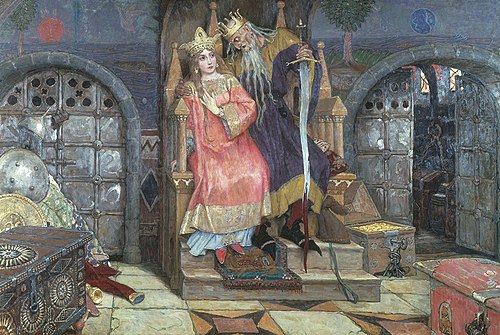
Well, somewhere I found the story, written down by Vasili Zhukovsky (who published several fairy tale adaptations in early 19th Century Russia), which is a mash-up of several fairy-tale incidents involving shape-changing spirits and the usual inter-incorporeal relationships between Prince Ivan, the son of Tsar Berendey (King Frost) and a princess who’s the daughter of some evil wizard (but of course), probably Kashchei the Deathless (who along with Prince Ivan also appears in another, more famous fairy tale, The Firebird, turned into a ballet by Igor Stravinsky). So yeah, you don’t have to know – much less understand – the story to enjoy the music!

The Mozart Trio (K.502) is a delightful work, full of the spirit of The Marriage of Figaro which was premiered the month after he wrote the trio, and just before he began the “Prague” Symphony. Just to show how little reality can intrude on creative genius, he finished this trio three days after the death of his not quite month old son, Johann Thomas Leopold. One has to keep going, regardless.

Mendelssohn’s trio – they’ll play the less familiar C Minor trio – was dedicated to the great violinist Ludwig Spohr who, next to Paganini, was probably one of the most highly acclaimed performers of the day, playing it a few times together. I’m not sure why Mendelssohn quoted a Lutheran chorale by Martin Luther – “Vor deinen Thron tret ich hiermit,” Before Your Throne I Now Appear – a setting of which Bach was revising at the time of his death. Given Mendelssohn’s associations with Bach’s music, bringing much of it to a public awareness it had long been denied, it might seem a logical idea to include it, though Mendelssohn, then 36, would hardly have been thinking that seriously about death. The fact he died unexpectedly two years later, shortly after the sudden death of his sister Fanny, would have nothing to do with the timing here.

Mendelssohn was born in the Jewish faith. His father later had him and his sister baptized in the official state Lutheran religion so they might not have to experience the more or less official anti-Semitism of Prussian society, not that it helped much. But hearing the chorale in this context – viewing death as a release from life’s pain as something glorious – might imply there was something else going on behind the trio as Mendelssohn composed it, whatever his association might have been with either the melody or the hymn text. It wouldn’t make a lot of sense for a composer to just say “Oh, that’s a nice tune, I’ll stick it here...”

So I hope you’ll be able to join us Sunday afternoon at 3:00 – after Hannah’s rains move out of the area and cools things off a little bit – for some great chamber music at St. Luke Lutheran in beautiful downtown Schaefferstown!

*** ***** ******** ***** ***

Need directions? Check out this page.

Photo credits:
Top: St. Luke Chamber Music banner from the church website.
Middle: The St. Luke historical marker was taken at a 2006 concert by John Clare and posted at Classically Hip.
Bottom: The cover of a Russian lacquer box featuring different fairy tales as transcribed by Vasili Zhukovsky, though I have no idea if this or any of the others on this box might correspond to what Janáček tells in his music.

Monday, September 01, 2008

The Last Night of Gretna's Summer: A Pre-Concert Talk

Sunday evening, I spoke before the last concert of Gretna Music's 2008 Summer season. It was my first pre-concert talk as a private citizen: the text is included, below. We had a nice, attentive crowd for the talk and a good, responsive crowd for the concert - not to mention great weather! Even the tree-frogs and cicadas seemed to be enjoying themselves.

The performance was wonderful and there were probably very few in the audience who'd consider themselves familiar with the Chausson Piano Quartet, a real discovery even for me.

In fact, before it was listed on the program, I didn't even know it existed. It was Gretna's artistic coordinator and general second-in-command Carl Kane who came up with it. I asked him how he had first heard it and he said, simply, he was tooling around on the internet looking for repertoire that doesn't get performed much, and there it was. So he checked out a recording and suggested it to the performers.

This also surprised me because that meant it wasn't already in their repertoire: they learned it just for this concert. Apparently, they complained about how hard the piece was to play - it is certainly no easy piece and Anna Polonsky, the pianist, said it was harder than it looked (but then, on a different level, one can say the same for Mozart). They played it like it was something they've been playing for years and made a very strong case for it to be performed more often. I was thinking it would be nice if groups looking for works to play might consider it as an alternative the next time they program standards like Schumann, Dvořák or Fauré.

It's in the four usual movements with a whirlwind of a finale that just keeps driving more and more to the end, with its endless reams of right arpeggios sweeping up and down the keyboard. The third was a whistful waltz with some fascinating rhythmic twists that reminded me of music Ravel would write a few years later (especially his Piano Trio, written 17 years later). But there was one moment in the slow movement that just grabbed me: the three stringed instruments are playing the melody in unison - the viola in its characteristic middle register, the cello in its more pungent upper register, the violin in its lower register, each one added a different sonority to the mix - when suddenly they all three part their separate ways, blossoming out to create a few chords to round out the phrase with a rich cadence. Just a superb if subtle touch.

The Schubert was elegant and sounded like well-ordered Mozart. The Mozart had passion where it was needed and sounded like something Schubert might have written (it's certainly not typical of 1780s classicism). The balance between the drama and lyricism of the first movement gave way to a gorgeously played slow movement. But it was in the playful last movement that you discover how much fun it can be to play great music like this. Smiling as they tossed phrases back and forth or complemented each other with responses, they were clearly enjoying themselves. Too bad it was the last concert of the season: it was the kind of music-making you wanted to just keep on going... and going...

*** ***** ******** ***** ***

Schubert
: String Trio in B-flat, D.471 (in one movement)
Mozart: Piano Quartet in G Minor, K.478
- - - -
Chausson: Piano Quartet in A Major, Op.30
Members of the Lark Chamber Artists & pianist Anna Polonsky

Looking at tonight’s program – Schubert, Mozart and Chausson – you may notice there are lots of contrasts on either side of intermission: Schubert writing the first piece 30 years after Mozart wrote the 2nd piece, both almost equidistant from the year 1800; and Chausson writing the piece on the 2nd half at the tail-end of the 19th Century... The Classical Era, in the sense of its aesthetic, on the first half; a more Romantic style after ‘half-time.’

A common thread in this program could be the game “What If” – since they each died young, more ore less, or at least certainly before they might have reached their full potential. Schubert died at 31 – Mozart at 35 – and Chausson at 44. Though older but something of a late-bloomer, only 21 years span Chausson’s first piece to his last. Mozart was composing for about 29 years of his life and Schubert a mere 18.

What they all might have accomplished if they’d lived longer is anybody’s guess. There are only 39 opus numbers in Chausson’s published catalogue. The Köchel Catalogue of Mozart works lists his last work, the unfinished Requiem, as K.626. In those 18 years, Schubert wrote enough works that Otto Deutsche’s catalogue ends at 998 – and several additional works like the fragments of an unfinished symphony that came to light years later inserted as D.708-A...

Schubert was 19 when he composed the String Trio that opens the concert. It’s in one movement. There is also a fragment of the start of a second movement so you could officially call it the “Unfinished String Trio” which might help distinguish it from the four-movement and therefore complete string trio – also in the same key, just to keep it confusing – which he wrote exactly one year later. Schubert left a lot of unfinished business – not just ONE unfinished symphony but at least four more. There’s also the famous “Quartetsatz” or “Quartet Movement” which is not a one-movement work for string quartet since there are also fairly extended sketches for a second movement to go along with it. He just didn’t write the rest of it.

WHY this piece (or the Quartetsatz) never received three more movements is not something anyone can really answer. Or why the one he wrote a year later did. It’s possible he didn’t think it that worthwhile and so he didn’t bother. Two years later, he’d complained to a friend, whenever he felt “stuck,” or he was producing “boring stuff” as he called it, he just put it aside and started something else. It would fit Schubert’s nature to do that: friends described him as writing music as easily as a fruit tree produces fruit...

What else was Schubert writing in September, 1816, when he started the trio we’ll hear tonight? Later that month, he would complete his Fifth Symphony – a delightful, Mozart-like work famously “without trumpets or drums,” which an amateur sight-reading orchestra read through in October. This orchestra grew out of the Schubert Family Quartet – brothers Ferdinand and Karl playing violins; Schubert himself, the viola; their father, the cello – gradually including more friends and other amateur musicians. The concertmaster who led the orchestra at this time was a merchant named Hatwig. It was in his house the orchestra gathered periodically to read through standard repertoire. Behind him sat Ferdinand Schubert. Franz Schubert was the principal violist, and one of the flute-playing Doppler brothers was the principal bassoonist. A second violinist was Heinrich Grob, the son of a well-to-do silk merchant who lived in the Schuberts’ neighborhood – Teresa Grob, Heinrich’s sister, by the way, was the soprano soloist in Schubert’s first public performance, his first Mass, written when he was 17. She had a fine, high soprano voice and he wrote a number of songs for her – including something you might be familiar with, a little number called “Gretchen am Spinnrad.”

When these teen-agers fell in love is hard to say, but her father wasn’t terribly interested in a poor musician who’d probably be just another poor Viennese school-teacher, just like his father. During 1816, Schubert wrote out many of his songs for her which she kept in a specially bound album, including a few she copied out herself. She kept this till the day she died – her family and their descendants wouldn’t allow anyone else to even see this collection until well into the 20th Century.

Schubert’s heart wasn’t into following in his father’s footsteps. But in April, 1816, he applied for a fairly reasonable teaching position in a town far to the southern reaches of the Austrian Empire, what is now the Capital of Slovenia, formerly part of Yugoslavia. By early September he got his rejection letter. That was the month he wrote the string trio we’ll hear this evening.

It was clear without a job like this one, Teresa’s father wasn’t going to let him marry his daughter. Two years later, she married Johann Bergmann, a master baker several years her senior. After all, what promise did a boy like Schubert have?

Two other things happened earlier that summer in 1816. Franz Schubert wrote a little cantata for him and his friends to sing at a celebration for the 50th Anniversary of his teacher’s arrival in Vienna. His name was Antonio Salieri and he’s more famous today not for any music he ever composed but because of the rumors he had poisoned Mozart. All that aside, he was a very important composer in Vienna – actually, more important, technically, than Mozart had been. After this anniversary party, Schubert wrote in his diary:

“It must be fine and enlivening for an artist to see all his pupils gathered around him, each one striving to give of his best for his master’s jubilee, and to hear in all these compositions the expression of pure nature, free from all the eccentricity that is common nowadays and is due almost wholly to one of our greatest German artists” (by that, he meant Beethoven) “that eccentricity which combines and confuses the tragic with the comic, the agreeable with the repulsive, heroism with howlings and that which is most holy with harlequinades, without distinction, so as to goad people to madness instead of soothing them with love, to incite them to laughter instead of lifting them up to God.”

The work we’re about to hear is a far different work from the Quintet in C Major you might have heard last week with the Audubon Quartet, a masterpiece written in the final months of his life but when he had long been following the path Beethoven had set up in his own final years. Amazing what 12 years can do...

In 1816, however, Beethoven had been in the midst of a dry period – five years earlier he’d written his 7th and 8th Symphonies; the Hammerklavier Sonata would be written the following year. Perhaps his most recent famous piece was “Wellington’s Victory” which was actually a timely response to Current Events. It had been written following the news that Napoleon’s troops in Spain had been defeated by the English General, the Duke of Wellington. In 1815, it was being performed during the celebration of the defeat of Napoleon himself at the Battle of Waterloo. Diplomats and crowned heads from across Europe gathered in Vienna to re-draw the map following two decades of almost constant warfare with Napoleon and the ever-expanding French Empire which he tried to stretch all across the continent, from Spain to Russia, from Egypt to Sweden. 1816 was now the first year someone as old as Franz Schubert would have lived without some war somewhere against Napoleon!

One other event in Schubert’s life, that summer: he was 19 and had some 450 works in the catalogue already when he composed a cantata for another celebration, this one called “Prometheus.” The music is lost and we know nothing about the music but we know that it exists because people wrote about it, including Schubert. Going back to his own journal entry at the time: on June 27th, 1816, he wrote after finishing it, “Today I composed for money for the first time.”

Mozart had been, you might think, luckier. He was recognized as a child prodigy, trundled about Europe by his father, Leopold, the original Stage Father, when he was not even yet in double-digits, amazing everybody with his talents at the keyboard and as a composer. By the ripe-old-age of 19, he had already written the first 220-some works in the Köchel Catalogue. That year, he composed the five violin concertos.

When he was 25, he broke from his father’s grasp and moved to Vienna, famously getting himself quite literally kicked out of a respectable but not very edifying job with the Archbishop of Salzburg. After all these years of not finding even an un-reasonable job as a court musician – no doubt hampered by the fact his whole family came along as part of the deal (the Empress of Austria flatly advised her son, the Archduke of Milan who was considering hiring Mozart, “Do not have anything to do with these people”) – Mozart wanted to be on his own and so he took off for the incredible opportunities of the imperial capital of Vienna, leaving his home-town of Salzburg and its go-nowhere provincialism behind.

That was in 1781. It was not all that easy, trying to make a living in Vienna. For one thing, he was not very good at Reality 101. His father, who looked after everything for him, had more or less seen to that. Rather than feeling sad at losing a son, he was angry because he had lost the income of managing his son’s career. His biggest fear, once he realized Mozart was interested in marrying Constanze Weber, was that another family would take advantage of his talent and make a fortune from it.

In the year Mozart composed the piano quartet on tonight’s program, Leopold Mozart came to Vienna to visit his son. He must have been mightily impressed that his son was doing so well – writing several piano concertos and frequently performing in public during his visit. He had a chance to hear some of the new quartets Mozart had dedicated to Haydn when Haydn himself told the proud father, “Before God, and as an honest man, I tell you that your son is the greatest composer known to me either in person or by name. He has taste, and, what is more, the most profound knowledge of composition."

You’d think Leopold was a proud father. In actuality, there was an edginess between them. Leopold was realizing that the gulf between them was widening with each new success. Mozart was still like a little boy trying to please and impress his father. It was obvious to them that if the son had heeded his father’s advice, he would still be the court organist for the Archbishop of Salzburg, churning out serenades and masses as needed. It was now the son’s fault that he had, in fact, surpassed his father’s expectations.

So, after Leopold returned to Salzburg, a very strange thing happened. Mozart older sister, known to history by the nickname Nannerl, gave birth to her first child. She named her son Leopold after their father. And Leopold Sr took the baby into his own house and raised him himself for the first years of the boy’s life, determined to create in him another child prodigy.

By establishing the proper environment for the child, something the mother herself could not manage, Leopold felt the “family genius” would develop in his grandson, who was nicknamed Leopoldl or “Little Leopold” – he might as well have called him “Mini-Me.”

The plan was to be kept a secret from Mozart who only found out by word-of-mouth through family friends about four months later. Early the next year, realizing what was going on (and why), Mozart took on a student of his own, a little more mature at the age of seven, and moved him into his home – which, thinking of Mozart, Constanze and the chaos that seemed to accompany them everywhere, could hardly have been the same kind of environment Leopold had in mind. But yet, Johann Nepomuck Hummel DID go on to become the leading pianist of his generation and a major composer, a “famous pupil of Herr Mozart.” The fact the same thing did NOT happen to Mozart’s nephew, Little Leopold, is more the fault of Leopold Sr’s death when the child was only 2. True, he did grow up to play the piano, a little, but he preferred collecting old weapons and privy seals. He lived into his mid-50s, retiring as a respected auditor in the Imperial Revenue department.

On the 16th of October, 1785, not quite three months after the birth of his nephew, Mozart completed the Piano Quartet in G Minor we’re about to hear.

G Minor is a key that doesn’t appear often in Mozart’s catalogue. There are only two symphonies – out of all 41 – in a minor key, and both of those are in G Minor. In fact, minor keys at all are fairly unusual: the old adage that Major Keys sound happy and Minor Keys sound sad may have something to do with it. To the late-18th Century, minor keys meant something serious (if not always sad), often too dramatic for what was considered “good entertainment.”

The first movement of this piano quartet is more 19th-Century Romanticism than 18th-Century Classicism, complete with a dramatic dialogue between the instruments – Bruce Adolphe, in an amusing presentation with Market Square Concerts a few seasons ago, described it as a murder trial, complete with an accusing lawyer and a demure suspect. The rest of the piece is far removed from that: as if to make up for the intellectual turmoil of its first movement, there’s a gorgeous slow movement (truly “to die for” if not “to kill for”); the last movement is one of the most delightful finales in Mozart’s catalogue.

While most contests to “name your favorite composer” end up with more votes for Mozart, Bach, Beethoven or Schubert than anyone else – and in this year of Presidential Politics, it’s interesting to note that neither Mozart nor Schubert lived long enough to be able to run for President, should such a surreal occurrence have happened.

Ernest Chausson is not likely to appear very high on such lists. Unlike Schubert and Mozart – and most great composers – who were always having problems with money all their lives, Chausson had something more in common with Mendelssohn who was born into a wealthy banker’s family in Germany. They set up Sunday afternoon musicales at their Berlin home where the greatest musical and literary figures gathered to hear the two talented children perform – Fanny who was a brilliant pianist and composer, and her little brother Felix, who composed, played the piano and the violin. Oh, and both kids also conducted the little orchestras their father hired for some of the larger scale musicales.

Ernest Chausson’s father made the family fortune by being a public works contractor in Paris when the city was being almost completely rebuilt into the modern city we know today with its great monuments, wide avenues and beautiful vistas. His tutor stimulated his interest in the arts – in music and in drawing, primarily. At the age of 15, he gained access to some of the best salons of Paris, rubbing shoulders with celebrities in the arts and the social worlds of the City of Light. He met another young composer named Vincent D’Indy and he got to know a lot of great music – curiously, the names that meant most to him were German names: Schubert, Schumann and Mendelssohn. He became acquainted with the music of Bach and with Beethoven symphonies played as piano duets.

The son did not, essentially, NEED to work, but his parents were not keen on the idea of a career in the arts. He was destined for a life as a lawyer – after all, he could play music or fill his sketchbooks with pretty pictures in his spare time, right? Though he showed talent in both areas, he gave in to his father’s wishes and earned a law degree in 1876, earning his doctorate the following year. Later that year, he wrote his first song. He was 22.

By the age of 22, Mozart had written his 31st Symphony, “The Paris Symphony;” Schubert, his “Trout” Quintet.

Two years later, Chausson became a student at the Paris Conservatoire, studying w/Jules Massenet. He had gotten his law degrees and was even sworn in as a member of the Bar, becoming a lawyer on Paris Court of Appeal. But he never actually practiced – he figured he’d given his father what he wanted – a law degree – and from here on out, he was going to follow his own plan.

There are two lines of style in France at this time – a more classical oriented style led by Camille Saint-Saëns (whom one of my college text books had referred to as the “Leader of the Charm School”) and Jules Massenet, known primarily for his operas, like Thaïs; and a more romantic, German-inspired or, depending on your patriotism in the years following the French loss in the Franco-Prussian War, the German-infested style that drew inspiration from Richard Wagner and was led by the Belgian-born Cesar Franck (though he had long lived in Paris, followers of Saint-Saëns pointed out he was, after all, not French).

So it’s rather surprising that a student of Massenet’s would travel to Munich not once but twice to hear the complete Ring in 1879 and again the following year to hear Tristan und Isolde; then going to the very home of Wagner himself for the world premiere of Parsifal in 1882.

After two years of study, though, and losing out on the Prix de Rome, he withdrew from the conservatory and began composing on his own. His Piano Trio in G Minor – published as Op. 3 – is obviously influenced by his teacher Massenet, but the harmonic language starting to go over to the “Dark Side” of French music, the chromatic richness of Cesar Franck – who at this point had premiered his Piano Quintet (dedicated to Saint-Saëns who premiered it but despised it): the Violin Sonata, the Symphonic Variations and the D Minor Symphony were all in the near future. He “monitored” Franck’s classes as a non-paying “listener” rather than an official student.

A few months after attending the premiere of Parsifal, with its sensuous music for the sorceress Kundry, Chausson wrote a symphonic poem about a fairy named Viviane, taking an episode from the legends around King Arthur, in which she has an affair with the wizard Merlin. He dedicated this work to his fiancé – incidentally, they spent their honeymoon at Bayreuth, attending another performance of Parsifal.

He was, however, a slow composer – there are only 39 published works in his catalogue. While he didn’t need to write for money, he spent a lot of time perfecting each piece so as not to be branded a dilettante. His affluence came in handy: he was able to give discreet assistance to younger composers like Debussy who were in need.

He became director of the National Music Society at 31 and now began developing a more intense style, as if his new involvement in the artistic and intellectual life of Paris demanded even more self-doubts requiring even more care. He went from writing charming songs to large-scale works like “The Songs of Love and of the Sea” and “The Legend of St. Cecilia” – plus the opera “King Arthur” which he worked on for 9 years. It may sound like a French version of Tristan, but the work is far removed from Wagner’s philosophical pessimism.

Living in Paris, he began holding his own salon where some of the great names – or not-yet-great names – of the arts gathered and discussed their arts: poets like Mallarmé, composers like Debussy and Albeniz, and performers like Alfred Cortot and Eugene Ysaÿe.

Two more works were written during this time – his only Symphony and a rather strange work that is combination violin sonata, double concerto and string quartet. It’s called, in French, “Concért” in D Major for violin, piano and string quartet – not a piano sextet (usually translated into English as “Concerto”). The quartet essentially acts as the accompaniment to the violin and piano combination though the divisions of labor are really a little more complicated than that.

By the time his father died in 1894, Chausson had discovered Russian writers and with that influence - despite his tranquil personal life - realized a kind of latent pessimism, typical for the end of a century. His most famous work dates from this period, his “Poeme” for violin and orchestra which was inspired by a short story by Turgenev though the subject matter kind of got misplaced along the way.

At this point, now in his early-40s, he made a conscious effort to eliminate “all outside influences” from his musical voice. The first work of this new approach is the work that closes tonight’s program – the Piano Quartet in A Major, Op. 30 – which writers have described as “luminous,” “confident” – yet “almost gay” work. To be honest, I’ve not heard a note of this piece [before the concert], so if you’ve not heard it before, we’ll discover it together.

In it - and the few works he wrote in the next two years - he does things musically that Ravel and Koechlin got credit for doing later. Who knows where this influence might have developed given the other works on his desk – a nearly finished string quartet, sketches for a new symphony – when he was riding down a hill on his country estate one late Spring day, lost control of his bicycle and slammed head-first into a stone wall, dying at the age of 44.

According to the Grove Dictionary, near the end of his life he’d begun to apply “the rule which corrects emotion... to achieve that supreme [unflagging effort] that renders the thought loftier, the image clearer,” combining in some context a balance between form and content, structure and emotion, classical and romantic, the sort of quest of artists who begin dealing with more mature issues rather than just purely creative ones. It’s hard to believe that, at the time of his death, Chausson was just beginning to attain his maturity.

Tonight, as we round out the summer, we’ll hear three pieces of music by three great composers, none of whose lives had happy endings, necessarily, but we’re happy to have the works we do have of theirs.

- Dr. Dick

*** ***** ******** ***** ***

Picture credits:
top - an anonymous portrait of Franz Schubert as a teen-ager;
middle - a family portrait painted in 1780 by Johann Nepomuck della Croce of The Mozarts with Nannerl (Maria Anna) and Wolfgang at the keyboard, their father Leopold leaning against the piano, with the portrait of Mozart's mother, Anna Maria, who had died a few years before, hung on the wall behind them;
bottom - Ernest Chausson in 1897, the year he composed the Piano Quartet in A Major.