Showing posts with label shostakovich. Show all posts

Wednesday, September 18, 2013

Have Quintet, Will Travel: Shostakovich and His Piano Quintet


Jasper Quartet
The past month, I've spent much of my time getting a new novel started – The Labyrinth of Klavdia Klangfarben, continuing the saga from two earlier novels, The Doomsday Symphony and The Lost Chord – but more of that later. I've also been reading about Dmitri Shostakovich's Piano Quintet which Stuart Malina will be playing again, this time with the Jasper Quartet, to open Market Square Concerts' new season on Saturday, September 21st at 8pm at Market Square Church.

(You can read more about that concert, and hear different excerpts from the Quintet, in my blog for Market Square Concerts, here.)

In this post, I'm re-posting the famous video recorded in 1982 with the legendary Sviatoslav Richter and the Borodin Quartet which had a long working relationship with Shostakovich since 1944. In the course of the post, the cellist of the Borodin - performing in this recording - remembers working with Shostakovich when they first played the Quintet with him in 1947.

At the end of the post, there are audio clips of the recording the composer himself made with the Beethoven Quartet, the ensemble he'd originally composed it for.

*** ***** ******** ***** ***

The G Minor Piano Quintet began life as almost his 2nd String Quartet. But friends of his in the Beethoven String Quartet had asked him to compose something with piano that he could play with them, and so the quintet began to take shape. He began working on it during the summer of 1940 and completed it on September 14th. He and the Beethoven Quartet gave it its first performance on November 23rd at the Moscow Conservatory. It was received with universal acclaim and the scherzo and finale both had to be encored.

Here is the Borodin Quartet (who first performed the quintet with the composer in 1947) recorded in 1983 in a concert at the Great Hall of the Moscow Conservatory (the same space where it had been premiered) with legendary pianist Sviatoslav Richter:

= = = = =

= = = = =

In fact, it was so well received, it won the Stalin Prize in 1941, something rather unusual for a chamber work without an overtly political programme, given the timing, but also ironic, perhaps, since Shostakovich had been in such political hot water for his opera Lady Macbeth of the Mtsensk District which resulted in the (in)famous attack in the press – the article “Muddle Instead of Music” – brought on by Stalin's dislike of the opera and its “degenerate Western influences” (Stalin and his wife went to the opera and stormed out, highly offended, despite the fact it had already proven to be a box-office success). He was able to save himself – quite literally – by composing his famous 5th Symphony which someone (not the composer) called “A Soviet Artist's Response to Just Criticism.”

To place things in a chronological perspective, the article appeared on January 28th, 1936; in the spring of 1937, he was nearly arrested (he would have been one of over seven million people who'd be arrested in Stalin's purges between 1936 and 1939) and was saved only because the person who was preparing his arrest was himself arrested first!

This was around the time he'd already been sketching what would become his 5th Symphony. He finished sketching it on September 11th, 1937 and completed the “short score” a week later and the full score in October. The premiere on November 21st was a huge success that no doubt saved his career (and quite possibly his life).

In 1938, he wrote his first string quartet, starting what would become a new interest in chamber music through the rest of his career. If for no other reason, it usually failed to attract the attention of the government bureaucrats who were more concerned about the large-scale “public statements” the composer made in his more public works like symphonies and operas. He would save many of his most personal statements for his chamber music, especially his later string quartets – like the 8th which incorporates his famous musical signature, his initials D SCH in the pitches D – E-flat – C – B-natural in German notation.

His Sixth Symphony, then, composed shortly after the string quartet, was a more “public” work and was being anticipated as “more of the same,” an offering to the concept of Soviet-Socialist Realism. Unfortunately, the work met with almost universal confusion and has always been a difficult symphony to make sense of, in three movements with a long, slowly unfolding first movement (instead of the traditional allegro) and then a seemingly unrelated scherzo and galloping finale, almost vulgar compared to the expected heroic finish.

This was premiered in November, 1939.

The following summer, then, he composed another chamber work – which, as I mentioned, was originally going to be a second string quartet before being turned into the Piano Quintet.

As Shostakovich told the story to his life-long friend, the literary critic Isaak Davidovich Glickman:

= = = = =
“Do you know why I added a piano part to this quartet? So that I could have the chance to perform [it] myself and thereby travel on concert tours. Now the 'Glazunovs' and the 'Beethovens' [the two quartets whom he'd scheduled performances of the quintet with] won't be able to do without me – and I'll get a chance to see the world.”

We both burst out laughing.

“Are you joking?” I asked.

Dmitri Dmitriyevich [Shostakovich] answered, “Not in the slightest! You are an inveterate stay-at-home, while at heart I'm an inveterate traveller!” But from the expression on his face it was impossible to tell if he was joking or not. We had this conversation in the summer of the year preceding the war [1941].

[Glickman, Letters to a Friend, quoted in Elizabeth Wilson's “Shostakovich: A Life Remembered,” p.165]
= = = = =

Though Shostakovich performed the quintet often during his career as a composer-pianist, the quintet never became the “vehicle” that allowed him to tour the world. There were trips abroad – one notable one to Paris where he recorded the two piano concertos but where the illness that would make it impossible for him to continue playing was already affecting his hands.

The next-to-last time he performed in public was in February 1964. He was scheduled to play the quintet with the Borodin Quartet in the city of Gorki, but played only the Intermezzo because of the unreliability of his hands. Though he announced it was to be his last public appearance, he agreed to accompany Galina Vishnevskaya, the soprano who was married to his friend and protege, Mstislav Rostropovich, and a baritone in a program in May 1966, but he was so nervous about the concert and whether his hands would cooperate or not, his friend Isaak Glickman who was in the audience saw the composer was in physical agony, presumably brought on by his nerves.

The next night, Shostakovich suffered a serious heart attack and spent the next two months in the hospital. (It was while he was in the hospital this time that he chose the texts for his 14th Symphony which is a combination symphony/song-cycle for soprano and baritone with strings: all of the texts deal with death...)

*** ***** ******** ***** ***

Shostakovich in 1941
When Shostakovich performed the piece for the first time with the Glazunov String Quartet (in 1941), the cellist recalled how

= = = = = =
“We, the string players, wanted to 'sing,' to play with more emotion. Shostakovich accentuated the constructive, motor elements and achieved his effect through clarity and the flow of the music. The emotional restraint of his playing led to a certain contradiction with the nature of strings. He demanded the minimum use of vibrato. The fast tempi excluded in themselves any possibility of emotional exaggeration and an open cantilena.”
[quoted in Elizabeth Wilson's “Shostakovich: A Life Remembered”, p. 165.]
= = = = =

Valentin Berlinsky, the cellist of another quartet – this one, not yet called the Borodin String Quartet – recalls their first association with the composer in 1944 when they were still conservatory students. He was coming to hear them play his first quartet and “he had arrived a few seconds after nine [o'clock]. To my amazement, he started apologizing for being late.”

They didn't perform the quintet with him until 1947, but Berlinsky recalls some details from their rehearsals:

= = = = =
“...which took place at his home. In the Prelude, he asked us not to make a ritenuto [a drawing out of the tempo] despite its being written in the score. 'But ritenuto is written here,' we exclaimed. He came up to us very nervously, took out a pen and crossed out the marking in every part.

“Rudolf Barshai was the violist in the quartet at the time. In the Finale there is an imitation between the cello and viola. It's in the score now but it wasn't then. The cello and viola were supposed to play together but Barshai made a mistake and came in after I did. Shostakovich stopped playing and said, 'Please, mark it the way you played it just now.'”
[ quoted in Wilson, “Shostakovich: A Life Remembered,” p.279]
= = = = =

Barshai told Ms. Wilson separately his side of this story:

= = = = =
“Barshai was also studying composition [she writes in a footnote] and on occasion would show Shostakovich his scores. Once, just before the rehearsal mentioned [by Berlinsky], he visited Shostakovich and during their meeting they talked about the Piano Quintet. Barshai suggested a small correction in the finale. 'Play it like that tomorrow in the rehearsal and we'll see,' the composer suggested. At the rehearsal Barshai played the suggested correction in the relevant bars without warning his colleagues. Shostakovich then stopped the rehearsal and told him, 'Leave it like that, please.' Berlinsky in turn was skeptical... telling me that it was unheard of that Shostakovich should accept advice from anyone.”
[ – Wilson, “Shostakovich: A Life Remembered,” p.279]
= = = = = =

Berlinsky continues, saying how, in all, the Borodin Quartet played the quintet eight times with the composer, the last time being that sad occasion where he could only play the Intermezzo.

= = = = =
“Shostakovich was a very anxious performer. Because of that all our tempi tended to be too fast. The amazing thing is that he appeared to be ashamed of his own music. He used to say, ' Let's play it fast, otherwise the audience will get bored.' He particularly rushed the slow movements. For instance, in the 3rd Quartet, he hurried us on in the great funeral march of the fourth movement. 'No, no,' he would say, 'while you're stretching out that first C-sharp, the audience will fall asleep.' In general, his marking of the tempo often contradicted what he really wanted.

“We would say, 'But, Dmitri Dmitriyevich, your metronome mark is such-and-such.'

“He replied, 'Well, you see, my metronome at home is out of order, so pay no attention to what I wrote.'

“Sometimes he wrote in the metronome markings after the first performance by the Beethoven Quartet [who usually premiered his new quartets]. It's leader, Dmitri Tsyganov, was by nature a fast player, and this influenced Shostakovich's tempo markings. We never played the same tempi that the Beethoven Quartet took.

“Many years later, we recorded the first eleven quartets [there would eventually be fifteen, in all] in Japan and we presented Shostakovich with the records. Shortly afterwards, he wrote us a very detailed letter which didn't contain a single reference to the tempi. Most of the complaints were in regard to the dynamics... and to some wrong notes. These mostly turned out to be misprints in the score.”
[ – Wilson, “Shostakovich: A Life Remembered,” p.280]
= = = = =

A violinist who later joined the Leningrad Philharmonic, Yakov Milkis recalled seeing Shostakovich for the first time in the late-1940s when he was in his prime as a performer.

= = = = =
“I often heard him perform his own works and I particularly remember his concerts with the Beethoven Quartet. He was a wonderful pianist and when performing, he was completely absorbed in his own world. His playing conveyed an ideal sense of form and structure but more than that it was an expression of his innermost world, one that cost him sweat, blood and tears. He played with a special touch and colour, and often quite intentionally treated the piano as a percussion instrument. It is rare that a composer uses the upper register of the piano like a xylophone, making a sharp, percussive sound. This is how he played the Scherzo from the Piano Quintet, for instance. I still have the particular sound of his sarcastic dry staccato in my ears today. It completely suited the style of the music.

“He always sat alone [in orchestra rehearsals] preferring some inconspicuous spot in the stalls. He... seemed to retire into himself, melting into his surroundings, so as to be left undisturbed while listening and working. This incredible modesty was apparent also when he was in a gathering of people. Here too he appeared to fade into the background, doing his best not to attract attention to himself.
[ – Wilson, “Shostakovich: a Life Remembered,” p.355]
= = = = =

1948 had been another terrible year for Shostakovich. Unlike the attack in 1936, Zhdanov's decree was intent on rooting out Western influences in Soviet music in which Shostakovich, Prokofiev and several other leading composers were condemned first by the Stalinist bureaucrats and then by their colleagues. This affected Shostakovich differently, this time.

Rather than writing another “Soviet Artist's Reply to Just Criticism,” he ceased composing at all. Or, that is, publishing anything. Life was difficult, his income dried up – no one would perform his music so he had no income and who would risk commissioning new works from him with Stalin's displeasure so close to the surface? – and so he turned inward, writing solely for himself, often leaving things unseen by others in desk drawers, like his Violin Concerto and, perhaps, much of his 10th Symphony which either didn't see the light of day or wasn't begun until after Stalin's death in 1953 (the same day as Prokofiev's, as it turned out).

But he did compose a series of piano pieces inspired by Tatiana Nikolayeva's performance of Bach's Well-Tempered Clavier: his own set of 24 Preludes and Fugues.

Imagine what it must have meant for a composer, accused of being too influenced by Western Music and Germanic forms like the symphony, to sit down and write Bach-inspired fugues: there can hardly be a more Germanic formalist approach to writing music than a fugue! How completely un-Soviet!

And yet his Piano Quintet, composed in 1940 before the Nazi invasion drew the Soviet Union into the 2nd World War, opens with a Prelude and Fugue, as Bach-like, Germanic and formalist as anything he was accused of writing in 1948!

And yet in 1941, this Quintet won the Stalin Prize, the Soviet Union's highest award in the arts!

If it had been such a patriotic issue to attack a composer for his “formalist Western” style in 1948, why was the same “formalist Western” style worthy of receiving the government's highest award seven years earlier?

Vagaries of politics aside, given that – now listen to Dmitri Shostakovich playing his Piano Quintet which he premiered in 1940 with the Beethoven Quartet for whom it was composed, but recorded here in 1949, the year he turned 43:

= = = = =
Prelude:

Fugue:

Scherzo:

Intermezzo:

Finale:

= = = = =


– Dick Strawser

Sunday, September 18, 2011

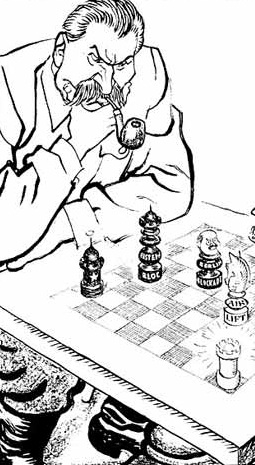
Prokofiev & the Chess Match Between Soviet Politics & Music

Stuart Malina conducts the Harrisburg Symphony in Prokofiev's 5th Symphony at the first concert of their new season - Saturday, Sept. 24th at 8pm and Sunday, Sept. 25th at 3pm at the Forum.

You can read my introductory post on the Harrisburg Symphony Blog which also includes audio clips of an old 1960s recording of the complete symphony conducted by David Oistrakh (seen below, playing chess with the composer).

Prokofiev's 5th Symphony quickly became one of his most popular and frequently performed works. Coming at the end of World War II, it was perhaps one of the most composer's happiest moments, artistically.

But two things happened after the War.

Now, back when he was 3 years old, Prokofiev fell, hitting his head against an iron trunk. He carried the resulting bump on his forehead till he was 28 years old, a few years after he’d composed his notorious 1st Piano Concerto and his “Classical” Symphony (someone joked that perhaps his talent lay in that bump).

Shortly after the successful premiere of his 5th Symphony in mid-January, 1945, Prokofiev fell as the result of a spell brought on by overwork and his typically high blood pressure, suffering such a severe concussion that he almost died. Complicated by the heart attack he’d suffered in the spring of 1941 and which had seriously impeded his work on the opera, War and Peace, he now found his health quickly deteriorating. Basically, he never really recovered from this episode.

His 6th Symphony in the dark key of E-flat Minor, often considered the 5th‘s “dark twin,” was completed and premiered in 1947, even though it had been begun before he started work on what became the 5th. It’s probably more representative of a “war symphony,” especially hearing the first two movements as an elegy on the tragic losses of war.

But then came the political fallout after the war.

Andrei Zhdanov was a party official under Stalin who became the director of the Soviet Cultural Policy in 1946 and one of his first actions was to censor the poet Anna Akhmatova. “The only conflict that is possible in Soviet culture,” he said, “is the conflict between good and best.”

Given that, how could government officials react to Prokofiev’s new symphony, his 6th?

In February 1948, four months after the 6th Symphony was premiered, Zhdanov initiated purges against several musicians over the issue of “formalism” which sent both Shostakovich and Prokofiev into creative tail-spins. During the different artistic crises of the ‘30s, both were young enough to either argue their positions or adapt, but now, both of them older and in ill-health, they more or less retreated.

(You can read more about this in relation to Shostakovich and his 5th and 10th Symphonies.)

For many American listeners, it may be difficult to understand this.

Here is Aram Khachaturian – himself an Armenian, not a Russian, who composed during the Soviet era – writing about the definition of the “Soviet Composer”:

--- --- --- --- ---
“In the Soviet Union, the composer occupies a place of honor. He benefits by the attention and solicitude of the people. His material comfort is assured. He knows that his work is necessary and highly appreciated by Society. Moreover, he has, of course, deep consciousness of his responsibility towards Society, towards history and towards humanity.”
--- --- --- --- ---

During the 1930s, when the new nation was still struggling to create itself barely a decade after the Bolsheviks’ unexpected success in toppling the weak provisional government following the overthrow of the Tsar in February 1917, the question was one of frequent debate and discussion as if Art, usually evolving over generations and centuries of cultural development, could be created from above for lack of time.

Prokofiev wrote,

--- --- --- --- ---
“I would describe the music needed here as ‘light serious’ or ‘serious light’ music; it is by no means easy to find the term which suits it. Above all, it must be tuneful, simply and comprehensibly tuneful, and must not be repetitious or stamped with triviality.” h
--- --- --- --- --- 

In 1934, the Composers’ Union, the Communist Party’s bureaucratic organization that had oversight of official ideology regarding music and composers, suggested the following guidelines:

--- --- --- --- ---
“The main attention of the Soviet composer must be directed toward the victorious progressive principles of reality, towards all that is heroic, bright and beautiful. This distinguishes the spiritual world of Soviet man and must be embodied in musical images full of beauty and strength. Socialist Realism demands an implacable struggle against folk-negating modernistic direction modernistic directions that are typical of the decay of contemporary bourgeois art, against subservience and servility towards modern bourgeois culture.”
--- --- --- --- ---

Now, depending on your viewpoint, much of this could be defined different ways: certainly anything that tweaked bourgeois (Western) conventions must be suitable for Soviet consumption. What was more “real” than the stories of real people – or taking great dramatic themes and translating them into modern-day situations?

This “modernistic direction” was soon labeled Formalism, a reliance on bourgeois (or simply “Western”) art forms that were primarily abstract: the structure of a sonata or a procedure like the fugue were examples of “Formalism” to be avoided. Art that was abstract was not “real.”

Attitudes about such issues may change with time and may change drastically and unexpectedly. We might joke about “I didn’t get the memo” but in many cases, artists found themselves in very real danger, politically and personally, if the winds of musical aesthetics changed.

This attack on “formalism” or “bourgeois influences” first began in 1936 with the attack in the press on Shostakovich’s Lady Macbeth of the Mtsensk District and, more or less as a result, hoping to win back good favor, he composed his 5th Symphony. (Again, for more details, read this earlier post at Thoughts on a Train already mentioned).

As it happened, Prokofiev left the Soviet Union in 1918 feeling that, given the strife following the Revolution and the ensuing Civil War there, there was no room for his revolutionary approach to music (besides, all his premieres were being postponed because of the war, anyway). But after failing to find success much less recognition in the United States and creative satisfaction in France, Prokofiev made the decision to return to the Soviet Union in 1935, hoping to reconnect with his Russian roots.

Keep in mind, Prokofiev was no longer the enfant terrible he had been in his early-20s: he was now 44 years old – is it possible this mellowing had something to do with the traditional mid-life crisis? Who knows, but it’s difficult to balance the Prokofiev who said music must be “tuneful, simply and comprehensibly tuneful” with the Prokofiev who’d composed his 2nd Symphony in Paris, a symphony patterned on Beethoven’s last piano sonata, begun when he was 33.

And what is this “formalism” Shostakovich was accused of?

In Western usage, musicologically speaking, it implies music that is defined by the composer’s attention to structural details – its form as well as, say, use of counterpoint or boundary-stretching harmonies – but in the Soviet Union, the implication was music that was too intellectual to be appreciated by the masses - and the Communists were all about the Masses (not to confused with Catholic liturgical music, just to point out how confusing terminologies can be). In fact, Prokofiev quipped that “formalism is music that people cannot understand on first hearing.”

Today, we would express this as an argument between music that is too intellectual versus music that is too shallow, depending on your point of view: is it music of the heart or music of the brain (as Roger Session, a well-known “difficult” composer, said, “as if one could exist without the other”)?

In 1936, Shostakovich was being held up as the Party’s Whipping Boy though soon enough, not just artists in the Soviet Union were contending with the purges brought on by Stalin’s paranoia, often referred to as The Great Terror.

So Prokofiev returned to find his old country violently in the throes of reinventing itself.

And what did Prokofiev write, once he was back on this soil that was once Russia? Unlike Shostakovich, who was becoming primarily a symphonist – and a symphony was considered a bourgeois Western form – Prokofiev composed film scores (attractive to the Masses), large-scale choral works based on texts by “approved Soviet poets” (inspiring to the Masses) and a children’s tale set to music called Peter and the Wolf.

He did not write a symphony until the end of World War II when Party regulations about music were, for some reason, relaxed. Aside from his “Classical” Symphony, his next three symphonies had all been written in Paris: the 2nd, inspired by Beethoven’s Op.111, was a symphony of “iron and steel.” On the surface, this sounded like a subject that should appeal to the new Soviet aesthetic, keeping in mind something like Mosolov’s The Iron Foundry depicting in exact detail the noises of a busy factory, considered a masterpiece of the Revolution’s denouncement of bourgeois Romanticism of the 1920s but which would hardly pass muster with the attitudes of the ‘30s and ‘40s.

His 3rd Symphony, written in 1928, was basically a four-movement suite based on material from the opera, The Fiery Angel which he was having trouble getting produced. The 4th is also based on stage music rather than being something symphonically conceived (I mean, in the traditional sense of a symphony), taking music from the ballet, The Prodigal Son, which he premiered in 1930 but which he revised so completely in 1946, following the success of his new 5th Symphony, that he even gave it a new opus number.

So between 1924 (still in Paris) and 1944 (eight years after the prodigal Prokofiev returned to the Soviet Union) he had not really risked writing anything so formalistically bourgeois as a formally conceived abstract Symphony.

Then, in the few short years between 1944 and 1947, he wrote three symphonies – the 5th, the large-scale revisions of the 4th, and the 6th.

Could this be why Prokofiev decided to make his comments about "singing the praises of the free and happy Man," to give his new symphonic symphony an acceptable socialist patina?

The next great shift in Soviet aesthetics occurred in 1948 and this time, Zhdanov and the bureaucrats came down hard on Shostakovich and Prokofiev, accusing them and several others of the crime of Formalism, essentially banning the performance of their music in Soviet concert halls.

His health issues aside, Prokofiev never really regained his creative spark, though he continued to compose – especially inspired by the young cellist, Mstislav Rostropovich – but even politically correct works we would consider the product of a Party Hack were not well received either popularly or critically.

In the end, even in death, Stalin had the last laugh.

Stalin’s death was announced on March 5th, 1953 – he may have died the night before – and Prokofiev, suffering the after-effects of a cerebral hemorrhage, died hours later. A music periodical reported the composer’s death on page 116 – the first 115 pages were about Stalin. Even the crowds gathering in Red Square mourning the death of their leader, not far from where Prokofiev had lived, made it impossible for his friends to even remove the body from his home to take him to the headquarters of the Composers’ Union for the funeral until three days later.

Hardly anyone in the great Soviet Masses knew that the composer whose 5th Symphony was so popular and appealing – and somehow lacking in formalism – had died.

Checkmate…?

Dr. Dick

Friday, September 16, 2011

Music & Politics: Shostakovich's 5th & 10th Symphonies


Let me begin with a seemingly unrelated anecdote.

Several years ago, a friend took me to hear an open rehearsal with Riccardo Muti conducting the Philadelphia Orchestra. I forget what major work was to be on the program but the moment I will always remember from that experience concerned the orchestra’s first read-through of a work they’d never performed before: Hindemith’s little-known Symphony in E-flat which I’d never even heard of before. They read through the scherzo (the lighter movement of a symphony which translates from the Italian as “joke”) and I thought “okay, cute, kind of scurrying and unsettled, but in a hushed kind of way, cute.” Then Muti said “Yes, but it’s supposed to be... spooky!”

With that, he flung out his arms, hunkered his head down between his shoulders – one could almost see the glare in his eyes from our balcony seats – and they began again.

This time, the music was riveting, spooky above all, and almost demonic, like some breathless nightmare. After they’d read through the notes, now the orchestra gave the music its soul. But they were the same notes: how could two run-throughs make it sound like an entirely different piece? I’ve never heard another recording of the piece match the fear and intensity of that rehearsal.

What is it about music that allows two interpretations to be so radically different? Hindemith wrote the piece in the summer of 1940, shortly after he’d arrived in America as a voluntary exile from Hitler’s Germany in the months following the start of the Second World War. Think about it.

While music can be considered on its own value – whatever that may be – the life of its composer and the times in which it was composed often have some bearing on an even more elusive aspect of art: its “meaning” (whatever that may be).

One of the great things about art, of course, is that it transcends all of that to speak to each individual on a unique basis. The biography of a piece of music is full of certain facts and tinged with interpretation, just like the biography of the person who wrote it. One supplements the other and yet the music can be appreciated without our needing to be aware of either.

An old Cold War complaint was that Shostakovich was just a "propaganda" composer. Yes, he wrote things like the “Song of the Forest,” a cantata glorifying Stalin’s reforestation program (imagine an American composer writing a large-scale choral work extolling the virtues of the Bush Administration’s argument for increased oil drilling in the Alaskan Wilderness) but we in the United States have not lived under the kind of threat artists in totalitarian regimes deal with on a daily basis: while we may argue about Freedom of Speech, we do not necessarily fear for our lives as a consequence. Under Stalin, someone speaking out against the government would simply ‘disappear’ in the middle of the night, when a late-night knock on the door could be from the dreaded KGB, the Soviet secret police, coming to arrest you and subsequently, as happened to various friends of Shostakovich’s, imprisoned or executed.

The 1936 denunciation appeared in the state-run newspaper Pravda (“Truth”) the day after a performance of his most recent success, the opera Lady Macbeth of the Mtsensk District had been attended by Stalin and his wife who then famously stormed out in the midst of it. The opera had already received rave reviews, had already been running for about 90 performances each in Moscow and Leningrad when it had even been hailed as the “prototypical Soviet music-drama,” and yet when the unsigned article, “Muddle Instead of Music” appeared on page 3 – Shostakovich himself, six-months shy of his 30th birthday, discovered the article after buying a paper in a train station while on a concert tour – even his staunchest supporters dropped him for fear of any contamination.

It was not just a bad review: it was clear the article came not from some disgruntled critic but quite possibly from Stalin himself, whoever may actually have written it.

A week later another scathing attack appeared, this one about his ballet The Limpid Stream, and he was now labeled an “enemy of the people.” He'd seen others arrested for merely espousing non-Soviet principals or pro-Western “decadence” in their art – when would they come for him?

During this year, then, a former companion, a family friend, his mother-in-law and brother-in-law and an uncle were all arrested by the NKVD, the People’s Commisariat for Internal Affairs. In the midst of composing his 5th Symphony, he himself was called in to be interrogated by the NKVD about his association with a powerful military figure, Mikhail Tukachevsky, a fan of Shostakovich’s music who had recently been implicated in a plot to assassinate Stalin.

The story is told by a friend who recalls the composer telling him how he had been “interviewed” on a Friday but since he could not recall ever discussing politics with Tukachevsky, just music, he was told to return on Monday as if, perhaps, his memory might improve. That weekend, Shostakovich hardly slept. When he left for his second “interview,” his wife had prepared a little bag for him with traveling stuff (like warm underwear) because they feared he would not return but be sent off to a prison like many of his friends.

This time, his name was not on any list of “interviewees” and he was again sent home, only to discover later the officer interrogating him had himself been arrested!

Shortly after Tukachevsky was executed, Shostakovich’s close friend, the musicologist Nikolai Zhilayev, was arrested and executed. A short time before, the composer had shown him part of the new piece he was working on at the moment, his Fifth Symphony. A couple of years later, the poet who wrote the words Shostakovich had set in his film-music, The Counterplan, was executed as well as the poet who wrote the book for his ballet, The Limpid Stream. Even the great theatrical director Vsyevolod Meyerhold was arrested, tortured and executed, implying even an internationally recognized figure like Shostakovich was perhaps not immune from Stalin’s Terror.

Given that atmosphere, you might understand how a composer who wished to survive to write another day might decide to do the dictator’s bidding only to put his true soul into music that could be left, by the very nature of art, a secret.

Someone called Shostakovich’s 5th Symphony “a Soviet artist’s practical response to just criticism,” a comment that stuck (I think it’s even inscribed in the published score) and on the surface the music genuinely responds to the Pravda attack: instead of screaming dissonance and an acute lack of melody as his earlier music had often been described (or derided), this work veers away from the more aggressive harmonic direction his music had been taking in the previous decade, creating something simpler that could be called a “populist” tone.

Consider, however, the history of his 4th Symphony which he’d begun writing the year before this Pravda article, then completed four months afterwards. After ten rehearsals – wow! – and just days before its scheduled December premiere, he was talked into withdrawing the work, an hour-long extravaganza for a huge orchestra and two nearly half-hour long movements separated by a brief scherzo, music full of violence and violent contrasts that perhaps was even more deserving of Stalin’s complaint about “neurotic” music. Whether it was out of fear or dissatisfaction with the piece, he put it aside (it would not see the light of day for another 25 years).

In mid-April four months later, he began work on the 5th Symphony which he completed in three months: its premiere in November, then, would establish him as an artist rehabilitated. It went on to become perhaps his most popular piece, if not his greatest symphony.

Reports say that during the last movement, many in the audience stood as if royalty had entered the room, as one described it; the ovation at the end, depending on whom you read, lasted a half-hour, 40 minutes, almost an hour. Clearly, Shostakovich had proven he could write a symphony that would reach the Soviet masses.

In many respects, it is a symphony about the struggle with fate – like Beethoven’s 5th, Mahler’s 5th, Tchaikovsky’s 4th and 5th (perhaps it's a 5th Symphony Thing to struggle with fate).

In lectures about his father’s music, Maxim Shostakovich who later became famous for conducting his father’s music, called the 5th his father’s “Heroic” Symphony, quoting his father that “the hero is saying, ‘I am right. I will follow the way I choose.’”

At this point, it becomes impossible to avoid the book that has changed the West’s perception of the composer from a political doormat to a raging undercover dissident, Semyon Volkov’s Testimony which purports to be Shostakovich’s memoirs as told to the author in numerous meetings in the years before his death in 1975, then smuggled out of the country and published in 1979.

In it, we read many new and surprising comments made by the composer regarding many of his major works, including the 5th Symphony, one of the most famous quotes – so famous, it has become part of the Shostakovich Canon – pertaining to the last movement: “I think that it is clear to everyone what happens in the Fifth. The rejoicing is forced, created under threat, as in [Mussorgsky’s] Boris Godunov. It’s as if someone were beating you with a stick and saying, ‘Your business is rejoicing, your business is rejoicing,’ and you rise, shaky, and go marching off, muttering, ‘Our business is rejoicing, our business is rejoicing.’ What kind of apotheosis is that? You have to be a complete oaf not to hear that.”

This is certainly a viable comment since it's a famous moment from the very opening scene of what is considered the greatest Russian opera, Boris Godunov by Mussorgsky, an historical opera based on a tsar who usurped the throne, possibly murdering the only available heir, and who desires to be declared the new tsar by the acclamation of the people. Only the people are not willing to do so until forced by the police to beg Boris to become tsar. Did people in the 1870s see this scene as a comment on the Russian social system? Perhaps not at the moment, but I think many Russians would understand it as part of their heritage: certainly the poorer classes were constantly being coached and badgered against their own deeper feelings to acclaim the country’s rulers and their policies.

Part of this begins long before the finale: the struggle that has gone on with the first movement’s constantly shifting tempos always accelerating before breaking off into something almost static or perhaps only to start over again, as if one’s heartbeat is racing but then you catch your breath; the stark contrast of the brief scherzo; the agonizingly tragic lament of the slow movement; and then the rousing (or supposedly rousing) march of the final movement comes to a long drawn-out expansion of the march-tune which can be played in two ways. If you conduct it in 2 (two beats to the bar, conducting half-notes) , it is fast and triumphant sounding; if, however, you conduct it in 4 (four beats to the bar – quarter notes – but with each beat in the same tempo as the previous half-notes), it loses its drive and perhaps does sound mechanical and hollow. I have not seen the original manuscript in the composer’s handwriting to know if what some people have said is true, that there was a misprint in the published score and the composer “intended” it to be “in 4" or if the quartet-note got the beat, not the half-note, and my miniature score is so miniature, even a magnifying glass doesn’t clear it up.

Even before Volkov’s “Testimony” appeared, I’ve heard performances with the “expansive” ending: the recording Maxim Shostakovich conducted (recorded in 1977 and available on RCA) also takes the expansive ending.

Then too, there is the figure of Mahler who is one of the major influences on Shostakovich the symphonist, and in this case Mahler of the 3rd Symphony. Mahler’s finale is also not a “faster/louder” ending meant to get the audience to its feet. It is a grand, expansive slow movement lacking any sense of irony, but there are many similarities between Shostakovich’s and Mahler’s conclusions, that one in fact can end slow and loud and sound triumphant. To this, just add a touch of Soviet (or Russian) Socialist Realism – the police-persuaded peasants inherited from Mussorgsky’s Boris Godunov. Possible? [Hmmmm...]

A composer writes notes on a page, choosing pitches that create the right combination for what he wants to express in the melodies, harmonies, colors and rhythms of his creation. But it is the music “between the notes,” left to the performer, which the composer has no control over: once he is finished writing it and sends it off into the world, the music is at the mercy of first the performer and then the listener. The listener can only approach it after a performer interprets it and then walks away with something that could have little to do with what the composer had in mind.

Not to denigrate the musicianship of Eugene Ormandy or the Philadelphia Orchestra, but when the last series of Shostakovich symphonies were recorded in the West, it was their recordings that introduced us to these dark and often difficult pieces – not technically difficult, but difficult to comprehend their “meaning” because so many of us were listening for something beyond the clarity of formal structure and so on. This is obviously music “about” something - two of them are collections of poems set to music - and I found these recordings lacking in something. As a naive 20-something, I dismissed the Late Shostakovich Symphonies as “boring.”

Then I heard the next batch of recordings to come out, conducted by the composer’s son, Maxim: now, I discovered, these were wholly different works, exciting and deep, thought-provoking and sometimes even just plain scary. The notes were the same: why was the music different?

Did Ormandy not “understand” these pieces? Or was I just more receptive to Maxim Shostakovich’s approach?

It could be a little of both, plus how I felt on that particular day, who knows... Remember my opening anecdote about the performance of the Hindemith, hearing the orchestra read through it and then, after being told it was supposed to be “spooky,” how suddenly everything changed?

When I heard Stuart Malina conduct the Harrisburg Symphony in Shostakovich’s 5th several seasons ago, his approach to the accelerations in the first movement’s tempos left me so breathless I was almost imagining the "knock on the door" myself: how could these not be the thoughts of a composer who was fearing for his life – not Beethoven’s Fate that knocks at the door, but the KGB – and who was watching as friends and relatives around him were hauled into the net of Stalin’s Terror? If the slow movement is a lament, who is it a lament for? The reviled Soviet Artist being criticized for having written neurotic, dissonant music or the Russian people under the shadow of the tyrant? And so in the end, is it the Russian People who are hollowly rejoicing, mimicking the policeman’s call to rejoice, or is it the composer saying “I will do your bidding, but...”?

There is another tradition that we in the West do not understand, and it is what is usually called “The Holy Fool.”

We think of the Village Idiot as a figure of ridicule but to the Russians, this person was closer to God and given a certain amount of respect and “distance,” allowing him to say things and get away with them that an ordinary person would, perhaps, be arrested for. Returning to Mussorgsky’s Boris Godunov, one of the minor figures (to us) is The Simpleton, as he’s called – in Russian, this yurodivy – who appears in a few scenes lamenting the tears shed by the poor Russian people.

There is a scene that has often been cut from performances, at least in the past. Boris is now faced with open rebellion among the people who support a renegade monk posing as the reborn prince, Dmitri, the legitimate heir Boris is rumored to have killed so he could ascend the throne himself. Coming out of the cathedral, the tsar, dressed in robes and crown, is confronted by the Simpleton in his rags who’s had his last penny stolen by a bunch of rowdy children: “why don’t you have them killed,” he asks the Tsar, “like you had Dmitri killed?” One of the noblemen orders the fool arrested but Boris stops them and instead asks the fool to pray for him. “How can you pray,” the simpleton asks the tsar, “for the murderer of a child?”

It is a chilling scene and even in the West with our claims for Freedom of Speech, such an affront might not go without some retribution. Depending on how the scenes and episodes of this opera may be staged (they are individual tableaux, not a continuous drama), one can conclude the opera with Boris’ death (which makes sense in the West because, after all, the tsar is the star) or with the scene in the forest where the people, in open revolt, have captured some of the tsar’s supporters and, led by the False Dmitri, now march off to Moscow to bring down Boris’s government, leaving only the Simpleton on stage with his sing-song lament – tears, no matter what happens, only tears for the poor starving Russian people.

Ending the opera with Boris’ death is a powerful operatic story about a man overcome by fate; ending the opera with the Simpleton’s lament is a powerful emotional ending to a story about the people who, despite their impending victory, will continue to suffer regardless who’s in control.

Which do you think might resonate more with the Russian people themselves?

And so we come to the 10th Symphony.

During World War II, Shostakovich composed a series known as the “War Symphonies,” especially the 7th, written during the dramatic siege of Leningrad and smuggled past the Nazi lines to become a rallying cry in the West in support of the Soviet Union against the Nazi aggression. Once the war was over, everybody was awaiting Shostakovich’s 9th and, thinking of Beethoven’s 9th, wondering what kind of victory celebration it would be, what heroic salute to the glorious Stalin it would conclude with. Instead, they heard a succinct, often humorous symphony with no apparent programmatic content, certainly no glorious portrait of Soviet Victory – I’d often described it as Haydn Lost on the Steppes – and even though it’s perhaps Shostakovich’s most “accessible” symphony just from its sound alone, it was met with confusion and derision. Shostakovich himself called it “a joyful little piece” -“musicians will like playing it and critics will delight in blasting it.”

Since the symphony was a German musical form, the Soviets felt it was too Western for good Soviet listeners who needed less formalism, less pro-Western influences in their art, and so once again, Shostakovich – along with several other leading composers – was denounced as being a “deviationist,” “occupied by private whims,” for being “pathologically discordant”... and for writing symphonies.

This time, he chose simply to retire from the symphonic stage and produced no new major works for the next six years. That didn’t mean he wasn’t composing: he wrote several works intended for more private performances, like the 5th String Quartet (“one of the toughest and most uncompromising of all his quartets”). He put his 1st Violin Concerto in the drawer and composed perhaps his most “western formalist” pieces inspired by the playing of a young pianist who could play all 48 Preludes & Fugues from Bach's “Well-Tempered Clavier” from memory upon request (which is how she won a major competition where Shostakovich had been one of the judges).

Whether he fell in love with Tatiana Nikolaeva or her playing is immaterial, but she inspired him to write his own set of Preludes and Fugues (his Op. 87): in fact, she would die in the midst of a public performance of these in San Francisco in 1993.

She told the story that Shostakovich immersed himself in Bach and was writing one prelude or fugue almost every day: she would stop by every few days to play through the newest one. One day, she said, he told her “There will be no fugue today: today, I will start the 10th Symphony.”

This was in 1951. Stalin died in 1953.

The circumstances of his death can still be debated but the immediate impact on Shostakovich was one of release: Stalin was dead! He was still alive!

And so in quick succession, he produced a series of new works that would not have fared well under the old regime, some of them lying in his desk drawer for several years: perhaps the new regime would be more lenient with the arts? He reported that he had begun his 10th Symphony in the summer following Stalin’s death and that it was a direct response to that event.

And yet Nikolaeva said he’d begun it, apparently even completed it in 1951. According to her, during these “Fugue Visits,” he eventually played her the whole symphony as he was composing it: yet there are letters to friends and students saying how difficult the process was of composing it during the summer of 1953.

Regardless, the work was premiered that December.

There is a very long Mahler-like slow movement to open – Shostakovich always seemed uncomfortable with the traditional “Symphonic Allegro” to open his symphonies – followed by a brief but brutal “scherzo,” if one can call it that. The third movement is a nocturne, dark and mysterious, permeated by a horn call and a short motive that takes on more significance in the last movement. This finale, opening with a long slow introduction, contains a happy theme followed by a rough Georgian Hopak reminiscent of the violent “scherzo” before ending with a loud and decidedly triumphant ending.

That’s the surface.

One of the opening brooding themes is actually a quote from a setting of Pushkin which he apparently completed in 1952 – a poem beginning “What is in my name?” Few of us in the West might know this song (or this poem), but what significance might it have had for the composer?

Let’s look at the famous motive that concludes the symphony: it first appears in the middle of the nocturne but becomes triumphant at the final curtain, even blazing out on the timpani at the very end.

It consists of the notes D - E-flat - C - B-natural.

It was a ‘game’ that many composers played over the centuries, turning their names or their initials (or their secret girlfriends) into musical themes or motives: the most famous is Bach, spelling his name in the traditional German notation where H is B-natural and B is really B-flat – B-flat - A - C - B-natural. In German, E-flat is called Es and in German, Shostakovich’s name would be spelled with "Sch" instead of "Sh" (the initial letter, in Russian, transliterates to an "sh"). So these pitches he uses at the end of his 10th Symphony are actually his monogram – in German (how personal, pro-Western formalist is that?!) – D-S-C-H. He would later use this as a musical signature in other works, too: it also appears on his tombstone.

What no one knew before it was revealed in the early 1990s was that Shostakovich had met and fallen in love with a student of his, the pianist and composer Elmira Nazirova.

Though they’d met years before, many of the 34 letters he wrote to her correspond exactly to the time he was writing the 10th Symphony, the first one in April. He says he began work on the symphony in July: Elmira received 18 letters from him between late June and the week following the symphony’s official completion. She was living in Baku, Azerbaijan, and he was in Moscow. They rarely met and it’s quite likely she was more muse than lover and the letters trail off to only 5 the year after the premiere and stop when he announces, after the death of his first wife, he has remarried. Her name, too, is part of this symphony: the horn call that permeates the Nocturne.

In a mixture of English and Italian syllables representing the pitches (as in do re mi fa so la), he could spell her name E - LA (for L) - MI - RE (for R) - A... or E-A-E-D-A, a fairly standard-sounding horn-call that brings to mind a famous theme from Mahler’s “Song of the Earth” (the opening movement, “The Drinking Song of the Earth’s Misery” [hmmm]). Throughout this movement, Shostakovich weaves his monogram with Elmira’s name.

Later, when asked what this symphony was “about,” since its inherent drama clearly had some programmatic intent to most listeners, he replied in his famously side-stepping way, “in this composition, I wanted to portray human emotions and passions” and most elusively of all, “let them listen and guess for themselves."

And what are the last lines of Pushkin's poem, "What is in my name"? In M. Kneller's translation:  

But silently, in time of anguish
Pronounce it softly while grieving 
Say that my memory won't vanish 
That there's a heart in which I'm living... 

 Hmmmm...

Then there is Volkov’s Testimony, once again. In it, Shostakovich is quoted as having admitted the demonic second movement, this violent scherzo, is a musical portrait of Stalin “roughly speaking.” The fact the innocent-sounding theme that opens the main section of the finale is attacked by a Georgian Hopak might imply another appearance of Stalin who, after all, was born in the Soviet Republic of Georgia. In the end, it is the D-S-C-H motive that is triumphant as if our “Holy Fool” were dancing on Stalin’s grave: Stalin is dead – but I’m still alive! Possible. Possible...

Toward the end of his life, when Shostakovich was feeling old and in constant pain, he was reading Chekhov’s story, “Ward 6,” about a doctor who halfheartedly performs his duties at a squalid provincial hospital: “Dr. Ragin was a great believer in intelligence and honesty, but he lacked the strength of character and the confidence in his own right to assert himself in order to see to it that the life around him should be honest and intelligent. He simply did not know how to give orders, to prohibit, or to insist. It was almost as though he had taken a vow never to raise his voice....When deceived or flattered or handed a quite obviously fraudulent account for signature, he turned as red as a lobster and felt guilty, but he signed the account all the same.”

In a letter to his student Boris Tishchenko, written around the same time he was meeting with Volkov, Shostakovich wrote, “when I read in that story about Andrey Yefimovich Ragin, it seems to me I am reading memoirs about myself.”

Whether Volkov’s testimony is even partly accurate or may be more conjecture than “straight-from-the-horse’s-mouth” accuracy – given the furor over James Frey’s memoir, “A Million Little Pieces,” a few years ago – there are more arguments now that it is a forgery. Since many of its quotes and ideas have already permeated the Shostakovich Legacy, it will be hard to filter what is fact from what may only be fiction.

But the point remains, the music is there: however we choose to interpret it, pointing out this background fact or that possible afterthought, the music is capable of speaking in different ways to different individuals, with or without these references.

Spooky.

I only point them out.

-- Dr. Dick

--- --- --- --- --- --- --- ---
P.S. For more details concerning Prokofiev and his music on this same subject, see this post, Prokofiev and the Chess Match of Soviet Politics & Music.